
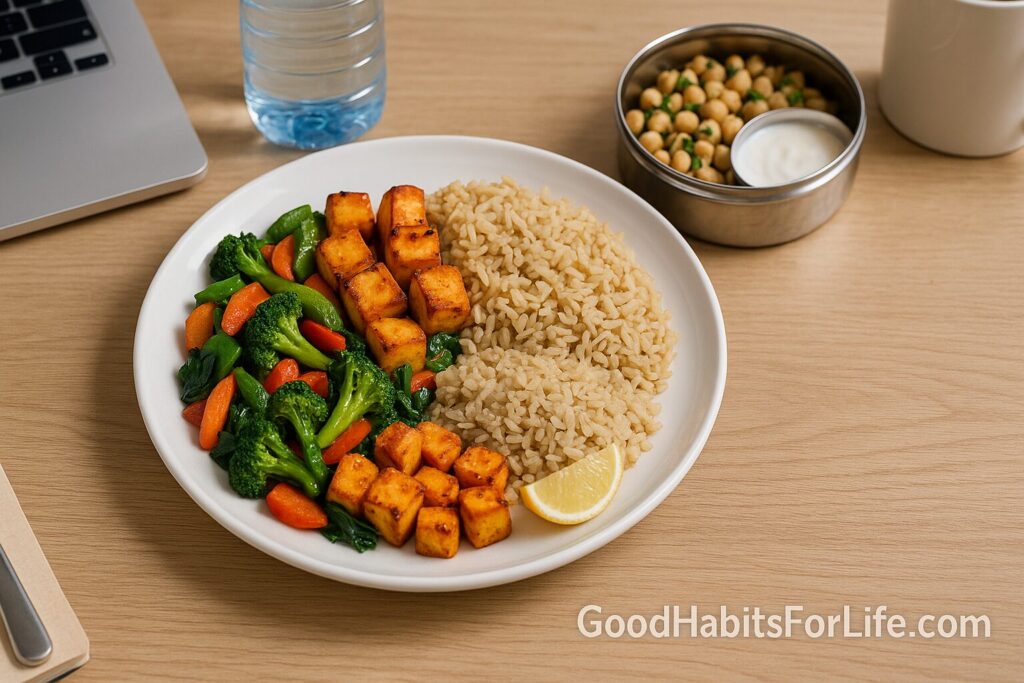
Plate Method at Home & Work: Easy Visuals: Protein-Forward Plan (2025)
Plate Method at Home & Work (2025): Protein-Forward
Table of Contents
🧭 What is the Plate Method (and Why It Works)
The Plate Method is a simple visual guideline for building balanced meals:
-
½ plate non-starchy vegetables (volume, fiber, micronutrients).
-
¼ plate lean protein (satiety, muscle support).
-
¼ plate whole grains/starchy foods (steady energy, fiber).
-
Plus a small portion of healthy fats (e.g., oils, nuts, seeds) and fruit/dairy as sides.
This approach appears in global public-health guidance (e.g., USDA MyPlate, Harvard Healthy Eating Plate, ADA Diabetes Plate Method, ICMR-NIN in India). Benefits include:
-
Portion control without weighing food.
-
Higher meal quality (more fiber, micronutrients).
-
Better satiety when protein is adequate.
-
Flexible across cuisines—perfect for home, tiffins, and cafeterias.
Protein-forward? Emphasizing ~20–30 g protein per meal helps reduce hunger, support muscle, and stabilize energy—crucial on busy workdays.
🛠️ Quick Start: Do This Today
-
Grab a 25–28 cm plate. Mentally draw the ½–¼–¼ lines.
-
Pick your protein first (20–30 g): dal + egg/paneer/chicken/fish/tofu/soya chunks/Greek-style curd.
-
Fill half the plate with veg: kadhai mixed sabzi, ghiya/tori, beans, bhindi, salad (kheera-tamatar-gajar), sautéed greens.
-
Add your starch/whole grain: 1–2 rotis (preferably atta/millet), or ¾–1 cup cooked brown rice/quinoa, or 1 cup poha/upma.
-
Add healthy fat: 1–2 tsp oil/ghee for cooking, or a few nuts/seeds.
-
Optional sides: fruit (1 small piece/½ cup) and/or ½–1 cup dahi/chaas.
-
Water first: drink 250–300 ml water before you eat; sip chaas/unsweetened beverages with the meal.
-
2-minute check: Are the veggies half? Is protein at least a palm-sized portion? Adjust, then eat.
✅ 7-Day Protein-Forward Starter Plan
Targets: 3 balanced meals/day; 20–30 g protein per meal. Portions are guides—adjust for your size, activity, and goals.
| Day | Breakfast | Lunch | Dinner |
|---|---|---|---|
| Mon | Veg besan chilla (2) + curd (½–1 cup) + salad | Roti (2) + rajma (¾–1 cup) + kachumber + sautéed bhindi | Grilled chicken/paneer (100–150 g) + brown rice (¾ cup) + mixed sabzi |
| Tue | Oats + milk/curd + nuts + fruit | Millet khichdi (1–1½ cups) + cucumber raita + salad | Fish curry/tofu (100–150 g) + roti (2) + ghiya/tori |
| Wed | Boiled eggs (2) / tofu scramble + toast (1–2) + tomato | Chole (¾–1 cup) + roti (2) + salad + veg | Dal + paneer bhurji (75–100 g) + jeera rice (¾ cup) + greens |
| Thu | Greek-style curd (1 cup) + fruit + seeds | Lemon rice (¾–1 cup) + grilled chicken/soya (100–150 g) + veg | Sambar (1 cup) + idli (2–3) + veg poriyal + salad |
| Fri | Veg poha (1 cup) + peanuts + buttermilk | Egg curry (2 eggs) + roti (2) + salad + veg | Dal makhani (¾ cup) + brown rice (¾ cup) + sautéed veg |
| Sat | Smoothie: milk/curd + whey/soya (20–25 g) + spinach + berries/banana | Paneer tikka (100–150 g) + roti (2) + veg | Chicken/tempeh stir-fry (100–150 g) + quinoa (¾ cup) |
| Sun | Sprouts chaat (1 cup) + omelet/tofu | Fish/paneer curry + rice (¾ cup) + veg + salad | Family meal—apply ½–¼–¼ to biryani/thali portions, add salad/raita |
Batch-prep Sunday (90 minutes):
-
Cook 2 dals/beans, roast paneer/chicken, chop salad veg, roast a tray of mixed vegetables, cook a pot of brown rice/millets, portion curd/raita. Store in clear boxes.
🧠 Techniques & Frameworks
1) The Visual Rule (½–¼–¼)
-
Half plate = non-starchy veg (aim ≥300 g).
-
Quarter = protein (~20–30 g): 2 eggs, 100–150 g paneer/chicken/fish/tofu, ¾–1 cup beans/dal + ½ cup curd.
-
Quarter = whole grains/starches: 1–2 rotis, or ¾–1 cup cooked rice/millet, or 1 cup poha/upma.
2) Protein-Forward Ladder
-
Level 1: Add one palm-sized protein at each meal.
-
Level 2: Add a second small protein (e.g., ½ cup curd or milk) when extra hunger hits.
-
Level 3: Distribute ~1.2–1.6 g/kg/day if you’re active/trying to lose fat (check with a pro if you have kidney/metabolic issues).
3) Color & Crunch Heuristic
-
At least 2 veg colors + one crunchy element (salad, cucumber, carrot) to increase satisfaction and fiber.
4) Smart Fats
-
Cook with 1–2 tsp oil/ghee per serving; add a teaspoon of seeds or 6–8 nuts for flavor and heart-healthy fats.
5) 3-Box Meal Prep
-
Box A: Protein, Box B: Veg, Box C: Starch. Assemble like Lego for different meals all week.
🧳 Variations for Home, Tiffins & Office Cafeterias
Home/Tiffin
-
Pack two tiers: Tier-1 veg + salad; Tier-2 protein + starch. Add a tiny jar of seeds/nuts.
-
Keep “office plate kits”: reusable plate/bowl, spoon, 10-ml oil bottle, salt/pepper, lemon, roasted chana.
Cafeteria Ordering
-
Ask for extra sabzi (swap for some rice).
-
Choose grilled/roasted over fried; dal + paneer/egg/chicken over only rice/noodles.
-
Add raita/salad; skip sugary beverages.
👥 Audience Tips
-
Students: Build a budget protein list (eggs, sprouts, soya chunks, curd). Carry a shaker + milk powder/soya isolate for backup.
-
Busy Professionals: Default lunch: roti (2) + dal + paneer/egg/chicken + salad. Keep nuts/fruit at desk.
-
Parents: Use a family platter—serve veg first; pre-cut fruit after meals. Let kids pick their veg color.
-
Seniors: Prioritize soft proteins (curd, dal, fish, tofu) and hydration; aim for 25–30 g protein at the main meal to protect muscle.
⚠️ Mistakes & Myths to Avoid
-
Myth: “Carbs are bad.” → Whole grains and starchy veg fuel activity; portion and fiber matter.
-
Myth: “Protein is only for gym-goers.” → Adequate protein helps everyone with satiety and muscle maintenance.
-
Mistake: Skipping veg because you “took fruit.” → Fruit adds, it doesn’t replace veg.
-
Mistake: Tiny protein portions. → Palm-size per meal is your baseline.
-
Mistake: Drowning salads in dressing. → 1–2 tsp oil is enough.
🗣️ Real-Life Examples & Scripts
-
At a North Indian thali: “Please add extra sabzi and salad; I’ll take one roti less.”
-
At the canteen rice counter: “Half rice, more dal and veg, and one boiled egg.”
-
When ordering: “Grilled paneer/chicken with extra veg; curd on the side.”
5 Quick Plate Builds (copy-paste):
-
Roti + Dal + Paneer + Salad
-
Brown rice + Rajma + Mixed veg + Curd
-
Millet upma + Sprouts salad + Buttermilk
-
Egg curry + Roti + Ghiya sabzi + Salad
-
Fish tikka + Quinoa + Stir-fried veg + Lemon wedge
🧰 Tools, Apps & Resources
-
Kitchen scale & 25–28 cm plate for consistency.
-
Insulated tiffin + two-tier lunchbox.
-
Apps: MyFitnessPal/Cronometer (protein tally), Yazio/HealthifyMe (India foods), Water-reminder apps.
-
Batch-prep helpers: Oven/air-fryer, pressure cooker/Instant Pot.
📌 Key Takeaways
-
A ½–¼–¼ plate keeps meals balanced without math.
-
Protein-forward (20–30 g/meal) boosts satiety and protects muscle.
-
Apply it anywhere—home, tiffin, cafeteria—using simple swaps.
-
Batch-prep once to make weekday eating automatic.
-
Customize portions for your body, activity, and goals.
❓ FAQs
1) Does the plate method work for weight loss?
Yes. It naturally reduces calorie density and increases fiber/protein, which improves fullness. Pair with daily steps and sleep.
2) How do I hit 20–30 g of protein without meat?
Combine foods: ¾–1 cup beans/dal + ½ cup curd, or 100–150 g paneer/tofu, or sprouts + milk/curd.
3) Is white rice allowed?
Yes—manage portion (¼ plate), add more veg/protein, and consider brown rice or millets for extra fiber.
4) Can I use a bowl instead of a plate?
Use a bowl-plate ratio: 2 parts veg, 1 part protein, 1 part starch. Or plate your food first to visualize, then transfer to a bowl.
5) What about snacks?
Use the P+F rule: a Protein + Fruit/Fiber combo—roasted chana + fruit, curd + berries, paneer cubes + cucumber.
6) Is higher protein safe?
For healthy adults, modestly higher intakes are generally safe; speak to your clinician if you have kidney or metabolic conditions.
7) How do I eat balanced at social events?
Scan the buffet: fill half with veg/salad, add a protein (paneer/egg/chicken/fish), then a small serving of biryani/roti.
8) Can teens use this?
Yes, with larger portions and guidance from caregivers; prioritize milk/curd, dal, eggs, and plenty of veg.
9) How much oil is okay?
About 1–2 tsp per serving for cooking, plus a small sprinkle of nuts/seeds if desired.
10) Do I need supplements?
Food first. Consider protein powder only for convenience if you consistently miss targets.
📚 References
-
U.S. Department of Agriculture. MyPlate. https://www.myplate.gov
-
Harvard T.H. Chan School of Public Health. Healthy Eating Plate. https://www.hsph.harvard.edu/nutritionsource/healthy-eating-plate/
-
American Diabetes Association. Diabetes Plate Method. https://diabetes.org/healthy-living/recipes-nutrition/eating-well/diabetes-plate-method
-
World Health Organization. Healthy diet: Key facts. https://www.who.int/news-room/fact-sheets/detail/healthy-diet
-
ICMR-NIN (India). Dietary Guidelines for Indians (2020). https://www.nin.res.in/DietaryGuidelinesforNINwebsite.pdf
-
Leidy HJ, et al. The role of protein in weight loss and maintenance. Am J Clin Nutr. 2015;101(6):1320S–1329S. https://academic.oup.com/ajcn/article/101/6/1320S/4564499
-
Wycherley TP, et al. Effects of higher protein diets on weight loss & metabolic outcomes. Br J Nutr. 2012;108(S2):S122–S129. https://www.cambridge.org/core/journals/british-journal-of-nutrition/article/abs/effects-of-energyrestricted-highprotein/
-
NIDDK. Choosing foods with protein. https://www.niddk.nih.gov/health-information/weight-management/healthy-eating-nutrition/choosing-protein
-
CDC. Rethink your drink (added sugars & beverages). https://www.cdc.gov/healthyweight/healthy_eating/drinks.html
-
Aune D, et al. Fruit and vegetable intake and risk of cardiovascular disease. Int J Epidemiol. 2017;46(3):1029–1056. https://academic.oup.com/ije/article/46/3/1029/3039477
⚖️ Disclaimer
This guide is educational and not a substitute for personalized medical or nutrition advice; consult your healthcare professional for individual recommendations.