
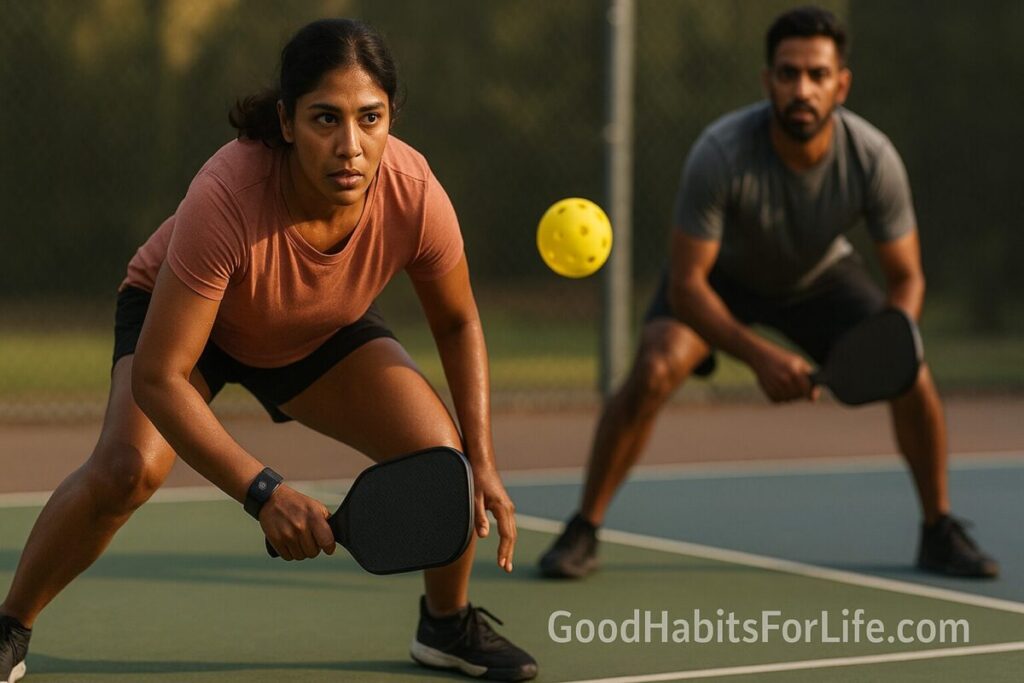
Pickleball Performance: Lateral Speed Plan: Zone 2 + NEAT (2025)
Pickleball Lateral Speed Plan: Zone 2 + NEAT (2025)
Table of Contents
🧭 What This Plan Is & Why It Works
Goal: Move quicker side-to-side, win more kitchen exchanges, and maintain speed late into games.
Three pillars:
-
Lateral mechanics + short explosive work (shuffle speed, split-step timing, first step)
-
Zone 2 aerobic base (easy, conversational cardio that improves recovery and repeatability)
-
NEAT—Non-Exercise Activity Thermogenesis (daily movement that supports energy balance, tissue health, and conditioning between workouts)
Why it works (evidence-aligned):
-
Change-of-direction (COD) and agility depend on eccentric strength, braking, and re-acceleration—trainable with lateral strength and plyometrics.
-
Zone 2 (≈60–70% HRmax or RPE 3–4/10) builds mitochondrial capacity and improves the ability to repeat high-intensity bursts without gassing out.
-
NEAT elevates total daily energy expenditure and circulation, aiding recovery and weight management—both linked to better on-court performance.
✅ Quick Start: Do This Today
-
Warm-Up (8–10 min):
-
2 min brisk walk/jog → dynamic hips (leg swings, hip circles) → 2×20 m lateral shuffles → 10 skater steps/side → 3× split-step + first shuffle.
-
-
Two Lateral Basics (10–12 min):
-
Cossack Squat 3×6/side (slow, deep, upright chest)
-
Skater Hop (stick the landing) 3×6/side (soft knees, hips back)
-
-
Court Sprint Set (6–8 min):
-
From centerline, shuffle to sideline and back × 8–10 reps; rest to full nasal breathing between reps.
-
-
Zone 2 Cardio (20–30 min):
-
Easy cycle/row/fast walk at conversation pace; HR ≈ 60–70% max.
-
-
NEAT:
-
Take 1–2 “movement snacks” every hour of sitting: 60–90 s walk + 10 bodyweight squats + 20 heel raises.
-
🗓️ 30-60-90 Roadmap (with Weekly Template)
Phase 1 — Build the Engine (Days 1–30)
Focus: Technique, adductor/abductor strength, Zone 2 base, consistent NEAT.
Weekly Template (example)
-
Mon – Strength A (lateral): Cossacks, lateral lunges, banded lateral walks; core (side planks).
-
Tue – Zone 2 30–40 min + 8×15 s easy shuffles (technique only).
-
Wed – Court Skills: split-step timing, paddle-ready stance, kitchen line shuffle ladders (low intensity).
-
Thu – Strength B: hip hinge, Copenhagen plank (regress as needed), calf raises; mobility.
-
Fri – Zone 2 30–45 min + NEAT bump (10k steps).
-
Sat – Light play or practice games; finish with 6×20 m controlled lateral shuttles.
-
Sun – Off/Walk/Mobility (20–30 min).
Checkpoints by Day 30:
-
Zone 2 feels easy at 30–40 min; you can breathe through your nose most of the time.
-
Cossack depth improved; no groin pain; can perform 3×8 skater hops/side with solid landings.
Phase 2 — Add Speed & Braking (Days 31–60)
Focus: COD power, deceleration (safe “braking”), short reaction drills; maintain Zone 2 + NEAT.
Weekly Template (example)
-
Mon – Strength Power: lateral box step-offs to stick, skater bounds (short), trap-bar or kettlebell deadlifts (moderate).
-
Tue – Zone 2 35–45 min (or 2×20 min) + mobility.
-
Wed – Court COD: 5-10-5 shuttle (short distances), T-drill variants scaled to pickleball court; 4–6 sets, full quality rest.
-
Thu – Strength Armor: adductor slideboard or towel-slides, single-leg RDLs, Copenhagen regressions.
-
Fri – Zone 2 30–40 min + strides (4×10 s fast shuffle).
-
Sat – Match play; between games do 3×(sideline-center-sideline) at 70–80% effort.
-
Sun – Off/Walk (extend NEAT: errands on foot, stairs).
Checkpoints by Day 60:
-
Smooth, low stance shuffle; minimal crossing of feet until recovery step.
-
Can complete 6× pro-style short shuttles with consistent times (±5%).
Phase 3 — Sharpen & Repeat (Days 61–90)
Focus: Game-speed bursts, reactive agility, repeatability under light fatigue.
Weekly Template (example)
-
Mon – Contrast Lateral Power: 2×(Cossacks 6/side → skater bounds 6/side) + split-step pops 3×8.
-
Tue – Zone 2 40–50 min (or 30 min + 10 min easy strides).
-
Wed – Reactive Drills: partner/random callouts (L/R/F/B), color or number cues; 8–12 short bouts.
-
Thu – Strength Maintain: single-leg work, adductors, calves, trunk anti-rotation.
-
Fri – Zone 2 30–40 min; keep NEAT high.
-
Sat – Competitive play; finish with 4× court-width shuttles at 85–90% with full rest.
-
Sun – Off/Walk/Mobility.
Checkpoints by Day 90:
-
Faster first step off the split-step; fewer late reaches at the kitchen.
-
Can perform 8–10 high-quality reactive sets without form loss.
🧠 Techniques & Frameworks That Drive Lateral Speed
Split-Step → First Step Hierarchy
-
See the opponent’s contact →
-
Split (small hop) as they strike →
-
Load hips/ankles evenly →
-
Decide (react cue) →
-
Move: shuffle for short distances; crossover/run only when behind the ball.
Braking & Re-Acceleration
-
Train eccentric control (landing “quiet,” knees over mid-foot).
-
Use stick landings before bounds; progress distance only when stable.
Hip & Adductor Strength
Key builders: Cossack squats, lateral lunges, Copenhagen planks (regressions ok), banded lateral walks, single-leg RDLs.
Plyometric Progression (lateral)
-
Skater step (no hop) →
-
Skater hop, stick →
-
Bound to bound →
-
Reactive bounds (random cues).
Zone 2 Made Simple
-
Intensity: HR ≈ 60–70% of HRmax; or RPE 3–4/10; can talk in full sentences.
-
How to estimate HRmax: 220 − age (simple) or use a tested/validated device.
-
Modes: brisk walk, incline treadmill, cycling, rowing; avoid pounding if adductors/calves are sore.
NEAT Habits That Stick
-
7–10k steps/day (≈5–8 km).
-
Hourly movement snacks (60–90 s): walk, calf raises, mini-squats, hip openers.
-
Errand rules: stairs > lift; walk calls; park further; carry groceries.
👥 Audience Variations
Beginners
-
Start with bodyweight only; keep shuffles short (3–5 m); 2×/week Zone 2 for 20–25 min.
Seniors
-
Emphasize balance (lateral toe taps, supported Cossacks), calf/achilles care (eccentric heel drops). Prefer cycling for Zone 2 if joints complain.
League/Competitive Players
-
Track shuttle times (best and average). Add mini-clusters: 3×(10–12 s hard / 40–50 s rest) after warm-ups 1–2×/wk.
Office-bound Pros
-
NEAT alarms every 45–50 min. Walk-and-talk meetings and staircase rules keep tissues fresh for evening play.
⚠️ Mistakes & Myths to Avoid
-
Myth: “Only HIIT builds pickleball fitness.” → Aerobic base (Zone 2) underpins repeatability and recovery.
-
Mistake: Over-crossing feet on defense. → Shuffle first; crossover only if late.
-
Mistake: Skipping adductor work. → Groin strength is your lateral insurance policy.
-
Mistake: Plyos too soon. → Earn them with good landing mechanics and slow eccentrics.
-
Mistake: Ignoring calves/Achilles. → Do daily heel raises; progress jumps slowly.
🛠️ Real-Life Drills, Cues & Copy-Paste Mini-Sessions
12-Minute Court-Side Lateral Primer (pre-play)
-
Warm-up walk 2 min → dynamic hips/ankles.
-
Split-step pops 3×8 (cue: “soft, springy, quiet feet”).
-
Kitchen shuffle ladder: 5× (L-Center-R-Center) at 50–60%, then 5× at 70–80%.
-
Skater hops, stick 2×6/side.
Reactive Color Callouts (partner or app)
-
Place four colored cones (front/back/left/right). Partner calls color; you split → go.
-
2–3 sets × 6–10 calls; full quality rest between sets.
Home Strength Micro-Dose (no equipment, 10 min)
-
Cossack Squat 3×6/side
-
Side Plank with top-leg raise 3×8/side
-
Heel Raises (straight + bent knee) 2×20 each
📚 Tools, Apps & Resources
-
Heart-Rate Apps/Devices: Polar Beat, Garmin, Apple Watch, Coros. Pros: HR feedback; Cons: cost, sensor accuracy varies.
-
Agility Gear: Mini-cones, slideboard or towels, light bands. Pros: cheap, portable; Cons: floor space needed.
-
Timers/Randomizers: “Seconds,” “Tabata Timer,” or cue apps that call colors/numbers. Pros: easy react training; Cons: phone-dependency.
-
Tracking: Simple spreadsheet or Notes app—record shuttle best/avg times, weekly Zone 2 mins, daily steps.
🔑 Key Takeaways
-
Lateral speed = good mechanics + braking strength + quick first step, not just “running fast.”
-
Zone 2 builds the engine so you can repeat bursts; NEAT keeps tissues healthy and energy high.
-
Two short strength sessions + two Zone 2 sessions + smart court work can transform your game in 12 weeks.
-
Progress gradually, land softly, and protect adductors and calves.
❓ FAQs
1) How do I know I’m in Zone 2 without a heart-rate monitor?
Use talk test (full sentences) and RPE 3–4/10. Breathing should be steady, mostly nasal.
2) How many Zone 2 minutes per week?
Aim for 120–180 min/week, split across 3–4 sessions.
3) Will jogging make me slower laterally?
No—done easy, it improves recovery and work capacity. Keep your speed work lateral and short.
4) What distances should I use for shuttles on a pickleball court?
Think 3–7 m bursts: centerline ↔ sideline, kitchen-line ladders, and short T-drills scaled to court size.
5) How do I prevent groin pulls?
Warm up, build adductor strength (Cossacks, Copenhagen regressions), and progress volume (no >10–15% jump/week).
6) I cramp in calves during play—what helps?
Daily heel raises (straight & bent knee), adequate hydration/sodium, and avoid sudden jumps in plyo volume.
7) Can I do strength and Zone 2 on the same day?
Yes—Zone 2 after strength or in a separate session. Keep at easy intensity.
8) What’s the best shoe for lateral speed?
A court shoe with stable sidewalls, grippy outsole, and firm heel counter; replace when outsole smooths.
9) Do I need ladders and fancy cones?
No—use lines on the court. Quality mechanics and timing matter more than gadgets.
10) How soon will I feel faster?
Many players notice better positioning and stamina by 4–6 weeks, with sharper bursts by 8–12 weeks.
References
-
American College of Sports Medicine. ACSM’s Guidelines for Exercise Testing and Prescription. (Overview of aerobic intensity & HR methods) — https://www.acsm.org
-
Sheppard JM, Young WB. Agility literature review: Classifications, training and testing. Sports Med. 2006. — https://link.springer.com/article/10.2165/00007256-200636030-00004
-
Brughelli M, et al. Understanding change of direction ability in sport. Sports Med. 2008. — https://link.springer.com/article/10.2165/00007256-200838010-00004
-
Spiteri T, et al. The contribution of eccentric strength to COD performance. J Strength Cond Res. 2014. — https://journals.lww.com/nsca-jscr/Abstract/2014/10000/The_Contribution_of_Eccentric_Strength.12.aspx
-
Seiler S. What is best practice for training intensity and duration distribution in endurance athletes? Int J Sports Physiol Perform. 2010. — https://journals.humankinetics.com/view/journals/ijspp/5/3/article-p276.xml
-
Levine JA. NEAT—non-exercise activity thermogenesis. Best Pract Res Clin Endocrinol Metab. 2002; and Mayo Clinic resources on NEAT — https://www.mayoclinic.org/healthy-lifestyle/fitness/expert-answers/nonexercise-activity-thermogenesis/faq-20057933
-
WHO. Guidelines on Physical Activity and Sedentary Behaviour. 2020. — https://www.who.int/publications/i/item/9789240015128
-
Suchomel TJ, et al. Implementing eccentric training for athletic performance. Strength Cond J. 2019. — https://journals.lww.com/nsca-scj/Fulltext/2019/04000/Implementing_Eccentric_Training.4.aspx
-
Papadopoulos K, et al. The role of adductor strength in groin injury prevention. Aspetar Sports Med J. — https://journal.aspetar.com
-
Karvonen MJ, et al. The effects of training on heart rate. Ann Med Exp Biol Fenn. Classic reference for HR reserve method. — (overview) https://pubmed.ncbi.nlm.nih.gov/13470504/
Disclaimer
This article provides general fitness guidance for healthy adults; it is not medical advice. Consult a qualified professional before starting or modifying your exercise program.