
Physics Problem Templates: Free-Body to Formula
Physics Problem Templates: Free-Body to Formula
Table of Contents
🧭 What & Why
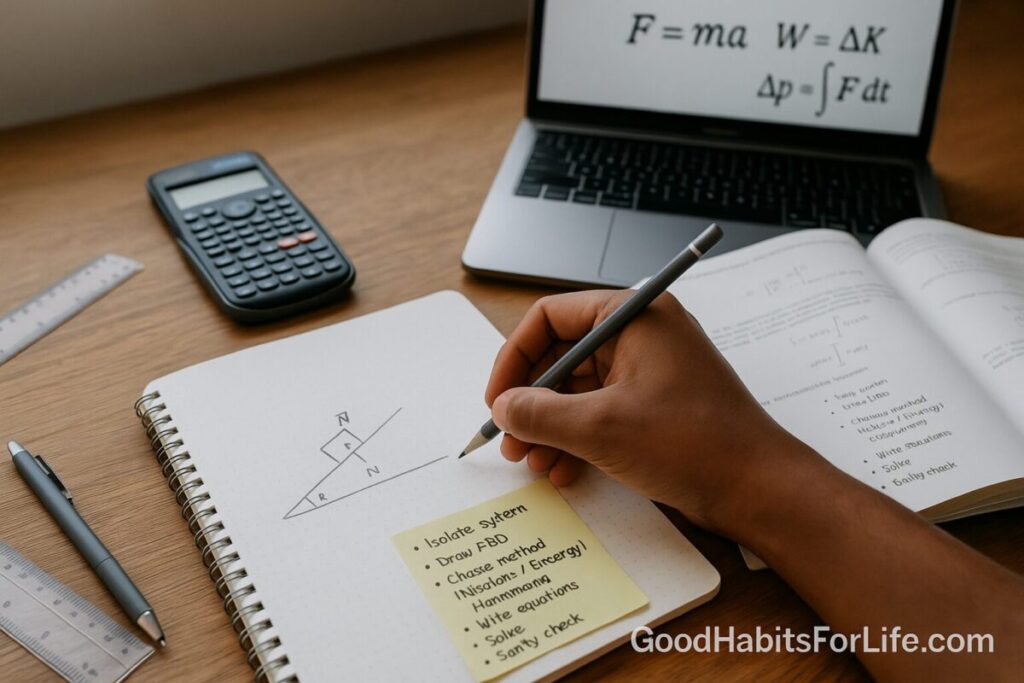
“Physics problem templates” are repeatable checklists that take you from reading the question to writing the right equations with minimal hesitation. They standardize the moves experts make: isolate a system, diagram forces, pick an approach (Newton/Energy/Momentum), write equations, solve, and sanity-check.
Why templates work:
-
Worked examples reduce cognitive load for novices, speeding up pattern recognition and transfer. tll.mit.edu+2Physical Review+2
-
Free-body diagrams (FBDs) are the backbone of mechanics reasoning; consistent steps produce fewer sign errors and cleaner equations. The Expert TA+2AIP Publishing+2
-
Method selection rules (Newton vs. Work-Energy vs. Impulse-Momentum) shorten solutions and clarify what’s actually being asked. Brown University+3Brown University+3Physics LibreTexts+3
✅ Quick Start (Do This Today)
-
Triage: What’s the target (acceleration, speed, force, time, range)?
-
Choose the system (object or set of objects).
-
Draw an FBD: all external forces, neat axes, components. The Expert TA
-
Pick the method:
-
Find accelerations/forces → Newton (ΣF = ma).
-
Compare speeds/heights/springs → Energy (work-energy).
-
Bounces/collisions/short interaction times → Impulse-Momentum. Lumen Learning+1
-
-
Write equations cleanly, count unknowns = equations.
-
Solve and check: units, limiting cases, order-of-magnitude (Fermi). Lumen Learning+1
Copy-paste this mini-checklist into your notebook:
System → FBD → Method → Equations → Solve → Units → Limits → Sense-check
🛠️ Core Templates: FBD → Formula (Newton’s 2nd Law)
Template A — Newton (FBD→Formula)
Use when: You need forces/accelerations/tensions/normal/friction components.
Steps
-
System & Axes: Choose axes that simplify components (e.g., align x along incline).
-
FBD: Draw only external forces on the chosen system (weight, normal, tension, drag, friction).
-
Components: Resolve forces along each axis.
-
ΣF = ma on each axis.
-
Constraints: Geometry (pulleys), rolling/no-slip, equal tensions if ideal, etc.
-
Solve: Unknowns from simultaneous equations; check signs/units.
Why this works: A disciplined FBD prevents phantom forces and ensures ΣF = ma is applied to the right body along the right directions. The Expert TA+1
Template B — Work-Energy
Use when: You care about speeds, heights, springs, or the path is messy but start/end states are clear.
Steps
-
Identify initial/final states; note Ki,UiK_i, U_i and Kf,UfK_f, U_f.
-
Account for work by non-conservative forces (friction, applied).
-
Apply work-energy theorem: ΔK=Wnet\Delta K = W_{\text{net}} (or include potential to use energy conservation when appropriate).
-
Solve for the unknown (often v,h,k,xv, h, k, x).
Energy solutions are often shorter than force-balance derivations for many problems. Physics LibreTexts+1
Template C — Impulse-Momentum
Use when: Collisions, kicks, averages over short times; you need Δp\Delta p or average force.
Steps
-
Choose system and time window of interaction.
-
Compute impulse J=∫F dt≈FavgΔtJ = \int F\,dt \approx F_{\text{avg}}\Delta t.
-
Use Δp=J\Delta p = J (vector form); add components if needed.
-
Combine with geometry/angles for rebounds.
Impulse methods shine when forces vary rapidly but total impulse is accessible. Brown University
Template D — Dimensional Analysis (DA)
Use when: You’re unsure of the formula shape, want a quick check, or need a scaling law.
Steps
-
List relevant quantities and their dimensions.
-
Demand dimensional homogeneity; solve for exponents.
-
Identify nondimensional groups (e.g., Π\Pi terms).
DA quickly flags impossible answers and reveals scaling. www-thphys.physics.ox.ac.uk+1
Template E — Fermi Estimate
Use when: You need a ballpark answer to sanity-check results or plan an approach.
Steps
-
Break the unknown into countable chunks.
-
Use round numbers and known anchors.
-
Combine to get order-of-magnitude; report 1–2 sig figs.
Great for “does this make sense?” checks before/after solving. Lumen Learning+1
⚙️ Choosing the Right Method: Newton vs Energy vs Momentum
| Situation | Best first approach | Why it’s efficient |
|---|---|---|
| Find acceleration, tension, normal, multi-body links | Newton (FBD→Formula) | Direct force balance on each body. The Expert TA |
| Find speed/height/spring compression between two states | Work-Energy | Path-independent; often fewer steps. Physics LibreTexts+1 |
| Collisions, rebounds, short impacts | Impulse-Momentum | Integrates over messy force-time histories. Brown University |
Tip: Start with the shortest route to the target quantity; switch methods if algebra explodes.
🧠 Techniques & Frameworks That Compound Learning
-
Worked-Example + Faded-Steps Practice: Study a full solution, then solve a near-twin with one step hidden, then two, until independent. This reduces extraneous load and builds schemas. tll.mit.edu+1
-
Polya’s 4 Steps (Understand → Plan → Execute → Look back): a timeless wrapper for any template. Use it as your section headers. OPEPP+1
-
Context-Rich Problems (Heller & Heller): Practice with realistic scenarios and excess info to train decision-making, not just algebra. groups.physics.umn.edu+1
-
Dimensional Analysis Primers: Quick consistency checks and scaling insights (Oxford, Purdue, MIT notes). www-thphys.physics.ox.ac.uk+2Purdue Engineering+2
👥 Audience Variations
-
Students (AP/Intro Uni): Drive the habit of “System → FBD → Method.” Keep a one-page template sheet taped inside your notebook.
-
Professionals/Engineers: Use DA first to bound designs; energy/momentum methods give fast feasibility checks before detailed modeling. Purdue Engineering
-
Seniors returning to learning: Prioritize worked examples + short spaced sessions; avoid cognitive overload by solving fewer, deeper problems. tll.mit.edu
-
Teens: Use PhET sims to visualize invisible forces/energy transfers; then sketch the FBD that matches what you see. PhET
⚠️ Mistakes & Myths to Avoid
-
Forgetting to define the system: You can’t tell internal from external forces without it.
-
Throwing every method at once: Decide first; don’t mix Newton and Energy algebra mid-derivation.
-
Phantom forces & wrong axes: FBDs use only real external forces on the system; choose axes that simplify components. The Expert TA
-
Skipping unit checks: Dimensionality is your fastest error detector. www-thphys.physics.ox.ac.uk
-
Thinking energy always works: Non-conservative work must be handled correctly; sometimes Newton is cleaner. Physics LibreTexts
📚 Tools, Apps & Resources
-
PhET Interactive Simulations (CU Boulder): Visualize forces, energy bars, collisions. Great for intuition before formal math. PhET
-
OpenStax University Physics (Vol. 1–3): Peer-reviewed, free textbooks with clear FBD and energy/momentum treatments. OpenStax+1
-
LibreTexts (OpenStax mirror & extras): Concise topic pages like Work-Energy Theorem. Physics LibreTexts
-
Heller’s Cooperative/Context-Rich Problems: Train decision-making under realistic conditions. AAPT+1
Pros: free, aligned to curricula, rich visuals. Cons: still need disciplined paper-and-pencil FBD and method choice.
🗺️ Key Takeaways
-
Solve faster by standardizing the first 60 seconds: system → FBD → method.
-
Choose Newton for forces/accelerations, Energy for state-to-state speed/height, Momentum for impacts. Lumen Learning+1
-
Build skill with worked-example → faded steps, not random problem grinding. tll.mit.edu
-
Dimensional analysis and Fermi estimates are your quickest error detectors. www-thphys.physics.ox.ac.uk+1
❓ FAQs
1) Should I always start with a free-body diagram?
For mechanics, yes—FBDs clarify forces and directions and prevent sign mistakes. The Expert TA
2) When is energy better than Newton’s laws?
When you only need speeds/heights between two states; energy often yields one short equation. Physics LibreTexts+1
3) How do I handle friction in energy methods?
Account for work by non-conservative forces: Wf=−fkdW_f = -f_k d. If the path is messy and friction varies, a Newton approach might be simpler. Physics LibreTexts
4) Is impulse-momentum only for perfectly elastic collisions?
No. It applies to any interaction over a time interval; elasticity affects energy, not momentum conservation of the system + external impulses. Brown University
5) What if my units don’t match?
Stop and fix before proceeding—dimensional inconsistency means a wrong formula or algebra slip. www-thphys.physics.ox.ac.uk
6) How can I practice smarter?
Use worked examples, then fade steps; add context-rich problems to train choice of method under realistic clutter. tll.mit.edu+1
7) Are PhET sims acceptable for serious study?
Yes; research-based simulations complement formal problem solving and improve concept understanding when used well. University of Colorado Boulder
References
-
OpenStax University Physics, “Drawing Free-Body Diagrams.” (Vol. 1) PDF. The Expert TA
-
Lee, A. “Helping Students Draw Correct Free-Body Diagrams.” Phys. Teach., 2017. AIP Publishing
-
Danesh-Yazdi, A.H. “The Exploded View: Teaching the Free-Body Diagram.” ASEE. Peer Review
-
Brown University Engineering Notes, “Work-Energy Methods” & “Impulse-Momentum.” Brown University+1
-
LibreTexts (OpenStax mirror), “Work-Energy Theorem.” Physics LibreTexts
-
Lumen Learning (SUNY), “Estimates and Fermi Calculations.” Lumen Learning
-
UC Berkeley “Sense & Sensibility in Science,” Topic: Fermi Problems. sensesensibilityscience.berkeley.edu
-
MIT Teaching + Learning Lab, “Worked Examples.” tll.mit.edu
-
Morphew, J.W. et al., “Effect of presentation style and problem-solving attempts on example-based learning.” Phys. Rev. Phys. Educ. Res., 2020. Physical Review
-
Schekochihin, A. (Oxford), “Dimensional Analysis” (tutorial). www-thphys.physics.ox.ac.uk
-
Purdue Engineering Notes, “Dimensional Analysis—Introduction.” Purdue Engineering
-
Heller & Heller, University of Minnesota, “Cooperative Group Problem Solving” + PhysPort: Context-Rich Problems. groups.physics.umn.edu+1
-
PhET Interactive Simulations, University of Colorado Boulder. PhET
-
OpenStax University Physics (Vol. 1–3). OpenStax+1