
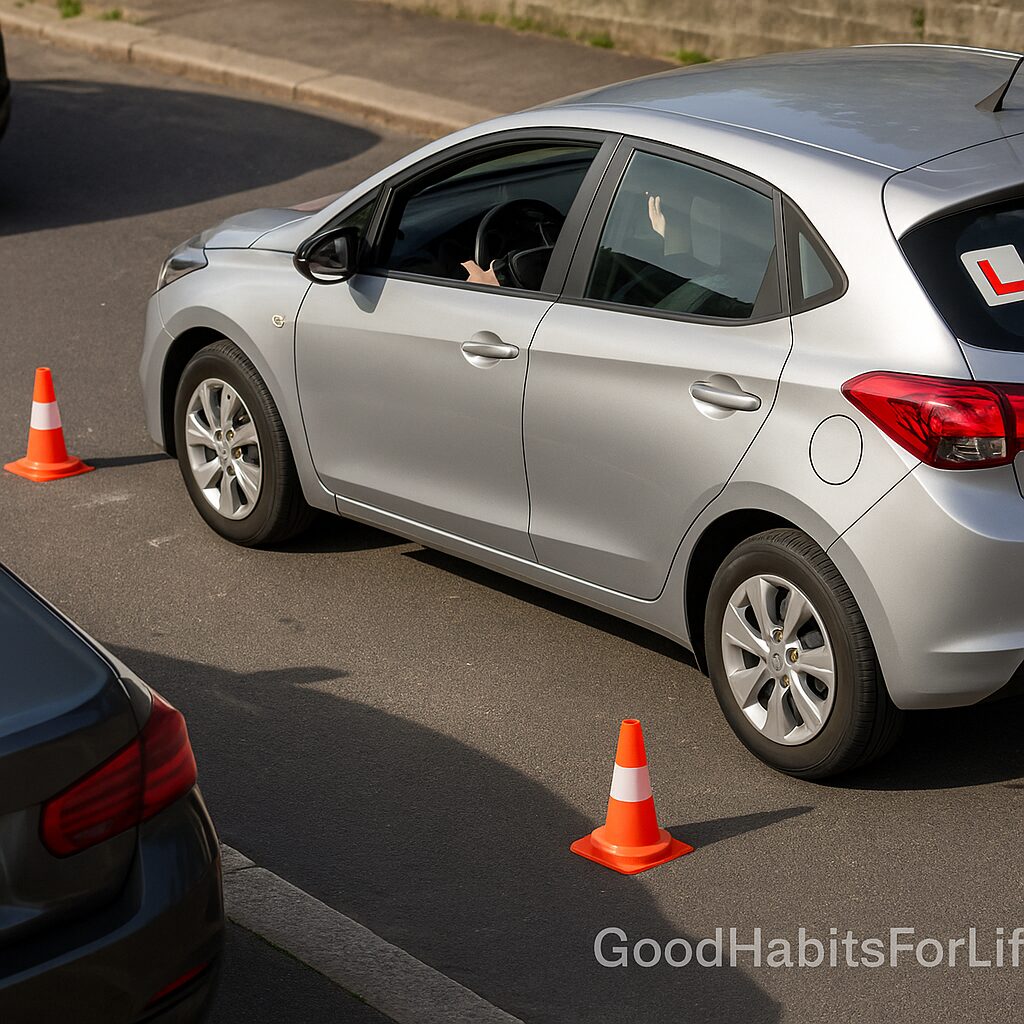
Parallel Parking for New Drivers: A 3Cue Method
Parallel Parking for New Drivers: A 3Cue Method
Table of Contents
🧭 What Is the 3-Cue Method & Why It Works
Definition. The 3-Cue Method is a simple, repeatable sequence for parallel parking using three visual cues that tell you when to steer:
-
Line-Up Cue (start position)
-
Turn-In Cue (full lock toward kerb)
-
Counter-Steer Cue (full lock away to straighten)
Why it works.
-
Reduces guesswork with fixed reference points so beginners can park consistently.
-
Aligns with examiners’ priorities: control, observation, accuracy, and safe positioning within 15–30 cm (6–12 in) of the kerb.
-
Encourages slow-speed control (creep speed) and 360° observation, both emphasized in official driver manuals (see References).
✅ Quick Start: Parallel Park in 8 Moves
Set-up: Find a space at least 1.5× your car length. Signal, mirror checks, and 360° look before every direction change.
-
Line-Up Cue (Start)
-
Pull parallel to the front car, about 0.8–1.0 m (3 ft) away.
-
Your rear axle (roughly the center of your back wheel) aligns with the other car’s rear bumper.
-
Handbrake if needed, then reverse gear selected; check all around.
-
-
Begin to Roll Back (Creep)
-
Reverse at walking pace. Keep wheels straight for the first ½–1 car length.
-
-
Turn-In Cue
-
When your back seat/C-pillar reaches the front car’s rear bumper (or the bumper corner appears just past the middle of your rear side window/mirror), full lock toward the kerb.
-
Keep rolling slowly; keep scanning mirrors and right-shoulder/blind-spot.
-
-
Establish the Angle
-
Your car forms roughly a 45° angle to the kerb; you’ll see the kerb cutting diagonally toward the rear wheel in the kerb-side mirror.
-
-
Counter-Steer Cue
-
As your front bumper clears the rear bumper of the front car or when the kerb appears 15–30 cm from your rear wheel in the kerb-side mirror, steer quickly to full lock away from the kerb while continuing to creep back.
-
-
Straighten into the Space
-
As you draw parallel to the kerb, straighten wheels. Stop with your car centered between vehicles.
-
-
Adjust
-
If >30 cm (12 in) from kerb, move forward slowly, add ¼-turn toward the kerb, then reverse with ¼-turn away to re-center.
-
-
Secure the Car
-
Select neutral/park; apply handbrake where required. Wheels straight; cancel signal.
-
Targets:
-
Final distance: 15–30 cm (6–12 in) from kerb.
-
No contact with kerb.
-
Smooth, continuous creep; eyes moving.
🧠 7-Day Practice Plan (Beginner → Test-Ready)
Equipment: 2 cones or small objects to mark a “car,” tape measure, quiet street or empty lot with a kerb.
-
Day 1: Setup & Cues (15 min)
Mark a front “car” with cones. Practice the line-up distance (0.8–1.0 m). Walk the 3 cues around the car. -
Day 2: Turn-In Timing (15–20 min)
Reverse to Cue 2 repeatedly. Stop and check your angle. Aim for the 45° “triangle” view of the kerb. -
Day 3: Counter-Steer Control (15 min)
Practice Cue 3. Feel the quick steering away while still rolling. End parallel. -
Day 4: Full Sequences (20 min)
Perform full parks 6–8 times. Record kerb distance each time. Target ≤30 cm. -
Day 5: Tight Spaces & Two-Move Adjust (20 min)
Reduce the length to 1.3× car length. Practice the micro-adjust forward/back to finish ≤20 cm. -
Day 6: Real-World Variations (20–25 min)
Try a mild slope (see Hills), different vehicles, and with light traffic (if legal/safe). -
Day 7: Test Simulation (20 min)
From approach → decision → one clean attempt. Narrate observations (see Scripts). Aim for calm, steady creep.
🛠️ Techniques & Visual Reference Points
1) The Three Cues—Explained
-
Cue 1 (Line-Up):
Rear axle ↔ front car’s rear bumper, 0.8–1.0 m lateral gap. Sets the geometry so your rear swings in without clipping. -
Cue 2 (Turn-In):
When rear seat/C-pillar aligns with the front car’s rear bumper (or bumper corner mid-rear window), full lock toward kerb. Too early = wheels hit kerb; too late = too wide. -
Cue 3 (Counter-Steer):
Once front bumper clears or kerb sits 15–30 cm from your rear wheel in the kerb-side mirror, full lock away to square up.
2) Speed, Vision, and Control
-
Creep speed = clutch/creep in automatics; do not coast fast.
-
Scan pattern: mirrors → over-shoulder → front → mirrors. Every change of gear/steering: look first, then move.
-
Keep wheels moving slowly while steering; stationary full-lock is hard on tires and slower.
3) Position Goals & Tolerances
-
Kerb distance: 15–30 cm (6–12 in).
-
Centering: roughly equal gaps to front/rear cars.
-
Wheels straight when parked.
4) Using Tech (without depending on it)
-
Cameras/sensors = great for awareness; don’t rely solely on them on tests. Always perform mirror + shoulder checks.
🎯 Variations: Tight Spaces, Hills, Long Cars, SUVs
Tight Spaces
-
Start slightly closer to the front car (≈0.6–0.8 m).
-
Delay Cue 3 a touch to tuck the nose in, then counter-steer decisively.
-
Use two-move adjust (small forward/back) to finish clean.
Hills
-
Uphill (kerb on right in RHD countries / on left in LHD): Finish with wheels turned away from the kerb; allow the vehicle to roll back gently into the kerb stop (if local rules).
-
Downhill: Finish with wheels toward the kerb; engage handbrake firmly.
-
Always follow your local handbook rules.
Long Cars / SUVs
-
Increase the space to ≥1.5× length.
-
Expect slower steering due to larger turning radius; hold Cue 2 a fraction longer.
With a Passenger/Examiner Talking
-
Keep narrating in your head: “Clear, reverse, Cue 2, full lock, clear, Cue 3, full lock away, straighten.”
⚠️ Mistakes & Myths to Avoid
-
Turning in too early → rear wheel clips kerb. Wait for Cue 2.
-
Not counter-steering soon enough → nose swings wide; you’ll be far from kerb.
-
Fast reversing → you’ll miss cues and lose observation. Creep.
-
Staring at one mirror → miss hazards. Keep eyes moving.
-
Myth: You must do it in one move. Small adjustments are allowed if safe and legal.
-
Myth: Cameras make checks unnecessary. Examiners require observations regardless of tech.
🗣️ Real-Life Scripts (Copy-Paste Friendly)
Approach Script (to self):
“Mirror, signal, position. Space looks ≥1.5×. I’ll stop parallel and 1 m out.”
Before Reversing:
“360° check… reverse gear… looking back… moving at creep.”
Cue Calls:
“Cue 1 line-up… Cue 2 full lock to kerb… watching rear wheel/kerb… Cue 3 full lock away… straighten… stop.”
If You Need an Adjust:
“I’m >30 cm. Forward a touch, ¼-turn toward, reverse ¼-turn away. Re-check surroundings.”
On Test (speaking calmly helps some candidates):
“I am checking mirrors and blind spot, reversing slowly, now steering to the kerb, checking around, now counter-steering to straighten.”
📚 Tools, Apps & Resources
-
2 cones or foam markers: Safer than using real cars while you learn.
-
Measuring tape: Check 15–30 cm kerb distance and improve accuracy.
-
Chalk/tape lines: Mark start points to make cues consistent.
-
Parking practice log (notes app): Track attempts, kerb distance, and errors.
-
Car tech: Reverse camera and parking sensors = awareness aids; still do full observations.
-
Apps: Any dash-cam app for reviewing mistakes; simple metronome app to pace slow creep (optional).
🧾 Key Takeaways
-
Use 3 precise cues to remove guesswork.
-
Keep creep speed and constant observations.
-
Aim to finish 15–30 cm from the kerb with wheels straight.
-
Practice 10–15 minutes daily for one week to lock in timing.
-
Tech helps, but mirrors + shoulder checks are essential for safety and tests.
❓ FAQs
1) How far from the kerb should I end up?
About 15–30 cm (6–12 in). Closer risks rubbing; farther out may be penalized on tests.
2) Do I fail if I touch the kerb?
A gentle touch may be a minor fault in some jurisdictions if corrected safely; mounting the kerb or poor observation may be serious. Check your local test rules.
3) Can I use the reverse camera during my test?
Usually yes, but you must still check mirrors and blind spots. Examiners assess observation and control, not just gadget use.
4) What if the space is very tight?
Start slightly closer to the front car and expect a confident two-move adjust to finish neat.
5) Manual vs automatic—any difference?
Automatics make creep control easier; manuals require clutch control. The cues and observation are the same.
6) How do I parallel park on a hill safely?
Turn wheels toward the kerb when downhill, away when uphill (jurisdiction-dependent). Always secure the vehicle with the handbrake/park.
7) Should I cross my hands when steering?
Follow your local guidance. Many manuals allow hand-over-hand at low speed as long as you maintain control.
8) How long should the space be?
For beginners, aim for ≥1.5× your car length. With practice, ≈1.3× is realistic.
📚 References
-
Driver and Vehicle Standards Agency (UK). Parking and Manoeuvres—Reverse (Parallel) Parking (Safe Driving for Life). https://www.safedrivingforlife.info/
-
AAA. How to Parallel Park. https://exchange.aaa.com/safety/driving-advice/how-to-parallel-park/
-
ICBC (British Columbia). Learn to Drive Smart—Parking. https://www.icbc.com/driver-licensing/driving-guides/Pages/Learn-to-Drive-Smart.aspx
-
PennDOT. Pennsylvania Driver’s Manual—Chapter on Parking (Parallel). https://www.penndot.pa.gov/
-
Ontario MTO. Official Driver’s Handbook—Parking. https://www.ontario.ca/document/official-mto-drivers-handbook
-
New Zealand Transport Agency (Waka Kotahi). The Official Road Code—Parking. https://www.nzta.govt.nz/
-
NHTSA. Backing Safely & Preventing Backover Crashes. https://www.nhtsa.gov/road-safety/road-safety-parents
-
National Safety Council. Backing Safety Tips. https://www.nsc.org/
⚖️ Disclaimer
Driving rules and test criteria vary by country/state. Always follow your local driver handbook and examiner instructions.