
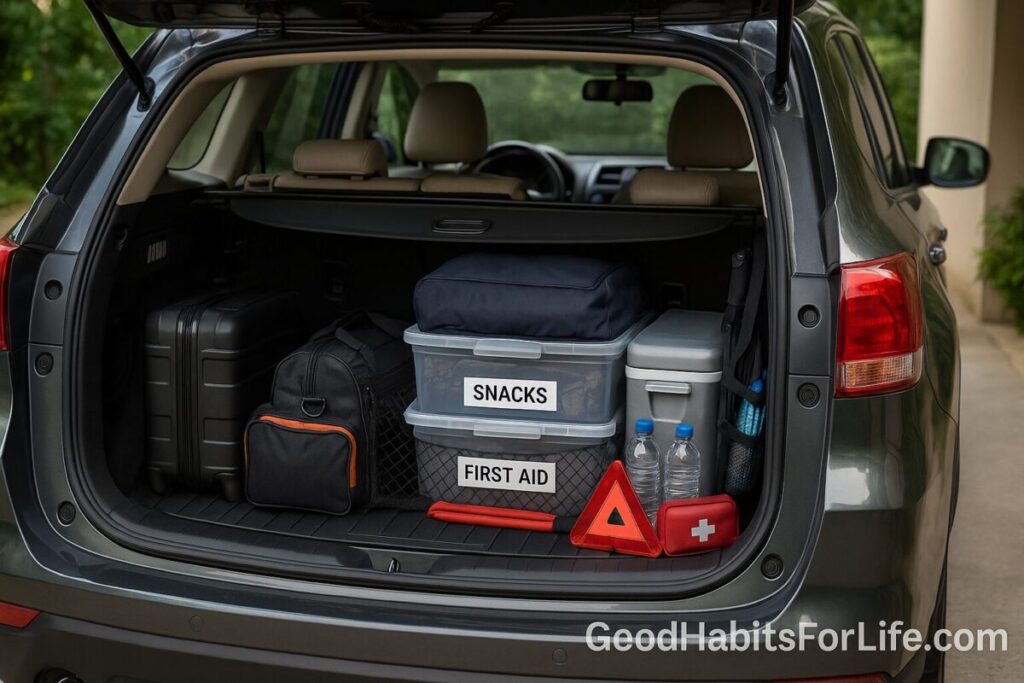
Packing the Car: Safety, Snacks, and Space
Packing the Car: Safety, Snacks & Space
Table of Contents
🧭 What & Why: Safety, Performance, Sanity
What: A repeatable packing system that puts safety first, keeps food fresh, and uses space efficiently so driving is calm and focused.
Why it matters:
-
Crash safety: Unsecured cargo can become dangerous projectiles in sudden stops. Securing and placing items correctly protects passengers and prevents driver distraction.
-
Vehicle performance: Balanced loads help braking, steering, tyre wear, and fuel/energy efficiency.
-
Trip comfort: Clear access to essentials (documents, water, wipes, chargers) reduces stress and stop time.
✅ Quick Start: 10-Minute Pack-Ready Checklist
-
Empty & stage: Clear the boot and floor. Lay out gear by category (safety, luggage, snacks, tech).
-
Heaviest first: Place dense items low and against the rear seatbacks (or forward in the cargo well). Strap if needed.
-
Balance left/right: Don’t create a heavy side.
-
Keep sightlines: Nothing above seatback height that blocks the rear view.
-
Airbags clear: No hard items in front of airbags; glovebox/door bins only for soft/light items.
-
Cooler strategy: Chilled cooler (≤4 °C/≤40 °F) on the floor behind a front seat; dry-snack tote at passenger feet (secured).
-
Emergency kit reachable: First-aid, reflective triangle/torch, tyre pump/sealant, poncho, gloves—top of boot or under a hatch net.
-
Documents & quick-grab: License, registration/insurance, toll tags, wipes, tissues, power bank in the centre console.
-
Roof box last: Only if needed. Keep light, bulky things up top; respect roof load rating.
-
Final walk-around: Tyres (pressures per door-jamb label), lights, mirrors, straps, charging/fuel level.
🧠 The 3S Framework: Safety • Snacks • Space
Safety (non-negotiables)
-
Heaviest low & forward: Suitcases/water packs on the floor against the seatbacks; use anchor points/ratchet straps.
-
No head-level hazards: Avoid hard/metal items on parcel shelves or loose in the cabin.
-
Child zone: Nothing loose near car seats; stow spare toys/books in soft organizers.
-
Roof rules: Light/bulky only; stay under the vehicle + roof system ratings; distribute evenly; check straps at each stop.
-
Visibility: Keep the central mirror view clear; use nets/cargo covers.
Snacks (smart, safe, spill-proof)
-
Two-bin method: (1) Cold bin ≤4 °C (≤40 °F) for perishable snacks; (2) Dry bin for ready-reach items.
-
Non-messy picks: Whole fruit (pre-washed/pre-cut where safe), nuts/trail mix, protein bars, whole-grain crackers, yoghurt pouches, string cheese (chilled).
-
Hydration: Refillable bottles; freeze some bottles overnight to act as ice packs.
-
Kid-safe: Avoid round hard foods for young children (choking risk) while moving; pull over for tougher foods.
-
Waste control: Zip bags, wet wipes, small trash sacks, paper towels.
Space (clean, modular, quick access)
-
Cubes & totes: Use packing cubes and two stackable crates for the boot.
-
Zones:
-
Red (driver reach): Docs, glasses, phone mount, charger.
-
Amber (passenger reach): Dry snacks, wipes, entertainment.
-
Green (stop-only): Luggage, bulk gear, roof box items.
-
-
Last-in/first-out: Overnight bag and jackets near the hatch.
🛠️ Techniques & Mini-Frameworks
-
Load Triangle: Heaviest items at the base, centered near the seatbacks; lighter items stacked above and outward.
-
Strap Strategy: Use two crossing straps (X-pattern) to prevent forward shift; check tension after 20–30 km.
-
Tire & Load Label: Use the door-jamb placard for cold tyre pressures and max load. Don’t exceed GVWR/GAWR.
-
Roof Box Playbook:
-
Check the roof load rating (often 50–100 kg / 110–220 lb, including bars/box—see manual).
-
Pack soft items (duvets, jackets) to fill voids and prevent movement.
-
Expect more wind noise/drag; consider moderating speed and watch crosswinds.
-
-
Spare-tyre access: Keep the hatch floor panel clear enough to lift without unpacking half the car.
-
Night stop kit: One tote with PJs, toiletries, one change of clothes, chargers—right behind the hatch.
🧊 Cooler & Food Safety Basics
-
Temperature: Perishables travel at or below 4 °C (40 °F); use ice packs/frozen bottles.
-
Packing: Cold items pre-chilled; keep the cooler full (less air = colder). Open briefly; keep in shade at stops.
-
Separation: Raw meats separate from ready-to-eat food (ideally skip raw meats for travel).
-
Time: If power is available, consider a 12 V compressor fridge for longer trips.
-
Cleaning: Sanitize cooler after the trip; discard foods left above 4 °C (40 °F) for >2 hours.
🧳 Packing Map: Cabin vs Boot (Trunk)
| Zone | What Goes Here | Why |
|---|---|---|
| Front console | License, toll card, sunglasses, phone mount, cable, tissues | Fast access; no digging while driving |
| Passenger footwell (secured) | Dry-snack tote, wipes, trash bag | Reachable without stretching |
| Rear floor behind front seats | Cooler (chilled), soft bag with kids’ items | Low/secure; minimal movement |
| Boot—forward against seatbacks | Heaviest luggage, water packs, tools | Stability; protects cabin in hard braking |
| Boot—top layer | Night-stop tote, jackets | Last-in/first-out convenience |
| Side pockets | First-aid kit, triangles, gloves, torch | Quick grab at roadside |
| Roof box (if used) | Bulky/light: bedding, coats, inflatable mats | Keeps mass out of roof box; reduces rollover risk |
👪 Audience Variations (Kids, Seniors, Pets, EVs)
Families with young kids
-
Soft seat-back organizers for books/toys; tether organizers to headrests.
-
Pre-portion snacks; plan 2-hour stretch/water stops; avoid choking-risk foods while moving.
Students/new drivers
-
Minimalist kit: triangle, hi-viz vest, basic tools, tyre inflator, jump-starter.
-
Practice the 10-minute checklist before the first long drive.
Seniors
-
Keep mobility aids accessible; avoid high lifts to roof boxes.
-
Label meds; store in a small insulated pouch if heat sensitive.
Pets
-
Use crash-tested harness or crate attached to anchors; water bowl + seat protector.
-
Never place a pet in the front seat; avoid leaving pets in cars at stops.
EV drivers
-
Extra mass and roof drag reduce range—pack lighter and keep roof clear if possible.
-
Stage charging cables/adapters in an outer pocket; plan charging stops near shaded parking.
⚠️ Mistakes & Myths to Avoid
-
Myth: “Heavy stuff can go on the roof.” → Keep heavy items inside, low, and forward.
-
Mistake: Blocking the rear mirror or side-mirror views with tall luggage.
-
Mistake: Overinflating tyres “just in case.” → Use placard pressures for loaded conditions.
-
Myth: “Any box fits any bars.” → Match roof-bar spread and total roof load rating.
-
Mistake: Loose tech (laptops, power banks) without sleeves or straps.
-
Mistake: Cooler on a seat without a belt/strap—secure it.
-
Mistake: Burying the emergency kit under luggage.
🗣️ Real-Life Scripts & Labels
-
Pre-drive safety callout (15 seconds):
“Seat belts on, doors locked, nothing loose at head level, cooler strapped, emergency kit top-right hatch. Everyone good?” -
Kid hand-off script at stops:
“We’ll eat grapes/yogurt only when parked. In the car, it’s bars, crackers, or pouches.” -
Labeling:
-
Tape labels on cube handles: CLOTHES – DAY 1–2, TECH & CHARGERS, NIGHT-STOP.
-
Roof box tag inside lid: Light/bulky only—check straps at every stop.
-
🧰 Tools, Apps & Resources
-
Packing cubes & trunk nets: Keep stacks stable; use an X-strap over the heavy base.
-
12 V compressor fridge vs passive cooler: Fridge = steady temp, pricier; cooler = cheaper, needs ice.
-
Tyre inflator & digital gauge: For correct cold pressures on loaded trips.
-
USDA FoodKeeper App: Shelf-life guidance and reminders.
-
Navigation add-ons: Offline maps, charger/stop planners; save rest areas ahead of time.
Pros/Cons (quick):
-
Roof box: +Space; –Drag, wind sensitivity, height clearance.
-
Soft roof bag: +Cheap; –Weather/noise; must double-check straps.
-
Crates vs duffels: Crates stack well; duffels fill gaps.
🗓️ 7-Day Trip-Prep Habit Plan
Day –7: Create the trip checklist (copy this article’s sections). Confirm tyre kit, first-aid, triangles, torch.
Day –5: Test-pack the boot; measure what fits; decide if a roof box is needed.
Day –3: Grocery + snack plan; freeze two water bottles for ice packs.
Day –2: Launder clothes; pre-pack cubes; pre-chill drinks.
Day –1: Load heavy base, strap it; stage cooler in the fridge; charge power banks; update offline maps.
Morning of: Pack cooler (≤4 °C/≤40 °F), dry-snack tote, night-stop bag near hatch; check pressures/fluids.
First stop (30–60 min in): Re-tighten straps, quick mirror/strap/roof check, sip water, stretch.
🔑 Key Takeaways
-
Safety leads: Heavy low/forward, nothing loose at head level, straps + nets.
-
Smart snacks: Cold bin + dry bin, simple foods, stop to eat higher-risk foods.
-
Space strategy: Cubes, zones, last-in/first-out, emergency kit reachable.
-
Know your numbers: Door-jamb tyre pressures, GVWR/GAWR, and roof load rating.
-
Repeat the ritual: Same checklist every trip for stress-free starts.
❓ FAQs
1) What’s the safest place for heavy luggage?
Against the rear seatbacks on the boot floor, centered. Strap it so it can’t shift forward.
2) Is it okay to put the cooler on a seat?
Only if belted/secured and low. The floor behind a front seat is usually better.
3) How do I know if I’m overloading the car?
Check the door-jamb placard and owner’s manual for GVWR/GAWR and roof load limits. If the car squats or steering feels light, reassess.
4) What snacks travel best for kids?
Low-mess, soft options in small portions (e.g., yoghurt pouches, cheese sticks, cut fruit). Avoid hard, round foods while moving.
5) Should I adjust tyre pressures for a loaded trip?
Use the loaded cold pressures shown on the placard/manual. Don’t exceed recommended values.
6) How do I pack a roof box correctly?
Keep to the roof system rating; put light/bulky items inside, fill voids so nothing shifts, and check straps at each stop.
7) Any tips for EV range when packed?
Pack lighter, avoid roof drag if possible, use eco speeds, and plan shaded charging stops.
8) Where should the emergency kit go?
Top layer of the boot or a side pocket—never buried. You should reach it with the hatch barely open.
9) How can I prevent spills?
Use resealable containers, a small trash bag, and keep wipes and paper towels in the passenger tote.
10) What if I need the spare tyre under the boot floor?
Leave a fold-back aisle. Don’t pile heavy items over the access panel.
📚 References
-
National Highway Traffic Safety Administration (NHTSA). Tire Safety & Loading Basics. https://www.nhtsa.gov/equipment/tires
-
NHTSA. Summer Driving Tips (Emergency Supplies). https://www.nhtsa.gov/summer-driving-tips
-
American Automobile Association (AAA). Emergency Car Kit Checklist. https://exchange.aaa.com/safety/roadway-safety/emergency-roadside-kit/
-
USDA Food Safety & Inspection Service (FSIS). The “Danger Zone” (40–140 °F). https://www.fsis.usda.gov/food-safety/safe-food-handling-and-preparation/food-safety-basics/danger-zone-40f-140f
-
CDC. Food Safety: Travel & Events. https://www.cdc.gov/foodsafety/keep-food-safe.html
-
HealthyChildren.org (American Academy of Pediatrics). Car Seats & Passenger Safety: Tips (secure loose items). https://www.healthychildren.org/English/safety-prevention/on-the-go/Pages/Car-Safety-Seats-Information-for-Families.aspx
-
National Safety Council (NSC). Driving Safety & Roadside Preparedness. https://www.nsc.org/road
-
Transport for NSW (AU). Load Restraint Guide—Light Vehicles. https://www.nsw.gov.au/driving-boating-and-transport/roads-safety-and-rules/load-restraint
-
USDA. FoodKeeper App. https://www.foodsafety.gov/keep-food-safe/foodkeeper-app
-
Consumer Reports. How to Safely Pack Your Car for Vacation. https://www.consumerreports.org/cars-driving/car-safety/how-to-safely-pack-your-car-for-vacation-a1160100836/
⚖️ Disclaimer
This guide is for general information only; always follow your vehicle’s owner manual and local laws, and use judgment for your specific trip and passengers.