
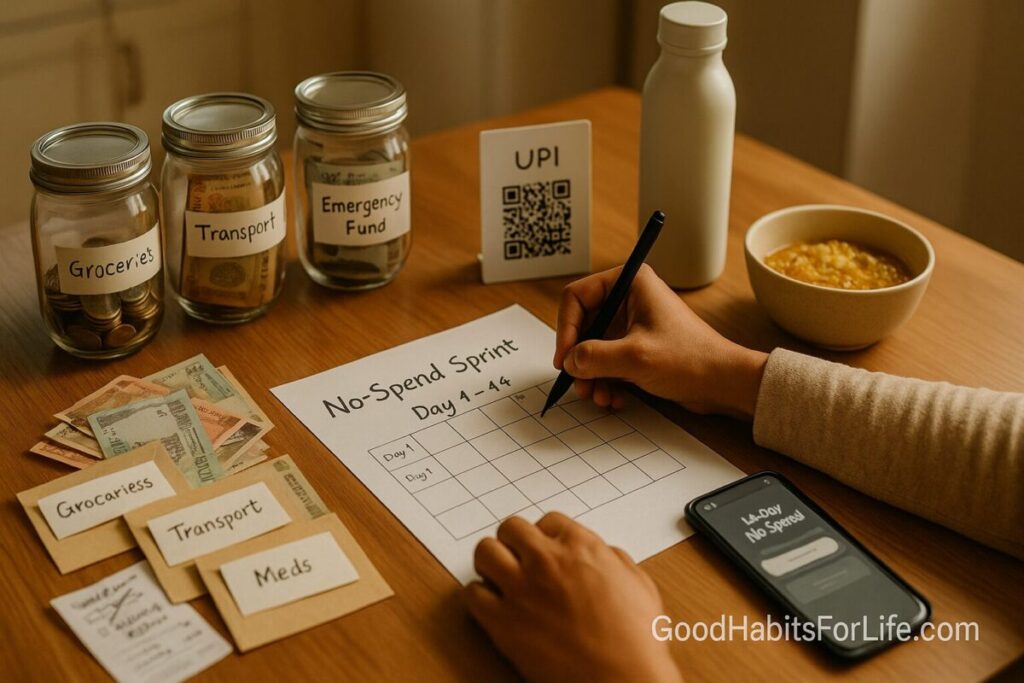
NoSpend Sprint: A 14Day Reset
No-Spend Sprint: 14-Day Reset (Save Fast)
Table of Contents
🧭 What Is a No-Spend Sprint?
A no-spend sprint is a short, time-boxed reset—here, 14 days—where you pause all non-essential spending (e.g., dining out, impulse buys, micro-transactions) while paying essentials (rent, utilities, transport, groceries, meds). The aim is to surface habits, create friction against impulses, and free up cash to kick-start goals (emergency fund, debt overpayment, sinking funds). Short sprints are easier to complete, provide fast feedback, and can be repeated monthly.
This approach aligns with well-established budgeting guidance: track money, set limits, and review regularly—core steps recommended by consumer finance regulators. Consumer Financial Protection BureauCanada Government
Why it works
-
Habits form with repetition and cues; two focused weeks build momentum toward automation. (Median habit formation ≈66 days—your sprint is a strong start.) Wiley Online Library
-
Real-time tracking and simple tools help curb impulse spending and close the gap between intentions and actions. OECD
-
Mental accounting and the “pain of paying” make cash/envelope methods surprisingly effective for some people. University of BathMassachusetts Institute of Technology
✅ Quick Start: Do This Today
-
Define essentials vs. non-essentials. Essentials: housing, food staples, transport to work/school, healthcare, core utilities.
-
Write your rules. Example: “No takeout, no fashion, no in-app game buys; groceries capped at ₹X/$X; pre-paid fuel/metro only.”
-
Set a start date with a “fresh-start” moment (next Monday or the 1st). Fresh-start timing measurably boosts motivation. Wharton Faculty Platform
-
Create spending friction: remove saved cards from browsers/apps, uninstall shopping apps, and move discretionary funds to envelopes. Consumer Financial Protection Bureau
-
Pick a tracker: paper diary, spreadsheet, or app; record every transaction for 14 days. The Royal College of Nursing
-
Tell someone + post your rules (fridge/notes). Implementation intentions (“If X, then Y”) make follow-through far more likely. ScienceDirect
🗓️ The 14-Day Plan
Daily rule: No non-essentials. Log everything. If a true need appears, add it to an “allowed list” for next pay cycle.
-
Day 1 – Baseline & Rules: List recurring bills; set grocery cap and transport plan; publish your rules.
-
Day 2 – Pantry & Prep: Inventory pantry/fridge. Plan 5–7 simple meals; batch-cook one staple.
-
Day 3 – Subscription Audit: List all subscriptions; pause anything not critical for 14 days.
-
Day 4 – Trigger Hunt: Review last month’s statements; tag impulse triggers (late-night scrolling, commute boredom).
-
Day 5 – Cash Envelopes: Withdraw a small, fixed cash amount for groceries & transport; stop card use for these categories. Consumer Financial Protection Bureau
-
Day 6 – Free Fun Menu: Brainstorm 10 zero-cost activities; schedule two for this week.
-
Day 7 – Mid-Sprint Review: Total spend vs. cap; note 3 wins + 1 friction to fix.
-
Day 8 – If-Then Plans: Write 5 personal if-then scripts for known triggers (see Scripts below). ScienceDirect
-
Day 9 – Declutter & Sell: List 3 unused items to sell or donate; ring-fence proceeds for goals.
-
Day 10 – Meal Stretch: Cook from staples; try a “use-it-up” recipe.
-
Day 11 – Bill Check: Confirm autopays, due dates; avoid late fees.
-
Day 12 – Micro-Negotiations: Call one provider (data, streaming, gym) to downgrade/cancel or seek a retention credit.
-
Day 13 – Future Guardrails: Draft a simple zero-based budget; add one weekly low-spend day. Consumer Financial Protection Bureau
-
Day 14 – Debrief & Deploy: Calculate savings; move money to goal (emergency fund or debt). Lock in 2–3 habits to keep.
🧠 The Psychology That Makes It Work
-
Implementation intentions (if-then plans) turn vague goals into automatic responses (e.g., “If I feel like ordering, then I brew tea and set a 15-minute timer”). Meta-analyses show strong effects on goal attainment. ScienceDirect
-
Present bias: We overweight “now” and overspend on near-term rewards. Short sprints + precommitment rules help the “future you.” cpb-us-e1.wpmucdn.com
-
Mental accounting: Separating money into categories counters overspending; physical partitioning (envelopes) raises salience. University of Bath
-
Pain of paying: Cards/contactless can feel less “painful,” increasing willingness to pay; cash/envelopes restore friction. Massachusetts Institute of Technology
-
Fresh-start effect: Starting at meaningful landmarks (new week/month) reliably boosts aspirational behavior. Wharton Faculty Platform
-
Temptation bundling: Pair a “treat” with a “should” (podcast only while batch-cooking or doing budget admin). PMC
🛠️ Techniques & Frameworks
1) Envelope / Cash-Stuffing (for allowed categories)
Allocate fixed cash to envelopes (Groceries, Transport). Stop spending when empty. Especially helpful for impulse spenders and new budgeters. Consumer Financial Protection Bureau
2) Spending Diary
Track every purchase (what/when/why). This increases awareness and can reduce mindless outflow. The Royal College of Nursing
3) Zero-Based Budget (ZBB)
Give every rupee/dollar a job before the month starts (needs, goals, fun). Recommended by regulators as part of “make a budget, then review and stick to it.” Consumer Financial Protection Bureau
4) Real-Time Prompts
Use bank/app notifications and weekly calendar nudges during and after the sprint to close intention–action gaps highlighted in behavioral programs. OECD
5) Habit Formation Basics
Attach the diary/budget update to a stable cue (e.g., after dinner). Consistency builds automaticity over weeks. Wiley Online Library
👥 Audience Variations
Students: Keep transport and food simple (campus meal preps, refillable bottles). Track micro-spends (snacks, late-night orders).
Parents: Pre-plan low-cost family activities; hold a “pantry party” dinner; pre-portion kids’ snacks to avoid top-ups.
Professionals: Calendar-block 15 minutes daily for tracking; pack work lunches; mute shopping emails and Slack channels with brand promos.
Seniors: Focus on meds/utilities optimization; review recurring services; use cash for groceries to protect against online impulse buys.
Teens: Co-create rules with a parent; use a prepaid card with a hard cap; log every purchase in a simple sheet.
⚠️ Mistakes & Myths to Avoid
-
Myth: “Two weeks can’t matter.”
Reality: Short sprints leverage fresh-start motivation and create repeatable habits that compound. Wharton Faculty Platform -
Mistake: Vague rules (“spend less”).
Fix: Write if-then plans and category caps. ScienceDirect -
Mistake: All-or-nothing thinking.
Fix: Allow essentials; if you slip, log it, learn, and continue same day. -
Myth: “Cash is outdated.”
Reality: For some, cash raises salience and reduces overspend via mental accounting and payment pain. University of BathMassachusetts Institute of Technology
💬 Real-Life Scripts & Examples
If-Then Scripts (copy-paste):
-
If I feel like “adding to cart” after 9 pm, then I put the item on a 24-hour wishlist and make tea. ScienceDirect
-
If a colleague invites me to lunch out, then I say: “I’m on a 14-day reset—walk + home lunch?”
-
If I finish a tough day, then I use my “free fun menu” (walk + playlist, board game, documentary).
No-Spend Rules (example)
-
Essentials only; grocery cap ₹3,000/$40 this week; no food delivery; no clothes/cosmetics; transit via pre-paid card; one free outing (park/book/library).
-
Allowed substitutions: homemade coffee; swap-meets with friends; library ebooks.
Wishlist Workflow
Add non-essentials to a shared wishlist with the date. Revisit after the sprint; often the urge fades.
🧰 Tools, Apps & Resources (brief pros/cons)
-
Paper diary / Google Sheets – Free, flexible; requires discipline.
-
FCAC Budget Planner (Canada) – Simple guided budget builder with categories. Pro: easy; Con: web-based. iTools
-
Bank app alerts – Real-time notifications; Con: may need custom rules. OECD
-
Envelope cash system – Strong salience and hard stops; Con: physical cash handling. Consumer Financial Protection Bureau
🔑 Key Takeaways
-
Two weeks of no-spend reveals leaks, builds momentum, and funds goals fast.
-
If-then plans, envelope cash, and a spending diary are simple, high-impact tools. ScienceDirectConsumer Financial Protection BureauThe Royal College of Nursing
-
Use fresh-start timing and friction (remove saved cards, uninstall shopping apps) to support your future self. Wharton Faculty Platform
-
After 14 days, keep a weekly low-spend day and a monthly mini-sprint to reinforce habits. Consumer Financial Protection Bureau
❓ FAQs
1) Is a 14-day challenge long enough to change behavior?
It won’t fully automate a habit (often takes weeks), but it jump-starts routines and confidence—then you layer weekly low-spend days. Wiley Online Library
2) Can I include birthdays or planned events?
Yes—pre-budget essentials for the event and avoid impulse add-ons; reschedule the sprint if it collides with a heavy-spend period. Consumer Financial Protection Bureau
3) What if groceries blow my cap?
Adjust next week’s cap, prioritize staples, and use cash envelopes to create a hard stop. Consumer Financial Protection Bureau
4) Do I need to use cash?
No, but cash/envelopes add salience and curb overspending for many people. Try it for one category like groceries. University of BathMassachusetts Institute of Technology
5) How do I handle emergencies?
Essentials and emergencies are always allowed. Log them, then debrief on Day 14 to adjust future rules. Consumer Financial Protection Bureau
6) Should I cancel subscriptions?
Start by pausing during the sprint. On Day 12, call providers to seek downgrades or credits; keep only what passes a value test. Consumer Financial Protection Bureau
7) What if I live with others?
Co-create rules and envelopes for shared categories; split tracking and celebrate wins together to boost adherence. OECD
8) Is there evidence that simple plans help?
Yes—implementation intentions (if-then plans) reliably raise follow-through across domains. ScienceDirect
📚 References
-
Consumer Financial Protection Bureau. Budgeting: How to create a budget and stick with it. Consumer Financial Protection Bureau
-
Financial Consumer Agency of Canada. Budget Planner (tool). iTools
-
OECD/INFE. Application of Behavioural Insights to Financial Literacy… (report). OECD
-
Lally, P. et al. (2010). How are habits formed? Eur. J. Soc. Psychol. Wiley Online Library
-
Gollwitzer, P. (2006). Implementation Intentions and Goal Achievement (meta-analysis). ScienceDirect
-
Prelec, D., & Simester, D. (2001). Always Leave Home Without It (credit cards ↑ WTP). Massachusetts Institute of Technology
-
Thaler, R. (1999). Mental Accounting Matters. University of Bath
-
Dai, H., Milkman, K., & Riis, J. (2014). The Fresh Start Effect. Management Science. Wharton Faculty Platform
-
CFPB. Consumer Voices on Financial Rules to Live By (envelope system mentions). Consumer Financial Protection Bureau
-
Royal College of Nursing (UK). Keeping a Spending Diary. The Royal College of Nursing
Disclaimer: This article is educational and not financial advice; consider your own circumstances or consult a qualified adviser before making money decisions.