
NoGym Strength: Backpack, Bands, Floor: Zone 2 + NEAT (2025)
NoGym Strength: Backpack, Bands & Floor (Zone 2 + NEAT)
Table of Contents
🧭 What “NoGym Strength” Means & Why It Works
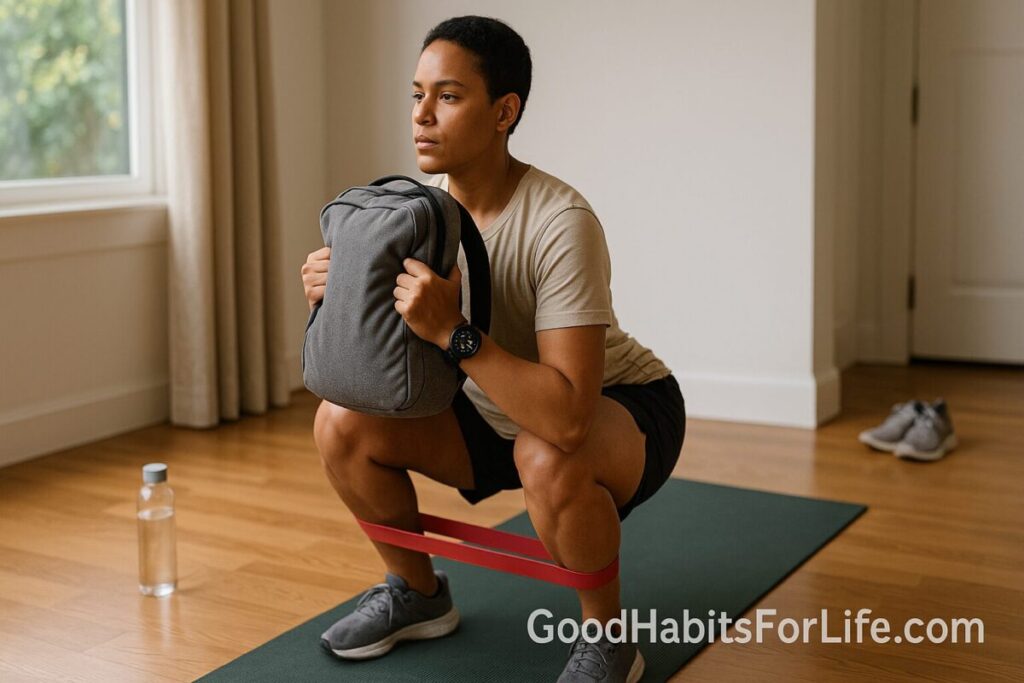
Definition. NoGym Strength is a minimalist program built on three tools—backpack (as a loadable weight), resistance bands, and floor exercises—combined with Zone 2 cardio (easy aerobic work) and NEAT (your all-day movement). The goal is full-body strength and energy without a gym or expensive equipment.
Why it works (evidence-aligned).
-
Strength without machines. Muscle adapts to progressive overload—more resistance, reps, range or time under tension—regardless of the tool (backpack/bands/bodyweight). Research shows elastic resistance and bodyweight can meaningfully increase strength and hypertrophy when progressed properly.
-
Backpack = adjustable dumbbell. Water bottles, books, rice/sandbags let you micro-load safely.
-
Bands add joint-friendly resistance through full range and support pulling patterns that floor work alone can’t hit well.
-
Zone 2 builds your engine. Keeping a conversational pace improves mitochondrial function and recovery so you can train more often.
-
NEAT multiplies calorie burn and health benefits outside “workouts,” supporting weight management and metabolic health.
Primary benefits.
-
Time-efficient: 25–40 minutes, 4–6 days/week.
-
Scalable: from total beginner to advanced by adjusting load/tempo/volume.
-
Joint-friendly: bands and tempo work reduce joint stress.
-
Portable: hotel room, park, living room.
⚙️ Quick Start: Set Up in 10 Minutes
Gear checklist (budget-friendly).
-
Backpack: sturdy straps + chest clip if possible.
-
Load: fill with 2–15 kg (5–35 lb) using books/water bags; add a towel to stop shifting.
-
Bands: 2 loop bands (light & medium) + 1 long resistance tube with door anchor (optional).
-
Floor: yoga mat or carpet; towel for knee support.
-
Timer + tracker: phone timer and any notes app.
Warm-up (4 minutes).
-
1 min brisk marching or stair up-downs
-
30 s each: hip hinge sweep, ankle rocks, arm circles, thoracic rotations
-
1 min light band pull-aparts + air squats
Foundational movement menu (learn these first).
-
Hinge: backpack hip hinge/RDL
-
Squat: backpack front squat or goblet squat
-
Push: floor push-up (elevate hands if needed)
-
Pull: band row or pulldown (door anchor)
-
Carry/Core: backpack front carry or suitcase carry, plus plank variations
First workout (20–25 min).
-
A) Backpack squats — 3×8 (RPE 6–7)
-
B) Band rows — 3×10 (RPE 6–7)
-
C) Push-ups — 3×AMRAP* (stop at 2 reps in reserve)
-
D) Backpack RDL — 3×10
-
E) 60–90 s front carry + 30–45 s plank, repeat twice
Finish with 5–8 min easy walk for cooldown.
*AMRAP = as many reps as possible with form.
Zone 2 (pick one, 20–40 min).
-
Brisk walking with a light pack (rucking), cycling, or easy jog.
-
Talk test: you can speak full sentences, breath slightly elevated.
-
Heart-rate ballpark: ~60–70% of max (or ~2–3 on a 10-point breathlessness scale).
Daily NEAT.
-
Target 7–10k steps/day (or +2–3k above your baseline), stairs whenever possible, 5-min movement “snacks” each hour.
✅ 30-60-90 Habit Roadmap (with Zone 2 + NEAT)
Build capacity in phases. Use RPE (Rate of Perceived Exertion) 1–10 to manage effort.
Days 1–30: Foundation & Consistency
-
Strength (3×/week, non-consecutive): Full-body A/B alternating.
-
A: Squat, Row, Push-up, RDL, Carry, Plank
-
B: Split Squat or Step-up, Band Pulldown, Pike/Incline Push-up, Hip Thrust (floor), Side Plank
-
Sets/Reps: 2–3×8–12 @ RPE 6–7
-
-
Zone 2 (2×/week): 20–30 min easy walk/ride; optional light ruck with 5–7 kg (11–15 lb).
-
NEAT: +2k steps over baseline; stand up hourly.
-
Goal: nail technique, find starting loads, finish fresh.
Days 31–60: Progressive Overload
-
Strength (3–4×/week):
-
Move to 3×10–12 or 4×8–10 @ RPE 7–8.
-
Add load: +0.5–2 kg (1–5 lb) to backpack or slower tempo (3-1-3).
-
Introduce single-leg work (rear-foot-elevated split squat), band face pulls, push-up depth (books/handles).
-
-
Zone 2 (3×/week): 25–40 min; one can be a hilly walk.
-
NEAT: 8–10k steps/day; short evening walk after dinner (10 min).
-
Checkpoint: re-test max quality push-ups and 60-s carry load.
Days 61–90: Performance & Variety
-
Strength (4×/week): Upper/Lower split or Push/Pull split.
-
Intensity waves: Week A slightly heavier (RPE 8–9 on last set), Week B back to RPE 7–8.
-
Add band-assisted pull-ups (door bar optional), backpack thrusters, hip hinge with 2-second pause, carries up to 2–3 min.
-
-
Zone 2 (3–4×/week): Maintain 30–45 min; sprinkle Zone 3 strides 1×/week (6–8×20 s brisk with full recovery).
-
NEAT: Keep 8–12k steps/day; add 1–2 “walk-and-talk” calls.
-
Checkpoint: repeat push-ups and carry test; aim +20–40% improvement.
Weekly template (after Week 2).
-
Mon: Strength A + 10 min walk
-
Tue: Zone 2 (30–40 min)
-
Wed: Strength B
-
Thu: NEAT focus + mobility (10 min)
-
Fri: Strength A (or Upper)
-
Sat: Zone 2 (30–45 min) + short carry finisher
-
Sun: Optional stroll; recharge
🛠️ Techniques & Frameworks (Progression, RPE, Patterns)
Movement patterns (use this cheat sheet).
| Pattern | Backpack | Bands | Floor |
|---|---|---|---|
| Hinge | RDL, Good Morning | Hip extension with band | Hip thrust, Bridge |
| Squat/Lunge | Goblet/Front Squat, Split Squat | Band-assisted squat | Box/air squat, Step-ups |
| Push | Weighted Push-up/Thruster | Band Chest Press | Push-up variants |
| Pull | — | Row, Pulldown, Face Pull | Towel row under table* |
| Carry/Core | Front/Suitcase Carry | Pallof Press | Plank/Side Plank, Dead Bug |
* Only if your table is rock-solid and safe.
Progression knobs (rotate weekly).
-
Load: +0.5–2 kg to backpack.
-
Volume: +1 set or +2 reps (stay within 6–15).
-
Tempo: e.g., 3-1-3 (down-pause-up).
-
Range: deeper squats, full lockout rows.
-
Density: same work in less time (once technique is solid).
RPE guide.
-
RPE 6 = ~4 reps in reserve (easy-moderate)
-
RPE 7–8 = 2–3 in reserve (working)
-
RPE 9 = 1 in reserve (hard, sparingly)
Zone 2 guide.
-
Conversational pace; breathe through nose most of the time.
-
If tracking HR: ~60–70% HRmax. If untracked: keep it “easy-steady.”
NEAT upgrades that stack.
-
Park farther, stairs not lifts, walk coffee chats, 5-min post-meal walks, tidy 10, standing desk cycles.
🧠 Audience Variations
Students (dorm-friendly). 20–30 min blocks between classes; backpack loads are books + water. Do floor push-ups on a towel; door-anchored rows.
Parents. Nap-time micro-sessions: 10-min blocks ×2/day; stroller walks = Zone 2; kids join for carries.
Professionals. Calendar “walking 1:1s”; brief lunch circuits; keep a band in your desk.
Seniors (or beginners returning). Prioritize sit-to-stand, light band rows, wall push-ups, 10–20 min Zone 2 walks; build to carries with empty pack.
Teens. Technique first; add playful challenges (step-up ladders, carry relays); avoid maximal loading.
⚠️ Mistakes & Myths to Avoid
-
Myth: “You need heavy barbells to get strong.” → Truth: Progressive overload with bands/backpack works when programmed.
-
Mistake: Jumping from 5 to 15 kg in a week. → Increase gradually.
-
Mistake: Skipping pulls. → Band rows/pulldowns keep shoulders happy.
-
Myth: “Zone 2 is too easy to matter.” → It’s the base that lets you train more, recover better.
-
Mistake: Training to failure every set. → Save RPE 9 for last set occasionally.
-
Mistake: Long static stretching before strength. → Do it after or separately; warm up dynamically first.
🗣️ Real-Life Examples & Scripts
5-move Anywhere Circuit (25–30 min).
-
-
Backpack squats — 3×12
-
-
-
Band row — 3×12
-
-
-
Push-ups — 3×AMRAP –2
-
-
-
Backpack RDL — 3×10
-
-
-
Front carry — 2×90 s
Rest 45–75 s between moves; finish with a 5-min easy walk.
-
10-min “If-Then” Plan (busy day).
-
If I skip my main workout, then I’ll do 2 quick rounds:
-
15 air squats, 10 incline push-ups, 20 band rows, 30-s plank; immediate 10-min walk.
-
Progression script (weekly).
-
“Last week 3×10 squats @ 10 kg, RPE 7. This week: 3×12 or +1–2 kg; keep RPE ≤8.”
Carry ladder (core + grip).
-
Week 1: 2×60 s front carry (light).
-
Week 2: 2×90 s (slightly heavier).
-
Week 3: 3×90 s.
-
Week 4: 2×120 s or add hills.
🧰 Tools, Apps & Resources
-
Tracking: Strong / Hevy / Google Sheets — simple set-tracking; free tiers.
-
Heart rate/steps: Apple Health, Google Fit, Garmin, Polar — objective Zone 2 & NEAT.
-
Timers: Interval Timer, Seconds — EMOMs, rest timing.
-
Bands & anchors: Look for latex loop bands + a door anchor; inspect monthly for wear.
Pros: low cost, portable, quiet. Cons: bands have resistance curves; learn anchor safety.
📌 Key Takeaways
-
Minimal kit + smart progression = serious results.
-
Hit all patterns weekly; pull as often as you push.
-
Keep Zone 2 truly easy; let NEAT do hidden heavy lifting.
-
Progress one variable at a time; track RPE and notes.
-
Consistency beats complexity—show up 4–6 days/week in small chunks.
❓ FAQs
1) How heavy should my backpack be?
Start with 5–7 kg (11–15 lb). When sets hit RPE ≤6, add 0.5–2 kg.
2) I can’t do full push-ups yet—what now?
Elevate hands on a bench/couch or wall. Lower the incline over weeks until the floor.
3) What’s the simplest Zone 2 test without a watch?
Use the talk test—you can speak full sentences comfortably; breathing is steady but elevated.
4) Can bands really build muscle?
Yes—studies show elastic resistance improves strength and hypertrophy when progressed with enough volume and effort.
5) How often should I train?
Aim 3–4 strength sessions + 2–4 Zone 2 days weekly; many combine a short Zone 2 finisher after strength.
6) What’s NEAT and why care?
It’s your non-exercise movement—walking, chores, fidgeting. Small increases add up to big energy expenditure and health benefits.
7) Is rucking safe for beginners?
Yes if you start light, choose supportive shoes, and progress load/distance slowly; keep an upright posture and short steps.
8) How do I know I’m progressing?
You can use: higher reps at same RPE, more load, slower tempo with same form, longer carries, and easier breathing at the same Zone 2 pace.
9) Can I add sprints/HIIT?
After 4–6 weeks of base, add a brief HIIT session 1×/week if you recover well; keep most work Zone 2.
10) What if my knees or back feel cranky?
Reduce load/ROM, check hinge/squat form, add more band rows/hip bridges, and favor softer surfaces. If pain persists, consult a clinician.
📚 References
-
World Health Organization. Guidelines on Physical Activity and Sedentary Behaviour. https://www.who.int/publications/i/item/9789240015128
-
U.S. Department of Health and Human Services. Physical Activity Guidelines for Americans, 2nd ed. https://health.gov/paguidelines
-
American College of Sports Medicine. Progression Models in Resistance Training for Healthy Adults. Med Sci Sports Exerc. https://www.acsm.org
-
Hughes L, et al. The effects of resistance training using elastic bands on strength and body composition. Syst Rev & Meta-analysis. (e.g., SAGE/NIH PubMed) https://pubmed.ncbi.nlm.nih.gov
-
Lopes JSS, et al. Effects of training with elastic resistance on muscle strength. Sports Med. https://link.springer.com
-
Levine JA. Non-exercise activity thermogenesis (NEAT). Proc Nutr Soc. https://www.cambridge.org/core/journals/proceedings-of-the-nutrition-society
-
Seiler S. What is best practice for training intensity and duration distribution in endurance athletes? Int J Sports Physiol Perform. https://journals.humankinetics.com
-
San Millán I, Brooks GA. Assessment of metabolic flexibility by lactate and fat oxidation during exercise. Metabolism. https://www.sciencedirect.com
-
Knapik JJ, Reynolds K, Harman E. Soldier load carriage: historical, physiological, biomechanical considerations. Mil Med. https://academic.oup.com/milmed
-
NHS. Strength and Flex Exercises & Knee/Back Pain Advice. https://www.nhs.uk/live-well/exercise/
Disclaimer: This guide is educational and does not replace personal medical advice; consult a qualified professional if you have injuries, conditions, or concerns.