
NightShift Nutrition: Pace, Protein, and Light: AI workflows (2025)
Night Shift Nutrition: Pace, Protein & Light (2025)
Table of Contents
🧭 What & Why
Night work flips your circadian rhythm. At night, insulin sensitivity, gastric emptying, and alertness change—large, late carbohydrate loads hit harder; heavy, greasy meals slow you; and mistimed caffeine or bright light can wreck daytime sleep. Good night-shift nutrition focuses on pace, protein, and light:
-
Pace meals into smaller, regular portions to stabilize energy and avoid post-meal sleepiness.
-
Protein (≈1.2–1.6 g/kg/day for active adults; minimum 0.8 g/kg/day) supports satiety and muscle recovery. Distribute 20–40 g/meal.
-
Light is a biologic “drug.” Bright light early in shift boosts alertness; reduce blue light before sleep to protect melatonin.
-
Caffeine can help performance but should be front-loaded and cut 6–8 h before sleep.
-
Hydration: spread intake across the shift; avoid chugging before bedtime.
Evidence snapshot: Shift work disrupts circadian alignment and glucose control; timed light/caffeine helps alertness, and late-night eating impairs metabolic responses. Protein distribution improves muscle protein synthesis; adults should limit caffeine to ~400 mg/day; adequate fluid intake supports cognition and thermoregulation. (See references.)
⚡ Quick Start (Do This Tonight)
-
Pre-shift meal (T-60–90 min): balanced plate: 30–40 g protein, high-fiber carbs, veggies, and 10–20 g healthy fats.
-
First 3 hours on duty: 1–2 small items (e.g., Greek yogurt + fruit; nuts + cottage cheese). Up to 200 mg caffeine if desired.
-
Mid-shift mini-meal: 20–30 g protein + slow carbs (e.g., chicken wrap on whole-grain, or tofu + quinoa bowl).
-
Last 3 hours: avoid large meals and caffeine. Hydrate; choose light snacks (berries, carrots, a boiled egg).
-
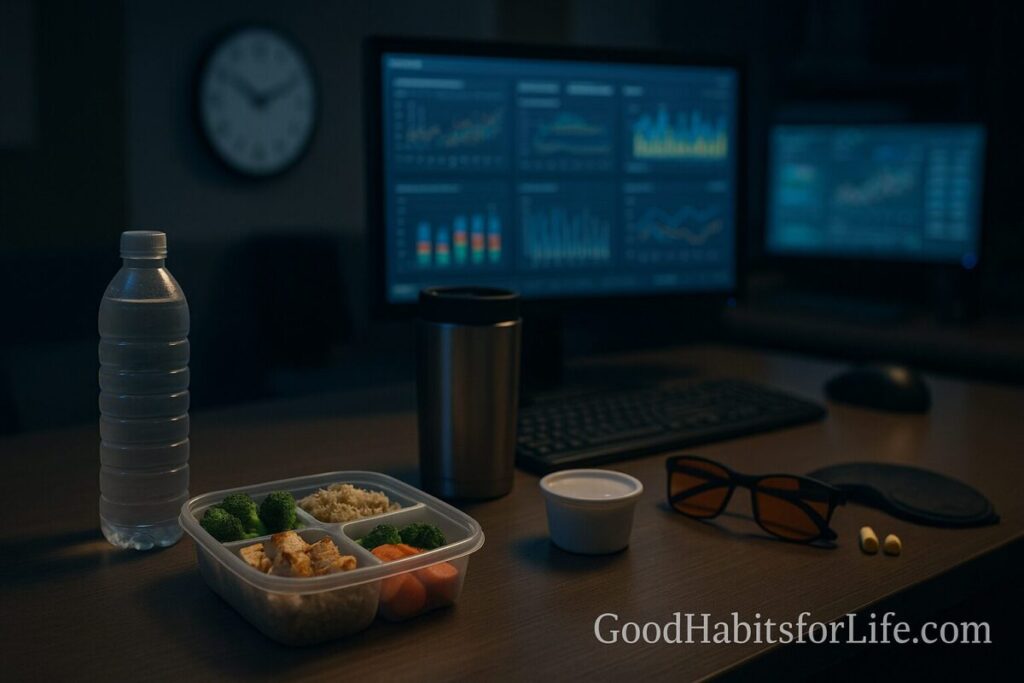
End of shift: dim light, blue-blocking glasses on commute; high-fiber, high-protein “sleep snack” if hungry (e.g., skyr + oats).
-
Sleep cave: cool, dark, quiet. Consider eye mask, blackout curtains, and a 20–30 min wind-down.
🗺️ Habit Plans: 7-Day Starter + 30-60-90
7-Day Starter
-
Day 1–2: Log your current shift window and eating times. Add pre-shift plate and front-loaded caffeine.
-
Day 3–4: Re-pack meals into 3–4 mini-meals (20–30 g protein each). Set a caffeine cut-off.
-
Day 5: Introduce bright light for the first 2–3 h of shift; wear blue-blockers after.
-
Day 6: Build a sleep snack and create a wind-down checklist.
-
Day 7: Review energy, GI comfort, and sleep length. Tweak meal sizes & timing.
30-60-90 Roadmap
-
30 days: Hit ≥80% adherence to pre-shift plate, protein at each stop, and caffeine cut-off.
-
60 days: Optimize macros to ~1.2–1.6 g/kg/day protein, 25–35 g fiber/day, and sodium/potassium balance.
-
90 days: Layer in meal prep rotation (3–4 boxes), micro-naps policy (if allowed), and personalized light schedule aligned to your roster.
🛠️ Techniques & Frameworks
1) The 3-P Framework: Pace–Protein–Portions
-
Pace: Eat every 3–4 h; avoid a giant 02:00 meal.
-
Protein: 20–40 g per eating occasion; include leucine-rich sources (dairy, eggs, soy, fish).
-
Portions: Favor slow carbs (oats, legumes, intact grains), colorful veg, and modest fats to limit sluggishness.
2) Caffeine “Windowing”
-
Dose ~1–2 mg/kg early; consider a small top-up mid-shift. Stop 6–8 h before sleep. Avoid “rescue” espressos late.
3) Light Management
-
Bright light (≥1,000 lux if possible) in the first half of shift; dim/blue-block after the midpoint; blackout commute.
4) Hydration Ladder
-
Aim for regular sips each hour; target daily intake consistent with guidelines (≈3.7 L men/2.7 L women from all beverages/foods; adjust for climate/exertion). Add electrolytes when sweating.
5) “Prep Once, Eat Thrice”
Batch-cook three protein bases (e.g., chicken thighs, lentil keema, tofu trays) + three carb bases (quinoa, brown rice, sweet potato) + mix-and-match sauces.
Example shift menu (12-hour):
-
Pre-shift (18:00): Salmon, brown rice, salad (40 g protein).
-
19:30: Skyr + oats + berries (25 g).
-
22:30: Lentil-quinoa bowl + veg (30 g).
-
01:00: Green tea + handful of nuts (6–8 g).
-
03:30: Egg wrap + spinach (20 g).
-
05:00: Water only/light fruit if needed.
-
07:00 (home): Sleep snack: cottage cheese + kiwi (20 g).
👥 Audience Variations
-
Healthcare & emergency services: Prioritize clean, hand-held foods; consider caffeine naps (10–20 min immediately after a small coffee) when policies allow.
-
Drivers/operators: Avoid heavy meals within 1 h of critical driving; schedule stops for brief protein snacks + water.
-
Students on night study: Use tea or modest caffeine tabs early; swap energy drinks for yogurt/fruit and nuts.
-
Seniors: Emphasize lower caffeine, softer textures, and hydration; discuss supplements/meds with a clinician.
-
Plant-based eaters: Build protein around tofu/tempeh, seitan, lentils, edamame, pea protein; add B12-fortified foods.
⚠️ Mistakes & Myths to Avoid
-
Myth: “A big meal at 2 AM keeps me going.”
Reality: Large late meals spike sleepiness and GI discomfort; mini-meals win. -
Mistake: Caffeine right before clocking out.
Fix: Last dose no later than 6–8 h before intended sleep. -
Myth: “Blue light blockers aren’t worth it.”
Reality: Reducing blue light before sleep supports melatonin and daytime sleep quality. -
Mistake: Ignoring protein distribution.
Fix: Aim for 20–40 g per eating occasion. -
Mistake: Hydrating only at shift end.
Fix: Evenly spaced fluids.
💬 Real-Life Scripts & Examples
Manager chat:
“I’m improving my night-shift alertness with scheduled mini-meals and early-shift light exposure. Could we place a bright task lamp in our team area and confirm a 10-min nutrition break every 3–4 h?”
Family text before sleep:
“Heading into blackout mode now—no calls for 6 h. Message if urgent; I’ll check after 14:00.”
Caffeine boundary with coworkers:
“I’m past my cut-off—going decaf. Happy to brew a pot for you all though!”
📱 Tools, Apps & AI Workflows
Meal planning & prep
-
Prompt an AI: “Create a 4-day night-shift menu at ~1.4 g/kg protein for a 72 kg person, 2,200 kcal/day, with 4 mini-meals per shift. Output shopping list grouped by store section.”
-
Auto-generate a batch-cook plan (oven timing, containers, reheating notes).
Timing & adherence
-
Calendar reminders: pre-shift plate (T-90), mid-shift mini-meal (T+4 h), caffeine cut-off, wind-down.
-
Wearable/alarm: hourly sip reminders.
On-the-go decisions
-
Chat prompts: “I’m at a convenience store on night shift; suggest 3 options ≥25 g protein, ≤10 g added sugar.”
Content ops for your site (bonus)
-
Tag/category suggestions: Use AI to read a draft and propose categories & tags (e.g., Eating for Performance; tags: nightshift, protein, light, caffeine).
-
Featured images: Auto-fetch license-free photos from Unsplash/Pexels/Pixabay via plugins or an API and queue choices in Media Library.
✅ Key Takeaways
-
Night shifts demand timing-first nutrition: pace meals, prioritize protein, and schedule light/caffeine.
-
Front-load caffeine, dim late light, and protect daytime sleep.
-
Use mini-meals (20–40 g protein) and steady hydration.
-
Lock habits with the 7-Day Starter then scale via the 30-60-90 plan.
-
Leverage AI workflows for menus, reminders, and on-the-go choices.
❓FAQs
1) What’s the best time for my largest meal?
Pre-shift or early in the shift, when alertness and glucose handling are better.
2) How much protein per shift?
Aim for 20–40 g per eating occasion; total daily ~1.2–1.6 g/kg if active (minimum 0.8 g/kg).
3) Is time-restricted eating good for night workers?
It depends. If it preserves sleep and allows enough protein and calories, it can work; avoid long fasts that push a huge 02:00 meal.
4) Are energy drinks okay?
They’re caffeine + sugar. Prefer coffee/tea or sugar-free options; respect total caffeine ≤400 mg/day and your cut-off.
5) What about naps?
If permitted, a 10–20 min caffeine-nap early/mid-shift can boost alertness without harming post-shift sleep.
6) Do blue-blocking glasses actually help?
They reduce short-wavelength light exposure and can support melatonin before sleep; combine with dim environment.
7) Any plant-based high-protein options?
Tofu/tempeh, seitan, lentils, edamame, Greek-style plant yogurts, pea-protein shakes, and mixed grains/legumes.
8) How much water should I drink?
Sip regularly; many adults land near 2.7–3.7 L/day from all beverages/foods—adjust for heat, activity, and medical advice.
9) Should I use melatonin?
Some shift workers benefit for timing sleep; discuss dosing/timing with a clinician to avoid circadian mistiming.
10) What if my schedule rotates?
Keep a portable core routine (pre-shift plate, caffeine window, light early/blue-block late) and adjust clock times to the new shift.
📚 References
-
CDC NIOSH. Work Schedules: Shift Work and Long Work Hours — health effects and strategies. https://www.cdc.gov/niosh/topics/workschedules/
-
American Academy of Sleep Medicine (AASM). Light therapy and circadian rhythm resources for shift workers. https://sleepeducation.org/
-
American Heart Association Scientific Statement (2023). Meal timing and frequency: implications for cardiometabolic health. https://www.ahajournals.org/
-
Scheer FAJL et al. Adverse metabolic and cardiovascular consequences of circadian misalignment. PNAS. 2009. https://www.pnas.org/
-
International Society of Sports Nutrition (ISSN) Position Stand: Protein and exercise (2017/2018 updates). https://jissn.biomedcentral.com/
-
EFSA Scientific Opinion (2015). Safety of caffeine. https://efsa.onlinelibrary.wiley.com/
-
Harvard Medical School – Harvard Health. Blue light has a dark side. https://www.health.harvard.edu/
-
National Academies of Sciences, Engineering, and Medicine (NASEM). Dietary Reference Intakes: Water, Potassium, Sodium… https://nap.nationalacademies.org/
-
Morris CJ et al. Endogenous circadian system and circadian misalignment impact glucose tolerance. Curr Biol. 2015. https://www.cell.com/current-biology/
-
NIOSH. Napping and break practices for night shift safety. https://www.cdc.gov/niosh/
Disclaimer
This guide is educational and does not replace personalized medical or nutrition advice; consult your clinician or registered dietitian, especially if you have health conditions, are pregnant, or take medications.