
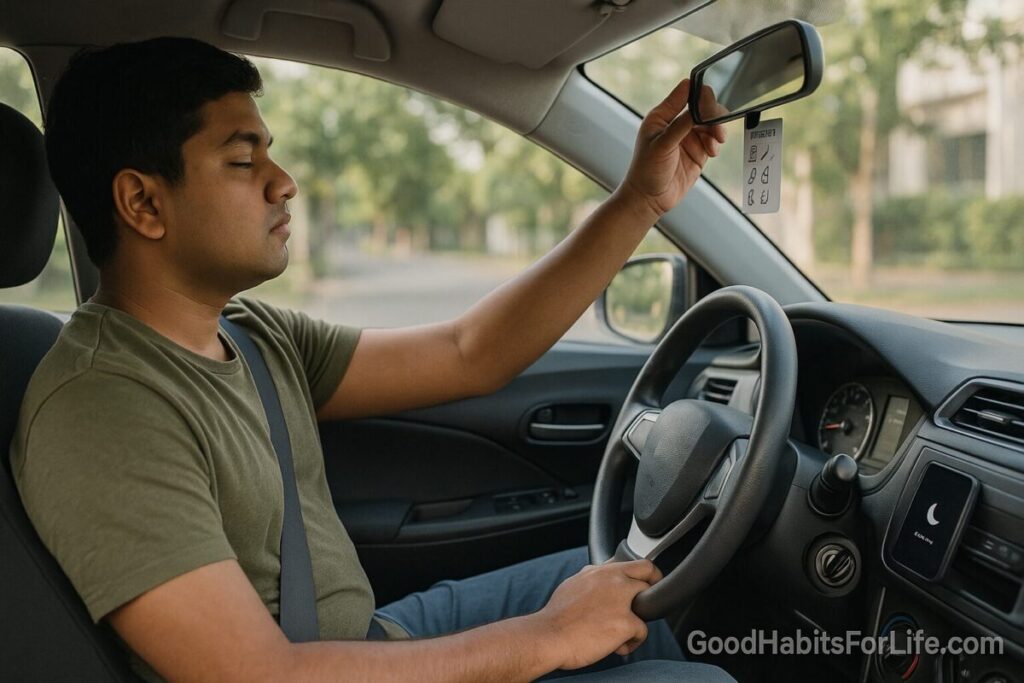
New Driver Nerves: PreDrive Rituals that Calm
New Driver Nerves: PreDrive Rituals that Calm
Table of Contents
🧠 What & Why: A Pre-Drive Ritual for Calm and Safety
“New driver nerves” are normal. A short, repeatable ritual—done before you move the car—reduces anxiety, improves focus, and makes safety steps automatic. Research on pre-performance routines shows they help under pressure by curbing distraction and stabilizing attention—exactly what a new driver needs. Taylor & Francis Online
Two pillars power this ritual:
-
Regulate your body (slow breathing, muscle release) to quiet the stress response. nhs.ukCleveland Clinic
-
Standardize safety actions (seat, mirrors, belt, phone) so they happen the same way every time. nsc.org+1
It also directly counters top crash risks for novices—distraction and fatigue—by locking in “phone away” behavior and a quick self-check for sleepiness. NHTSA+1
🛠️ Quick Start: The 2-Minute Pre-Drive Reset
Use this exactly as written for your next 10 drives.
Step 0 (Before you start the car):
-
Put your phone on Do Not Disturb and mount it if using nav. Music set, destination set. nsc.org
Step 1 — Body Calm (≈60–90 sec):
-
Sit tall, both feet planted.
-
Box breathe: Inhale 4, hold 4, exhale 4, hold 4—repeat 4 rounds. Or belly-breathe slowly to a count of 5 in/5 out. Cleveland Clinicnhs.uk
-
Quick progressive release: shrug and relax shoulders; press then soften hands on the wheel. Harvard Health
Step 2 — Safety Scan (≈30–45 sec):
-
Seat height/distance; belt on; mirrors aligned; headlights as needed.
-
Glance fuel, tire/engine lights; demist if needed. nsc.org
Step 3 — Focus Cue (≈10 sec):
-
Whisper: “Eyes up, hands steady, space and pace.”
-
Pick a first minute plan: gentle acceleration, 3–4 car lengths space, eyes scanning far ahead.
📅 7-Day Starter Habit Plan
Goal: Do the 2-Minute Reset before every ignition for seven days. Log each drive.
-
Day 1–2 (Easiest wins): Empty lot or quiet street; 10–15 minutes.
-
Day 3–4: Local errands at off-peak times; add lane changes and parking practice.
-
Day 5: Short arterial with a few traffic lights.
-
Day 6: Add a passenger who stays silent or reads directions only.
-
Day 7: Same route at a slightly busier time.
Checkpoints:
-
Rate pre-drive anxiety 0–10 before and after the reset; note trends.
-
Graduate only when anxiety drops ≥2 points on two consecutive drives. (That’s graded exposure, a gold-standard method for fear reduction.) Anxiety Canada
🧰 Techniques & Frameworks (What to Do When Nerves Spike)
1) Slow Breathing Options (pick one)
-
Box breathing 4-4-4-4 (4 rounds).
-
Belly breathing to a steady 5-in/5-out for ~1 minute.
Both techniques reduce sympathetic arousal and steady attention. nhs.ukCleveland Clinic
2) Micro-PMR (progressive muscle relaxation)
Tense–release shoulders, forearms, thighs for ~5 seconds each, then fully relax. It interrupts muscle bracing that feeds anxiety. Harvard Health
3) Exposure Ladder (confidence by levels)
Create 6–8 steps from easiest to hardest (e.g., empty lot → quiet streets → busier roads → short highway merge). Repeat each step until it feels routine; then climb. Use a one-line learning note after each drive. Anxiety Canada
4) If-Then Plans (Implementation Intentions)
Write tiny automations:
-
If my thoughts race at a red light, then I count 4 box breaths.
-
If I miss a turn, then I breathe once and let nav reroute.
These cues offload control to the plan, which boosts follow-through under pressure. prospectivepsych.org
5) Focus Cues You Can Use
-
“Eyes up” (look far ahead).
-
“Space & pace” (increase following distance, smooth inputs).
-
“Phone parked” (hands free, DND on). These reduce two giants: distraction and rushing. NHTSA
🧭 Variations: Tailor the Ritual
Students & New License Holders
-
Schedule practice just after a meal and short walk; avoid late-night sessions. Fatigue magnifies errors. NHTSA
Parents of New Drivers
-
Observe silently; give feedback at the destination using two positives + one fix.
-
Require the same pre-drive checklist in every vehicle (home, school, relatives). nsc.org
Professionals Returning to Driving
-
Start with work-adjacent routes at off-peak times; add mild stressors gradually (rain, unfamiliar parking garages) using your exposure ladder. Anxiety Canada
Older New Drivers
-
Add a quick flexibility check (neck/shoulders) and mirror fine-tuning for blind-spot coverage. Keep the 2-Minute Reset identical for consistency. (If you use memory seats/mirrors, verify positions each start.) nsc.org
⚠️ Mistakes & Myths to Avoid
-
Myth: “I should wait until I feel 100% calm to drive.”
Reality: Calm comes from short, repeated exposure with safety rituals. Anxiety Canada -
Mistake: Starting the car before setting mirrors, belt, and nav. (Distraction trap.) nsc.org
-
Mistake: “I’m fine—I’ll text at the light.” Even momentary phone use spikes crash risk. NHTSA
-
Mistake: Driving when short on sleep; microsleeps are invisible until too late. NHTSA
-
Myth: “Pep talks beat plans.”
Reality: Tiny if-then plans outperform vague intentions under stress. prospectivepsych.org
💬 Scripts & Real-Life Examples
Self-talk (pick one line):
-
“Nerves mean I’m alert. I’ll ride the energy and drive smooth.” (Reframing anxiety as useful can help performance.) APA
-
“Eyes up, steady hands, space and pace.”
-
“If my chest tightens, I box-breathe four rounds.”
Coach/Parent script (before drive):
“Run your reset: breathe, set up the car, DND on. I’ll be quiet unless you ask.”
Passenger boundary (friends):
“Hey—first minute I need silence to focus, then we can chat.”
Exposure ladder (sample):
-
Empty lot figure-8s → 2) Quiet grid streets → 3) Left turns at small intersections → 4) Two-lane roundabout → 5) Short highway merge and exit. Repeat each until anxiety is ≤3/10. Anxiety Canada
📱 Tools, Apps & Resources
-
Phone settings: iOS “Focus/Driving” or Android “Bedtime/Do Not Disturb” tied to Car/Auto mode.
-
Breathing timers: any timer or free apps with 4-4-4-4 visuals; NHS and Cleveland Clinic guides show exact steps. nhs.ukCleveland Clinic
-
Printable checklist: Mirror/seat/belt/phone/nav/lights/windows/alerts—tape to sun visor (or save as a phone lock-screen). Based on NSC guidance. nsc.org+1
-
Learning log: one note per drive—route, weather, lesson, anxiety change (before/after). Supports graded exposure progress. Anxiety Canada
📌 Key Takeaways
-
A 2-minute ritual (breathing + checklist + focus cue) reliably steadies nerves. nhs.ukCleveland Clinicnsc.org
-
If-then plans and an exposure ladder make progress automatic and measurable. prospectivepsych.orgAnxiety Canada
-
Protect yourself from the biggest threats: phones and fatigue. Plan DND + sleep checks every drive. NHTSA+1
❓ FAQs
1) How long until my pre-drive nerves fade?
Most new drivers feel a drop within a week of consistent practice. Expect ups/downs—stick with the ritual and exposure ladder.
2) What if I panic while driving?
Signal, pull over safely, breathe four box rounds, and re-enter when calm. Create an if-then plan for this exact moment.
3) Should I use music to relax?
Light, familiar music at low volume can help—set it before you move so it doesn’t become a distraction. nsc.org
4) Is hands-free phone use okay?
Safer than holding a phone, but still mentally distracting. Best practice for novices: phone parked (DND + mounted for nav only). NHTSA
5) How do I set mirrors correctly?
Adjust before ignition every time; confirm you can barely see your own car’s side in the side mirrors and have seamless blind-spot coverage. Make this part of the checklist. nsc.org
6) I sleep fine—do I still need a fatigue check?
Yes. Even small sleep debt impairs attention and reaction time; add a quick self-rating (sleepy 0–10) to your ritual. NHTSA
7) Are short “I’m excited” pep-talks useful?
Reframing nerves as excitement can improve performance for some tasks—use alongside your breathing and checklist. APA
📚 References
-
NHS. Breathing exercises for stress. https://www.nhs.uk/mental-health/self-help/guides-tools-and-activities/breathing-exercises-for-stress/ nhs.uk
-
Cleveland Clinic. How Box Breathing Can Help You Destress. https://health.clevelandclinic.org/box-breathing-benefits Cleveland Clinic
-
National Safety Council. Your Teen’s Pre-Drive Checklist. https://www.nsc.org/road/safety-topics/your-new-teen-driver/lesson-3-your-teens-pre-drive-checklist nsc.org
-
National Safety Council. Driver Safety Checklist (PDF). https://www.nsc.org/getmedia/c1823219-0413-4516-b957-f78319ffeb15/mem-sharing-roads-safely-checklist.pdf nsc.org
-
NHTSA. Distracted Driving. https://www.nhtsa.gov/risky-driving/distracted-driving NHTSA
-
NHTSA. Drowsy Driving: Avoid Falling Asleep Behind the Wheel. https://www.nhtsa.gov/risky-driving/drowsy-driving NHTSA
-
Anxiety Canada. Facing Your Fears: Exposure (PDF). https://www.anxietycanada.com/sites/default/files/FacingFears_Exposure.pdf Anxiety Canada
-
Anxiety Canada. Examples of Fear Ladders (PDF). https://www.anxietycanada.com/sites/default/files/Examples_of_Fear_Ladders.pdf Anxiety Canada
-
Rupprecht AGO, et al. The effectiveness of pre-performance routines in sports. Int Rev Sport Exerc Psychol (2024). https://www.tandfonline.com/doi/full/10.1080/1750984X.2021.1944271 Taylor & Francis Online
-
Gollwitzer PM. Implementation Intentions: Strong Effects of Simple Plans. (classic paper PDF). https://www.prospectivepsych.org/sites/default/files/pictures/Gollwitzer_Implementation-intentions-1999.pdf prospectivepsych.org
-
Harvard Health Publishing. Six relaxation techniques to reduce stress (incl. PMR). https://www.health.harvard.edu/mind-and-mood/six-relaxation-techniques-to-reduce-stress Harvard Health
-
APA Press. Getting excited helps with performance anxiety more than trying to calm down. https://www.apa.org/news/press/releases/2013/12/performance-anxiety APA
⚖️ Disclaimer
This article offers general information and is not a substitute for professional instruction or mental-health care. If anxiety significantly impacts your driving, consult a qualified instructor or clinician.