
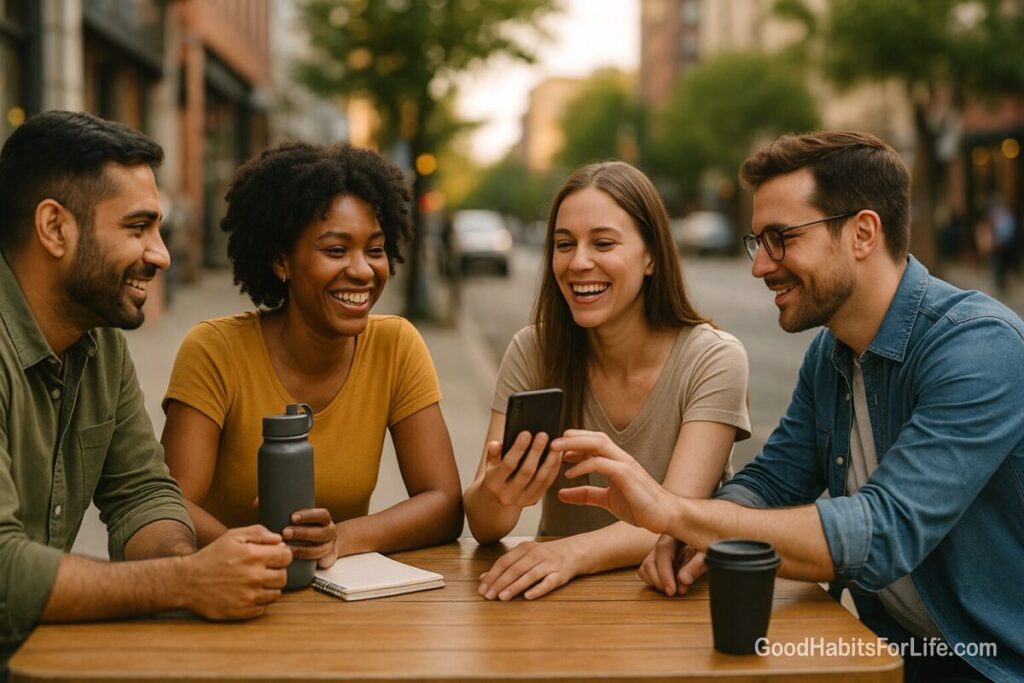
New City, New Circle: A 30Day Plan
New City, New Circle: 30-Day Plan to Make Friends
Table of Contents
🧭 What This Guide Covers & Why It Works
Moving resets your routines and your social graph. This guide gives you a practical, research-aligned roadmap to go from zero to a functioning local circle in 30 days. Strong social ties are consistently linked to better mental and physical health and even longevity; conversely, isolation and loneliness increase risks for depression, cardiovascular disease, and dementia. Harvard GazetteLiebert PublishingCDC+1
Two core truths to anchor your plan:
-
Friendship = hours together + positive interactions. Studies estimate ~50 hours to move from acquaintance to casual friend and 200+ hours for close friendship. You’ll accelerate that by planning repeated, low-friction contact. KU NewsSAGE Journals
-
Weak ties unlock opportunities. Casual connections broaden your reach and help you discover the people and places you’ll click with. Stanford NewsSNAP
✅ Quick Start: Your First 72 Hours
Day 1
-
Choose two “third places” (e.g., a climbing gym + a co-working café). Commit to fixed weekly times. Repetition triggers the mere-exposure effect—people warm up with repeated contact. PMC
-
Join one recurring group with attendance baked in (class, league, choir, language exchange).
Day 2
-
Create a “friendly bio” (one-liner you can reuse): “I just moved to ___ for ___; I’m into ___. Any favorite spots or groups I should know?”
-
RSVP to two events this week (Meetup/Eventbrite/club).
-
Message three locals (Bumble BFF/Nextdoor/FB Group/Slack) to set 15–45 min “get-coffee/walk” micro-meets.
Day 3
-
Go to your first event. Introduce yourself to three people using the 3-2-1 rule (3 intros, 2 follow-ups, 1 invite).
-
Send two invites for something specific and easy (“Sat 10:30 park walk; 25–30 mins?”).
🗓️ The 30-Day Plan (Week-by-Week)
Week 1: Plant Lots of Seeds
-
Attend 2 events and visit your two third places once each.
-
Try one volunteer shift (soup kitchen, park cleanup, tutoring).
-
Start a running notes file: names, one fact, next step.
Checkpoint: 10+ warm touches (smiles, intros, brief chats). Send 3 follow-ups (“Great to meet at ___—fancy a short coffee Wed or Thu?”).
Week 2: Repeat + Convert
-
Return to the same places at the same times. Repetition builds familiarity and trust. PMC
-
Host a low-stakes micro-hang (30–60 min): “bring-your-own beverage” bench chat, bookstore browse, dog-walk loop.
-
Ask for micro-help (“Which yoga studio do you like?”). People bond when they can help.
Checkpoint: 2–3 one-on-one meetups scheduled; 1 group activity locked.
Week 3: Broaden Weak Ties
-
Invite +1s: “Feel free to bring a friend.” You’ll tap into diverse networks (power of weak ties). Stanford News
-
Join one skill-based class (cook, code, climb, ceramics). Shared effort = faster bonding.
-
Start a small recurring thing: Saturday coffee crawl or “Wednesday 20-minute walk.”
Checkpoint: 15–20 hours logged across acquaintances; 1–2 people feel like early friends. SAGE Journals
Week 4: Stabilize Your Circle
-
Formalize one weekly ritual with 2–4 people (run club, quiz night, Sunday batch-cook).
-
Do something pro-social (host a swap, organize a park cleanup, lift-share to a hike).
-
Create a lightweight group chat (“New City Coffee Walkers”) to keep momentum.
End of 30 Days: You should have a starter circle (4–8 friendly regulars) and 1–2 people trending toward “good friend,” plus a predictable weekly rhythm. Remember: deep friendship still takes more hours—keep the cadence. SAGE Journals
🧠 Techniques & Frameworks That Speed Connection
The “RRP” Loop: Repeat, Reveal, Plan
-
Repeat contact in the same contexts (mere exposure). PMC
-
Reveal a little more each time (interests, routines, goals).
-
Plan the next micro-meet before ending the current one.
The “3-2-1 Social Rule”
-
3 introductions per event.
-
2 follow-ups within 24–48 hours.
-
1 concrete invite with time/place.
“Weak-Tie Webbing”
-
Ask warm acquaintances for intros (“Anyone else I should meet?”). Weak ties connect you into new clusters. Stanford News
“Ritual > One-Off”
-
Join/host things that recur (weekly game night, Tuesday run). Recurrence compounds hours toward meaningful friendship. KU NewsSAGE Journals
“Help-Ask-Offer”
-
Ask advice about the city; offer help (spare boxes, pet-sit list). Mutual aid builds trust and belonging.
👥 Variations by Life Stage
Students
-
Focus on campus orgs, study groups, intramurals.
-
Use department and dorm chats; sit in the same spot each week to trigger casual greetings → chats → plans.
Professionals
-
Try industry meetups, co-working lunches, after-work classes.
-
Set a standing “walk-n-talk” near your office (20 minutes, same route).
Parents
-
Playground loops at the same times; swap numbers after a quick chat.
-
Join school WhatsApp/PTA; propose “park picnic hour” after pickup.
Seniors
-
Look for senior centers, community colleges (audit classes), faith/community groups. Regular social contact protects health—treat it like a prescription. National Academies Press
⚠️ Mistakes & Myths to Avoid
-
Myth: “If it’s meant to be, it’ll happen.”
Reality: Friendship is scheduled. Put “social reps” on your calendar. KU NewsSAGE Journals -
Mistake: Over-optimizing the perfect event; under-showing-up.
Fix: Any recurring group beats a “maybe perfect” one-off. -
Myth: “I need lots of deep friends immediately.”
Reality: Start with weak ties and let a few deepen over time. Stanford News -
Mistake: Skipping follow-ups.
Fix: Message within 24–48 hours with a specific invite.
🗣️ Real-Life Scripts (Copy-Paste Friendly)
Warm Intro (event/class):
“Hey! I’m [Name]—just moved to [Area] for [work/study]. I’m trying a few local things. What brings you here?”
Follow-Up (24–48 hrs):
“Great chatting at [event]. I’m grabbing a quick [coffee/walk] near [place] on [Wed 6:15 pm/Thu 8:10 am]—want to join for ~25 minutes?”
Bring-a-Friend Invite:
“I’m checking out [quiz night/climbing intro] on Sat. Come along—and feel free to bring a friend.”
Neighbor DM (Nextdoor/FB Group):
“New to [neighborhood] and exploring running routes. Anyone up for a 3–4 km easy loop this weekend?”
Gracious Decline (keep door open):
“Timing’s rough this week, but I’d love to try [alt plan] next [Tue lunch/Thu walk].”
🛠️ Tools, Apps & Resources (Pros/Cons)
-
Meetup / Eventbrite — Huge range; easy discovery. Con: variable quality—try 2–3 groups before judging.
-
Bumble BFF — One-to-one intros; good for quick coffees. Con: quick drop-offs—follow up fast.
-
Nextdoor / Local FB Groups — Hyperlocal tips & neighbors. Con: notifications can be noisy—mute and curate.
-
VolunteerMatch / Local NGOs — Purpose-driven bonding. Con: fixed shifts may limit flexibility.
-
Sports/Rec Leagues & Classes (climbing, dance, pottery, choir, language) — Built-in repetition. Con: fees; sample free trials.
-
Coworking Spaces — Structured mingling. Con: cost—try day passes or community hours.
📅 Habit Plan: 30-60-90 Roadmap
Days 1–30 (Build the Base)
-
2 events/week + 2 third-place visits.
-
3 follow-ups/week + 1 micro-hang hosted.
Days 31–60 (Deepen & Design)
-
Keep the cadence; convert 2 acquaintances into “good friends” via weekly 60–90 min activities. Aim ~15–30 additional hours together. SAGE Journals
-
Add one ritual (Sun potluck, Thu run).
Days 61–90 (Stabilize & Spread)
-
Create a small group chat (4–8 people).
-
Host a monthly anchor (board-game night, hike).
-
Ask each friend for one introduction (weak-tie expansion). Stanford News
📚 Key Takeaways
-
Show up repeatedly in the same places; let familiarity work for you. PMC
-
Track hours with people you like; depth comes from time + shared effort. SAGE Journals
-
Nurture weak ties to discover “your people” faster. Stanford News
-
Small, steady actions beat rare, big social pushes.
-
Protect wellbeing: meaningful connection is a health habit. CDC
❓ FAQs
1) How long does it really take to make friends after moving?
Often weeks to months. Research suggests ~50 hours for casual friendship and 200+ for close friendship—schedule repeated contact. KU News
2) I’m introverted. What’s the least awkward path?
Choose structured, small-group activities (classes, volunteer shifts) and 1-to-1 coffees. Use scripts and short (20–30 min) “test hangs.”
3) What if my city feels cliquey?
Switch venues and leverage weak ties: ask friendly acquaintances for one intro or join a hobby-specific group. Stanford News
4) I’m busy—can I do this in under 3 hours/week?
Yes: one event (60–90 min), one third-place visit (30–60 min), and two brief coffees/walks (2×20–30 min). Prioritize recurring options.
5) How do I keep momentum after the first meet?
Follow up within 24–48 hours with a concrete invite and propose a next date before ending the current meetup.
6) Is online-only socializing enough?
Online helps discovery, but in-person hours build closeness; use digital to bridge between recurring offline activities. SAGE Journals
7) I feel lonely and it’s affecting my mood—what should I do?
Start with small, regular contact (class/volunteer). If mood or functioning suffers, consult a qualified professional; isolation can affect health. CDC
8) What’s one high-leverage move this week?
Pick one weekly ritual (e.g., Tuesday run) and invite two people; tell them it’s recurring.
📖 References
-
Hall, J.A. How many hours does it take to make a friend? Journal of Social and Personal Relationships (2019). SAGE Journals
-
University of Kansas News. Study reveals number of hours it takes to make a friend (2018). KU News
-
CDC. Health Effects of Social Isolation and Loneliness (2024). CDC
-
MMWR (CDC). Loneliness and Lack of Social and Emotional Support (2024). CDC
-
Harvard Gazette. Over nearly 80 years… relationships and healthy life (2017). Harvard Gazette
-
Hart, J. et al. Harvard Study of Adult Development—Human Connection (2023). Liebert Publishing
-
Stanford Report. The strength of weak ties (2023 overview of Granovetter). Stanford News
-
Granovetter, M. The Strength of Weak Ties (1973). SNAP
-
Yagi, Y. et al. Contribution of Attention to the Mere Exposure Effect (2018). PMC
-
National Academies (NASEM). Social Isolation and Loneliness in Older Adults (2020). National Academies Press
Disclaimer: This guide is for general information and is not a substitute for professional mental-health advice.