
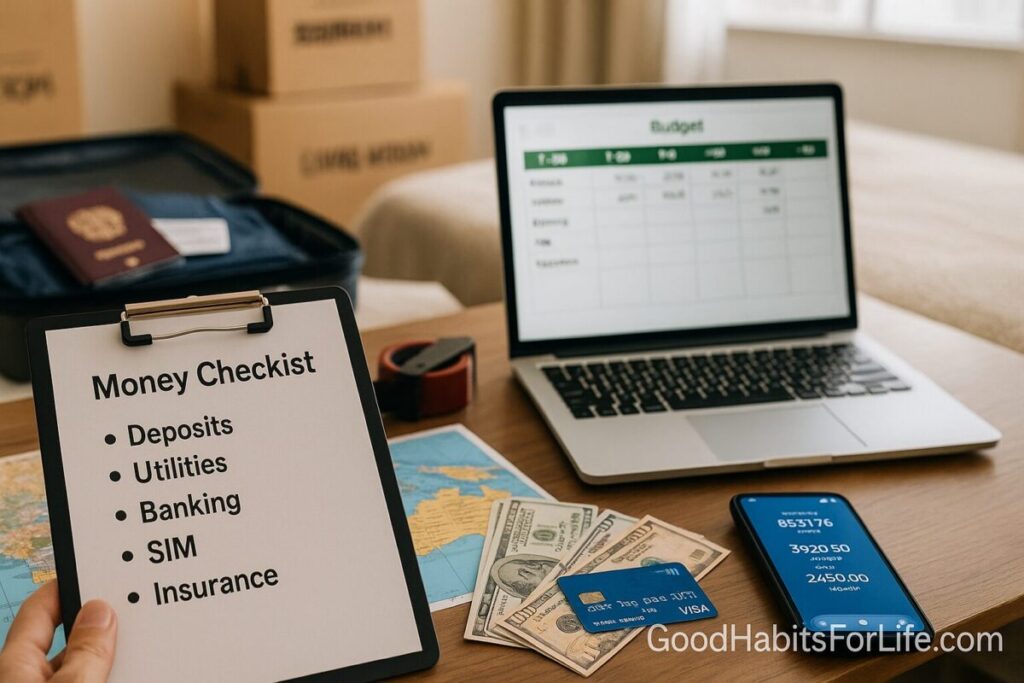
Moving Cities or Countries: Money Checklist: No-Spend Challenge (2025)
Moving Cities/Countries: Money Checklist 2025 (No-Spend)
Table of Contents
🧭 What & Why: A Money Checklist + No-Spend Sprints
What it is: A structured, step-by-step finance plan for moving home—across town or across borders—paired with a focused no-spend challenge (short, time-boxed spending freeze on non-essentials) to build a cash moat before, during, and after the move.
Why it works:
-
Moving concentrates a lot of one-off expenses in a short window. A checklist prevents “drip-drain” costs—from duplicate utilities to surprise fees.
-
Short, time-bound no-spend sprints leverage behavioral science (pre-commitment, implementation intentions, and friction) to lift savings rapidly and reduce decision fatigue.
-
When crossing borders, costs are amplified by exchange rates, transfer fees, and setup deposits. Getting multi-currency and banking steps right can save meaningful money.
Benefits you’ll see:
-
Clear, phased plan from T-90 days to +90 days
-
Lower fees and quotes, fewer “gotchas”
-
Faster cash build through no-spend + zero-based budgeting
-
Smoother cross-border tasks (banking, remittances, proofs, tax, health cover)
✅ Quick Start: Do This Today
-
Freeze the leaks (30–90 days): Launch a no-spend sprint on all wants—eating out, new clothes, subscriptions, gadgets. Keep only true needs + essential moving items.
-
List the Big Five:
-
Security deposits & overlapping rent/EMIs
-
Movers/shipping/storage & insurance
-
Travel & temporary stays (e.g., hotels, short lets)
-
Setup: utilities, broadband, SIM, transit passes, furniture basics
-
Buffer fund (minimum 1–2 months essential expenses)
-
-
Get 3 quotes per vendor: Movers, storage, cleaners, painters, internet, etc. Ask for itemized, all-in quotes with caps.
-
Start a moving folder: IDs, visas, tax numbers, proof of address, bank letters, employment/offer letters, insurance.
-
Open/prepare accounts:
-
Domestic move: Local bank in new city (if different bank coverage), mobile wallets, transit card.
-
International move: Low-fee transfer/multi-currency options, confirm receiving bank details, plan first paycheque route.
-
-
Audit recurring bills: Mark cancel/port/switch. Use the scripts below.
-
Zero-based budget: Give every rupee (or local currency unit) a job for the next 90 days.
🗺️ The Moving Money Checklist by Phase
T-90 to T-61 Days
-
Budget scenario-plan (base, stretch, worst case).
-
No-spend sprint starts (target 10–30% monthly spend cut).
-
Declutter & sell (marketplaces, donation).
-
Documents & IDs: Renewal windows, international driving permit (if needed), bank KYC updates.
-
School/childcare deposits (if moving with kids).
-
Health: Refill meds, get copies of records/prescriptions.
-
International: Check visa/permit timelines; research banking, remittance, and mobile plans; understand local proof-of-address norms.
T-60 to T-31 Days
-
Lock vendors: Movers/storage/cleaners. Demand in-writing caps.
-
Housing overlap math: Negotiate pro-rata, early access, or late checkout to reduce double-paying.
-
Utilities & internet: Schedule disconnect + connect dates; check installation fees/waivers.
-
Insurance: Renters/home contents in both places (gap cover).
-
International: Open multi-currency account, test a small transfer, prepare SIM/eSIM for arrival, shortlist local banks.
T-30 to T-8 Days
-
Pack & label (inventory photos for claims).
-
Address changes: Banks, payroll/HR, tax, insurance, subscriptions, loyalty programs, postal forwarding (where available).
-
Emergency kit: 2–4 weeks of essentials in carry-on: documents, meds, basic utensils, work gear.
-
Sell/transfer memberships (gym, clubs).
-
Goodbye fees: Check exit charges (break fees, cleaning).
-
International: Notify home-country bank of travel, set low ATM limits, enable app/mobile OTP options.
Move Week
-
Final meter readings & photos; share with landlords/utility firms.
-
Settlement checklist: Keys, deposits, condition reports.
-
Spending guardrails: Daily cap on food/ride-hail.
-
International: Use fee-aware payment route; avoid dynamic currency conversion (DCC).
+1 to +30 Days Post-Move
-
Batch setup days: Utilities, internet, local SIM, transit card, bank account (if needed).
-
Map new recurring costs: Update budget; cut duplicates immediately.
-
Employer payroll: Confirm tax codes/residency forms.
-
Emergency fund: Top up to 1–2 months essentials (3–6 months if possible).
-
International: Register with local authorities if required, confirm health cover, verify first pay hits correct account.
+31 to +90 Days
-
Review quotes vs actuals; file claims if any.
-
Extend/relax no-spend selectively (e.g., home basics fund).
-
Optimize bills: Switch broadband/energy if promo periods allow.
-
Taxes: Note residency changes, keep moving receipts for employer reimbursements/allowances if applicable.
📦 Cost Map: What to Budget (and How to Estimate)
Use this structure to avoid nasty surprises:
| Cost Bucket | What’s Inside | Estimation Tips |
|---|---|---|
| Housing overlap | Double rent/EMI days, deposits, agent fees | Aim for ≤ 2 weeks overlap; negotiate pro-rata or early access |
| Movers/storage | Packing, insurance, stairs/long carry, storage | Get 3 itemized quotes; cap extras; insure valuables |
| Travel & stays | Flights/train, hotel/short let, ride-hail | Book mid-week; carry snacks; set a daily cap |
| Setup & utilities | Internet install, energy deposit, SIM, basic furniture | Ask for install fee waivers; buy used/refurb where safe |
| Admin & docs | IDs, permits, notary, mail forwarding | Group appointments to cut transport/time costs |
| Buffer fund | 1–2 months essentials minimum | Grow via no-spend + selling/donating clutter |
Cross-border add-ons:
-
Transfer/FX fees, new-country deposits, international health cover, first tax consult, school admissions, immigration fees.
How to estimate fairly:
-
Use zero-based budgeting and a PPP/Cost-of-Living comparator to sanity-check local prices.
-
Run a 10%–20% contingency line item for slippage.
🧠 Techniques & Frameworks That Work
-
Zero-Based Budgeting (ZBB): Every unit of currency has a job before the month starts.
-
Envelope/Digital Jars: Ring-fence money for movers, setup, and buffer so you don’t tap it.
-
Implementation Intentions (“If X, then Y”):
-
If I get a new quote, then I ask for a price match and fee waiver.
-
If I’m tempted to buy décor, then I wait 72 hours and check the budget.
-
-
Pre-commitment: Announce the no-spend sprint to a friend or on a shared tracker.
-
Temptation Bundling: Pair tedious admin (utilities calls) with something pleasant (coffee/walk).
-
Fresh-Start Dates: Kick off sprints on a Monday, 1st of the month, or move-in day to harness momentum.
-
Rule of Three Quotes: Movers, storage, cleaners, and internet—always three, always itemized.
👥 Variations: Students, Professionals, Parents, Seniors, International
-
Students: Hunt student-only deals; consider furnished rooms; share broadband; use campus help for bank accounts and SIMs.
-
Professionals: Ask HR about relocation allowances, reimbursements, or tax-advantaged benefits; negotiate hybrid start dates to cut overlaps.
-
Parents: Budget for school deposits/uniforms; batch childcare transitions; keep a “kid kit” (meals/activities) to avoid last-minute spending.
-
Seniors: Check prescription transfer rules; consider movers with packing/unpacking support; verify accessibility costs early.
-
International:
-
Prepare multi-currency + low-fee transfer routes.
-
Understand proof-of-address requirements (banking, SIM, utilities).
-
Verify health coverage bridging (travel insurance vs local enrollment).
-
Track residency/tax notifications and deadlines.
-
⚠️ Mistakes & Myths to Avoid
-
Myth: “No-spend means buy nothing.” → It means no non-essentials, while pre-funding true move needs.
-
Mistake: Paying mover quotes without caps. → Demand line-items and ceiling prices.
-
Mistake: Over-buying furniture now. → Start with essentials; add slowly after 30 days.
-
Myth: International banking is the same as domestic. → FX/transfer fees and verification rules can add real costs.
-
Mistake: Forgetting to cancel/port bills. → Use the scripts and a single “cancel day.”
-
Myth: “I’ll remember every address change.” → Use a checklist + calendar blocks.
💬 Real-Life Scripts (Copy/Paste)
1) Movers Quote Negotiation
“Hi [Name], thanks for the itemized quote. Before I confirm, can you match [Competitor] at ₹[x]/$[x] and include insurance + taxes, capped at that total? If not, is there a returning-customer or weekday discount you can apply?”
2) Landlord on Overlap
“To avoid double rent, could we do a pro-rata for [x] days or allow early evening access on [date]? I’ll share meter photos and a cleaner invoice.”
3) Internet Installation Fee Waiver
“I’m choosing between providers this week. If you can waive the install/activation fee and confirm promo pricing for 12 months, I’ll sign today.”
4) Subscription Cancellation
“Please cancel [service] effective [date]. Confirm no further charges and a pro-rata refund if applicable.”
5) Bank/FX Fees Ask
“I’m moving abroad and expect higher transfers this quarter. Can you upgrade me to the low-fee tier or waive international transfer fees for 90 days?”
🧰 Tools & Apps (Pros/Cons)
Examples only; compare fees and local availability.
-
Budgeting: YNAB-style (ZBB), PocketGuard, simple spreadsheets
-
Pros: Clear allocations; good for sprints. Cons: Learning curve if new.
-
-
Marketplaces (sell/used): Local classifieds, Facebook Marketplace, credible refurb stores
-
Pros: Cash in; eco-friendly. Cons: Time/quality checks.
-
-
Money transfer & multi-currency: Bank transfer, fintech multi-currency accounts, brokered FX
-
Pros: Potentially lower fees and better rates; fast. Cons: Verification; limits.
-
-
Checklists & docs: Notion, Trello, Google Drive, password managers
-
Pros: Centralize everything. Cons: Setup time.
-
-
Bill switching: Comparison sites, energy/broadband switchers
-
Pros: Quick savings. Cons: Promos expire—calendar it.
-
🗓️ 30-60-90 No-Spend Roadmap
Days 0–30: Sprint & Stockpile
-
Freeze non-essentials (eating out, new clothes, décor, gadgets).
-
Automate transfers to a “Move Fund” the day income hits.
-
Sell unused items; log proceeds to the Move Fund.
-
Admin batch: Quote movers, book install dates, cancel/port subscriptions.
-
Target: Save 10–20% of typical monthly spend.
Days 31–60: Move & Install
-
Stick to daily caps for food/transport.
-
Buy only essentials (bed, work chair, basic kitchen).
-
Track actuals vs quotes; push back on overages.
-
International: Use low-fee routes; avoid DCC at card terminals/ATMs.
-
Target: Keep total move costs within budget + contingency.
Days 61–90: Stabilize & Optimize
-
Review bills; switch to better tariffs/plans.
-
Re-open small treats (e.g., one weekly meal out) inside a revised budget.
-
Rebuild emergency fund to 1–2 months (aim 3–6 months over time).
-
Declutter phase 2: Sell what you didn’t need after all.
-
Target: Settle recurring spend at or below pre-move level.
📌 Key Takeaways
-
A move is a project: scope it, budget it, and phase it.
-
No-spend sprints build your cash moat fast and keep focus.
-
Cross-border moves require banking/FX prep and residency/tax awareness.
-
Lock three quotes, demand caps, and document everything.
-
Zero-based budgeting turns chaos into a plan you can execute.
❓FAQs
1) How long should a no-spend challenge be for a move?
30–90 days works best. Shorter sprints boost motivation; longer runs (60–90) fund buffers and deposits.
2) What counts as “essential” during a moving no-spend?
Rent/EMI, utilities, groceries, transport, medical, child/school costs, and move-specific services (movers, boxes, install fees). Everything else pauses.
3) Is cash or card better during an international move?
Carry a small cash starter, but prefer fee-aware cards and low-fee transfers. Avoid dynamic currency conversion at terminals/ATMs.
4) How big should my buffer be?
Aim for 1–2 months of essential expenses before/just after moving; rebuild to 3–6 months later.
5) Should I buy furniture now or later?
Later. Start with essentials; reassess after 30 days to avoid mismatched sizes and impulse buys.
6) How do I avoid surprise mover fees?
Get itemized quotes, set caps, disclose stairs/parking/walk distances, and confirm insurance/exclusions in writing.
7) What if I’m waiting on my first paycheque in a new country?
Bring a cash cushion, confirm employer payroll timelines, and set up a receiving account in advance (or multi-currency route).
8) Do I need postal forwarding?
If available in your country, yes—use it temporarily while you update addresses with banks, payroll, and services.
📚 References
-
OECD. Purchasing Power Parities (PPP) and real expenditures. https://stats.oecd.org/
-
World Bank. Remittance Prices Worldwide (RPW). https://remittanceprices.worldbank.org/
-
European Commission. SEPA (Single Euro Payments Area) – payments in Europe. https://commission.europa.eu/
-
GOV.UK. Check what you need to do when moving or retiring abroad. https://www.gov.uk/
-
CFPB (U.S.). Sending money & minimizing fees; closing and managing accounts. https://www.consumerfinance.gov/
-
FMCSA (U.S. Dept. of Transportation). Protect Your Move (movers, estimates, disputes). https://www.fmcsa.dot.gov/protect-your-move
-
APA. Implementation Intentions & Goal Pursuit (overview of research). https://www.apa.org/
-
Milkman, K. L., et al. The Fresh Start Effect. Management Science. (For timing behavior-change attempts.)
Disclaimer
This guide is educational and not financial, tax, or legal advice; confirm details with your bank, employer, and local authorities before acting.