
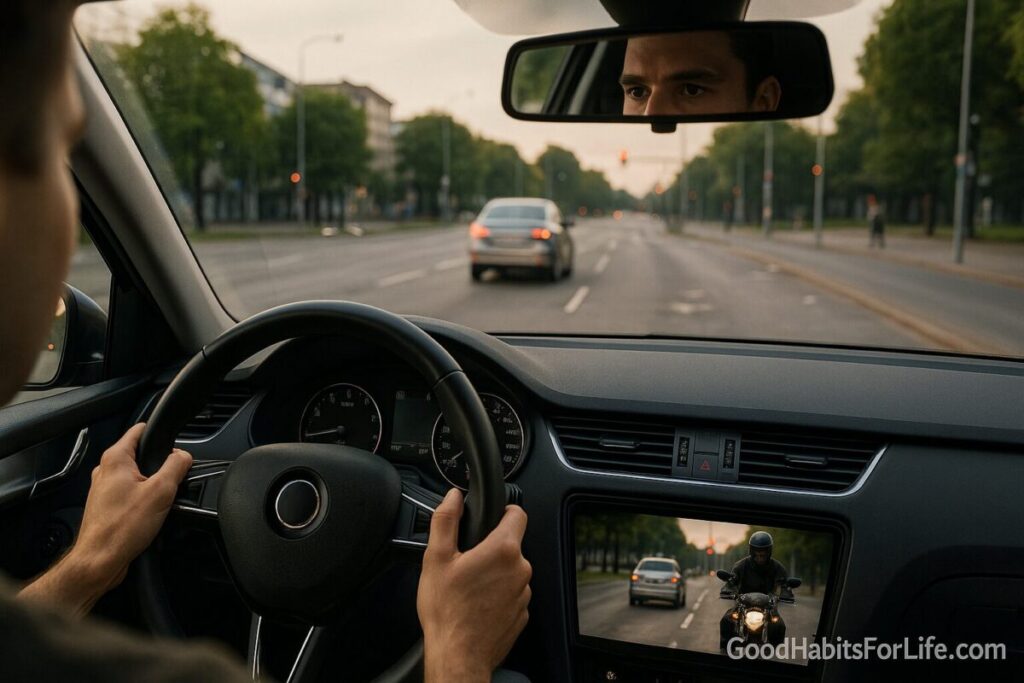
Motorcycle to Car: Skill Transfers that Help
Motorcycle to Car: Skill Transfers that Help
Table of Contents
🧭 What & Why
If you’ve spent time on two wheels, you already practice habits that many car drivers never learn: scanning far ahead, reading subtle surface changes, maintaining a space cushion, and assuming you’re less visible. Those “motorcyclist instincts” are gold when you switch to a car.
Why it matters: motorcyclists are consistently overrepresented in road deaths, largely because bikes are smaller and harder to detect. That exposure trains riders to anticipate threats earlier—a superpower behind the wheel of a car. IIHS Crash TestNHTSA
Research shows that hazard perception—spotting developing risks early—predicts crash risk and improves with training and experience. Bringing that rider-honed skill to car driving reduces surprises and keeps decision time high. SAGE JournalsScienceDirect
There’s also the well-documented “looked-but-failed-to-see” effect (LBFTS/SMIDSY): drivers may look but still miss smaller road users. Riders know this and drive accordingly—an attitude that protects everyone when you’re in a car. PMCAssociation for Psychological Science
✅ Quick Start: Do This Today
-
Adopt SEE on four wheels. At every junction: Search widely, Evaluate who can hurt you (and whom you could hurt), Execute with smooth, early signals. Motorcycle Safety Foundation
-
Mirror rhythm: 6–10 seconds. Scan rearview → left → road far → right; reset after any speed change or turn.
-
Two escape routes rule. At any speed, know two places you can steer/brake to if someone does something dumb.
-
Space cushion math. Keep 3–4 seconds dry (5+ in rain), extend if boxed in or tailgated.
-
Headlights on / DRL check. Be conspicuous; position the car to be seen (offset in the lane at junctions).
-
Narrate hazards for 5 minutes/day. On a familiar route, softly narrate: “van could merge… pedestrian near curb…”. That’s rider-grade situational awareness in a car.
-
Courtesy habit. Signal early (at least 3 flashes before moving), wave thanks, and leave room for bikes and cyclists.
🛠️ 30–60–90 Day Habit Plan
Days 1–30 — Foundations
-
Daily: mirror rhythm, SEE at every junction, narration on 1 stretch.
-
Weekly: review one dashcam clip (yours or public) to practice hazard spotting.
-
Metric: ≤1 surprise per trip (you noticed most hazards early).
Days 31–60 — Control & Positioning
-
Daily: practice smooth inputs (steady throttle, early lift, progressive brake).
-
Twice/week: choose a complex merge or roundabout and rehearse escape routes before entering.
-
Metric: braking events >0.4 g drop by 25% (most phones/dashcams show this).
Days 61–90 — Advanced Awareness & Courtesy
-
Daily: protect vulnerable users (leave 1.5 m when passing cyclists; 3 ft minimum).
-
Weekly: one blind-spot drill session (mirror set + shoulder check sequence).
-
Metric: zero horn-use “anger taps”; substitute space and timing for escalation.
🧠 Techniques & Frameworks that Transfer
SEE (Search–Evaluate–Execute)
-
Search: expand your visual cone; check 12–15 s ahead in city, 20–30 s on highways.
-
Evaluate: who has right-of-way and who might violate it; anticipate LBFTS at turns.
-
Execute: early signal, gentle speed adjustment, lane position for sight lines. Motorcycle Safety Foundation
Hazard Perception Drills
-
Click-timing practice: Videos that train you to spot developing hazards early are used in official tests. Learn what “developing” looks like (pedestrian pivoting, wheels rolling at a junction, brake lights two cars ahead). GOV.UK
-
Narrated drives: keep it quiet, but verbalizing keeps your scanning active.
Blind-Spot & Conspicuity
-
Set mirrors to barely show your car’s flanks; shoulder check before lateral moves.
-
At junctions, move your head/vehicle slightly to change viewing angle—riders do this to break visual camouflage.
Smooth Control = Spare Grip
-
Riders respect traction; bring that to cars: progressive brake, no last-second lunges, no snap steering.
-
Trust ABS as a safety net, not a plan; straight-line brake in emergencies to preserve steering.
📊 Skill-Transfer Map (Rider → Driver)
| Rider Habit | Car Skill Transfer | What to Do Behind the Wheel |
|---|---|---|
| Lane positioning for sight lines | Lane offset for visibility | Avoid sitting directly behind A-pillars; offset within lane to see and be seen. |
| Space cushion | Time-gap management | 3–4 s dry, 5+ wet; add 1 s for heavy vehicles ahead. |
| “Always an escape” | Emergency options | Identify left/right shoulder gaps; prefer brake then steer if needed. |
| Head-on threat sensitivity | Closing-speed awareness | Watch two vehicles ahead; brake early to flatten traffic waves. |
| Surface scanning | Grip management | Treat shiny patches, paint, leaves like low-grip zones, especially when turning. |
| ATGATT mindset (gear) | Passive safety checks | Belt + headrest height; secure cargo; clear windshield inside/out. |
| Be seen | Conspicuity positioning | Lights on/DRL; avoid hiding behind tall vehicles at junctions. |
👥 Audience Variations
-
Students & new drivers: practice narration and the hazard-video “click” drill 10 min/day for two weeks.
-
Professionals with long commutes: prioritize fatigue cues (yawns, zoning, tailgating). Insert 2-minute stretch + water stops every 90 minutes.
-
Parents: model courtesy—kids mimic. Announce your SEE steps at tricky junctions.
-
Seniors: extend following gaps by +1–2 s; schedule complex trips (night/rain) only when fresh.
-
Motorcyclists still riding: drive like you’re “protecting” riders—buffer them at merges and left turns.
⚠️ Mistakes & Myths to Avoid
-
Myth: “I’m in a car; I’m safer, so I can relax.”
Reality: complacency erases the rider edge; keep scanning. -
Mistake: treating ABS/ESC as a license to brake late.
Fix: ride/drive your plan, not your hardware. -
Myth: “If I looked, I saw.”
Reality: LBFTS is real; move your head, pause, and re-scan at junctions. PMC -
Mistake: sitting centered behind an SUV’s pillars.
Fix: offset to regain sight lines.
💬 Real-Life Examples & Scripts
-
Left-turn at a busy junction:
Script: “Search right–left–right, wheels rolling on cross traffic, pedestrian at island; Evaluate gap + tailgater behind; Execute early signal, creep for view, commit only with 3-second buffer.” -
Highway merge:
Script: “Mirror–signal–shoulder; Identify truck’s blind zone; choose early merge or lift 5 km/h to slot behind; escape route to shoulder if boxed.” -
Roundabout:
Script: “Eyes to entry, then to exit; offset for view; keep escape to center lane if cut off; no late lane changes.”
🧰 Tools, Apps & Resources (quick picks)
-
Hazard-perception practice clips (free/paid): train early click timing and scanning flow. GOV.UK
-
Dashcam: review your own near-misses weekly; tag lessons learned.
-
MSF SEE one-pager: keep it in your glovebox; reread monthly. Motorcycle Safety Foundation
-
IIHS & NHTSA topic hubs: periodic reality checks on risk trends and countermeasures. IIHS Crash TestNHTSA
📌 Key Takeaways
-
Bring your rider vigilance to car driving: SEE, scan, and give yourself time/space.
-
Use mirror cadence and escape-route planning on every trip.
-
Protect vulnerable road users; your rider empathy makes you a calmer, safer driver.
-
Train hazard perception with short, regular practice—small reps, big payoffs. SAGE Journals
❓ FAQs
1) Do rider habits really reduce car crashes?
Better hazard perception and earlier decisions are linked to lower crash involvement; rider training sharpens both and carries over to cars. SAGE JournalsScienceDirect
2) What’s the fastest way to improve my awareness in a car?
Adopt SEE, set a 6–10 s mirror rhythm, and narrate hazards for 5 minutes/day. Motorcycle Safety Foundation
3) How do I avoid “I looked but didn’t see” errors?
Pause an extra beat at junctions, move your head/vehicle for a new angle, and expect small road users; LBFTS is common. PMC
4) Are ABS and modern car aids a substitute for rider-style caution?
No. They’re safety nets; keep margins wide and inputs smooth.
5) Any quick courtesy wins that matter?
Signal early, yield generously, and guard extra space for motorcyclists and cyclists—your rider empathy saves frustration and risk.
📚 References
-
National Highway Traffic Safety Administration (NHTSA). Motorcycle Safety. https://www.nhtsa.gov/road-safety/motorcycles NHTSA
-
Insurance Institute for Highway Safety (IIHS). Motorcycles. https://www.iihs.org/research-areas/motorcycles IIHS Crash Test
-
World Health Organization. Powered Two- and Three-Wheeler Safety (2nd ed.). https://www.who.int/publications/b/61256 World Health Organization
-
Motorcycle Safety Foundation (MSF). Why it Helps to SEE. https://msf-usa.org/see/ Motorcycle Safety Foundation
-
UK Government (DVSA). Theory Test: Hazard Perception. https://www.gov.uk/theory-test/hazard-perception-test GOV.UK
-
Horswill, M. S. (2016). Hazard Perception in Driving. Current Directions in Psychological Science. https://journals.sagepub.com/doi/abs/10.1177/0963721416663186 SAGE Journals
-
Horswill, M. S., et al. (2020). Scores on a new hazard prediction test… Transportation Research Part F. https://www.sciencedirect.com/science/article/abs/pii/S1369847819308010 ScienceDirect
-
Wolfe, J. M. (2022). Normal blindness: when we look but fail to see. Psychonomic Bulletin & Review (PMC). https://pmc.ncbi.nlm.nih.gov/articles/PMC9378609/ PMC
-
Association for Psychological Science. Motorcycles are missed because drivers aren’t looking for them. https://www.psychologicalscience.org/news/motr/motorcycles-are-missed-because-drivers-arent-looking-for-them.html Association for Psychological Science
-
NHTSA. Countermeasures That Work — Motorcycle Safety. https://www.nhtsa.gov/book/countermeasures-that-work/motorcycle-safety NHTSA