
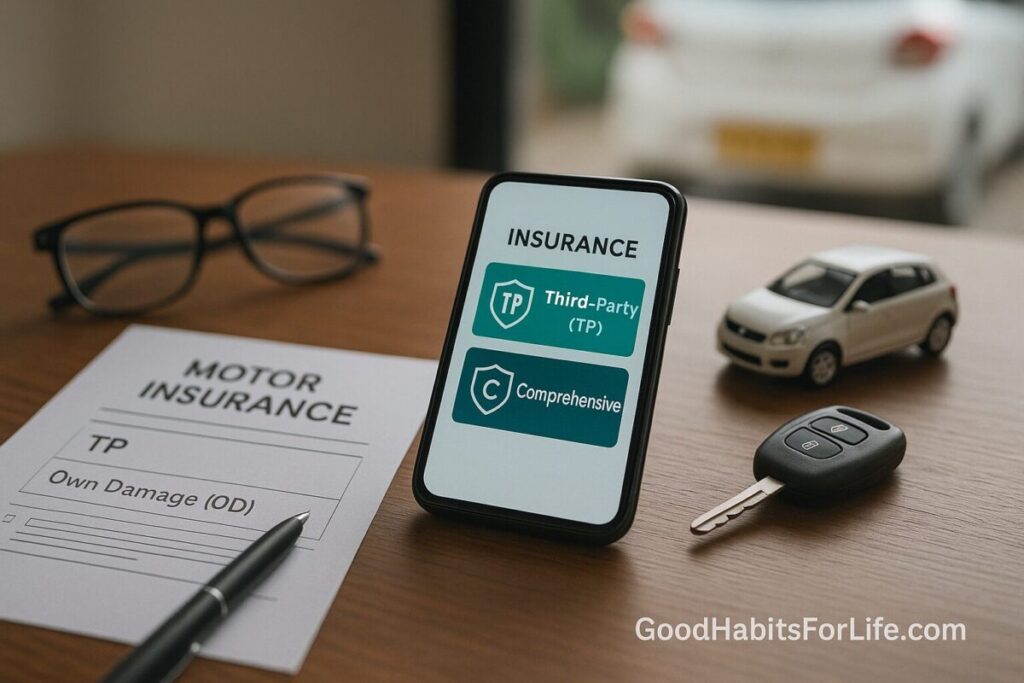
Motor Insurance 101: ThirdParty vs Comprehensive: No-Spend Challenge (2025)
Third-Party vs Comprehensive: No-Spend Motor Insurance
Table of Contents
🧭 What This Guide Covers & Why It Matters
Goal: help you choose between third-party and comprehensive motor insurance—quickly, safely, and cost-effectively.
-
Third-party (TP): Covers legal liability if your vehicle injures a person or damages someone else’s property. It’s mandatory for all vehicles on Indian roads.
-
Comprehensive (Package): TP + Own-Damage (OD) for your vehicle (accident, fire, theft, natural disasters). You can also buy Standalone OD if you already have valid TP.
Why it matters: The right cover shields you from large liabilities and predictable repair bills—and the right settings (IDV, NCB, deductibles, add-ons) can lower total cost without compromising protection.
✅ Legal Must-Know (India, 2025)
-
Mandatory: Under Section 146, Motor Vehicles Act, 1988, TP cover is compulsory for vehicles plying on public roads. Penalties apply for non-compliance.
-
Penalties: Driving without valid insurance can attract ₹2,000 for a first offence (and/or up to 3 months’ imprisonment) and ₹4,000 for subsequent offences.
-
Policy terms for new vehicles: New cars must carry 3-year TP at purchase; new two-wheelers must carry 5-year TP (OD remains annual).
-
Customer-friendly reforms (2024): Insurers are to offer “Pay as/How you drive” usage-based options as a prominent choice and settle motor claims faster (e.g., within 7 days of the final survey report, per regulator guidance).
-
Owner-Driver Personal Accident (PA): Minimum PA of up to ₹15 lakh is available (can be purchased separately if not bundled).
Bottom line: You cannot skip TP. Consider comprehensive or OD add-ons based on your vehicle’s age, usage, location risks, and budget.
🧠 Coverage at a Glance: Third-Party vs Comprehensive vs Standalone OD
| Feature / Risk | Third-Party Only | Comprehensive (TP + OD) | Standalone OD (with valid TP) |
|---|---|---|---|
| Legal liability to others (injury/death) | ✅ Yes (unlimited for injury/death as per law) | ✅ Yes | ❌ Needs a separate TP |
| Third-party property damage | ✅ Yes (policy-specified limits) | ✅ Yes | ❌ Needs TP |
| Damage to your vehicle (accident, fire, theft, natural calamities) | ❌ | ✅ | ✅ |
| Add-ons (zero-dep, engine, RSA, etc.) | ❌ | ✅ | ✅ |
| Meets legal requirement | ✅ | ✅ | ❌ (until TP active) |
| Who should pick | Older low-value vehicles where repairing/replacing is trivial vs premium | Newer, financed, high-value, or flood-prone usage | If TP is already in force and you want flexible OD |
Rule of thumb:
-
New or valuable car / frequent city/highway use / flood-prone area: Prefer comprehensive + targeted add-ons.
-
Very old, low IDV vehicle: TP may suffice if you can self-fund repairs/replacement; otherwise consider minimal OD.
🛠️ What Drives Your Premium (and How to Tweak It)
1) IDV (Insured Declared Value). The market value proxy for your vehicle used to calculate OD premium.
-
Higher IDV = higher premium but larger payout on total loss/theft.
-
Choose a realistic IDV (not inflated, not under-stated).
2) No-Claim Bonus (NCB). Discount on OD premium for claim-free years: 20% → 25% → 35% → 45% → 50% (max).
-
Protect NCB by avoiding small claims—repair minor dents yourself when cheaper than losing NCB.
-
NCB belongs to you, not the car; transferable on renewal/moving insurers.
3) Deductibles.
-
Compulsory deductible (fixed by class/cc).
-
Voluntary deductible (you opt to pay more per claim) can cut premiums—choose an amount you can actually afford at claim time.
4) Add-ons. Each adds cost; buy only what reduces your real risk (see next section).
5) Usage-based options. Pay-as-you-drive / Pay-how-you-drive can lower premiums for low-mileage or safe driving patterns.
6) Risk-linked discounts. ARAI-approved anti-theft devices, membership of recognised automobile associations, and age/location/garage factors may reduce OD premiums.
📚 Add-Ons That Actually Help (When to Buy, When to Skip)
High-value / <5-year vehicles
-
Zero-Depreciation (aka “bumper-to-bumper”): Insurer doesn’t deduct parts depreciation on approved repairs. Great for newer cars; typically limited by age/number of claims.
-
Return-to-Invoice (RTI): In total loss/theft, pays up to the invoice price (or on-road price as per policy). Useful up to ~3 years.
Flood-prone cities / monsoon risk
-
Engine Protection: Covers water ingress / hydrostatic lock / oil leakage damage to engine/gearbox—often excluded otherwise. Strong pick if your city waterlogs.
Convenience & continuity
-
Roadside Assistance (RSA): Towing, flat-tyre help, fuel delivery—low cost, high convenience.
-
NCB Protector: Lets you retain NCB despite one (sometimes two) claims—helpful if you have high NCB and want to avoid a reset.
Often skip
-
Add-ons overlapping with warranty, wear-and-tear items, or lifestyle services you won’t use. If an add-on doesn’t materially reduce your expected out-of-pocket risk, it’s optional.
🛠️ Quick Start: Pick the Right Policy in 15 Minutes
-
Confirm the legal baseline: TP must be active (3-year TP for new cars, 5-year TP for new two-wheelers).
-
Decide coverage:
-
New/financed/valuable car → Comprehensive.
-
Old low-IDV car you can replace from savings → TP (or minimal OD if theft risk high).
-
-
Set a realistic IDV: Look up market value; pick mid-range, not the extreme.
-
Maximise NCB: If you’ve been claim-free, ensure the NCB % is applied; consider NCB Protector if ≥35%.
-
Pick add-ons by risk:
-
Flood city → Engine Protect.
-
New car → Zero-Dep (age limits apply).
-
Long highway trips → RSA.
-
-
Trim premium smartly:
-
Choose a voluntary deductible you can afford.
-
Install ARAI-approved anti-theft device.
-
Consider Pay-as/How-you-drive if you drive less or drive gently.
-
-
Buy, store, verify: Purchase from a reputable insurer, store policy in DigiLocker, and verify on VAHAN.
🗓️ 30-Day No-Spend Insurance Challenge (2025)
Save money without cutting safety or legality.
Week 1 — Baseline & Legal
-
Check your policy expiry, NCB, and add-ons.
-
Verify TP status on VAHAN; upload all docs to DigiLocker.
-
If your policy is due soon, shortlist 3 quotes (like-for-like cover).
Week 2 — Price Levers
-
Re-estimate IDV to a realistic level.
-
Add a voluntary deductible you can comfortably pay.
-
If you’re low-mileage, get a Pay-as-you-drive quote (track annual kms).
Week 3 — Risk-Based Add-Ons
-
Flood city? Add Engine Protect. New car? Zero-Dep. Frequent travel? RSA.
-
Remove add-ons you won’t use. Keep NCB Protector if your NCB ≥35%.
Week 4 — Lock Savings
-
Call your insurer/agent, ask for loyalty/anti-theft/AAI discounts.
-
Opt for annual OD renewal reminders; set a 30-day pre-expiry calendar alert.
-
Renew before expiry to preserve NCB (and avoid inspection breaks).
Challenge win: Most drivers can shave 10–30% off OD premiums while improving fit-for-risk protection.
👥 Audience Variations
Students / First-time riders: Keep it simple; TP is non-negotiable. If the bike is new, consider zero-dep (age-limited) and engine protect if your city floods. Check 5-year TP is in place from day one.
Parents: Family car? Prefer comprehensive, add RSA for breakdowns; consider NCB Protector to preserve long claim-free streaks.
Professionals (city + highway): Evaluate Pay-how-you-drive; if you drive gently/low kms, premiums may drop.
Seniors: Keep documentation digital (DigiLocker), choose RSA and cashless networks near home for convenience.
⚠️ Mistakes & Myths to Avoid
-
Myth: “TP is enough for any car.”
-
Reality: TP protects others. Without OD or comprehensive, your car’s damage/theft isn’t covered.
-
-
Myth: “Higher IDV always better.”
-
Reality: Inflated IDV overpays premiums; under-stating risks under-insurance. Pick realistic.
-
-
Mistake: Claiming for tiny repairs and losing NCB.
-
Mistake: Skipping engine protection in flood-prone areas—engine damage from water ingress is usually excluded unless you buy this add-on.
-
Myth: “Zero-Dep covers everything.”
-
Reality: It typically excludes consumables/deductibles, and claims count may be capped.
-
💬 Real-Life Scripts (copy-paste)
Dealer trying to upsell bundles
“Please quote TP + OD separately and list each add-on with price. I only want Zero-Dep and Engine Protect. Keep IDV at ₹____ based on current market value. Apply my NCB of __%.”
Agent call to right-size premium
“I’m comfortable with a voluntary deductible of ₹____. I have an ARAI-approved anti-theft device; please apply the discount. Also check if Pay-as/How-you-drive lowers my premium given my annual mileage (~____ km).”
Post-monsoon renewal
“Last year our area flooded; please add Engine Protection and confirm age limits. Keep RSA and NCB Protector; remove add-ons I didn’t use.”
🧰 Tools, Apps & Resources
-
IRDAI Motor Insurance Handbook (official basics, NCB, IDV, TP): https://irdai.gov.in/documents/37343/369581/Motor%20Insurance%20Handbook%20%28English%29.pdf
-
Motor Vehicles (Amendment) Act, 2019 (penalties, compliance): https://morth.nic.in/sites/default/files/notifications_document/MV%20Act%20English.pdf
-
PIB (Govt. of India) — TP Insurance is compulsory (Sec. 146): https://www.pib.gov.in/PressReleasePage.aspx?PRID=2024337
-
Long-term TP for new vehicles (SC-led implementation): MoRTH circular (2018) & govt communication: https://www.pib.gov.in/Pressreleaseshare.aspx?PRID=1576500
-
Withdrawal of long-term “package” (TP+OD) from Aug 2020; OD annual: IRDAI circular summary: https://avantiscdnprodstorage.blob.core.windows.net/legalupdatedocs/9371/MOTOR-_Master_Circular_on_Motor_Insurance_products.pdf
-
IRDAI Master Circular reforms (2024) — Pay-as/How-you-drive choice; faster claims (news summary): https://bfsi.economictimes.indiatimes.com/news/insurance/explained-key-reforms-in-irdais-new-master-circular-for-general-insurance/110902838
-
Economic Times (2025) — Don’t drive without TP (context & liabilities): https://m.economictimes.com/wealth/insure/motor-insurance/dont-drive-without-third-party-insurance-its-mandatory-and-can-save-you-from-crippling-liabilities/articleshow/123465324.cms
-
Engine Protection (what it covers): https://www.hdfcergo.com/car-insurance/engine-protection-cover
-
Zero-Depreciation explainer (what it does/doesn’t cover): https://www.tataaig.com/knowledge-center/car-insurance/benefits-of-zero-depreciation-during-car-insurance-claims
-
Check insurance status (VAHAN): https://vahan.parivahan.gov.in/nrservices/faces/user/citizen/citizenlogin.xhtml
-
Store policy in DigiLocker (Gov): https://www.digilocker.gov.in/web/about/faq
📌 Key Takeaways
-
TP is mandatory; choose comprehensive or standalone OD for your own vehicle protection.
-
Fine-tune IDV, deductibles, and NCB; buy add-ons only for real risks (floods, new car, long trips).
-
Usage-based insurance can lower premiums if you drive less or more carefully.
-
Use VAHAN and DigiLocker for compliance, storage, and quick verification.
-
Follow the 30-day No-Spend Challenge to trim premiums without compromising safety.
❓ FAQs
1) Is third-party insurance enough?
Legally yes, financially often no. TP covers others’ losses, not your own. If theft, floods, or expensive parts worry you, add OD/comprehensive.
2) What is the difference between comprehensive and OD?
Comprehensive = TP + OD. Standalone OD only covers damage to your vehicle and must be paired with an active TP.
3) How is IDV decided?
It approximates current market value after depreciation. Higher IDV increases premium but raises total-loss/theft payout. Pick a realistic value.
4) What NCB can I get?
If claim-free, OD premium discounts usually step up 20% → 50% over 5 claim-free years. NCB is yours (transferable on renewal/insurer switch).
5) Is zero-depreciation worth it?
Often for newer cars (age limits apply). It reduces your out-of-pocket by waiving parts depreciation. It doesn’t cover consumables/deductibles unless specified.
6) Do I need Engine Protection?
If your city floods or you frequently cross waterlogged roads, yes—engine/gearbox damage from water ingress is typically excluded otherwise.
7) What is Pay-as/How-you-drive?
Usage-/behaviour-based pricing. Low-mileage and safe driving patterns can reduce premiums. Insurers have been encouraged to offer this as a primary option.
8) Can I keep my NCB if I change insurers or sell my car?
Yes. NCB belongs to the policyholder. On sale, you may carry NCB to your next vehicle (per documentation timelines).
9) How fast are claims settled?
Recent reforms push faster settlement (e.g., within ~7 days of the final survey report, per regulator guidance). Check your policy wording and insurer service standards.
10) Is the PA cover mandatory?
PA for the owner-driver up to ₹15 lakh is available; it can be bought separately if not bundled. Check if you already hold an active PA so you don’t duplicate.
References
-
Insurance Regulatory & Development Authority of India (IRDAI). Motor Insurance Handbook (English). https://irdai.gov.in/documents/37343/369581/Motor%20Insurance%20Handbook%20%28English%29.pdf
-
Ministry of Road Transport & Highways. Motor Vehicles (Amendment) Act, 2019. https://morth.nic.in/sites/default/files/notifications_document/MV%20Act%20English.pdf
-
Press Information Bureau (Govt. of India). Plying motor vehicles without valid motor third party insurance is a punishable offence (June 11, 2024). https://www.pib.gov.in/PressReleasePage.aspx?PRID=2024337
-
Press Information Bureau. Long-term third-party for new vehicles (2018 implementation). https://www.pib.gov.in/Pressreleaseshare.aspx?PRID=1576500
-
IRDAI (Circular summary). Master Circular on Motor Insurance products / withdrawal of long-term package (TP+OD) (Aug 2020). https://avantiscdnprodstorage.blob.core.windows.net/legalupdatedocs/9371/MOTOR-_Master_Circular_on_Motor_Insurance_products.pdf
-
Economic Times (BFSI). Key reforms in IRDAI’s Master Circular for General Insurance (Jun 11, 2024). https://bfsi.economictimes.indiatimes.com/news/insurance/explained-key-reforms-in-irdais-new-master-circular-for-general-insurance/110902838
-
The Economic Times Wealth. Don’t drive without third-party insurance (Aug 25, 2025). https://m.economictimes.com/wealth/insure/motor-insurance/dont-drive-without-third-party-insurance-its-mandatory-and-can-save-you-from-crippling-liabilities/articleshow/123465324.cms
-
HDFC ERGO. Engine Protection Cover in Car Insurance. https://www.hdfcergo.com/car-insurance/engine-protection-cover
-
Tata AIG. Benefits/limits of Zero-Depreciation during claims. https://www.tataaig.com/knowledge-center/car-insurance/benefits-of-zero-depreciation-during-car-insurance-claims
-
VAHAN (MoRTH). Check vehicle & insurance status. https://vahan.parivahan.gov.in/nrservices/faces/user/citizen/citizenlogin.xhtml
-
DigiLocker (MeitY). About/FAQ (validity of digital documents). https://www.digilocker.gov.in/web/about/faq
Disclaimer: This guide is for general information on insurance in India (2025). It is not financial or legal advice; please read your policy wording and consult a licensed advisor for your specific situation.