
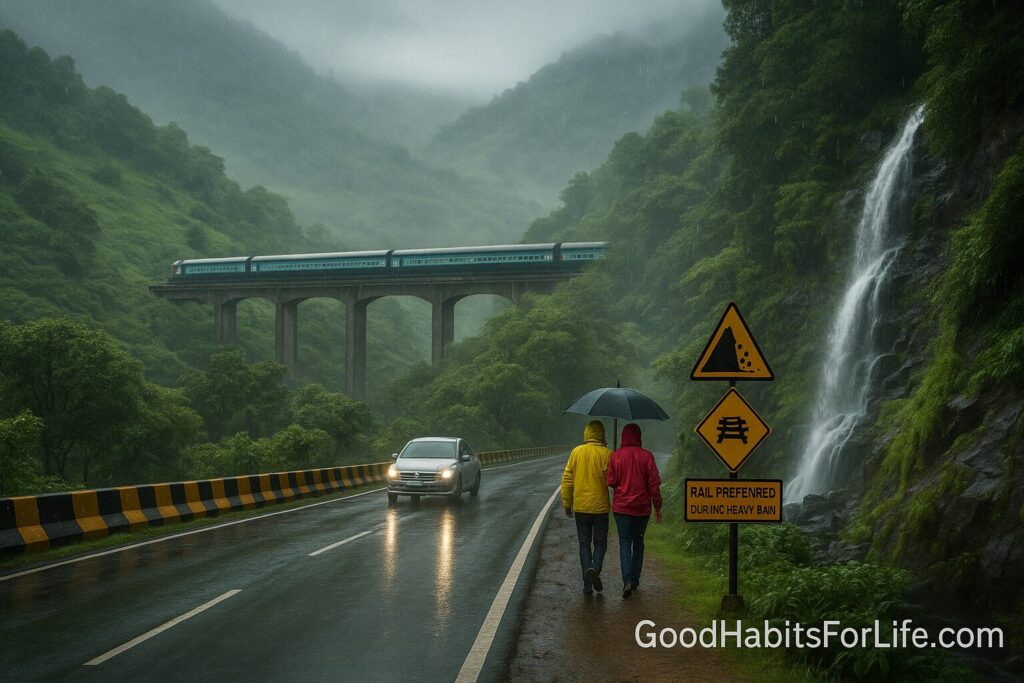
Monsoon Trips in India: Safe Routes & RainSmart Plans
Monsoon Trips in India: Safe Routes & RainSmart Plans
Table of Contents
🧭 What & Why: How to Think About Monsoon Travel
Monsoon in India isn’t a single downpour; it’s a moving, pulsing system that varies by coast, altitude, and week. Great monsoon trips are possible—waterfalls roar, forests glow, prices drop—if you plan routes around real-time weather windows and terrain risks (landslides, flash floods, poor visibility).
Benefits of RainSmart planning
-
More nature for less crowding and cost.
-
Lusher landscapes and unique seasonal foods/festivals.
-
Flexibility reduces cancellations and safety stress.
The big idea: Combine live weather (IMD), on-ground advisories (state disaster units, highway authorities), and route choices (rail > hill roads in heavy spells) to stay safe and make the most of the season.
✅ Quick Start: Do-This-Today Checklist
-
Pick 2 destinations in different rain patterns (e.g., Udaipur + Puducherry) so you can switch.
-
Check IMD: 5-day forecast + “Nowcast/Warnings” for districts on your route.
-
Lock flexible/refundable bookings; save helpline + hotel numbers offline.
-
Choose rail over overnight hill drives during red/orange alerts.
-
Create a water-tight kit: rain jacket, dry bag, power bank, headlamp, silica gel for electronics.
-
Set app stack: IMD Mausam, Damini lightning, offline maps, IRCTC/NTES, payment and ID backups.
-
Tell one contact your plan + daily check-in time; share live location only with trusted people.
🛠️ RainSmart Itinerary Builder (7-Day Starter Plan)
Goal: A flexible week that automatically adapts to heavy-rain windows.
Day 0 (Prep)
-
Screenshot IMD district forecasts + highway advisories.
-
Download offline maps and train PNRs/tickets.
-
Pack a grab-and-go storm kit (see below).
Day 1 (Arrival hub—by rail/flight)
-
Choose a city with multiple onward options (e.g., Ahmedabad, Kochi, Bengaluru, Jaipur, Delhi).
-
Confirm hotel’s backup power, rooftop/parking drainage, and 24×7 front desk.
Day 2–3 (Primary plan)
-
If forecasts are green/yellow, take planned day trips.
-
If orange/red, switch to indoor experiences (museums, food trails), spa/ayurveda days, or train-based scenic rides instead of long road drives.
Day 4 (Flex day)
-
Decide: stick or swap to your alternative destination with better window.
-
Use daytime trains for intercity moves; avoid late-night hill transfers.
Day 5–6 (Nature window)
-
Waterfalls/backwaters/beaches with lifeguarded zones only.
-
Keep a turnaround time (e.g., 15:30) to beat evening downpours.
Day 7 (Return + buffer)
-
Book a late-night buffer hotel near the departure station/airport.
-
Reconfirm transport 6–8 hours before leaving.
Storm Kit (hand-carry)
-
Rain jacket + compact umbrella; quick-dry layers; anti-slip sandals/shoes.
-
Dry bags/zip locks for electronics + documents; spare ID copies; cash float.
-
Electrolytes, ORS, basic meds, band-aids; insect repellent; small towel.
-
Headlamp/torch; power bank; whistle; small duct tape.
🗺️ Safer Picks by Region (June–September)
Use these as tendencies; always confirm with live advisories.
| Region | Typical Monsoon Character | Safer-leaning Picks | Notes |
|---|---|---|---|
| West Coast (Konkan, Western Ghats) | Very heavy rain, landslides on ghats | Konkan by train (Mumbai–Goa–Mangaluru), coastal city stays | Avoid long hill drives on NH ghat sections during orange/red alerts. |
| Kerala & Karnataka (coast/backwaters) | Intense spells but great greenery | Backwaters (Alappuzha/Kumarakom), protected beaches | Choose licensed boats; check dam release news. |
| Tamil Nadu (east coast) | Lighter in SW monsoon (heavier Oct–Dec) | Puducherry, Mahabalipuram, Rameswaram | Good July–Sep windows; still watch for local squalls. |
| Rajasthan & Kutch | Low to moderate rain; brief storms | Udaipur, Jodhpur, Jaisalmer (shoulder season) | Hot/humid early season; flash-flood pockets exist—use city bases. |
| Himalayas (HP, Uttarakhand, J&K) | High landslide/flash-flood risk | Valley bases on green days; rail to foothills | Avoid overnight bus drives on hill roads during alerts. |
| Northeast (Meghalaya, Assam, Arunachal) | Very wet; stunning waterfalls | City hubs (Shillong, Guwahati) with day-trip flexibility | Watch river level advisories; don’t trek in red alerts. |
| Rain-shadow (Ladakh/Spiti) | Generally drier but cloudburst risk | Fly-in city stays; short drives | Roads can close suddenly—buffer days essential. |
Rail beats road in sustained rain, especially on ghat and hill sections. If you must drive, stick to daylight, national highways, and turn back on first signs of waterlogging, rockfall, or poor visibility.
⚠️ Risks & How to Avoid Them
-
Landslides & rockfall (hills/ghats): Avoid travel during/after intense spells; never stop under cut slopes; keep distance from cliff faces.
-
Flash floods & swollen streams: Never wade or drive through moving water; 15–30 cm (6–12 in) can sweep feet; 30–45 cm (12–18 in) can move small cars.
-
Lightning: Seek shelter in buildings/cars; avoid lone trees/ridges; use Damini alerts.
-
Waterborne issues: Prefer boiled/bottled water; eat hot, fresh food; wash hands frequently.
-
Connectivity drops: Save offline maps, tickets, and emergency numbers; carry cash for when UPI/data fails.
-
Wildlife & leeches (forests): Closed shoes, salt/tissue, and light-colored socks; stick to marked trails with guides.
🧠 Techniques & Frameworks That Work
The 3-Layer Plan
-
National view: IMD all-India + monsoon axis.
-
District view: 24–72-hour warnings & nowcasts.
-
Local view: Hotel/taxi/guide update 2–4 hours before departure.
Rail-First Rule
-
When in doubt, choose trains for long moves in monsoon belts. Roads are the first to disrupt; rail timetables adapt faster and are safer than night hill drives.
Daylight-Only Hills
-
Start early, target arrival before 16:00, and never push through rain after dusk.
The “Turn-Back Early” Trigger
-
Any of these = immediate retreat: continuous rockfall, water crossing the road, wheel-arch waterlogging, guardrail streams, stalled vehicles ahead.
Two-Base Strategy
-
Book two cancellable bases in different weather zones (e.g., Jaipur and Udaipur) and decide 48 hours out.
👥 Variations: Families, Professionals, Solo Women, Bikers
-
Families with kids: Choose city bases with hospitals nearby; kid-size rain gear; extra snacks and ORS; indoor attractions list.
-
Busy professionals: Prioritize direct flights + rail; pick hotels with strong Wi-Fi/power backup; schedule meetings in mornings to dodge evening showers.
-
Solo women: Prefer reputed chains/hostels, illuminated areas, verified cabs; share live location with one trusted contact; keep a whistle + power bank.
-
Bikers/road-trippers: Fresh tires and brake pads; lube chain after wet rides; visor anti-fog; avoid water crossings; never tail close behind buses on ghats.
🗣️ Real-Life Scripts & Examples
Call to hotel (hill region)
“Hi, I’m arriving on [date]. Could you confirm current road conditions from [town], any landslide zones en route, parking on higher ground, and your backup power?”
Taxi inquiry
“Are you comfortable delaying or turning back if IMD upgrades alerts? I’ll pay for waiting time.”
Tour operator message
“Please shift tomorrow’s waterfall trek to a museum/food walk if district alerts are orange/red. Confirm tonight at 20:00.”
At a waterbody
“We’ll stay behind lifeguard flags and leave if visibility or currents worsen.”
📱 Tools, Apps & Resources
-
IMD Mausam (Android/iOS) — official forecasts, radar, warnings.
-
Damini Lightning Alert — hyperlocal lightning notifications.
-
State Disaster Management websites — district advisories & river levels.
-
IRCTC & NTES — rail booking + live status; consider Konkan Railway scenic runs during safe windows.
-
Map apps with offline mode — download state tiles; save hospitals, fuel, police.
-
Highway/Traffic handles (state police, NHAI) — closures, diversions, toll updates.
-
Travel insurance — check coverage for landslides, trip delays, medical evacuation.
Pros/Cons (quick):
-
Official weather apps = high credibility, sometimes clunky UI.
-
Social traffic updates = fast but unverified; cross-check with officials.
-
Rail = safer in rain; may still slow under caution.
-
Car/bike = flexible but riskiest in hills; always have Plan B.
📌 Key Takeaways
-
Plan people-first, rail-first, daylight-only for hills.
-
Keep two destinations and buffer days; switch with the weather.
-
Pack storm-smart and protect documents/electronics from water.
-
Trust official alerts; turn back early—no view is worth the risk.
-
Monsoon travel can be magical when you respect the water.
❓ FAQs
1) What months are best for monsoon trips?
June–September are core months; July–August are peak on the west coast/ghats. Tamil Nadu’s heavier rains come Oct–Dec, so July–Sep can be friendlier there.
2) Rail or road during heavy rain?
Rail, especially through ghats/hills. Choose daylight if any road segment is necessary.
3) Are Himalayan treks safe in monsoon?
Generally no on active rain days due to landslides and flash floods. Choose valley bases or postpone to post-monsoon.
4) What should I pack beyond a raincoat?
Dry bags/zip locks, anti-slip footwear, headlamp, power bank, ORS/electrolytes, small first-aid, insect repellent, and cash backup.
5) How do I read IMD alerts?
Green = normal, Yellow = watch, Orange = be prepared, Red = take action. Avoid hill travel on orange/red days.
6) Are beaches safe in monsoon?
Many have stronger currents and bigger waves; swim only in lifeguarded areas and heed local flags/notices.
7) Do I need travel insurance?
Helpful if it covers delays, cancellations, medical care, and natural calamities like landslides.
8) What about dengue or waterborne illness?
Use repellent, wear full sleeves, and drink boiled/bottled water; choose hot, fresh food.
9) Is Ladakh/Spiti immune to rain?
They’re drier but not immune; cloudbursts and road closures still occur—carry buffer days.
10) How much water is too much to drive through?
Avoid any moving water across roads; even 30–45 cm (12–18 in) can move small cars.
📚 References
-
India Meteorological Department (IMD) — Forecasts, Nowcast & Warnings: https://mausam.imd.gov.in/
-
IMD Monsoon Information: https://imd.gov.in/
-
National Disaster Management Authority (NDMA) — Floods & Landslides preparedness: https://ndma.gov.in/
-
Ministry of Road Transport & Highways (MoRTH) — Road safety advisories: https://morth.nic.in/
-
National Highways Authority of India (NHAI) — Traffic/closure updates: https://nhai.gov.in/
-
Konkan Railway — Monsoon operations & updates: https://konkanrailway.com/
-
WHO — Dengue and Severe Dengue (vector-borne disease info): https://www.who.int/news-room/fact-sheets/detail/dengue-and-severe-dengue
-
Ministry of Tourism, Incredible India — Travel safety tips & advisories: https://www.incredibleindia.org/
-
State Disaster Management Authorities (example hub): https://ndma.gov.in/state-dma
Disclaimer
This guide offers general travel-safety information. For health-specific concerns or vaccinations, please consult a qualified medical professional.