
Money Scripts: What You Learned at Home: No-Spend Challenge (2025)
Money Scripts & No-Spend Challenge (2025 Guide)
Table of Contents
🧭 What Are “Money Scripts”—and Why They Matter
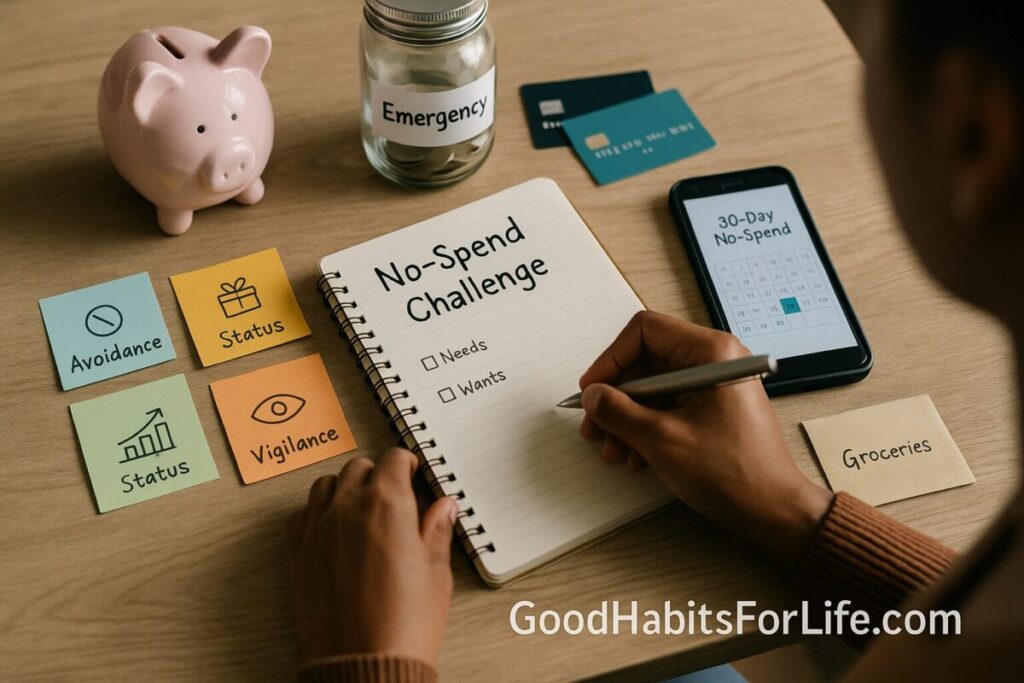
Money scripts are the automatic stories you learned about money at home (and through culture) that still steer your choices—often outside awareness. Research identifies recurring belief patterns (e.g., Money Avoidance, Money Worship, Status, Vigilance) and links them to behaviors like overspending, hoarding, or chronic worry. newprairiepress.org+1
Why this matters for a no-spend challenge: When you try to cut discretionary spending, your scripts quietly fight back. If your script is “I deserve treats when stressed,” late-night delivery sneaks in. If it’s “money is for safety only,” you may over-restrict then binge. Naming the script helps you plan friction in advance.
Two behavior-science anchors:
-
Habits: On average, automaticity builds over ~66 days (range 18–254). A 30-day sprint is the installation phase—enough to lay cue-routine loops you can continue. Wiley Online Library
-
Mental accounting & “pain of paying”: We don’t treat all money the same; payment modes change how spending feels (cash vs contactless), nudging behavior. bear.warrington.ufl.eduCarnegie Mellon University
✅ Quick Start: Your 30-Day No-Spend Challenge
Goal: Spend ₹0 (or $0) on non-essentials for 30 days while meeting essentials (rent, utilities, groceries, meds, transport).
Before Day 1 (takes 30 minutes):
-
Define “non-essential.” E.g., takeout, coffee outside, new clothes, gadgets, ride-hail upgrades.
-
Pre-decide exceptions (max 3): e.g., gift for close family birthday (≤₹1000/$15), one pre-booked event.
-
If-Then Plan (implementation intentions): “If I crave takeaway at night, then I’ll heat frozen dal, message my buddy, and log the urge.” cancercontrol.cancer.gov
-
Fresh-start timing: Begin on a temporal landmark (1st of month / Monday / birthday week) to get a motivational bump. INFORMS Publications
-
Commitment device: Tell a friend; pledge ₹1000 to charity only if you fail the rules. (Loss-framed stakes work.) J-PAL
-
Track daily with a one-line log: date, temptations, work-around used, spend = 0/exception.
Daily Routine (5–10 minutes):
-
Morning: Read your why (e.g., “Pay off ₹50,000 card by March”).
-
Throughout day: Swap temptations with bundled wants (audiobook only when walking). PMCScienceDirect
-
Evening: Log temptations + wins; prepare next day’s meals/snacks.
End of Week Ritual (15 minutes):
-
Review lapses neutrally; update 1 trigger → 1 counter-move.
-
Shift impulsive categories to cash envelopes for week 2+ to restore “pain of paying.” Carnegie Mellon University
🧠 30-60-90 Habit Roadmap
Days 1–30 (Install):
-
Freeze non-essentials; follow If-Then scripts for top 3 triggers.
-
Replace card swipes for snacks/coffee with cash (or UPI with daily hard limit).
-
Build temptation bundles: podcasts + chores; favorite tea + budgeting. PMC
-
Track streaks; celebrate no-spend “micro-wins.”
Days 31–60 (Stabilize):
-
Unfreeze one category with a cap (e.g., eating out ₹600/week) and keep envelopes.
-
Add MCII/WOOP (Wish-Outcome-Obstacle-Plan) once a week to troubleshoot urges. PMCSocMot
-
Automate savings: standing order on payday (defaults matter). PMC
Days 61–90 (Scale):
-
Move to a “spend calendar”: only shop on 1–2 planned days/week.
-
Convert short-term wins into goals (emergency fund 1–3 months; debt snowball).
-
Practice a 10-minute Sunday money meeting (review log, set caps, prep meals).
🛠️ Techniques & Frameworks That Make It Stick
-
Implementation Intentions (If-Then Planning)
Write tiny, specific plans: “If the office orders pizza, then I’ll eat the lunch I brought and join for chat.” These plans reliably bridge intention → action. cancercontrol.cancer.gov -
Mental Contrasting with Implementation Intentions (MCII / WOOP)
Pair your vision (debt-free by March) with real obstacles (late-night hunger) and a plan. Effective across domains, including time management and health. PMCSocMot -
Fresh-Start Effect
Start on the 1st/Monday/new term. Temporal landmarks help people initiate goals and generate commitment contracts. INFORMS Publications -
Temptation Bundling
Only allow a guilty-pleasure (series/podcast) during a “should” behavior (walking, meal prep). Field studies show boosts in follow-through. PMCScienceDirect -
Defaults & Pre-commitment
Automate transfers on payday, set bill autopay, choose higher default savings rates; defaults change behavior dramatically in savings contexts. NBEROxford Academic -
Mental Accounting & Payment Friction
Use cash envelopes for weak spots; schedule “spend windows.” Increasing salience of payment curbs impulse buys. bear.warrington.ufl.eduCarnegie Mellon University -
One-Line Spending Diary
A minimal log (date / trigger / workaround / spend) elevates awareness and preserves the streak effect.
👥 Audience Variations
-
Students: Create campus-friendly swaps (library coffee machine, bulk snacks). Use study-time bundles (lo-fi playlist only while prepping meals).
-
Parents: Meal-prep Sundays with kids; “adventure jar” of free activities for weekends; pre-decide birthday exceptions.
-
Professionals: Default to weekday packed lunches; schedule two “spend windows” (Wed 18:00, Sat 11:00).
-
Seniors: Prioritize health-related exceptions; use cash for groceries to maintain pacing.
-
Teens: “Wish list parking lot” (wait 30 days); earn-to-buy rule for non-essentials; teach envelopes with small amounts.
⚠️ Mistakes & Myths to Avoid
-
Myth: “30 days = permanent habit.” Average is ~66 days; range varies widely—use 30 as the start, not the finish line. Wiley Online Library
-
All-or-nothing rules. Allow 1–3 exceptions to prevent “what-the-hell” effect.
-
Invisible swipes. Tap-to-pay/contactless reduces salience; use cash for trigger categories. Carnegie Mellon University
-
No re-entry plan after a slip. Build a Reset in 3 script: breathe, log, next best choice.
-
Over-restricting essentials. Don’t starve grocery or meds; reallocate from non-essentials instead.
💬 Real-Life Examples & Scripts
Identify Your Script (pick one):
-
Avoidance: “Money stresses me—better not look.”
-
Worship: “Spending proves success.”
-
Status: “Nice things = respect.”
-
Vigilance: “Spending is dangerous.” newprairiepress.org
Counter-Script Affirmations:
-
“I face numbers calmly; data gives me control.”
-
“Success is savings rate, not shopping cart.”
-
“Respect comes from values, not receipts.”
-
“I spend mindfully on priorities and sleep well.”
If-Then Cards (print or phone note):
-
Food delivery: If it’s after 8pm and I want takeout, then I’ll heat my freezer meal and text Asha. cancercontrol.cancer.gov
-
Online browsing: If I open a store site, then I add to wishlist and wait 30 days.
-
Social pressure: If colleagues pick a pricey place, then I order tea and join post-meal walk.
Temptation Bundles:
-
Only listen to thriller podcast while doing dishes or prepping lunches. PMC
📚 Tools, Apps & Resources
-
Budget & Tracking:
-
CFPB monthly budget/goal worksheets (free, printable). Pros: simple, offline; Cons: manual entry. Consumer Financial Protection Bureau+1
-
Cash envelopes (physical or digital categories): high salience; may be less convenient but curbs impulse. Carnegie Mellon University
-
-
Automation:
-
Bank standing orders on payday to savings/debt; treat savings as a default bill. Pros: effortless; Cons: review quarterly to adjust. PMC
-
-
Habit Support:
-
WOOP/MCII worksheets for weekly problem-solving. Pros: fast, evidence-backed. PMC
-
Audiobooks/podcasts for temptation bundling (download free options from your library). ScienceDirect
-
🧾 Key Takeaways
-
Name your money script and write one counter-script you’ll read daily. newprairiepress.org
-
Run a 30-day no-spend with 1–3 pre-set exceptions; log daily.
-
Use science-based levers: If-Then plans, fresh-start timing, defaults, mental accounting, temptation bundling. cancercontrol.cancer.govINFORMS PublicationsPMC+1Carnegie Mellon University
-
Aim for 90 days to stabilize; 30 days installs, 60–90 makes it stick. Wiley Online Library
❓ FAQs
1) Is a no-spend challenge safe if I have debt?
Yes—protect essentials (rent, utilities, meds) and minimum debt payments first; use the no-spend to free cash for extra principal.
2) What if I slip once?
Use Reset in 3: breathe, log the trigger, apply your If-Then for next time. One lapse doesn’t void the streak.
3) How many exceptions are reasonable?
Keep it to ≤3 for 30 days to avoid loophole creep; list them before Day 1.
4) Should I include groceries?
No—opt for smart groceries (meal plan, cook once-eat twice). Consider a fixed weekly envelope for food.
5) Cash or card?
For weak spots (coffee, snacks), cash or prepaid caps increase salience and reduce overspend. Carnegie Mellon University
6) How do I start after a spend-heavy month?
Leverage a fresh start (new month/week). Announce your challenge and set a commitment device. INFORMS PublicationsJ-PAL
7) How long until this feels easy?
Many people feel easier control by week 3–4; full habit automaticity often needs longer (~66 days). Wiley Online Library
8) Are “spend windows” helpful?
Yes—batching purchases to planned days reduces impulse leakage and decision fatigue.
9) Can teens do this?
Yes—with smaller amounts, a wishlist wait period, and a parent “money meeting” once a week.
10) What happens after 30 days?
Reintroduce 1–2 categories with caps; keep your log, envelopes, and automations. Build toward emergency fund/debt goals.
📚 References
-
Klontz, B. et al. Money Beliefs & Financial Behaviors: Development of the Klontz Money Script Inventory (KMSI). Journal of Financial Therapy (2011). https://newprairiepress.org/jft/vol2/iss1/1/ newprairiepress.org
-
Taylor, C. D. et al. Reliability and Convergent Validity of the KMSI-R. Journal of Financial Therapy (2016). https://newprairiepress.org/jft/vol6/iss2/2/ newprairiepress.org
-
Lally, P. et al. How are habits formed? European Journal of Social Psychology (2010). https://onlinelibrary.wiley.com/doi/full/10.1002/ejsp.674 Wiley Online Library
-
Thaler, R. H. Mental Accounting and Consumer Choice. Marketing Science (1985). PDF: https://bear.warrington.ufl.edu/brenner/mar7588/Papers/thaler-mktsci1985.pdf bear.warrington.ufl.edu
-
Prelec, D., Loewenstein, G. The Red and the Black: Mental Accounting of Savings and Debt. Marketing Science (1998). PDF: https://www.cmu.edu/dietrich/sds/docs/loewenstein/redblack.pdf Carnegie Mellon University
-
Gollwitzer, P. Implementation Intentions: Goal Intentions to Action. (Overview PDF). https://cancercontrol.cancer.gov/sites/default/files/2020-06/goal_intent_attain.pdf cancercontrol.cancer.gov
-
Duckworth, A. L. et al. Mental Contrasting with Implementation Intentions (MCII). Social and Personality Psychology Compass (2013). https://pmc.ncbi.nlm.nih.gov/articles/PMC4106484/ PMC
-
Dai, H., Milkman, K. L., Riis, J. The Fresh Start Effect. Management Science (2014). PDF: https://faculty.wharton.upenn.edu/wp-content/uploads/2014/06/Dai_Fresh_Start_2014_Mgmt_Sci.pdf Wharton Faculty Platform
-
Milkman, K. L. et al. Temptation Bundling. Field experiments & summaries. PubMed Central article: https://pmc.ncbi.nlm.nih.gov/articles/PMC4381662/ ; 2020 field experiment: https://www.sciencedirect.com/science/article/pii/S074959782030385X PMCScienceDirect
-
Madrian, B., Shea, D. Inertia in 401(k) Participation & Savings. QJE (2001). NBER WP: https://www.nber.org/system/files/working_papers/w7682/w7682.pdf NBER
-
Consumer Financial Protection Bureau. Monthly Budget & Money Goal Worksheets. https://files.consumerfinance.gov/f/documents/cfpb_well-being_monthly-budget.pdf ; https://files.consumerfinance.gov/f/201406_cfpb_new-money-goal-worksheet-pdf6153.pdf Consumer Financial Protection Bureau+1
-
J-PAL. Commitment Savings Bulletin. (2021). https://www.povertyactionlab.org/sites/default/files/publication/Commitment-Savings-Bulletin-5.21.21.pdf J-PAL
Disclaimer: This article is educational and does not constitute financial advice. Consider your own circumstances or consult a qualified advisor for personalized guidance.