
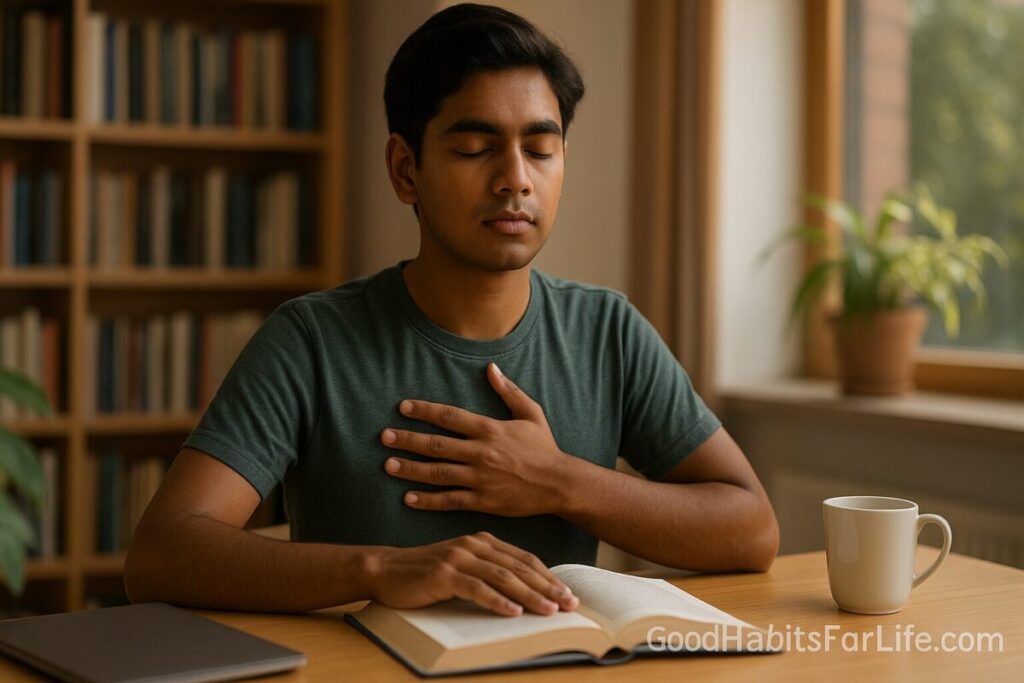
Mindfulness for Learners: Breathe Before You Read
Mindfulness for Learners: Breathe Before You Read
Table of Contents
🧭 What & Why
Mindfulness for learning means paying steady, non-judgmental attention to the present task—breath, body, words on a page—so your brain’s “noise” drops and comprehension rises. Two levers make it effective for study:
-
Arousal regulation via the breath. Slow, paced, diaphragmatic breathing (about 6–10 breaths/min) increases vagal tone and heart-rate variability (HRV), supporting calmer, more flexible attention. Frontiers+2ScienceDirect+2
-
Attention training via brief mindfulness. Even short courses improve reading comprehension, working memory, and reduce mind-wandering, which mediates performance gains. SAGE Journals
Large reviews in schools and universities show mindfulness programs reliably reduce stress and test anxiety, with small-to-moderate improvements in academic outcomes—especially when practices are short, frequent, and embedded in class routines. PMC+2PMC+2
✅ Quick Start (Do This Today)
Use this 4-minute pre-reading primer anywhere (library, classroom, desk):
-
Posture & Setup (20s): Sit upright, feet flat, phone on silent. Decide your first reading target (e.g., Section 1, pages 1–4).
-
Paced Breath (90s): Inhale through the nose ~4s, exhale ~6s. Light belly movement; keep shoulders relaxed. (Aim for ~6–7 breaths/min.) Frontiers+1
-
30-Second Body Scan: Sweep attention crown→eyes→jaw→shoulders→hands→stomach; release tension.
-
30-Second “Why This Text?” Name your purpose: “Find three mechanisms of X; note definitions.”
-
Focus Block (20 min): Read with a pencil; mark unknown terms; after each page, whisper a 5-word gist.
-
Micro-Reset (60s): One long exhale-weighted breath set (e.g., 2 short nasal inhales + long sigh out × 3). This pattern improved mood and calm in RCTs. PubMed+1
🗓️ Habit Plan — 7-Day Starter
Goal: Make “Breathe → Read” automatic before any learning block.
-
Day 1–2: Run the 4-minute primer once daily before a light reading task. Log: minutes read, one insight, effort (1–5).
-
Day 3–4: Two primers/day (morning notes + afternoon article). Add a 1-minute end-of-block reflection: What confused me?
-
Day 5: Use the primer before a hard chapter. Add a 2-minute summary card (3 bullets + 1 question).
-
Day 6: Practice the micro-reset between sections or slides.
-
Day 7: Mini-exam simulation (30–45 min). Begin with primer; end with 5-minute recall test.
Checkpoint: Anxiety ↓, clarity ↑, fewer re-reads; 10–15% faster page-through on familiar material.
🛠️ Techniques & Frameworks
1) Paced Diaphragmatic Breathing (PDB)
-
Why: Boosts HRV and parasympathetic tone; lowers respiratory rate. Frontiers+1
-
How: 4-second inhale, 6-second exhale, nasal, belly soft; 1–5 minutes.
-
Tip: Count silently on exhale; longer exhale biases calm.
2) Exhale-Focused “Cyclic Sighing” (3–5 mins)
-
Why: In a randomized trial, exhale-biased breathwork outperformed mindfulness meditation on mood and arousal improvements. PubMed+1
-
How: Two short inhales (nasal) + long sighing exhale (mouth), repeat gently.
3) 2-Minute Anchored Attention
-
Why: Brief mindfulness reduces mind-wandering; repeated practice improves working memory and reading scores. SAGE Journals
-
How: Eyes on a single word or your breath at the nostrils; when you drift, label “thinking” and return.
4) Read-Reflect Cycle (RR-3)
-
Why: Metacognitive checks keep attention active.
-
How: After each page/slide: Restate the gist (10 words), Record one question, Relate to the goal.
5) Test-Calm Protocol (TCP-7)
-
Why: Mindfulness programs reduce test anxiety; even brief trainings help. PMC+2PMC+2
-
How (7 steps): Seat → Breath 90s → Ground feet → Select first 3 items → Read prompts aloud in your head → Mark “sure/maybe” → 3 cyclic sighs before switching sections.
🧑🎓 Audience Variations
Students (school/college): Keep practices under 5 minutes; pair with a planner reminder and mid-lecture micro-resets. Campus data show benefits for anxiety and concentration; academic gains are small but real with consistency. PMC+1
Professionals: Use the primer before dense reports; add a 30-second “meeting breath” to reduce reactivity before speaking.
Neurodivergent learners (e.g., ADHD): Start with movement + breath (30s chair squats + 60s PDB). Short, frequent bouts beat long sessions; use tactile anchors (paperclip, textured notebook) to re-cue attention. Evidence for school-based MBIs indicates feasibility and stress benefits; adapt pacing to sensory comfort. PMC
Seniors/Returning learners: Emphasize nasal, gentle breathing; if dizzy, shorten exhale counts. Pair with large-print notes and frequent breaks.
Teens: Gamify: HRV/breath apps with streaks; 2-minute challenges before homework. Test-calm routines can reduce pre-exam arousal. PMC
⚠️ Mistakes & Myths to Avoid
-
Myth: “I need 20+ minutes or it won’t work.” → Even 1–5 minutes of breathwork shows measurable benefits. PubMed
-
Mistake: Mouth-breathing fast. → Prefer slow nasal breathing with light belly motion. Frontiers
-
Myth: “Mindfulness will skyrocket grades overnight.” → Effects on academics tend to be small-to-moderate and accumulate with use; biggest wins are anxiety and focus. PMC+1
-
Mistake: Using breath holds aggressively. → Keep it comfortable; skip advanced holds if you feel light-headed.
-
Myth: “If I drift, I failed.” → Noticing the drift is the rep—return gently.
💬 Real-Life Examples & Scripts
Pre-Reading Script (60s):
“Feet down. Shoulders easy. In…2-3-4… out…2-3-4-5-6. I’m reading Section 2 to find three causes of X. If thoughts pop up, I’ll label ‘thinking’ and return.”
During-Text Cue:
“Pause. One cyclic sigh. What’s the gist of this paragraph in 10 words?”
Test-Calm Whisper:
“Breathe low and slow. Read the stem twice. Underline the verb. Decide: sure/maybe. Next.”
Study Buddy Prompt (for group sessions):
“Before we start, 90-second breath. Each person states a question we’ll answer by the end.”
📚 Tools, Apps & Resources
-
Mindfulness apps: Headspace, Calm, Insight Timer — guided 1–5-minute primers; rich libraries.
-
Pros: Easy starts, reminders. Cons: Can drift into long sessions—set timers.
-
-
Breathwork/HRV: Breathwrk, Othership, Elite HRV, HRV4Training — timers at 4:6 inhale-exhale; trend HRV.
-
Pros: Visual pacing, data. Cons: Don’t obsess over scores; focus on feel.
-
-
Browsers/Readers: Mercury Reader, Reader View — declutter long articles to reduce cognitive load.
-
Timers: Visual Pomodoro (20–25 min focus + 3–5 min break).
-
Paper tools: Index cards for RR-3 summaries; sticky “Breathe First” cue on laptop bezel.
🧾 Key Takeaways
-
Breathe first, then read. One to five minutes of slow nasal breathing primes attention and calm. Frontiers+1
-
Mindfulness helps where it counts: less mind-wandering, better working memory, modest academic gains. SAGE Journals+1
-
Short + consistent beats long + rare. Embed micro-resets between sections and before tests. PMC
-
Adapt to your context: movement plus breath for ADHD, exhale-biased sighs for rapid calm. PubMed
❓ FAQs
1) How many breaths do I actually need before I study?
About 10–30 slow breaths (1–3 minutes) can meaningfully reduce arousal and steady attention. Frontiers+1
2) Is breathwork better than mindfulness?
Both help; one RCT found exhale-focused breathing produced larger mood and arousal benefits than mindfulness meditation in brief daily sessions. Use whichever you’ll repeat. PubMed
3) Will this raise my grades?
Expect small-to-moderate academic effects, with clearer gains in anxiety reduction and focus. Consistency matters more than session length. PMC+1
4) What pace should I breathe at?
Try ~6–10 breaths/min (e.g., 4s inhale, 6s exhale). If dizzy, shorten counts and return to normal breathing. Frontiers
5) Does this help with test anxiety right before an exam?
Yes—brief protocols (breathing + mindfulness) reduce test anxiety and aid regulation even in short windows. Practice the routine beforehand. PMC+1
6) Is there evidence this works for teens?
School-based trials and reviews show benefits for teen wellbeing and stress; embed short practices in class/homework for best results. PMC
7) I have ADHD—will sitting still make me worse?
Pair 30 seconds of movement with 60–90 seconds of paced breathing; short bouts are typically more tolerable and effective than long sits. School MBI data support feasibility. PMC
8) Should I breathe through my nose or mouth?
Prefer nasal breathing—often calmer and easier to pace; switch to relaxed mouth exhales during cyclic sighing if comfortable. Frontiers
📖 References
-
Mrazek, M. D., et al. Mindfulness Training Improves Working Memory Capacity and GRE Performance. Psychological Science (2013). SAGE Journals
-
Balban, M. Y., et al. Brief structured respiration practices enhance mood and reduce physiological arousal. Cell Reports Medicine (2023). PubMed+1
-
Zaccaro, A., et al. How Breath-Control Can Change Your Life: A Systematic Review. Frontiers in Human Neuroscience (2018). Frontiers
-
Laborde, S., et al. Effects of voluntary slow breathing on HRV: Systematic review & meta-analysis. Neurosci. Biobehav. Rev. (2022). ScienceDirect
-
Phan, M. L., et al. Mindfulness-based school interventions: Systematic review. Frontiers in Psychology (2022). PMC
-
Ostermann, T., et al. Mindfulness-based interventions and academic performance (GPA): Systematic review & meta-analysis. Frontiers in Behavioral Neuroscience (2022). Frontiers
-
Priebe, N. P., et al. Effect of Mindfulness Programs on Collegiate Test Anxiety: Meta-analysis. Int. J. Environ. Res. Public Health (2022). PMC
-
Yılmazer, E., et al. Effects of mindfulness on test anxiety: Meta-analysis. BMC Psychol. (2024). PMC
-
Shao, R., et al. Slow-paced breathing on cardiovascular and autonomic function: Systematic review. Mindfulness (2024). SpringerLink
-
Steffen, P. R., et al. Integrating Breathing Techniques Into Psychotherapy to Improve HRV. Frontiers in Psychology (2021). Frontiers
-
(Optional context) Stanford Medicine news on cyclic sighing and anxiety (2023). Stanford Medicine
Disclaimer
This guide offers general educational information on mental wellbeing for study and is not a substitute for professional medical or mental-health advice.