
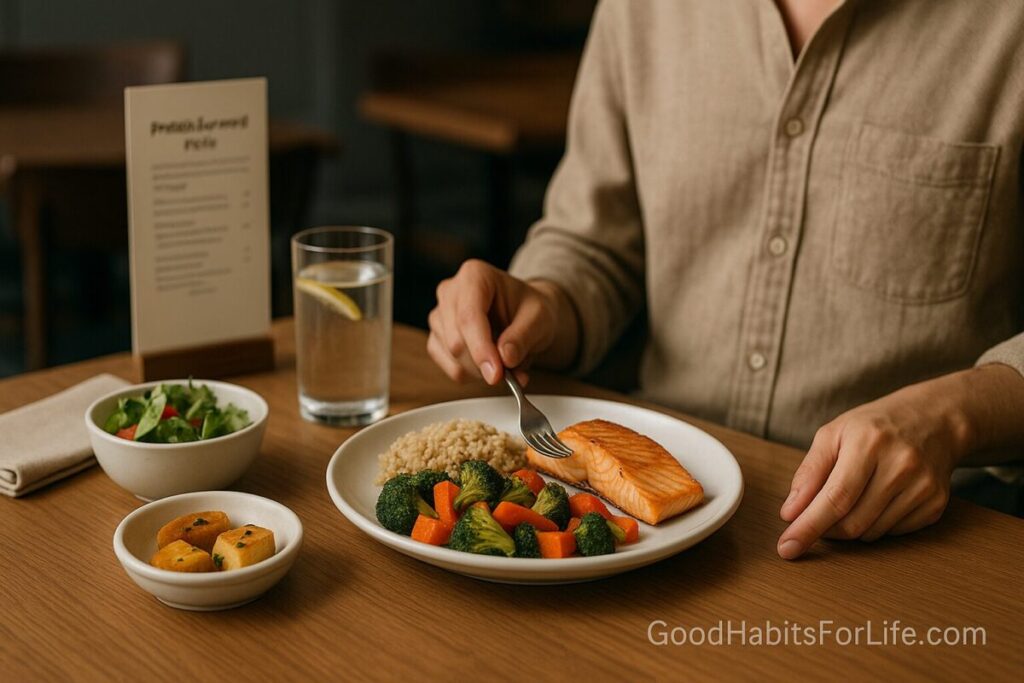
Mindful Dining Out: Taste More, Order Less: Protein-Forward Plan (2025)
Mindful Dining Out: Protein-Forward Plan (2025)
Table of Contents
🧭 What Is “Mindful Dining Out” & Why a Protein-Forward Plan Works
Mindful dining out means choosing and enjoying restaurant food with present-moment awareness—tasting more while ordering only what you truly want and need. It blends intuitive eating (internal cues) with practical nutrition (external tools like menu labels and plate building).
Why protein-forward?
-
Protein boosts satiety and helps you leave satisfied with fewer calories from refined starches and sugary add-ons. Harvard nutrition guidance highlights protein’s role in fullness and weight management.
-
Building meals around protein (fish, eggs, tofu/paneer, beans/lentils, poultry, lean meat) makes it easier to add flavourful sides in sane portions (veg, grains, shared appetizers).
-
Pairing protein + fibre + fluids slows digestion and supports steady energy.
Mindfulness keeps the pleasure; protein gives the structure.
✅ Quick Start: Do-This-Tonight Checklist
-
Pre-meal pause (30–60 min before): Water or unsweetened tea; quick snack only if ravenous (e.g., a yoghurt or a small handful of nuts).
-
Set an intention: “I’ll savour the first 3 bites, share sides, and stop at comfortable 7/10 fullness.”
-
Order an anchor protein: Grilled fish, tandoori chicken, tofu/paneer tikka, bean-based chili, eggs, dal + veg.
-
Add colour + crunch: One veg side or salad; dressing on the side.
-
Share the fun: Split a carb-heavy dish or dessert; request half-portion/box half early.
-
Table tempo: Put cutlery down every few bites; sip water between courses.
-
Exit plan: If you’re at 7–8/10 fullness, stop; take the rest home.
🧠 30-60-90 Day Habit Roadmap
Days 1–30: Foundation
-
Week 1: Practice the Hunger-Fullness 1–10 check before/after meals; log a sentence in your notes (“Arrived 3/10, stopped 7/10”).
-
Week 2: Choose a protein anchor at every restaurant meal.
-
Week 3: Share/half-box one item per outing.
-
Week 4: Add a veg side first; treat bread/chips as optional, not automatic.
Checkpoint: 70% of restaurant meals include a protein anchor + veg side; at least one pause during eating.
Days 31–60: Skill-building
-
Try the T.A.S.T.E. method (below) for sauces/appetizers.
-
Explore 3 new protein-rich dishes across cuisines.
-
Practice menu label literacy (where available): glance at calories to compare options, not to obsess.
Checkpoint: You consistently stop near 7–8/10 fullness without feeling deprived.
Days 61–90: Auto-pilot & Flex
-
Rotate a default order at your common restaurants.
-
Host friends with a “share bowl” mindset (one indulgent dish for the table, protein-veg mains for individuals).
-
Reflect monthly: What made mindful dining easy? Keep that.
Checkpoint: Your choices feel natural; satisfaction ↑, waste and overspending ↓.
🛠️ Techniques & Frameworks
Hunger-Fullness Scale (1–10)
-
1–2: Faint/very hungry
-
3–4: Hungry & ready to eat
-
5–6: Comfortable/neutral
-
7–8: Pleasantly full—ideal stop zone
-
9–10: Overfull/uncomfortable
Aim to arrive 3–4 and finish at 7–8.
The T.A.S.T.E. Method (for “taste more, order less”)
-
T — Taste first: Share 1–2 starters for the table; take 2–3 mindful bites.
-
A — Anchor with protein: Choose your own protein-centric main.
-
S — Swap sides: Trade fries/extra bread for a veg/grain side or share one portion.
-
T — Tune in: Mid-meal check at 5 bites: flavour? fullness?
-
E — Exit gracefully: Stop at 7–8/10; box the rest.
Plate Method (restaurant version)
-
½ plate veg/colour (salads, sautéed greens, grilled veg).
-
¼ plate protein (fish, tofu/paneer, beans, eggs, chicken).
-
¼ plate smart carbs (roti/naan, rice, potatoes, pasta, millet/quinoa).
Add sauces mindfully; ask for them on the side.
📚 Protein-Forward Menu Decoder (by cuisine)
| Cuisine | Protein-forward picks | Watch-outs / swaps |
|---|---|---|
| Indian | Tandoori chicken/fish; paneer/tofu tikka; dal makhani (share), rajma; egg bhurji; grilled kebabs | Cream-heavy gravies—order “light cream” or choose tomato/onion-based; butter naan → plain roti; biryani → share + extra raita/salad |
| Pan-Asian | Grilled/steamed fish; tofu/edamame bowls; chicken satay; sushi/sashimi with miso + seaweed salad | Tempura, thick sweet sauces; fried rice/noodles → steamed rice + stir-fried veg |
| Mediterranean | Grilled fish/chicken souvlaki; bean soups; hummus + veg; lentil salads | Endless pita/olive oil—portion it; creamy dips—order small and share |
| American/Global | Grilled salmon/chicken; omelette; chili; steak (small) + double veg | Giant fries; bottomless soda; loaded burgers—go open-face, add salad |
| Middle-Eastern | Shish tawook; kebabs; falafel (baked); labneh + veg | Oversized wraps—ask for half; heavy tahini—serve on side |
| Mexican/Tex-Mex | Grilled fish/chicken tacos; bean bowls; fajitas (skip most tortillas, load veg) | Nachos/queso—share; fried shells; sugary margaritas—go classic, smaller |
Menu verb cues: grilled, baked, tandoori, steamed, roasted, stir-fried, spice-rubbed = usually lighter.
Red-flag cues: loaded, creamy, bottomless, stuffed, all-you-can-eat = plan to split/share.
🧩 Audience Variations
-
Students: Budget hack—order one protein bowl and split a side; carry a collapsible container to save leftovers for tomorrow’s lunch.
-
Busy professionals: Decide your default order before you sit; bookend meetings with a 2-minute intention + mid-meal pause.
-
Parents with kids: Family-style sides (veg, rice/roti), individual protein mains. Ask for half-spice, sauce on side.
-
Seniors: Prioritize softer proteins (eggs, fish, dal, yoghurt); sip water to aid digestion; watch sodium—request low-salt prep.
⚠️ Mistakes & Myths to Avoid
-
Myth: “Mindful eating = no structure.”
Reality: Mindfulness + protein structure prevents autopilot overeating. -
Mistake: Skipping meals to “save up.”
Fix: Arrive at 3–4/10 hunger to avoid rebound overeating. -
Myth: “Salads are always light.”
Reality: Dressings, fried toppings, and cheese can outweigh mains—ask for dressing on the side. -
Mistake: Drinking calories without noticing.
Fix: Alternate alcoholic/sugary drinks with water or soda water; choose smaller pours. -
Myth: “If it’s labelled ‘keto/high-protein,’ it’s best.”
Reality: Still check portion, sodium, and balance with veg/fibre.
🗣️ Real-Life Examples & Copy-Paste Scripts
Scenarios
-
Friends at a new hotspot: Share 2 starters for tasting; each orders a protein-centric main; split one dessert.
-
Work lunch with fixed menu: Eat the protein + veg first, taste carb sides last; stop at 7/10, box remainder.
-
Hotel buffet: First plate: protein + veg; second plate (if still at 4–5/10): 1–2 favourite small items; finish with fruit/tea.
Scripts for the server (polite & specific)
-
“Could we have the sauce on the side and extra vegetables instead of fries?”
-
“We’ll split this dish; please bring an extra plate.”
-
“Can you box half now and serve the rest?”
-
“Is there a grilled or tandoori option for this?”
-
“Could you make it low-salt and keep the dressing separate?”
🧪 Tools, Apps & Resources (pros/cons)
-
Menu calories (where shown): Quick comparison tool; don’t let numbers override taste and fullness. (FDA menu labelling helps with transparency.)
-
Tracking apps (Cronometer, MyFitnessPal, Yazio): Useful for learning protein amounts; can be tedious—use temporarily.
-
Open Food Facts / FoodSwitch (for packaged sides): Scan and compare sodium/sugar; limited for fresh dishes.
-
Mindfulness timers (Insight Timer, Headspace): 1–3 minute pre-meal pause audio; optional but effective.
🗝️ Key Takeaways
-
Anchor your order with protein + veg, then add small taste-sides you truly want.
-
Arrive 3–4/10 hungry; finish around 7–8/10.
-
Use T.A.S.T.E. to sample widely without overeating.
-
Share, half-box, or swap sides to control portions while keeping pleasure.
-
Check labels/menus for calories/sodium where available—use as information, not judgment.
❓ FAQs
1) What’s a simple protein target at a restaurant?
Aim for 20–40 g protein in your main (e.g., ~120–170 g grilled fish/chicken; 1.5–2 cups dal/beans; 150–200 g tofu/paneer). Protein needs vary by body size and activity.
2) Is bread/chips on the table a deal-breaker?
No—treat them as a shared appetiser. Portion a small piece, enjoy it slowly, and move the basket to the centre.
3) How do I handle sauces and gravies?
Ask for them on the side; dip the fork into sauce, then into the food. Tomato/onion-based gravies are typically lighter than cream-based.
4) Can mindful dining help with weight management?
Mindfulness practices can reduce overeating and improve dietary quality; pairing them with a protein-forward plate increases satiety—helpful for weight goals.
5) What about alcohol?
Alcohol adds ~7 kcal per gram and can lower inhibition around food. Alternate with water; choose smaller pours or a single drink.
6) Are plant proteins filling enough?
Yes—beans, lentils, tofu/tempeh, paneer, yoghurt, eggs are highly satisfying, especially when paired with veg and whole grains.
7) How do I manage buffets?
Start with protein + veg; pause; then take small tastes of 1–2 favourites. Avoid the “I paid for it so I must finish” trap.
8) Eating out with kids—any tips?
Order family-style sides (veg, rice/roti) and individual protein mains. Keep sauces mild and separate; encourage 7/10 stop.
9) Low-salt request—will the kitchen do it?
Often yes. Say, “Please cook with minimal salt and keep sauces on the side.” Add a squeeze of lemon at the table for flavour.
10) How many restaurant meals per week can still be healthy?
There’s no fixed number. Focus on patterns: protein-veg anchors, mindful portions, and plenty of home-cooked meals for balance.
📚 References
-
U.S. Department of Health and Human Services & U.S. Department of Agriculture. Dietary Guidelines for Americans, 2020–2025. https://www.dietaryguidelines.gov
-
Harvard T.H. Chan School of Public Health — The Nutrition Source: Protein. https://www.hsph.harvard.edu/nutritionsource/what-should-you-eat/protein/
-
Harvard Health Publishing. Mindful eating overview. https://www.health.harvard.edu/staying-healthy/mindful-eating
-
U.S. Food & Drug Administration. Calorie labeling in restaurants. https://www.fda.gov/food/food-labeling-nutrition/calorie-labeling-restaurants-and-similar-retail-food-establishments
-
World Health Organization. Sodium intake for adults and children. https://www.who.int/publications/i/item/9789241504836
-
American Heart Association. Added sugars recommendations. https://www.heart.org/en/healthy-living/healthy-eating/eat-smart/sugar/added-sugars
-
Centers for Disease Control and Prevention. Energy density & healthy eating. https://www.cdc.gov/healthyweight/healthy_eating/energy_density.html
-
CDC. Diabetes Plate Method (adaptable for balance). https://www.cdc.gov/diabetes/managing/healthy-eating/diabetes-plate-method.html
-
National Institutes of Health — MedlinePlus. Protein in diet. https://medlineplus.gov/ency/article/002467.htm
-
National Institute on Alcohol Abuse and Alcoholism (NIAAA). Calories in alcohol. https://www.niaaa.nih.gov/alcohols-effects-health/overview-alcohol-consumption/calories-alcoholic-beverages
Disclaimer: This content is educational and not a substitute for personalised medical or nutrition advice; consult a qualified professional for individual needs.