
MicroSaves: RoundUps & Rules Youll Keep: No-Spend Challenge (2025)
MicroSaves: RoundUps & Rules You’ll Keep (No-Spend 2025)
Table of Contents
🧭 What Is “MicroSaves” & Why It Works
MicroSaves is a simple system for building savings through tiny, frequent, automated deposits driven by:
-
Round-ups: Each card/UPI purchase rounds up to the next whole amount; the difference moves to savings.
-
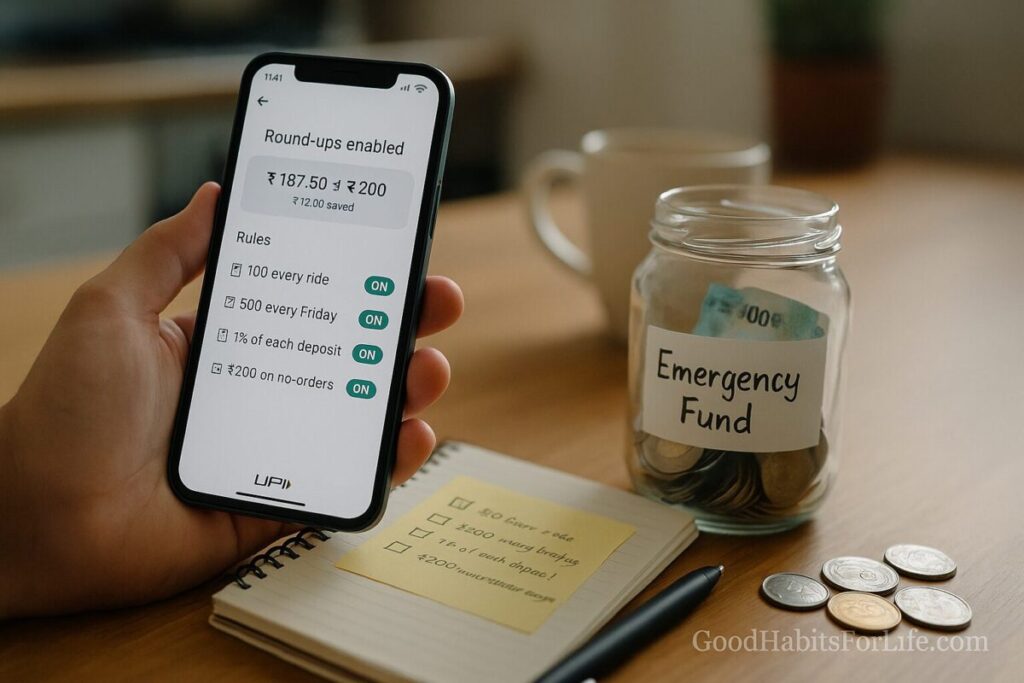
Rules: Fixed, easy triggers—“₹100 every ride,” “₹500 every Friday,” “1% of each deposit,” or “₹200 on days I don’t order in.”
Why it works
-
Friction-light: Decisions happen once; execution is automatic.
-
Visible progress: Small wins reinforce the habit loop.
-
Flexible: You can stack rules and pause as needed.
Start with your emergency fund. Even modest buffers reduce financial stress and help you handle surprises without debt, according to the U.S. Consumer Financial Protection Bureau (CFPB). Consumer Financial Protection Bureau
Reality check (2025): Only about 46% of U.S. adults report having at least three months of expenses saved—down from 53% in 2021—so small, steady systems matter. FINRA
🧠 How Round-Ups & Rules Work (and Which Save More)
There are two broad MicroSaves families:
-
Spend-trigger rules
-
Examples: round-up per transaction; save ₹50 each time you pay via UPI; save ₹100 for every coffee purchased.
-
Caution: One study finds that enrolling in a round-up savings program was associated with a rise in total spending, likely because people feel licensed to spend to “save the change.” Don’t use round-ups as an excuse to buy more. aeaweb.org+1
-
-
Income- or time-trigger rules
-
Examples: pay-day rule (move ₹1,000 on salary day), weekly rule (₹500 every Friday), percent rule (1–5% of any incoming deposit).
-
Evidence: A CFPB analysis of actual savings-app data suggests pay-day/time-based rules build larger balances than spend-trigger rules like round-ups. Use round-ups as a supplement, not the core engine. Consumer Financial Protection BureauConsumer Financial Protection Bureau
-
Bottom line: Anchor your plan with one income/time rule for reliable growth; add one small round-up for fun momentum.
✅ Quick Start: Do This Today
-
Name one goal: “₹30,000 emergency fund” (or $500–$1,000 starter). Consumer Financial Protection Bureau
-
Pick two automations:
-
Core: Pay-day rule (e.g., ₹1,000 on salary day).
-
Add-on: Round-up to next ₹10 (or ₹1), cap at ₹600/week to prevent overshoot.
-
-
Set a no-spend window: Choose 7 days (or 2 weekends) with allowed essentials (rent, utilities, groceries, meds, transport). FidelityPNC Bank
-
Open a “vault”: Separate savings space you can’t see in daily balances (reduces temptation).
-
Track one metric: Monthly net saved (automations + no-spend surplus).
-
Review in 15 minutes: If the week felt tight, lower rule amounts—consistency beats aggression.
🗓️ 30-60-90 Day Habit Plan
Days 1–30 (Install & Observe)
-
Automate: ₹1,000 pay-day rule + round-up to ₹10 with ₹600 weekly cap.
-
Run a 7-day no-spend in the first month; journal triggers (boredom, apps, friends’ invites). Fidelity
-
End-of-month checks:
-
Did rules ever cause strain? Reduce amounts by 20%.
-
Did round-ups creep up because of extra swipes? Consider lowering cap or pausing for a week. aeaweb.org
-
Days 31–60 (Right-Size & Stack)
-
Add weekday rule: ₹100 every weekday (~₹2,000/month).
-
Add “skip-spend” rule: ₹200 each day you don’t order in.
-
Run a second, lighter no-spend (e.g., “no fashion or gadgets,” groceries allowed). PNC Bank
-
Build a speed bump: move savings to an account with 1-day delay for withdrawals.
Days 61–90 (Lock-In & Aim Higher)
-
Step up pay-day rule by +10–20% if cash-flow is steady.
-
Choose one lifestyle swap (e.g., ₹150 daily coffee → ₹3,000/month rule).
-
Do a third, social no-spend: buddy or family joins; post weekly wins (accountability helps).
-
Celebrate the first ₹10,000–₹25,000 milestone—label it “Emergency Fund—Do Not Touch.”
🛠️ Techniques & Frameworks That Stick
-
Pay-Yourself-First: Automate before you see the money—works because it avoids “decision fatigue.” Consumer Financial Protection Bureau
-
Commitment Devices: Voluntary constraints (e.g., restricting transfers back to checking) increase follow-through. Use gentle penalties (e.g., public check-ins) over harsh fines. J-PALHarvard Scholar
-
Default + Cap: Keep round-ups on by default, but cap weekly totals to prevent spend creep. aeaweb.org
-
Goal Tagging: Label each rule with the same goal name (“Emergency 2025”).
-
Temptation Bundling: Only open your shopping app during a scheduled window and pair it with a ₹200 “delay” rule that goes to savings.
-
Cue-Routine-Reward: End every no-spend day with a mini-reward (walk, show, call a friend).
👥 Audience Variations
Students
-
Use a ₹50/day rule + “₹200 on days with campus lunch.”
-
No-spend focus: food delivery, impulse fashion.
Parents
-
Weekly family “free fun” list; kids help choose.
-
Round-up on groceries, cap ₹400/week; automate ₹1,000 on child-benefit day.
Professionals
-
Percent-of-income (1–3%) + ₹500 every commute day (if applicable).
-
No-spend on work-week lunches + coffee; prep on Sundays.
Seniors
-
Prioritize liquidity and safety; use time-based rules only (avoid spend-trigger).
-
Keep a 2-account setup (checking + easy-access savings).
Teens
-
Parental co-viewing; ₹20 per purchase round-up with strict weekly cap.
-
No-spend weekends for digital buys; replace with library/park plans.
⚠️ Mistakes & Myths to Avoid
-
Myth: “Round-ups alone will make me rich.” They help, but pay-day rules usually accumulate more. Consumer Financial Protection BureauConsumer Financial Protection Bureau
-
Mistake: “I spent more because I’m rounding up.” Watch for the “save-by-spending” trap. Cap or pause round-ups if you notice extra swipes. aeaweb.org
-
Myth: “No-spend must be extreme.” Flexible, well-scoped challenges work better and reduce rebound spending. FidelityPNC Bank
-
Mistake: “One big goal, many accounts.” Use one goal, one vault to keep motivation clear.
-
Myth: “More rules = more savings.” Start with two rules; complexity causes drop-off.
💬 Real-Life Rules & Scripts (Copy-Paste)
Rules you can paste into your app/notebook
-
Pay-day: “Move ₹1,500 to ‘Emergency 2025’ on salary day.”
-
Round-up: “Round to next ₹10; max ₹400/week.”
-
Skip-spend: “On any day I don’t order food, move ₹250.”
-
Percent rule: “Move 2% of any incoming deposit to savings.”
-
Weekly rule: “Every Friday, move ₹500 to Emergency 2025.”
No-spend challenge menu (choose one)
-
7-Day Reset: Essentials only; cancel carts; delete shopping apps for a week.
-
Two-Weekend Cleanse: Free activities; meal prep; use gift cards only.
-
Category Fast (30 days): No fashion/gadgets; essentials allowed. FidelityPNC Bank
Scripts
-
To friends: “I’m on a 7-day no-spend—down for a free walk or board-game night?”
-
To self (urge hits): “If I still want it after 72 hours, I’ll revisit. For now, ₹250 to savings.”
-
At checkout: “Not today—moving ₹300 to Emergency 2025 instead.”
🧰 Tools, Apps & Resources (Pros/Cons)
Examples only—pick what’s supported in your country/region.
-
Bank round-ups (e.g., Monzo, Starling, Revolut, Chime, Ally)
-
Pros: native integration, simple; Cons: limited rule variety; watch for overspending.
-
-
Savings apps (e.g., Qapital, Digit/Oportun, Acorns, Raiz AU)
-
Pros: rich rule engines (pay-day, round-up, triggers); Cons: fees possible; invest-round-ups carry market risk.
-
-
Automation helpers: standing instructions, scheduled transfers, IFTTT-style applets.
-
Tracking: one dashboard or spreadsheet; show net saved/month front and center.
Tip: Prefer pay-day/time-based rules as your main engine; add round-ups with caps for momentum. Consumer Financial Protection BureauConsumer Financial Protection Bureau
📌 Key Takeaways
-
Anchor on one pay-day rule, add a capped round-up.
-
Run short, flexible no-spend challenges to reset habits. Fidelity
-
Track one metric—monthly net saved—and adjust rules down if strained.
-
Keep savings in a separate vault; use gentle commitment devices to reduce dips. J-PAL
-
Build your emergency fund first, then expand to goals. Consumer Financial Protection Bureau
❓ FAQs
1) Do round-ups really help?
Yes—as a supporting habit. But data suggest pay-day/time rules usually build larger balances. Use both, with a weekly cap on round-ups. Consumer Financial Protection BureauConsumer Financial Protection Bureau
2) Can round-ups make me spend more?
They can if you treat them like permission to swipe. One paper found spending rose after round-up enrollment. Counter with caps and short no-spend resets. aeaweb.org
3) How long should a no-spend challenge be?
Start with 7 days or two weekends. Longer (30-day) versions are okay if you keep essentials allowed and rules clear. FidelityPNC Bank
4) What counts as “essential”?
Housing, utilities, basic groceries, medicines, transport, unavoidable school/work costs. Everything else pauses during the window. Fidelity
5) What if I slip up?
No shame. Log it, move a small “learning fee” (₹100–₹300) to savings, and continue. Habit strength > perfection.
6) How big should my emergency fund be?
Build a starter (e.g., $500–$1,000) quickly, then aim for multiple months’ expenses as feasible. Consumer Financial Protection Bureau
7) Should I invest round-ups?
Only after you’ve funded your emergency buffer and are comfortable with market risk and fees.
8) Can families do this together?
Yes—agree on allowed essentials, pick a shared rule (“₹500 every Friday”), and use a family calendar for no-spend days.
9) Is cash-stuffing better than apps?
If tactile helps you, great—but it’s harder to automate. Many people do best with automated digital rules.
10) How do I stop raiding my savings?
Use a separate bank, enable 1-day withdrawal delays, and label the vault “Emergency—Do Not Touch.” Commitment devices help. J-PAL
📚 References
-
CFPB. An essential guide to building an emergency fund. (Dec 12, 2024). https://www.consumerfinance.gov/ Consumer Financial Protection Bureau
-
FINRA Foundation. National Financial Capability—Key Trends & Insights (2025 update). (Aug 5, 2025). https://www.finra.org/ FINRA
-
CFPB. Consumer Savings App Strategies and Savings Outcomes (Qapital study). (Dec 7, 2022). https://www.consumerfinance.gov/ Consumer Financial Protection Bureau
-
Ratcliffe C., et al. CFPB Qapital Savings App Outcomes (PDF). (2022). https://files.consumerfinance.gov/ Consumer Financial Protection Bureau
-
Putz B. The Impossibility of Saving by Spending (Job Market Paper & slides). (2022–23). https://www.aeaweb.org/ aeaweb.org+1
-
J-PAL. Commitment Savings Bulletin. (May 26, 2021). https://www.povertyactionlab.org/ J-PAL
-
Fidelity. No-spend challenge: how to start and why it works. (Mar 12, 2025). https://www.fidelity.com/ Fidelity
-
PNC Bank. What is a No-Spend Challenge? (Jan 31, 2025). https://www.pnc.com/ PNC Bank
Disclaimer: This guide is educational and not financial advice; consider your circumstances or consult a qualified advisor.