
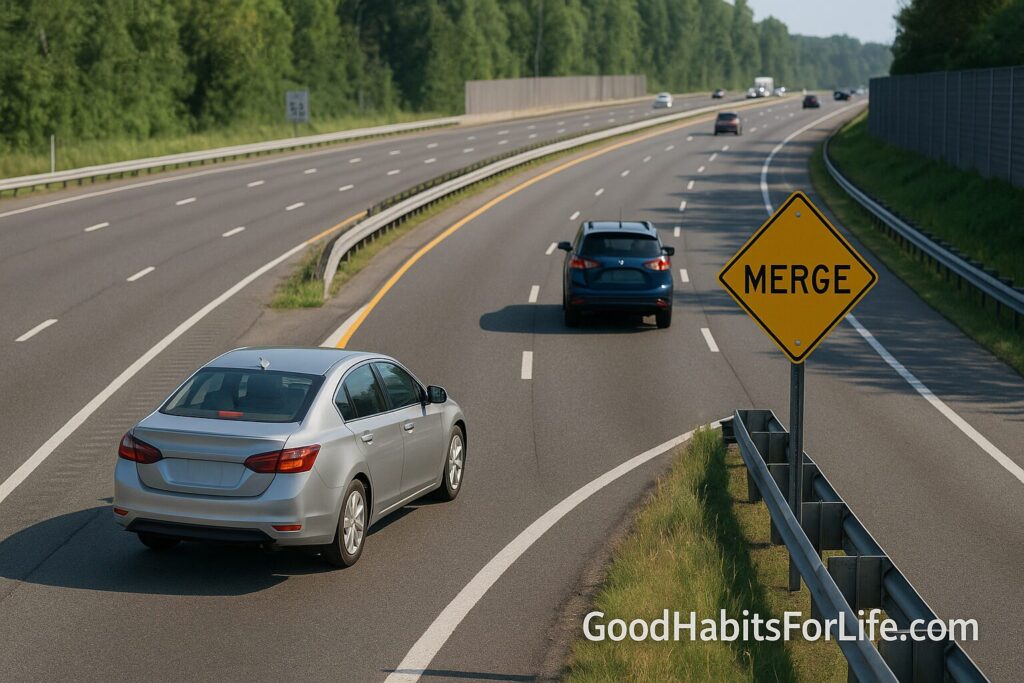
Merging with Confidence: Ramps, Gaps, and Signals
Highway Merging with Confidence: Ramps, Gaps, Signals
Table of Contents
🧭 What Merging Really Is (and Why It Goes Wrong)
Definition. Merging is the controlled transfer from an acceleration lane (on-ramp) into a flowing traffic lane at a speed that matches traffic, using clear signaling and safe gap selection.
Why it matters. Poor merging is a common cause of hard braking, sideswipes, and congestion waves. Smooth merges keep speeds steady, reduce crash risk, and minimize traffic shocks.
Core principles
-
See early. Read ramp geometry, signage (speed advisories, lane drops), and lane status well before the taper.
-
Match speed. Accelerate on the ramp to approximate mainline speed (e.g., 90–100 km/h / 55–62 mph on many expressways, per local limits).
-
Select a gap. Aim for 2–3 seconds of headway to the vehicle ahead after you merge; expand to 3–4 seconds in wet/low-visibility conditions.
-
Signal with intent. Indicator on, check mirrors, head-check (shoulder glance), then decisive steering—not drift, not dart.
-
Cooperate. Mainline drivers should make space; merging drivers must yield where required by local rules. In lane closures, use the zipper merge (alternate 1-for-1).
✅ Quick Start: Your Next 5 Merges, Step by Step
-
Ramp Recon (0–3 s). As you enter, note ramp length, advisory speed, and whether there’s a lane drop/closure ahead.
-
Build Speed (3–6 s). Accelerate on the ramp to match traffic. Keep right (or left, per country) in the acceleration lane; don’t enter the shoulder.
-
Signal & Scan (6–8 s). Signal early. Check rearview → side mirror → shoulder check into the target lane.
-
Pick the Gap (8–10 s). Choose a space that yields a 2–3-second following distance once merged. If tight, hold your speed and continue scanning.
-
Merge & Stabilize (10–14 s). Steer decisively into the gap. Cancel signal, hold steady throttle, then adjust to create a smooth 2–3-second buffer.
If no safe gap: Keep signaling, maintain ramp acceleration, and try the next gap. Only brake if absolutely necessary or signage requires. Avoid stopping on the ramp unless directed or the lane is blocked.
🧠 30–60–90 Mastery Plan
Goal: Eliminate last-second merges and hard brakes; execute zipper merges consistently; handle short ramps confidently.
Days 1–30: Foundation
-
Drills:
-
Speed match drill on long ramps (3–5 reps/session).
-
Head-check habit: say “Mirror, mirror, shoulder” aloud until automatic.
-
-
Metrics: 0 instances of hard braking on merge; signal ≥3 sec before lane entry.
-
Study: Watch a 5-minute explainer on zipper merging; review local road rules.
Days 31–60: Conditions & Complexity
-
Drills:
-
Practice in moderate traffic and at night or light rain.
-
Gap timing: count “one-one-thousand…” to verify 2–3 seconds after merging.
-
-
Metrics: Maintain ≥2 s gap post-merge; 100% zipper compliance in lane closures.
Days 61–90: Short Ramps & Busy Peak
-
Drills:
-
Short/curved ramp practice; plan earlier acceleration.
-
Cooperative merges: invite-a-vehicle (create a gap) once per commute.
-
-
Metrics: Zero last-second merges; no ramp stops; consistent speed match within ±5 km/h (±3 mph) of traffic at lane entry.
🛠️ Techniques & Frameworks That Work
The 4S Framework
-
See: Read the ramp and traffic early (signs, lane status, truck density).
-
Speed: Build to traffic speed on the ramp, not after.
-
Signal: Communicate intent before you move; keep it on through the merge.
-
Steer: Make a single, smooth lateral movement into the center of the lane.
The 2–3-Second Gap Rule
-
After merging, you should pass a fixed point 2–3 seconds after the car ahead. Increase to 3–4 seconds in rain/night.
Zipper Merge (Late Merge) for Lane Drops
-
Stay in your lane up to the merge point.
-
Alternate 1-for-1 with the through lane.
-
Benefits: shorter queues, fewer lane changes, less frustration.
Short Ramp Playbook
-
Eyes up early—you may have only a few seconds of acceleration.
-
Commit to throttle sooner to reach traffic speed.
-
If boxed out, target the next gap, not the current one.
Heavy Vehicles & Buses
-
They need longer following distances and more time to accelerate. Avoid merging directly ahead of them on an uphill; choose a gap behind or well ahead.
Wet/Night Conditions
-
Longer gaps, smoother throttle. Headlights on, defog, and avoid abrupt steering on ramp curves.
📚 Variations by Driver & Context
-
Students/Teens: Practice merges in off-peak hours first; say the mirror-mirror-shoulder checklist aloud.
-
Parents with Kids: Reduce cabin distractions before ramps; avoid mid-merge conversations.
-
Professionals/Commuters: Plan predictable routes; learn which ramps are short and pre-commit to speed matching.
-
Seniors: Prioritize daylight practice and clear weather sessions; consider wider mirrors for blind-spot coverage.
-
Motorcyclists: Make yourself visible; avoid lingering in blind spots near ramp tapers.
⚠️ Mistakes & Myths to Avoid
-
Myth: “Mainline traffic must always move over.”
Reality: Cooperation is expected, but local rules typically require the merging driver to yield unless signed otherwise. -
Mistake: Stopping on the ramp when traffic is moving.
-
Mistake: Drifting toward the lane without a firm speed match.
-
Mistake: Signaling as you cross the line (too late).
-
Myth: Early merge is always best in lane closures.
Reality: Zipper merging near the taper reduces backups and crash risk. -
Mistake: Staring at mirrors only; always shoulder check.
-
Mistake: Cutting in front of heavy vehicles or immediately changing lanes after merging.
🗣️ Real-Life Examples & Copy-Paste Scripts
Scenario 1: No Gap Appears
-
Script in your head: “Hold 95, signal, next gap.”
-
Action: Keep signaling, maintain ~traffic speed, merge into the next workable space. Do not dive into a tiny gap.
Scenario 2: Lane Closure Ahead (Zipper)
-
Script: “Use full lane; one-for-one.”
-
Action: Stay in your lane to the taper, then alternate with the adjacent lane smoothly—no racing.
Scenario 3: Short, Curved Ramp
-
Script: “Eyes up; throttle early; steady wheel.”
-
Action: Build speed on the straight portion, pick a gap early, and execute one smooth lateral movement.
Scenario 4: Heavy Truck Nearby
-
Script: “Don’t cut; merge behind.”
-
Action: Either merge behind the truck or far ahead with ample space—never force a short gap.
Scenario 5: Night Rain
-
Script: “3–4 seconds; small inputs.”
-
Action: Increase following distance, avoid abrupt throttle/steering, and keep lights and defog optimal.
🧩 Tools, Apps & Resources
-
Blind-spot mirrors / wide-angle add-ons: Cheap, effective; keep them adjusted.
-
Driver-assist (BSM/LCA): Helpful alerts; never a substitute for shoulder checks.
-
Navigation apps (e.g., Google Maps, Waze): Heads-up on ramp geometry and lane drops; set before driving to avoid distraction.
-
Dashcam (for review): Useful to self-coach merges after the trip.
-
Local driver handbook: The final word on right-of-way and procedures in your region.
🔑 Key Takeaways
-
Build to traffic speed on the ramp and signal early.
-
Target a 2–3-second following distance after you merge (3–4 seconds in poor conditions).
-
Use zipper merging during lane drops—alternate 1-for-1 at the taper.
-
If boxed out, hold speed and aim for the next gap—don’t stop on a live ramp.
-
Head-checks save merges; mirrors alone miss blind spots.
❓ FAQs
1) Who has the right of way during a merge?
Generally, the vehicle in the through lane has priority unless signage states otherwise. The merging driver must yield while mainline drivers should cooperate by creating space.
2) Should I accelerate or brake when merging?
Primarily accelerate on the ramp to match traffic speed; braking on the ramp creates rear-end risks and kills gaps. Brake only if safety or signage requires.
3) How big should the gap be?
Aim to be 2–3 seconds behind the vehicle ahead once you’re in the lane; increase to 3–4 seconds in wet/night conditions.
4) What is a zipper merge and when do I use it?
In lane closures, drivers use both lanes to the merge point and alternate 1-for-1. It shortens queues and reduces crashes.
5) Is it okay to stop on the ramp?
Avoid stopping on a live ramp. Only stop if traffic is stopped, a signal requires it, or the ramp is blocked.
6) How early should I signal?
Signal well before the lane change—begin on the ramp and keep it on through the merge. Early communication invites cooperation.
7) What if a driver speeds up to block me?
Stay calm. Hold speed, try the next gap, and avoid competitive behavior. Safety beats “winning” a space.
8) How do I merge in very slow, stop-and-go traffic?
Use creeping gaps (1-for-1), keep wheels straight, and avoid nose-to-tail contact. Zipper etiquette still applies.
9) Are driver-assist systems enough for merging?
No. Blind-spot monitoring and lane-change assist help, but shoulder checks and driver judgment remain essential.
10) Any special tip for short or curved ramps?
Accelerate earlier, pick the gap sooner, and make one decisive lateral move. Don’t drift or brake mid-curve.
References
-
Federal Highway Administration (FHWA). Freeway and Interchange Geometric Design Considerations (acceleration lanes & merging). https://www.fhwa.dot.gov/
-
National Highway Traffic Safety Administration (NHTSA). Traffic Safety Facts (speed, reaction time, headways). https://www.nhtsa.gov/
-
AAA Foundation for Traffic Safety. Driver Behavior & Performance reports (following distance, crash risk). https://aaafoundation.org/
-
Washington State DOT. Zipper Merge Guidance. https://wsdot.wa.gov/
-
Minnesota Department of Transportation (MnDOT). Use the Zipper Merge. https://www.dot.state.mn.us/
-
UK Highway Code. Rules for Motorways and Merging (e.g., Rules 259, 134). https://www.gov.uk/guidance/the-highway-code
-
Transport Canada. Merging and Lane Changing – Driver’s Guide. https://tc.canada.ca/
-
National Safety Council (NSC). Defensive Driving: Lane Changing & Merging. https://www.nsc.org/
⚖️ Disclaimer
Drive within posted limits and follow your local road rules; procedures and priorities can vary by jurisdiction.