
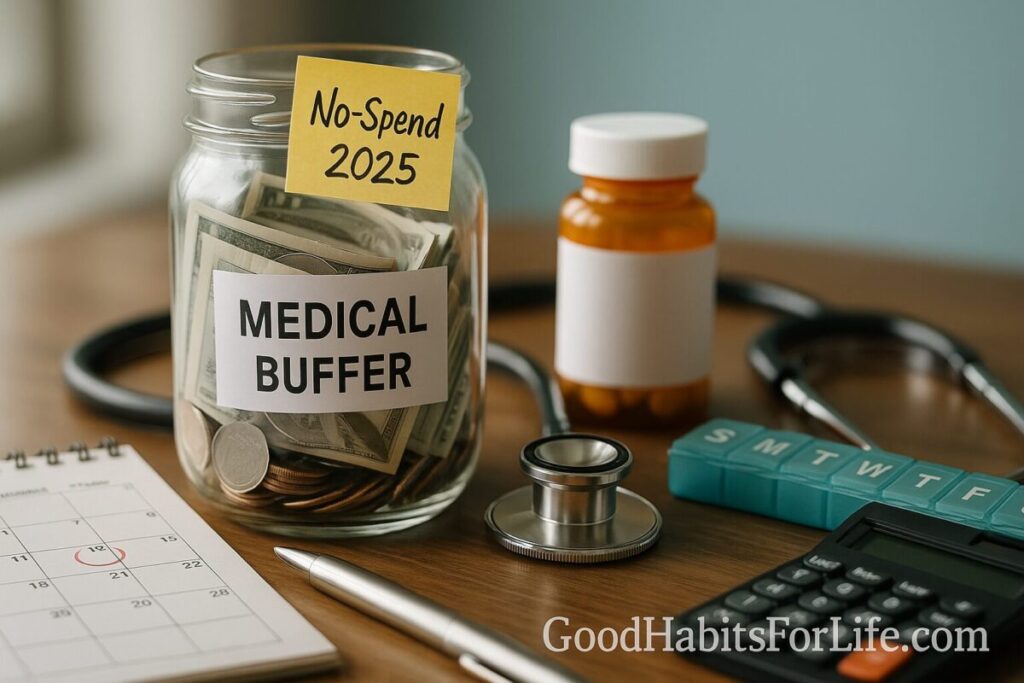
Medical Buffer Basics: OutofPocket Ready: No-Spend Challenge (2025)
Medical Buffer Basics: Out-of-Pocket Ready No-Spend 2025
🧭 What Is a Medical Buffer & Why It Matters
A medical buffer is a dedicated cash reserve for healthcare out-of-pocket costs: deductibles, co-pays, coinsurance, prescriptions, dental/vision, travel to appointments, and small medical gear. It prevents a surprise bill from derailing your budget or pushing you into debt.
-
Globally, financial hardship from medical bills remains widespread; around 1 billion people face catastrophic out-of-pocket health spending. Building a personal buffer is a powerful first defense. World Health Organization
-
In many countries, out-of-pocket shares are still significant. OECD households spend about 3% of total consumption on health on average (higher in some countries). OECD
-
In India, OOPE as a share of total health expenditure has fallen but remains material (39.4% in 2021–22). Ministry of Health and Family Welfare
Bottom line: Insurance lowers risk, but cash flow covers gaps. A medical buffer turns a health bill into a solvable cash event, not a debt spiral.
✅ Quick Start: Your First ₹/$/€1,000 This Month
Goal (30 days): Seed the buffer with your first ₹/$/€500–1,000.
-
Pick your parking spot (today, 15 min).
-
Instant-access savings (separate nickname: “Medical Buffer”).
-
US-only: if you’re HSA-eligible, consider routing part to an HSA (tax-advantaged). 2025 limits: $4,300 self-only, $8,550 family. IRS+1
-
-
Run a 30-day no-spend (start tomorrow).
-
Freeze wants in 3–5 categories (e.g., eating out, apparel, gadgets, subscriptions).
-
Auto-transfer those average spends to “Medical Buffer” every Friday.
-
-
Micro-wins (this week).
-
Sell 3 unused items.
-
Cancel/hibernate subscriptions.
-
Switch to generics for basics (toiletries/supplies).
-
Apply pharmacy discount cards/coupons where legal in your region.
-
-
Lower bills (this week).
-
Call insurer/hospital/clinic to check negotiated rates, cash-pay discounts, or payment plans. (Scripts below.)
-
-
Lock the habit (week 4).
-
Automate weekly transfers.
-
Add a mini threshold: never let the buffer fall below your deductible (or ₹/$/€500 if uninsured).
-
Review annually or with any plan change.
-
🧠 30-60-90 Day Roadmap
Day 1–30 (Seed):
-
Set the account/HSA.
-
30-day no-spend (track daily).
-
Call providers to audit old bills; ask about itemized bills, coding corrections, and financial-assistance programs.
Day 31–60 (Build):
-
Automate 5–10% of income (or a fixed weekly amount).
-
If in the US with a High-Deductible Health Plan (HDHP), set the minimum target to your deductible; HDHP minimum deductibles 2025: $1,650 (self-only) / $3,300 (family). IRS
-
Add 1–2 sinking funds (dental/vision).
Day 61–90 (Fortify):
-
Stretch goal: cover MOOP (maximum out-of-pocket) if feasible. 2025 ACA upper limits: $9,200 self-only / $18,400 family; Medicare Advantage OOP limits (A/B only) $9,350 in-network max. healthinsurance.orgKFF
-
Create a refill rule: After any use, repay the buffer within 90 days.
🛠️ Techniques & Frameworks
Table of Contents
1) How Much Should You Save? (3 Tiers)
Tier A — Minimum: Plan deductible (or ₹/$/€500 if uninsured).
Tier B — Solid: Deductible + typical co-pays (or 1–2 months’ essentials).
Tier C — Ideal: MOOP (or realistic local worst-case cash need).
-
In US individual/family plans, federal MOOP caps exist (see 2025 figures). healthinsurance.org
-
Outside the US, use local historic costs or national stats as a guide; global data show persistent OOP burdens. OECDWorld Health Organization
Quick formula:Target = max(Minimum Deductible Coverage, Local Typical Event Cost) → stretch toward MOOP
2) Where to Keep the Buffer
-
Instant-access savings: Safe, liquid, separate nickname. Consumer Financial Protection Bureau
-
US HSA (if HDHP-eligible): Triple tax advantage; 2025 limits $4,300 / $8,550; HDHP OOP caps $8,300 / $16,600. IRS
-
Not HSA-eligible? Keep funds in a high-yield savings; avoid locking them in long fixed-term deposits.
3) The No-Spend Challenge — Rules
-
Freeze 3–5 non-essential categories for 30 days.
-
Redirect every avoided purchase into your buffer the same day.
-
Keep one tiny joy (e.g., weekly coffee at home upgrade) to avoid rebound spending.
-
Track with a simple sheet; celebrate weekly wins.
4) Cut the Cost of Care (before/after visits)
-
Verify network status before scheduling.
-
Ask for estimates (CPT/package rates) and itemized bills.
-
Request generic prescriptions where appropriate.
-
Negotiate cash-pay discounts or interest-free plans.
-
Know your caps: For US ACA-compliant plans, 2025 MOOP caps apply to essential health benefits (EHB). DOL
5) Country/System Cheat Sheet (examples)
| System | Main Risk | “Good” Target | Parking Spot |
|---|---|---|---|
| US (HDHP) | Deductible + coinsurance up to MOOP | Deductible → stretch to MOOP (2025: $9,200/$18,400 cap for ACA plans; HSA-HDHP OOP max $8,300/$16,600) | HSA (if eligible) + savings healthinsurance.orgIRS |
| OECD universal systems | Dental/vision, non-covered extras, travel | 1–2 months’ essentials | Instant-access savings; check national co-pay rules OECD |
| India | Hospital deposits, drugs, diagnostics | ₹ buffer sized to local hospital norms; note OOPE trend but plan conservatively | Instant-access savings; consider family floater insurance support; verify “cashless” pathways Ministry of Health and Family Welfare |
📚 Audience Variations
Students: Lean on campus clinics and generic meds; set a mini-buffer equal to 2–3 typical visits + meds.
Parents: Add pediatric needs (urgent care, antibiotics, dental). Keep a small OTC stash to avoid last-minute markups.
Professionals: Automate pay-day transfers; enroll in FSA/HSA if eligible (mind use-it-or-lose-it for FSAs). Consumer Financial Protection Bureau
Seniors: For US Medicare Advantage, note 2025 OOP limits (A/B services). Track Part D $2,000 annual cap for drugs in 2025. KFF
Teens (with guardians): Build a small buffer for sports injuries, braces co-pays, and spectacles; teach no-spend as a family challenge.
⚠️ Mistakes & Myths to Avoid
-
Myth: “I have insurance; I don’t need cash.”
Reality: Deductibles, coinsurance, non-covered items, and travel costs add up fast; caps apply to in-network EHB only. DOL -
Mistake: Saving in your day-to-day account.
Fix: Separate, named account to prevent “accidental” spending. Consumer Financial Protection Bureau -
Mistake: Ignoring local stats.
Fix: Check national OOP trends to size realistically. OECDMinistry of Health and Family Welfare -
Myth: “No-spend means zero joy.”
Reality: Keep one small treat to improve adherence.
🗣️ Real-Life Examples & Scripts
A) Estimate before a procedure (call script)
“Hi, I’m scheduled for [procedure] with [clinician] on [date]. Can you confirm the CPT/package code, network status, and a pre-service estimate of total patient responsibility? I have [plan], deductible ₹/$/€[X], coinsurance [Y]%, and MOOP ₹/$/€[Z]. Are there cash-pay discounts?”
B) Itemized bill + coding review (post-visit)
“I received statement #[number]. Please send an itemized bill with codes. I’d like to verify network rates and check for bundling/unbundling or duplicate line items.”
C) Payment plan request
“I can pay ₹/$/€[amount] today and set up 0% monthly payments for the balance. Do you have a financial-assistance policy I can review?”
D) Pharmacy savings
“Is there a generic or therapeutic alternative? Can you process any manufacturer or pharmacy discount program I’m eligible for?”
🧰 Tools, Apps & Resources (quick takes)
-
Simple spreadsheet/Google Sheets — Free, flexible, great for a no-spend tracker.
-
Budgeting apps (YNAB, Wallet, Money Manager) — Helpful for automation and category freezes.
-
Bank automation — Set weekly transfers; name the account “Medical Buffer.” Consumer Financial Protection Bureau
-
US-only: HSA at a low-fee provider; learn 2025 limits & HDHP rules. IRS+1
-
Government guidance on emergency savings and buffer sizing (UK & US). Consumer Financial Protection BureauMaPS
🔑 Key Takeaways
-
A medical buffer protects your budget from health-cost shocks.
-
Start with your deductible; stretch toward MOOP or realistic local costs. healthinsurance.org
-
Use a 30-day no-spend challenge to seed the first ₹/$/€1,000.
-
Keep funds liquid (or in an HSA if eligible); automate weekly transfers. Consumer Financial Protection BureauIRS
-
Refill after use; review annually or when your plan changes.
-
Learn your system’s rules (caps, assistance programs) and negotiate bills.
❓ FAQs
1) How big should my medical buffer be if I can’t afford MOOP yet?
Start with your deductible (or a fixed mini-buffer like ₹/$/€500), then grow toward MOOP or local typical costs as your budget allows. healthinsurance.org
2) Where should I keep this money?
In a separate instant-access savings so it’s safe and easy to reach; US readers with HDHPs can also use an HSA for tax advantages. Consumer Financial Protection BureauIRS
3) I’m in an OECD country with public coverage—do I still need a buffer?
Yes—for dental/vision, non-covered services, travel, and wait-time workarounds. Household OOP shares vary and can still sting. OECD
4) I’m in India—what number should I aim for?
OOPE has declined nationally but remains significant. Aim to cover typical hospital deposits + medicines/diagnostics at local rates; then expand. Ministry of Health and Family Welfare
5) Does insurance cap my costs?
US ACA-compliant plans cap in-network MOOP (2025: $9,200 self-only / $18,400 family). Check your plan; caps apply to EHB only. healthinsurance.orgDOL
6) How do HSAs fit in?
If you’re HDHP-eligible, HSAs allow tax-advantaged saving for qualified medical expenses. 2025 limits: $4,300/$8,550; HDHP min deductibles $1,650/$3,300. IRS
7) What if I already have debt?
Build a small buffer (₹/$/€300–500) to avoid new debt, then snowball high-interest balances while continuing small automatic contributions. Consumer Financial Protection Bureau
8) Can I invest the buffer?
Generally no—liquidity beats yield. Keep it accessible; only excess beyond Tier B or C belongs in longer-term investments.
9) How often should I revisit the buffer?
At open enrollment/renewal, life events (baby, job change), or annually—update for new deductibles/MOOP figures. healthinsurance.org
10) Do no-spend challenges actually work?
Yes—short sprints create quick cash and new habits. Pair with automation and bill-cutting scripts to make gains stick. Consumer Financial Protection Bureau
References
-
World Health Organization. “Universal Health Coverage (UHC) – Key Facts.” 26 Mar 2025. https://www.who.int/… (financial hardship & catastrophic OOP). World Health Organization
-
OECD. Health at a Glance 2023 – Financial hardship & out-of-pocket expenditure. https://www.oecd.org/… OECD
-
Our World in Data (WHO/World Bank). “Share of out-of-pocket spending on healthcare (dataset).” https://ourworldindata.org/… Our World in Data
-
Government of India, MoHFW. “OOPE as % of THE has declined to 39.4% (NHA 2021–22).” Press release, 16 Dec 2024. https://www.mohfw.gov.in/… Ministry of Health and Family Welfare
-
Consumer Financial Protection Bureau. “An essential guide to building an emergency fund.” 12 Dec 2024. https://www.consumerfinance.gov/… Consumer Financial Protection Bureau
-
MoneyHelper (UK). “Emergency savings – how much is enough?” https://www.moneyhelper.org.uk/… MaPS
-
IRS. Rev. Proc. 2024-25 – 2025 HSA limits; HDHP deductibles & OOP caps. https://www.irs.gov/pub/irs-drop/rp-24-25.pdf IRS
-
IRS. Publication 969 (HSAs & Other Tax-Favored Health Plans) – 2025 HSA contribution limits. https://www.irs.gov/publications/p969 IRS
-
CMS/HHS. “2025 PAPI Parameters Guidance” – final 2025 maximum annual limitation on cost sharing (MOOP). https://www.cms.gov/files/document/2025-papi-parameters-guidance-2023-11-15.pdf CMS
-
KFF. “Medicare Advantage in 2025: Premiums & Out-of-Pocket Limits.” 28 Jul 2025. https://www.kff.org/… KFF
-
HealthInsurance.org. “Out-of-pocket maximums: 2025 limits.” https://www.healthinsurance.org/glossary/out-of-pocket-maximum/ healthinsurance.org
Disclaimer: This guide is educational and not financial, tax, or medical advice; please consult qualified professionals for your situation.