
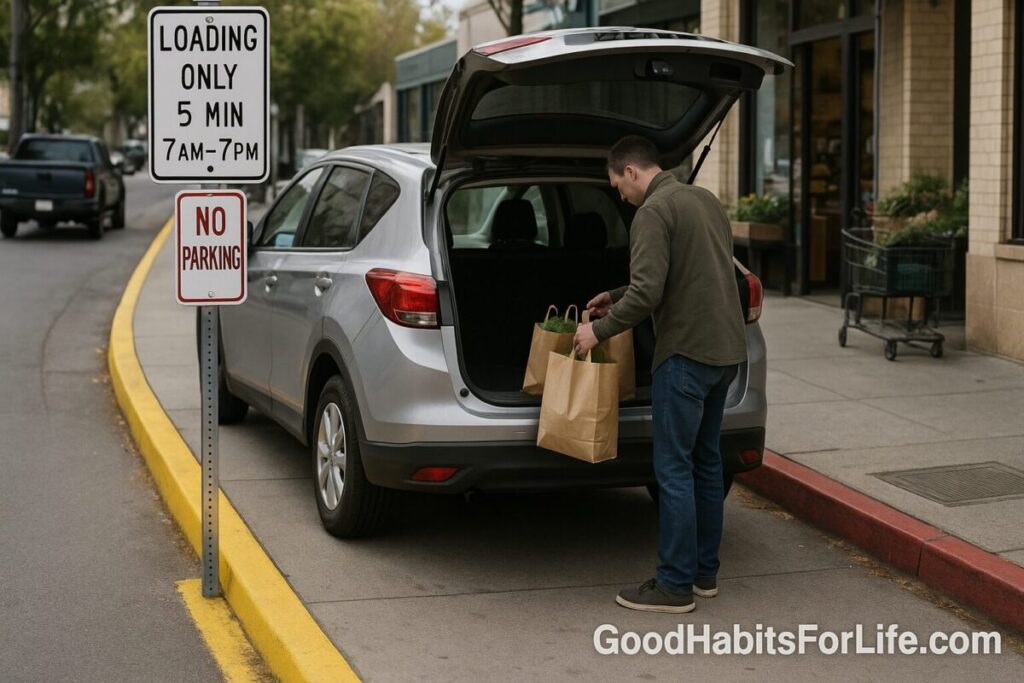
Market Runs: Loading, NoParking, and Tickets
Avoid Parking Tickets on Market Runs: Loading & No-Parking
Table of Contents
🧭 What “Market Runs” Really Mean & Why It Matters
A “market run” is a short, purposeful stop—picking up groceries, pharmacy items, or a parcel—often in busy curbspace. Because demand is high and turnover is essential, cities use strict curb rules (signs, colored curbs, time plates) to keep traffic moving. Misreading one line on a sign can turn a five-minute errand into a costly ticket or tow. Building better curbside habits saves money, time, and stress—and keeps streets safer and more predictable for everyone.
Key definitions (common, but always check local law):
-
No parking: You may stop temporarily to load or unload people or goods; no waiting. Driver may need to stay with the vehicle.
-
No stopping / no standing: Do not halt—even briefly—except for emergency. No loading.
-
Loading zone (passenger/commercial): A signed/painted area reserved for active loading for a limited time window. Conditions vary by time of day/day of week and vehicle type.
-
Curb colors (where used): Colors (e.g., white, yellow, red) indicate allowed uses and time limits.
✅ Quick Start: Do This on Your Next Grocery Stop
-
Approach slow, read the whole sign. Check arrows, days, and times. Look for a time plate (e.g., “10 min, 7–19h, Mon–Sat”).
-
Choose the legal option first. If a short-stay meter/lot is open within 100–200 m (330–660 ft), take it.
-
If using a loading zone:
-
Stay in or by the car; keep loading active.
-
Set a 5–10 minute timer on your phone.
-
Keep hazards on only if your local code permits (it rarely changes legality).
-
-
Split roles: One person shops while the driver circles or remains curbside if allowed.
-
Have a backup spot. Know one alternate legal space nearby to avoid risky last-minute choices.
-
Bag smart. Use a foldable crate or trolley so loading takes <2 minutes.
-
Receipt photo. If challenged, a time-stamped receipt can support that you were actively loading within limits (not a guarantee, but helpful).
🛠️ 30-60-90 Habit Plan for Ticket-Free Errands
Days 1–30 (Learn & set up)
-
Save your city’s curb color chart and loading rules as favorites on your phone.
-
Create a reusable market checklist (notes app): list, bags, trolley, payment, pickup code.
-
Map 2–3 legal short-stay options near your usual market.
-
Practice reading three signs fully each trip—even if you don’t park there.
Days 31–60 (Apply & optimize)
-
Shift errands to off-peak (e.g., weekday mornings).
-
Use store pickup or order-ahead once weekly to reduce curb time.
-
Time your loading—aim for ≤5 minutes curbside.
-
Track wins: tickets avoided, minutes saved, stress level.
Days 61–90 (Mastery & scale)
-
Build a “curb playbook” for 3–4 neighborhoods you frequent (favorite legal spots, loading windows, worst bottlenecks).
-
Train a partner/teen to read signs and run a 5-minute load.
-
Add a backup merchant (same items, better pickup bay) to reduce risk on busy days.
🧠 Techniques & Frameworks (Signs, Zones, Timing)
1) The “Full-Plate” Sign Reading Framework
Read the entire sign stack top-to-bottom:
-
What rule? (No parking / No standing / Loading only)
-
When? (Days/times; watch for school days, holidays)
-
Which way? (Arrows indicating zone direction)
-
Who? (Commercial vehicles only? Permit holders? Time limits?)
-
Overrides? (Temporary construction notices, event suspensions)
2) No-Parking vs No-Stopping
-
No parking: Short stops for active loading permitted; waiting is not.
-
No stopping/standing: Zero tolerance for stopping except emergencies. Plan a legal lot or pickup bay instead.
3) Passenger vs Commercial Loading
-
Passenger loading (often white curbs): drop-off/pick-up people; brief stops.
-
Commercial loading (often yellow): goods loading, sometimes commercial plates only during certain hours; after hours it may convert to general parking. Rules vary—check the plate.
4) Timing & Proof
-
Use a visible timer (phone/smartwatch).
-
Keep a bag-ready trunk (reusable bags, crate, cold pack).
-
When feasible, retain a timestamped receipt to support your case if disputed.
5) Risk Ladder (Prefer top options)
-
Legal short-stay bay or meter
-
Legal passenger/commercial loading (within limits)
-
Paid garage (validate if available)
-
Circle the block while partner collects
-
Avoid: bus stops, crosswalks, corners, hydrants, bike lanes—these are high-risk and dangerous.
👥 Audience Variations
Parents with kids
-
Use passenger loading for drop/pick. Keep children on the kerbside; pre-strap younger kids.
-
Consider click-and-collect with a dedicated bay.
Students
-
Shop off-peak; batch errands mid-morning.
-
Use bike+lock or campus shuttles for dense areas; never block bike lanes.
Busy professionals
-
Use order-ahead windows on commute routes.
-
Keep a 15-minute buffer before meetings to avoid risky stops.
Seniors
-
Prefer accessible bays and stores with assisted loading.
-
Keep a light folding cart to minimize repeated trips to the car.
⚠️ Mistakes & Myths to Avoid
-
“Hazard lights make it legal.” ❌ They don’t. They signal presence, not permission.
-
“No one checks at this hour.” ❌ Enforcement often targets rush and turnover windows.
-
“It’s only 2 minutes in a bus stop.” ❌ Bus stops and bike lanes are typically zero-tolerance.
-
“If I’m in the driver seat, I’m fine.” ❌ You still must be in a permitted activity (e.g., active loading) within limits.
-
“My disabled placard covers everything.” ❌ Many restrictions still apply (e.g., no stopping zones, bus stops, hydrants).
🗣️ Real-Life Examples & Scripts
Script: Passenger pickup in a loading zone (legal window active)
“I’m in passenger loading, two-minute limit. I’ll stay at the wheel. Text me when you’re at the door—I can’t wait here.”
Script: Team errand (driver + runner)
“I’ll circle once if the zone is full. If I don’t see you in 6 minutes, I’m heading to the backup lot.”
If approached by enforcement (and you believe you’re compliant):
“Officer, I’m actively loading in the posted zone and set a timer when I arrived at [time]. I’ll be gone within the limit.”
If you’ve parked in error (own it and move):
“My mistake—I misread the sign. I’m moving immediately.” (Then move. Don’t argue curbside.)
🧰 Tools, Apps & Resources
-
Store order-ahead / curbside pickup: Minimizes curb time; pickup bays are usually legal. Cons: pickup windows can be crowded.
-
Timer / smartwatch: Keeps you honest and shows intent. Cons: still your responsibility to comply.
-
Notes app checklist: Fewer return trips; faster loading.
-
Foldable crate/trolley: One-trip loading; less idling time.
-
City parking app (where available): Pay for 15–30 min when in doubt. Cons: fees, but cheaper than fines.
-
Curb color charts & local DOT pages: Know the rules before you go.
📌 Key Takeaways
-
Read the whole sign stack—rule, time, arrows, and exceptions.
-
Active loading means you’re moving items/people continuously; don’t wander off.
-
Use order-ahead or a backup legal spot to avoid risky edges.
-
Hazard lights don’t legalize a stop.
-
When uncertain, pay for short-stay parking—it’s the most reliable ticket-avoidance habit.
❓ FAQs
1) Is “no parking” the same as “no stopping”?
No. “No parking” often allows brief active loading; “no stopping/standing” means do not halt at all (except emergencies). Always verify your local sign.
2) Can I leave the car in a loading zone to run inside?
Only if your local rules permit goods loading and you stay within the time limit—many places expect the driver to remain with the vehicle.
3) Do hazard lights protect me from tickets?
No. They only indicate you’re stopped; they do not override posted restrictions.
4) Are commercial loading zones only for trucks?
Often they require commercial plates during signed hours. Some convert to general parking off-hours. Read the time plate.
5) What about quick stops in bus stops or bike lanes?
Treat them as zero-stopping areas. Use a legal bay or lot.
6) Does a disabled placard allow stopping anywhere?
No. Many absolute prohibitions still apply (e.g., bus stops, fire hydrants). Check local rules.
7) If the sign is confusing, can I challenge a ticket?
Yes—document the sign, your arrival/departure times, and activity (receipt). Processes vary by city; timely appeals help.
8) Are curb colors standard everywhere?
No. Color meanings (e.g., white/yellow/red) vary by city. Always consult your municipality’s chart.
9) How long is “loading”?
Ranges widely (often 3–10 minutes passenger, longer for commercial), with strict limits posted. Follow the posted time where you are.
10) What’s the safest default when unsure?
Choose a legal paid bay or short-stay lot. It’s predictable and rarely disputed.
📚 References
-
NYC Department of Transportation — Parking Signs & Regulations (incl. loading zones): https://www.nyc.gov/html/dot/html/motorist/parking-regulations.shtml
-
NYC311 — Commercial Vehicle Loading Zones: https://portal.311.nyc.gov/article/?kanumber=KA-01062
-
UK Highway Code — Waiting and Parking (Rules 238–252): https://www.gov.uk/guidance/the-highway-code/waiting-and-parking-238-to-252
-
Transport for NSW — Loading Zones Explained: https://roadsafety.transport.nsw.gov.au/stayingsafe/roadsafety-rules/loading-zones
-
City of Los Angeles LADOT — Curb Colors & Uses: https://ladot.lacity.org/how-do-i/curb-colors
-
San Francisco SFMTA — Curb Colors & Parking Rules: https://www.sfmta.com/getting-around/parking/curb-colors
-
NACTO — Curb Management Strategies: https://nacto.org/publication/curb-management
-
FHWA — Curb Management Primer: https://ops.fhwa.dot.gov/publications/fhwahop20026/
⚖️ Disclaimer
Parking and loading regulations are local laws—use posted signs and your city’s official guidance; this article is general information, not legal advice.