
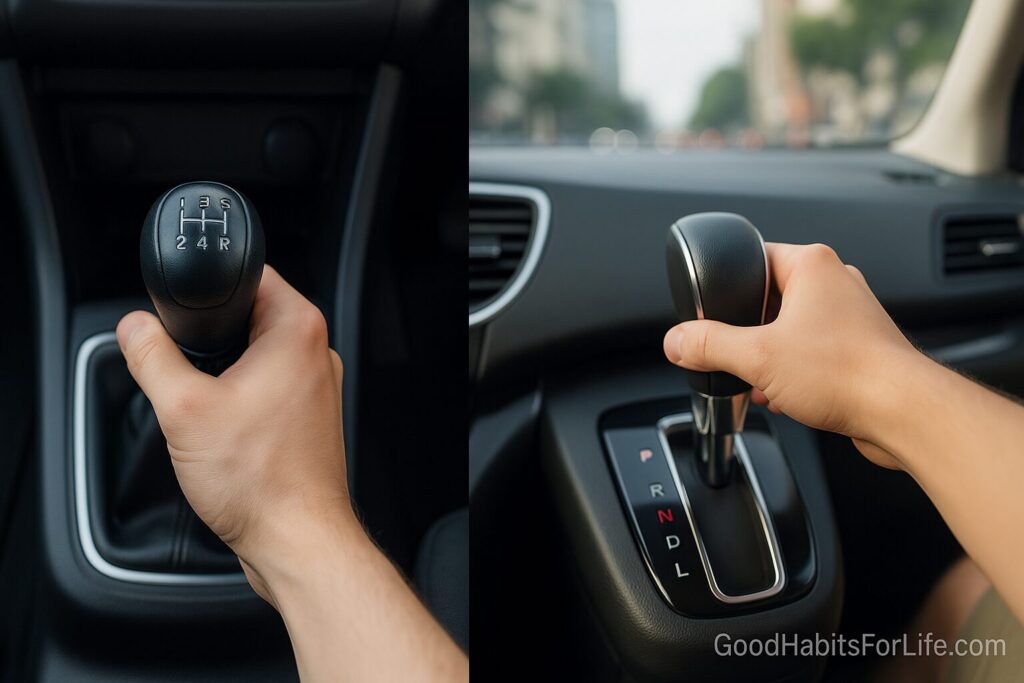
Manual vs Automatic: How to Choose as a Beginner
Manual vs Automatic: How to Choose as a Beginner
Table of Contents
🧭 What this choice really means
“Manual vs automatic” is about how the car handles gears.
-
Manual (stick shift): You choose the gear using a clutch pedal and gear lever. You control engine power delivery and can “feel” the car more directly.
-
Automatic: The car shifts for you (via torque converter, CVT, or dual-clutch mechanisms). You focus on steering, braking, speed, and road awareness.
For first-time drivers, the decision affects learning curve, confidence, daily stress, cost, and availability of cars in your market. There is no one “best”; there’s a best for your situation.
✅ Pros & Cons at a Glance (Comparison Table)
| Factor | Manual | Automatic |
|---|---|---|
| Learning curve | Steeper (clutch bite, hill starts, stall risk) | Easier (no clutch or shift timing) |
| City traffic | Tiring (frequent shifting) | Relaxed; better focus on traffic |
| Control/engagement | High (gearing, engine braking) | Moderate to high (manual modes/paddles in many cars) |
| Purchase price | Often lower on comparable models | Often higher; autos standard on many new cars |
| Maintenance risk | Clutch wear if misused; cheaper transmissions overall | Generally reliable; repairs can be costly if they fail |
| Fuel economy | Historically better; now similar or slightly worse vs modern autos | Modern autos/CVTs often match or beat manuals |
| Resale options | Good for enthusiasts; fewer buyers in some markets | Broadest appeal and availability |
| Availability of models | Shrinking on new cars in many countries | Very common; some markets are almost all automatic |
| Hill starts & parking | Requires skill; handbrake technique | Easy with creep and hill-hold |
| Licensing (local rules) | May limit you to manuals/allow both; check your authority | Auto-only license may restrict driving manuals later |
Bottom line: If you’re anxious about stalling or drive mostly in stop-start traffic, automatic is simpler. If you’re excited to master skills, want maximum control (snow, gravel, mountain roads), or plan to drive older/enthusiast cars, manual is rewarding.
🛠️ Quick Start: Decide in One Weekend
Day 1 (2 hours):
-
Sit & simulate in both cars (friends, school, rental). Practice pedal feel, visibility, gear lever, parking brake.
-
Short coached drives (15–20 min each). In a quiet area, try starting, stopping, cornering, and a gentle hill.
Day 2 (2 hours):
3. Realistic route test for each: 20–30 minutes through traffic, a hill, a U-turn, and a parallel park.
4. Stress check: Which car lets you keep your eyes up and mirrors active more often?
5. Decision scorecard (0–5 each): Confidence, Traffic comfort, Hills, Parking, Fun, Budget. Pick the higher total.
🗺️ 30-60-90 Roadmap: From “Unsure” to Confident
Days 1–30 — Explore & Choose
-
Book two professional lessons: one manual, one automatic.
-
Practice observation routine: Mirrors → Signal → Maneuver (MSM) and Scanning 12–15 seconds ahead.
-
Use our scorecard across three drives; choose by Day 30.
Days 31–60 — Build Core Skills
-
Manual path: clutch control (bite point holds, hill starts with handbrake), smooth upshifts at ~2,000–2,500 rpm (light cars), downshift rev-matching basics.
-
Automatic path: low-speed precision (creep control), gentle throttle/brake modulation, using manual mode/paddles to manage speed on descents.
-
Both: hazard perception drills, safe following distances (≥2–3 seconds in dry), parking practice (parallel + reverse bay).
Days 61–90 — Real-World Confidence
-
Night + rain sessions; mix of city and ring road/highway.
-
Emergency basics: firm straight-line braking, avoiding target fixation, controlled evasive lane change in a clear, empty area.
-
Prepare for licensing exam (local checklist; mock test with instructor).
🧠 Techniques & Frameworks That Help Beginners
-
“SLLR” Scan: Scan → Locate risk → Leave space → React smoothly. Keeps your eyes up and mind ahead.
-
“Three Smooths” for manual: smooth clutch release, smooth throttle, smooth steering. If one is jerky, pause and reset.
-
Hill-Start Ladder (manual): handbrake on → find bite point → release to just vibrate → add throttle → ease handbrake → roll.
-
Parking Triangle: anchor reference (mirror line), slow crawl, one clean steering input; if off, stop → reset instead of salvaging a bad angle.
-
Speed Control on Descents: manual—downshift 1–2 gears for engine braking; automatic—select L, B, or manual mode if available.
-
Mental Load Rule: if shifting distracts you from mirrors/hazards, choose automatic for now; you can learn manual later when basics are automatic (pun intended).
👥 Variations by Driver
Students/Teens: Pick the option that keeps attention on hazard perception. If friends/family cars are mostly manual, consider learning manual first to stay flexible.
Parents with school runs: Automatic reduces fatigue in heavy traffic and frees attention for complex urban environments.
Professionals with long commutes: Automatic pairs well with adaptive cruise and stop-go traffic.
Seniors returning to driving: Prioritize simplicity, visibility, and fatigue; automatic often wins.
Motorsport/enthusiast track goals: Learn manual for clutch control and heel-toe techniques; later, explore dual-clutch automatics for track consistency.
⚠️ Mistakes & Myths to Avoid
-
Myth: “Manual is always cheaper to run.” Not always—modern automatics (including CVTs) can match fuel economy; total cost depends on model and maintenance.
-
Myth: “Automatic drivers are less skilled.” Skill = observation, spacing, and judgment. Transmissions don’t make safe drivers—habits do.
-
Mistake: Riding the clutch (manual) or resting a foot on the brake (automatic) causing premature wear.
-
Mistake: Ignoring local licensing rules—some jurisdictions issue auto-only licenses that restrict manual driving.
-
Mistake: Buying before testing both in your traffic and hills; showroom spins don’t count.
-
Mistake: Skipping safety tech. For beginners, AEB (automatic emergency braking), lane-keeping alerts, and rear camera meaningfully reduce risk.
🗣️ Real-Life Examples & Scripts
Script to ask an instructor/dealer for the right test:
“I’m a new driver deciding between manual and automatic. Can we do a 25-minute mixed route with a short hill, a U-turn, and a parallel park? I want to compare workload and confidence.”
Manual clutch drill (empty lot):
-
5 reps of start-stop without throttle (find bite, roll 1–2 m, stop).
-
5 reps of gentle upshift 1→2 at low speed; focus on smoothness, not speed.
Automatic precision drill (empty lot):
-
5 reps of 1-meter creep into a parking box without crossing the line.
-
3 reps of reverse into bay using mirrors and slow, steady inputs.
Choosing script for parents/partners:
“I felt calmer and looked further ahead in the automatic; I stalled twice in the manual on hills. Automatic fits my daily traffic, so I’ll start there and add a few manual lessons later.”
🧰 Tools, Apps & Resources
-
Official Driver’s Handbook (your state/country): Learn rules and signs first; pair with hazard perception videos.
-
Instructor-led lessons: A certified instructor accelerates safe habits and exam prep.
-
Dashcam for self-review: Useful for spotting late mirror checks and following-distance mistakes.
-
Check vehicle features: AEB, ESC, hill-hold, rear camera, parking sensors—these help beginners regardless of transmission.
-
Practice planner: 2× 45-min sessions/week; one quiet-area skills, one mixed traffic.
📌 Key Takeaways
-
Pick the transmission that keeps your attention on the road and builds confidence fastest.
-
Automatic suits dense traffic and anxious beginners; manual suits drivers who value control and flexibility.
-
Test each on the same route and score it.
-
Follow a 30-60-90 plan to go from unsure to exam-ready.
-
Whatever you choose, prioritize safety tech and instruction.
❓ FAQs
1) Is an automatic license limiting?
In some places, an automatic-only license restricts you from legally driving manuals. Check your local licensing authority.
2) Are manuals dying out?
Fewer new cars offer manuals in many markets, but they remain popular in enthusiast segments and some regions.
3) Which is safer: manual or automatic?
Safety depends more on driver behavior, speed management, and safety features than on transmission type.
4) Which is cheaper to maintain?
Manuals can have lower transmission repair costs; automatics can be pricier when they fail. However, clutches wear and need replacement on manuals—your total cost depends on model and driving habits.
5) What about fuel economy?
Older manuals often had an advantage; modern automatics, CVTs, and dual-clutch units frequently match or beat manuals. Compare the exact model’s ratings.
6) Can I learn automatic first and manual later?
Yes. Many drivers start in automatics to build road sense, then take targeted manual lessons for clutch control.
7) Do automatics make you a lazy driver?
No. Use the freed mental bandwidth for better scanning, spacing, and anticipation.
8) Are manuals better in snow or mountains?
Manuals offer fine control and engine braking. Many automatics provide manual modes or low-gear selections that work well too.
9) What’s best for hilly, stop-start cities?
Usually automatic, thanks to creep and hill-hold, which reduce stalls and fatigue.
10) I’m buying used—what should I check?
Manual: clutch bite point/slip, smooth engagement. Automatic: fluid condition/history, shift smoothness, no “flare” or shudder. In all cases: maintenance records and a pre-purchase inspection.
📚 References
-
UK DVSA. Learn to drive a car: step by step. https://www.gov.uk/learn-to-drive-a-car
-
NHTSA. Teen Driving & Graduated Driver Licensing. https://www.nhtsa.gov/road-safety/teen-driving
-
AAA. Teen Driving Safety & Choosing a Vehicle. https://teendriving.aaa.com
-
Edmunds. Manual vs. Automatic Transmission: Which is Better? https://www.edmunds.com/car-buying/should-i-get-a-automatic-or-manual.html
-
RAC. Manual or automatic: which is best? https://www.rac.co.uk/drive/advice/know-how/manual-or-automatic-which-is-best/
-
The AA (UK). Manual vs Automatic: Gearboxes Explained. https://www.theaa.com/driving-advice/learning-to-drive/manual-or-automatic
-
Consumer Reports. Car Transmissions: What to Know. https://www.consumerreports.org/cars/car-repair-maintenance/car-transmissions-what-to-know-a1167722251/
-
Transport Canada. Driving: Safety & New Drivers. https://tc.canada.ca/en/road-transportation/driving-safety
⚖️ Disclaimer
Licensing rules, training requirements, and vehicle regulations vary by country/state—always verify with your local licensing authority before booking lessons, tests, or purchasing a vehicle.