
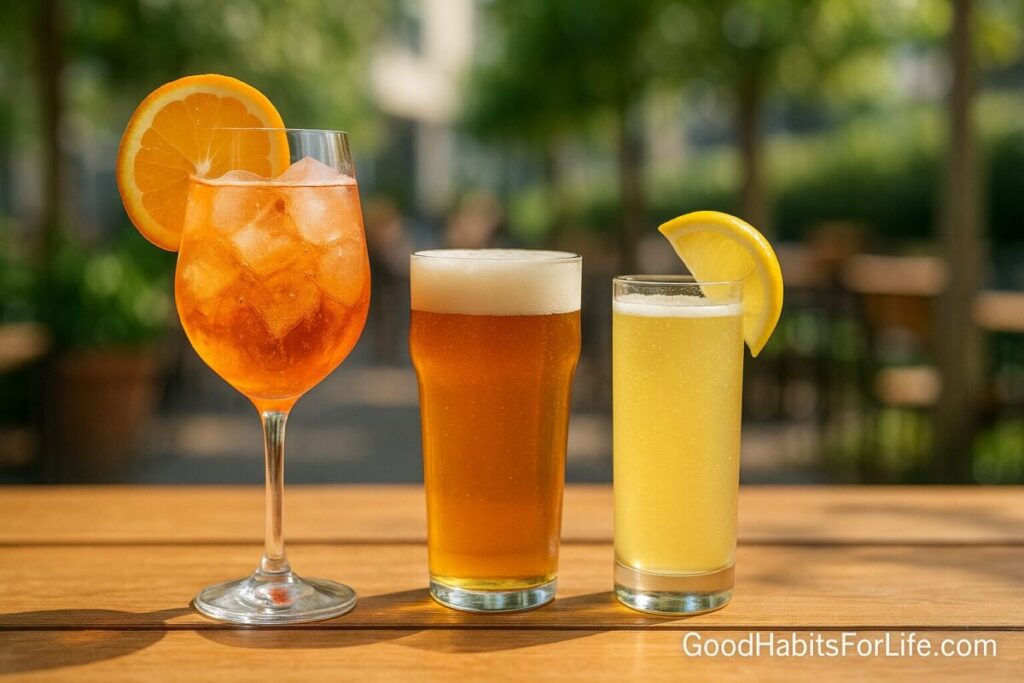
LowABV Choices: Spritzes, Session Ales & Shandies
Low-ABV Drinks: Spritzes, Session Ales & Shandies
Table of Contents
🧭 What Are Low-ABV Drinks & Why They Help
Low-ABV generally means beverages with ~2–5% alcohol by volume (ABV)—far less than typical cocktails (often 12–20% ABV in the glass) or strong craft beers (6–8%+). Popular low-ABV families include:
-
Spritzes / Spritzers: Wine or aromatized wine (e.g., vermouth), bitters, or low-proof liqueurs stretched with soda water.
-
Session ales: Beer styles brewed to be flavorful yet lighter in alcohol—often 3.0–4.5% ABV.
-
Shandies / Radlers: Beer cut with lemonade, citrus soda, or ginger ale; commonly 2–4% ABV.
Benefits
-
Lower ethanol per serving → easier to stay within recommended limits.
-
Slower intoxication curve → more control, clearer judgment, better next-day feeling.
-
Lower calorie load (ethanol is ~7 kcal/g; mixers matter) → easier weight management compared with higher-ABV options.
-
Social fit: You still have a “drink in hand” without overdoing it.
Evidence check: Public health guidance consistently emphasizes counting “standard drinks,” understanding ABV, and pacing to reduce short- and long-term risks. See NIAAA/CDC/NHS/WHO in References.
✅ Quick Start: What to Order or Mix Tonight
At a bar or restaurant
-
“Wine spritzer, please—150 ml white wine topped with soda water in a tall glass.”
-
“Americano (Campari + sweet vermouth + soda) over ice—great bitter low-ABV option.”
-
“Session pale ale around 3.5–4% ABV—what’s on tap?”
-
“Shandy with half-beer, half-fresh lemonade (not syrupy if possible).”
-
“Vermouth & soda with orange slice.”
At home (simple ratios)
-
Wine spritzer: 120 ml dry white wine + 120–180 ml soda water + citrus twist.
-
Vermouth spritz: 90 ml dry or bianco vermouth + 150–200 ml soda + olives/orange.
-
Shandy: 1:1 light lager (3–4% ABV) + lemonade/ginger ale; add lemon slice.
-
Session beer picks: look for labels noting “session” or ABV ≤4.5%.
Pro tips
-
Use tall, narrow glassware and extra ice—keeps dilution cool and steady.
-
Alternate water (250–300 ml) between alcoholic servings.
-
Eat first: protein + fiber slows absorption.
📚 ABV & “Standard Drink” Basics (with examples)
A standard drink is a fixed amount of pure alcohol (ethanol).
-
U.S.: 14 g ethanol ≈ 355 ml beer (5% ABV) OR 148 ml wine (12%) OR 44 ml spirits (40%).
-
U.K.: 1 unit = 8 g ethanol; guidance is expressed in weekly units.
Why this matters: A spritz, shandy, or session ale often contains well under one U.S. standard drink per typical serving—making it easier to stay within limits.
Typical low-ABV ranges & serving ideas (approx.)
| Drink style | Typical ABV | Common serving | Rough standard-drink equivalent* |
|---|---|---|---|
| Shandy / Radler | 2–4% | 330–500 ml | ~0.5–1.0 (US) |
| Session ale | 3.0–4.5% | 330–473 ml | ~0.8–1.2 (US) |
| Wine spritzer (50:50) | ~5–6% in glass | 240–300 ml | ~0.8–1.0 (US) |
| Vermouth & soda | 3–8% (varies) | 180–240 ml | ~0.5–1.0 (US) |
*Indicative only; ABV and pour size change the math. Always check the label/menu and count accordingly.
🛠️ 30-60-90 Habit Roadmap
Day 0 (Baseline): Track one normal week. Log each drink (type, ABV, size, context, mood).
Days 1–30 (Swap & Structure):
-
Default order: Pick one go-to low-ABV (e.g., 3.8% session pale, vermouth spritz).
-
2-drink plan: Max two low-ABV servings on social nights; water between.
-
Home kit: Stock soda water, citrus, one session beer, one vermouth.
-
Weekly review: Note social situations that made it easy/hard.
Days 31–60 (Refine & Expand):
-
Add a second low-ABV you like (e.g., shandy variant).
-
Event strategy: If big night, start with two low-ABV rounds before any higher-ABV.
-
Budget cue: Set a spend cap; low-ABV often costs less.
Days 61–90 (Sustain & Automate):
-
Social scripts (see below) + calendar reminders for “drink-free days.”
-
Data check: Are weekly totals within guidelines most weeks?
-
Make it identity: “I’m a low-ABV person.” Keep your home and social defaults aligned.
🧠 Techniques & Frameworks for Mindful Drinking
-
Standard-drink counting: Use a unit/standard drink calculator; track in notes/app.
-
Pacing: One low-ABV drink per 45–60 minutes; water between; eat first.
-
HALT check-in: If Hungry/Angry/Lonely/Tired, pause; choose no- or low-ABV.
-
Implementation intentions: “If offered shots, then I’ll order a spritz instead.”
-
Environment design: Keep chilled soda water on the table; choose venues with session options.
-
Week plan: Schedule 2+ alcohol-free days; cluster social plans around low-ABV venues.
👥 Audience Variations
-
Students/Young adults: Learn standard-drink math early; pair with food; skip mixed energy drinks; pre-commit ride share.
-
Professionals: Default to vermouth & soda at work events; alternate with sparkling water in the same glassware.
-
Parents/Caregivers: Plan finish-by times to preserve next-morning energy; choose shandies with lower sugar mixers.
-
Seniors: Check for medication interactions; consider smaller pours; prioritize hydration.
⚠️ Mistakes & Myths to Avoid
-
“Low-ABV means I can drink unlimited.” Intoxication can still occur—keep count.
-
Sugar creep: Some shandies/radlers use sweet mixers; choose drier options or dilute more.
-
Driving myths: “I feel fine” ≠ safe/legal. Arrange transport regardless of ABV.
-
Hangover hacks: Water helps, but time and dose are the big levers.
-
Hidden high-ABV: Some “light” craft beers are 5.5–6%—always check the label/tap list.
💬 Real-Life Scripts (Copy-Paste Friendly)
-
At the bar: “What low-ABV options are on? A session ale around 3.5–4% or a vermouth spritz would be great.”
-
At a table: “I’m doing low-ABV tonight—starting with a wine spritzer and water.”
-
When offered a shot: “I’m sticking to low-ABV—happy with a spritz, thanks.”
-
Hosting: “We’re pouring vermouth & sodas and a house shandy—plus plenty of sparkling water and snacks.”
-
Refill pushback: “I’m pacing—water for now; I’ll grab a session beer in a bit.”
🧰 Tools, Apps & Resources
-
Drinkaware Unit/Standard Drink Calculators — quick ABV math; web tools. Pros: simple; Cons: UK-centric units.
-
NIAAA Rethinking Drinking calculators — U.S. standard drinks and risk charts. Pros: authoritative; Cons: UI is basic.
-
Try Dry / Sunnyside / Reframe — tracking, goals, coaching. Pros: habit features; Cons: subscriptions vary.
-
Sparkling water & citrus at home — friction-free low-ABV mixing. Pros: cheap; Cons: needs restocking.
📌 Key Takeaways
-
Know your numbers: ABV + serving size = alcohol dose.
-
Choose low-ABV defaults: spritzes, session ales, shandies.
-
Pace & pair with water and food.
-
Track for 30–90 days to lock the habit.
-
Still count it: low-ABV is lower risk—not no risk.
❓ FAQs
1) What counts as low-ABV?
Roughly 2–5% ABV per serving; compare with typical cocktails in the glass at 12–20% ABV.
2) Are spritzes healthier than cocktails?
They usually contain less alcohol per glass and can be lower in calories, but sugar/mixers vary. Choose dry mixers and keep count.
3) Can I drive after low-ABV drinks?
Not necessarily safe or legal—impairment varies by dose, body size, food, and timing. Arrange transport regardless of ABV.
4) Will low-ABV prevent hangovers?
Lower doses reduce risk, but hangovers can still happen. Dose, pace, hydration, and food are the big levers.
5) Is “session beer” a specific style?
It’s a brewing approach across styles to keep ABV modest (often 3–4.5%) with good flavor.
6) Do alcohol guidelines differ by country?
Yes. The U.S., U.K., and others define standard drinks/units differently. Check your local guidance.
7) Are non-alcoholic (≤0.5%) beers better than low-ABV?
They’re a great option for no/near-zero alcohol. If your goal is less rather than none, low-ABV can be a stepping stone.
8) How do I make a lighter cocktail at home?
Use aromatized wines (vermouth, aperitif wine) and lengthen with soda; more ice and citrus; measure pours.
📚 References
-
World Health Organization (WHO). Alcohol – key facts and risks. https://www.who.int/news-room/fact-sheets/detail/alcohol
-
National Institute on Alcohol Abuse and Alcoholism (NIAAA). What Is a Standard Drink? https://www.niaaa.nih.gov/alcohols-effects-health/overview-alcohol-consumption/what-standard-drink
-
Centers for Disease Control and Prevention (CDC). Alcohol Use and Your Health. https://www.cdc.gov/alcohol/fact-sheets/alcohol-use.htm
-
NHS. Alcohol units. https://www.nhs.uk/live-well/alcohol-advice/calculating-alcohol-units/
-
Harvard T.H. Chan School of Public Health. Alcohol: Balancing Risks and Benefits. https://www.hsph.harvard.edu/nutritionsource/healthy-drinks/alcohol/
-
Dietary Guidelines for Americans, 2020–2025. Alcoholic Beverages. https://www.dietaryguidelines.gov/
-
NHS. Calories in alcohol. https://www.nhs.uk/live-well/alcohol-advice/calories-in-alcohol/
-
NIAAA. Rethinking Drinking – calculators & moderation guidance. https://www.rethinkingdrinking.niaaa.nih.gov/
Disclaimer: This article is for general information only and is not medical advice. If you have health conditions or take medications, consult a healthcare professional before drinking alcohol.