
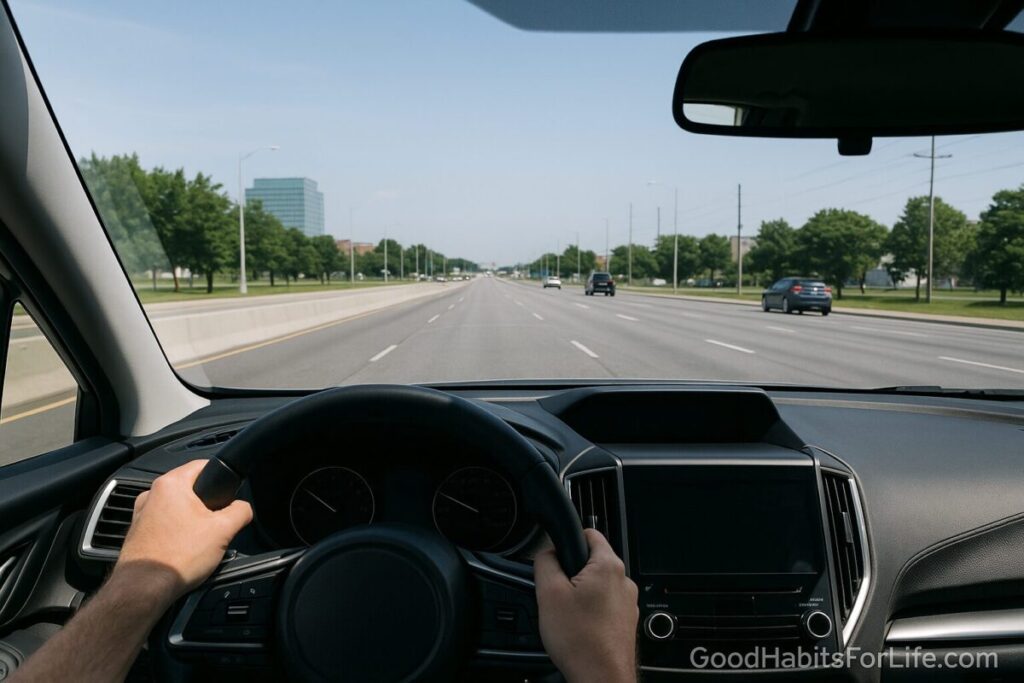
Looking Ahead: Vision, Scanning, and Safe Speed
Looking Ahead: Vision, Scanning & Safe Speed
Table of Contents
🧭 What “Looking Ahead” Really Means
“Looking ahead” is not staring at the bumper in front—it’s keeping your vision high and wide so you can predict what will happen, not just react. A practical target used by driver handbooks is to scan 12–15 seconds ahead of your vehicle: roughly one city block at urban speeds or about 400 m (¼ mile) on highways. That gives you time to change lanes, adjust speed, and avoid last-second swerves. pa.gov
Just as important: sweep your gaze left-to-right across the road scene and mirrors so nothing surprises you from the sides or behind. A simple rhythm is to refresh your scan every 5–8 seconds, with extra attention at intersections and complex environments. Road Safety at Work
Finally, remember speed compounds risk. As average speed rises, both crash likelihood and severity increase—small changes in speed can produce large changes in fatal-crash risk. World Health OrganizationWHO
✅ Quick Start: Do This on Your Very Next Drive
-
Set your eyes up: Pick a point 12–15 seconds ahead and keep returning your gaze there between checks. (In town ≈ one block; on highways ≈ 400 m.) pa.gov
-
Adopt a scan rhythm: Every 5–8 seconds: mirrors → far road → near road → side zones. Road Safety at Work
-
Call out hazards (quietly): “Brake lights two cars ahead,” “Pedestrian near curb,” “Merging truck.”
-
Hold a time gap: Count “one-thousand-one… one-thousand-two…” to the fixed roadside reference. Add more time in rain/night/traffic. GOV.UK
-
Match speed to visibility: If you can’t stop within what you can see, you’re too fast. GOV.UK
-
Intersections: Look left-right-left, then scan crosswalks again as you roll. pa.gov
🛠️ 7-Day Habit Plan (Vision, Scanning & Speed)
Goal: Automate a smooth scan, maintain safe time gaps, and choose speeds you can stop within.
Day 1 – Baseline Drive (15 min):
-
Pick familiar roads. Record a note after: How often did you scan mirrors? Did you spot issues early?
Day 2 – 12–15s Look-Ahead:
-
In clear traffic, keep a focal point 12–15s ahead. If your eyes droop to the bumper, reset. Use a sticky note on the dash: “Eyes UP.”
Day 3 – 5–8s Scan Cycle:
-
Timer vibe: every few breaths, sweep mirrors → far road → near → side streets. Aim for 6+ complete cycles in 15 minutes. Road Safety at Work
Day 4 – Following-Gap Drill:
-
Practice the count with a roadside marker. Hold ≥2s (UK minimum) or 3–4s commonly recommended elsewhere; double in rain; much more on ice. GOV.UKpa.gov
Day 5 – Intersections Focus:
-
Every junction: left-right-left + crosswalk re-check as you roll. Note any hidden sightlines. pa.gov
Day 6 – Speed-to-Vision:
-
Choose a speed you can stop within what you can see (headlights at night = your stopping envelope). If not, slow down. GOV.UK
Day 7 – Hazard Perception Sets:
-
Watch a short hazard-perception clip or simulate by “reading the road” from the passenger seat; narrate latent hazards (parked van could hide a pedestrian, etc.). Research shows targeted training improves this skill. AAA Foundation for Traffic Safety
Weekly checkpoint: Did your braking become earlier/smoother? Fewer last-second lane changes? Short journal note + one improvement to carry forward.
🧠 Techniques & Frameworks That Work
-
SEE / Scan–Evaluate–Execute: Keep eyes moving; evaluate closing speeds, escape paths; execute a small adjustment early rather than a big correction late.
-
12–15s Lead Vision: Re-center your gaze far ahead to avoid “tunnel vision.” pa.gov
-
Mirror Micro-Habits: Every 5–8s, quick left/right/rear glance. Pair it with breaths or signposts. Road Safety at Work
-
Left-Right-Left at Intersections: Vehicles from the left are nearer—look left first, then right, then left again. pa.gov
-
Glance Hygiene: Any in-car glance should be <2s; keep total glance time minimal to preserve forward view. Transport Canada
-
Space Cushioning: Leave escape space to sides; avoid lingering in blind spots. pa.gov
-
Deliberate Practice for Hazards: Short, focused drills (video or supervised practice) build anticipation in novices. AAA Foundation for Traffic Safety
⚖️ Choosing a Safe Speed (and Proving It)
Speed is not just a number on a sign; it’s a stopping-distance equation plus injury math. Evidence shows that even a 1% rise in mean speed increases fatal-crash risk by ~4% and serious-injury risk by ~3%. World Health OrganizationWHO
How to “prove” your speed is safe:
-
Visibility test: Can you stop within the distance you can see to be clear? If not, you’re too fast (especially at night or in fog). GOV.UK
-
Traction test: In rain, gravel, or worn tires, double your following gap and ease off speed pre-corner. GOV.UK
-
Complexity test: More pedestrians, cyclists, side roads, or parked cars → drop speed to raise your thinking margin. GOV.UK
-
Self-check: If you’re often braking late, your chosen speed is too high for the environment.
For context, speeding remains a top contributor in fatal crashes—about 29% of U.S. traffic fatalities recently involved speeding. NHTSA
📏 Following Distance That Buys You Time
At any speed, time beats meters. Use a time gap, not a car-length guess.
-
Base rule: At least 2 seconds (UK guidance) in good conditions; double in wet, up to 10× on ice. GOV.UK
-
Many U.S. manuals advise 3–4 seconds as a general buffer on dry roads; add more for rain, darkness, heavy vehicles, or if someone tailgates you. pa.gov
-
How to measure: When the vehicle ahead passes a sign, start counting. If you reach it before your chosen number, back off.
Remember: larger vehicles and motorcycles need more distance to stop; give them extra space. GOV.UK
🧩 Audience Variations
Teens & Novice Drivers: Prioritize hazard-perception training (videos, coached drives). Narrate what you see out loud to build anticipation. AAA Foundation for Traffic Safety
Parents with Kids in the Car: Reduce secondary tasks; pre-set navigation and playlists; adopt the 2-second glance max rule for any in-car display. Transport Canada
Professionals/Commuters: Use routine routes to practice micro-improvements: smoother approaches to stale green lights, earlier merges, and proactive lane choices.
Seniors: Schedule longer trips for daylight and good weather; extend following gaps; keep eyewear prescriptions current; minimize glare at night.
⚠️ Mistakes & Myths to Avoid
-
Myth: “At the limit = safe.” The posted limit is a ceiling, not a target—conditions often demand less. GOV.UK
-
Mistake: Bumper-fixation. Staring close up causes jerky braking and missed hazards. Reset eyes to the 12–15s zone. pa.gov
-
Mistake: Static gaze. If your eyes aren’t moving every few seconds, you’re missing information. Road Safety at Work
-
Myth: “Two car lengths is fine.” Use time, not car lengths; distance needed changes with speed and traction. GOV.UK
-
Mistake: Screen glances >2s. Long glances dramatically raise miss-rates for hazards. Keep glances short or park. Transport Canada
🗣️ Real-Life Examples & Scripts
-
Merging onto a busy highway:
“Mirrors… signal on… shoulder check… I see a truck 12s ahead closing faster; I’ll build speed to match, then merge behind the van.” -
Approaching a “stale” green light:
“Lead car is slowing, cross-traffic creeping—cover brake, widen gap to 3–4s, check mirrors, prepare to stop smoothly.” -
Night driving on a rural road:
“My headlight reach is my stopping zone. I’ll cruise 10 km/h slower than by day and widen the gap; scanning edges for wildlife eyes.” -
Urban intersections:
“Left-right-left. Pedestrian stepping off curb; I’ll hold speed early, then roll through only when clear.” pa.gov
📚 Tools, Apps & Resources
-
Car features: Forward Collision Warning, Automatic Emergency Braking, and adaptive cruise can help maintain gaps—still keep eyes scanning.
-
Navigation apps (e.g., Google Maps, Waze): Useful for speed-limit reminders and congestion; mute non-essential alerts before driving.
-
Dash cams: Encourage smoother, anticipatory driving (it’s like being observed).
-
Window/Glass care: Clean interior glass to reduce night glare; aim headlights correctly after service.
-
Training: Local advanced-driving or hazard-perception modules for teens and returning drivers—short sessions can yield big gains. AAA Foundation for Traffic Safety
🧾 Key Takeaways
-
Keep your eyes high and scan 12–15s ahead; refresh the scene every 5–8s. pa.govRoad Safety at Work
-
Choose a safe speed you can stop within; speed multiplies both crash likelihood and harm. World Health Organization
-
Use time gaps (2s minimum UK; 3–4s common elsewhere) and expand them for weather, night, and traffic. GOV.UKpa.gov
-
Train hazard perception like a sport—deliberate drills improve what you notice. AAA Foundation for Traffic Safety
❓ FAQs
1) Is it 10, 12, or 15 seconds I should look ahead?
Aim for 12–15 seconds; some handbooks say at least 10 seconds. On highways, that’s roughly 400 m (¼ mile). pa.govdmv.ca.gov
2) What following distance is “safe”?
Use time not meters: ≥2s (UK guidance), with many U.S. manuals teaching 3–4s in dry conditions. Double in the wet; much more on ice. GOV.UKpa.gov
3) How often should I check mirrors?
Build a rhythm every 5–8 seconds, plus before braking, after lane changes, and when approaching hazards. Road Safety at Work
4) Does speeding a little really matter?
Yes. A small rise in mean speed significantly increases fatal and serious-injury risk. World Health Organization
5) How do I manage intersections more safely?
Adopt left-right-left, scan crosswalks again as you roll, and keep a rolling buffer with vehicles ahead. pa.gov
6) How do I know my night speed is safe?
If you can’t stop within your headlight range, you’re too fast—slow down until you can. GOV.UK
7) Can hazard-perception training really help?
Yes—controlled studies show measurable improvements for novice drivers. AAA Foundation for Traffic Safety
8) What if someone tailgates me?
Increase your gap to the vehicle ahead, signal early, and change lanes when safe. Don’t brake-check; it raises collision risk. GOV.UK
📖 References
-
UK Department for Transport. The Highway Code — Rules 125–126 (speed, stopping distance, following gaps). GOV.UK
-
Commonwealth of Pennsylvania. Online Driver’s Manual — Managing Space & Looking Ahead (12–15s; side space; left-right-left). pa.gov
-
World Health Organization. Road traffic injuries (Speed and risk relationships). World Health Organization
-
WHO. Speed Management, 2nd ed. (power-law effect of speed on fatal/serious crashes). WHO
-
NHTSA. Speeding — Key safety facts and campaign page (share of fatalities). NHTSA
-
AAA Foundation for Traffic Safety. Simulator-Based Evaluation of Hazard Anticipation Training (novice drivers). AAA Foundation for Traffic Safety
-
Road Safety at Work (BC). Driver Assessment Guide — Scanning every 5–8 seconds. Road Safety at Work
-
Transport Canada. Guidelines to Limit Driver Distraction from Visual Displays (glance durations). Transport Canada