
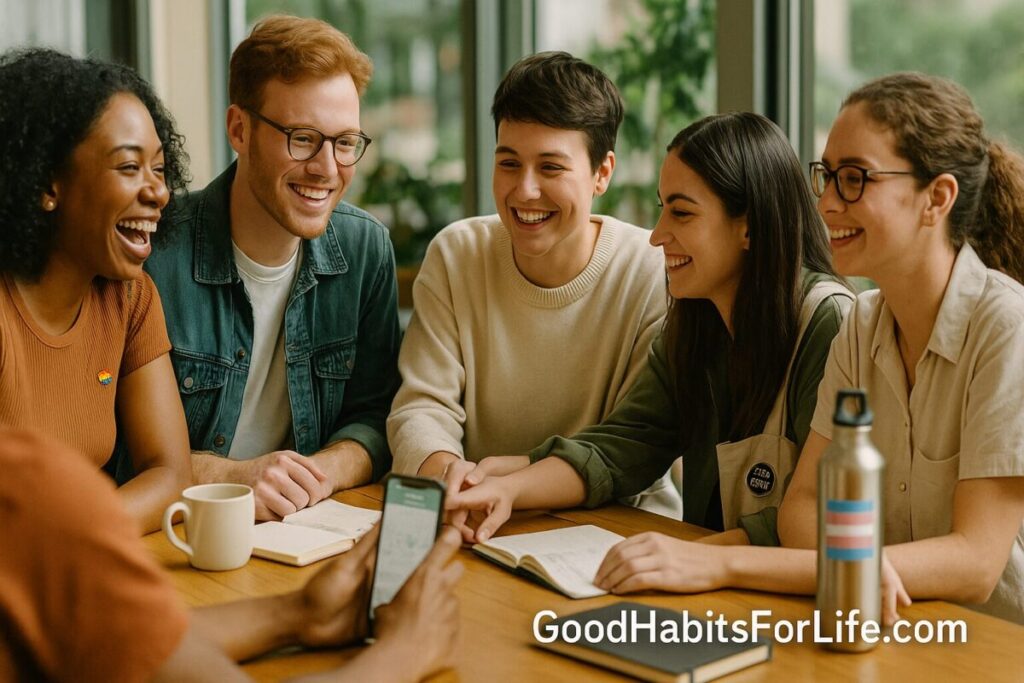
LGBTQ+ Allyship in Friend Groups (2025)
LGBTQ+ Allyship in Friend Groups (2025)
Table of Contents
🧭 What Allyship Looks Like in Friend Groups (and Why It Matters)
Allyship means using your everyday influence to make your friend circle safe and affirming for LGBTQ+ people. It’s not a label; it’s a set of repeatable actions—listening, learning, speaking up, and changing norms so everyone can show up as themselves.
The need is real. LGBTQ+ young people report high levels of distress; in 2024, 39% seriously considered suicide, with higher rates among transgender and nonbinary youth. Inclusive, supportive peers and adults help buffer risk. The Trevor ProjectCDC
Everyday respect is protective. For example, research shows that using a transgender person’s chosen name in multiple settings is associated with lower depression and suicidal ideation. PMC
Small acts add up. Correct pronouns, challenge derogatory “jokes,” and ensure everyone is invited. That consistency—especially from friends—signals belonging and lowers the social cost of being out.
✅ Quick Start: Do This Today
-
Add pronouns to intros. “I’m Asha (she/her). What pronouns do you use?” If you slip, apologize briefly, correct, and move on. GLAAD
-
Set a group norm against slurs and “jokes” that punch down.
-
Practice the 5Ds of bystander action: Distract, Delegate, Document, Delay, or Direct if you witness harassment—start with the safest option. righttobe.org
-
Audit your spaces: group chats, game servers, and gatherings—are they welcoming?
-
Share two resources (e.g., GLAAD’s guide; HRC’s ally primer) and schedule a 15-minute chat to align on norms. GLAADHRC
🛠️ 30-60-90 Allyship Plan for Your Group
Days 1–30 (Foundation)
-
Norms: Publish a simple statement in your group description: “Respect names & pronouns; no slurs; challenge stereotypes; use content warnings when needed.”
-
Signals: Add pronouns in bios/display names. Pin a short “allyship 101” message with do’s/don’ts. GLAAD
-
Safety: Nominate two weekly “ally on duty” buddies who check language, call in kindly, and are point people if harm occurs.
-
Bystander basics: Share a 1-page visual of the 5Ds and rehearse two scenarios. righttobe.org
Days 31–60 (Skills & Systems)
-
Skill-building: 20-minute micro-session on microaggressions (what they are + quick repairs). APA Dictionary
-
Repair protocol: When harm happens, use a consistent flow: Acknowledge → Apologize → Act (change behavior) → Ask (check in).
-
Inclusion ops: Rotate event types (quiet hangouts, accessible venues, non-alcohol options).
-
Resource map: Pin local/national support lines and groups (e.g., Trevor Project, PFLAG chapters). The Trevor Project
Days 61–90 (Culture & Continuity)
-
Review: Short retro: what worked, where people felt excluded, what to fix.
-
Deep-dive topics: Trans allyship, bi erasure, asexual/aromantic inclusion—use established guides. PFLAG
-
Sustain: Keep “ally on duty,” refresh pinned resources quarterly, and celebrate progress.
🧠 Techniques & Frameworks That Work
Pronoun & name respect. Ask how people describe themselves and use those words; it’s a core best practice across leading guides. GLAAD
Microaggression literacy. Learn to spot subtle digs (e.g., “You don’t look nonbinary”). Name the impact, not the intent; repair quickly. APA Dictionary
5Ds bystander intervention. Keep options:
-
Distract: change the subject, ask for directions.
-
Delegate: get help (host, admin, teacher).
-
Document: note details, screenshot with consent.
-
Delay: check in with the person after.
-
Direct: set a boundary (“We don’t use that language here”). righttobe.org
Evidence-aligned support. School connectedness and supportive friendships are protective factors for LGBTQ+ youth—your group culture matters. CDC+1
Language evolves. Trust reputable style guides for terms to use/avoid; when unsure, ask respectfully. GLAAD
Health framing. WHO shifted “gender incongruence” out of mental disorders in ICD-11—affirmation reduces stigma. World Health Organization
🧩 Audience Variations
Students: Normalize pronouns in class group chats; use the 5Ds in hallways and online; invite LGBTQ+ peers to lead on what support looks like (don’t tokenize). righttobe.org
Parents: Model inclusive language at home; learn with your child; connect with local PFLAG for coaching and community. PFLAG
Professionals: Add pronouns in email signatures, advocate inclusive benefits (partner coverage, transition support), and intervene in meetings if jokes appear. Straight for Equality
Seniors: Share stories; ask questions with curiosity; ensure venues are accessible and calm (lighting, seating, hearing support).
Teens: Use group rules in Discord/WhatsApp; if you can’t go Direct, use Distract/Delegate and check in after. righttobe.org
⚠️ Mistakes & Myths to Avoid
-
Myth: “Asking pronouns is awkward.” Reality: it normalizes inclusion and reduces guesswork. GLAAD
-
Myth: “Allyship is political, not personal.” Reality: it’s about safety and respect in your immediate circle.
-
Mistake: Expecting LGBTQ+ friends to educate you—do your own reading first. HRC
-
Mistake: Over-apologizing after a slip; keep it brief and correct. GLAAD
-
Myth: “Being trans is a mental illness.” Reality: ICD-11 reclassified gender incongruence outside mental disorders. World Health Organization
🗣️ Real-Life Examples & Copy-Paste Scripts
Ask pronouns during intros:
-
“Hi, I’m Rahul (he/him). What pronouns do you use?”
If you slip on pronouns:
-
“Sorry—they. Thanks for the correction.”
Shut down a “joke” safely (Direct):
-
“We don’t make jokes about people’s identities here—let’s keep it respectful.”
If Direct feels unsafe (Distract/Delegate):
-
“Hey, can you help me in the kitchen?” (to move target away)
-
DM the host/admin: “Can you step in? A comment crossed the line.”
When someone comes out:
-
“Thanks for trusting us. How can we support you? Anything you’d like shared—or kept private?”
Check-in after harm (Delay):
-
“I noticed that comment. Want to talk? I’m here, and we can address it with the group if you want.” righttobe.org
Name/pronoun updates in chats:
-
“Team update: Alex uses she/they now. I’ve updated our group notes—please use these going forward.” GLAAD
📚 Tools, Apps & Resources (pros/cons)
-
GLAAD Media Reference Guide (11th ed.) — Gold-standard language/pronoun guidance. Pro: clear do/don’t terms. Con: media-oriented but broadly useful. GLAAD
-
HRC — Being an LGBTQ+ Ally — Plain-English ally basics. Pro: accessible; good for newcomers. Con: U.S. framing. HRC
-
PFLAG Ally Guides (2025 update) — Deep ally training; local chapters. Pro: community support; parent-friendly. Con: availability varies by area. PFLAG
-
Right To Be — 5Ds — Practical bystander training. Pro: step-by-step; scenario-based. Con: may require practice. righttobe.org
-
Trevor Project (U.S.) — Crisis support and research. Pro: 24/7 help for youth; authoritative surveys. Con: youth-specific. The Trevor Project
-
CDC LGBTQ+ Youth — Protective-factor approach & school resources. Pro: evidence-based. Con: school-heavy focus. CDC
🧾 Key Takeaways
-
Allyship is action, not a label—make inclusion your group norm.
-
Respecting names/pronouns is simple and powerful—and linked with better mental health outcomes. PMC
-
Use the 5Ds to respond to harassment without escalating risk. righttobe.org
-
A 30-60-90 plan helps you embed allyship into the culture, not just a one-off talk.
-
Keep learning; language evolves—follow credible guides (GLAAD, HRC, PFLAG). GLAADHRCPFLAG
❓ FAQs
1) Is it rude to ask someone’s pronouns?
No—normalize it by sharing yours first: “I’m Zoya (she/they). What pronouns do you use?” If you make a mistake, apologize briefly and move on. GLAAD
2) What if my friends say I’m being “too sensitive” about jokes?
Explain the norm: “We don’t joke about identities.” If pushback continues, use Delegate (host/admin) or Delay (check in with the targeted friend). righttobe.org
3) How do I support a friend who just came out?
Thank them, ask what they need, respect confidentiality, and avoid assumptions. Share resources like PFLAG for family conversations. PFLAG
4) Is being transgender a mental illness?
No. WHO’s ICD-11 places gender incongruence outside mental disorders to reduce stigma and improve care. World Health Organization
5) Does getting pronouns right actually matter?
Yes. Respect reduces harm; research links chosen-name use with fewer depressive symptoms and lower suicidal ideation for trans youth. PMC
6) I’m not confident confronting people. What else can I do?
Use indirect 5Ds (Distract, Delegate, Document, Delay); even a quick check-in after can make a big difference. righttobe.org
7) We’re an online-only friend group. Any tweaks?
Set pinned rules; add pronouns to profiles; moderate slurs; screenshot harassment (Document) and report per platform rules; follow up with targets (Delay). righttobe.org
8) How do we handle disagreements about terminology?
Consult reputable guides (GLAAD/HRC), ask individuals how they self-describe, and update your language accordingly. GLAADHRC
9) My friend’s family isn’t supportive. What can we do as peers?
Offer consistent affirmation, safe hangout spaces, and connections to supportive orgs (Trevor Project, local PFLAG). The Trevor ProjectPFLAG
10) We want one training we can do together. What’s best?
Start with a 30-minute 5Ds practice and a 15-minute pronoun/name etiquette refresher using GLAAD’s materials. righttobe.orgGLAAD
📚 References
-
The Trevor Project. 2024 U.S. National Survey on the Mental Health of LGBTQ+ Young People (key findings & state data). https://www.thetrevorproject.org/survey-2024/ The Trevor Project
-
CDC. Supporting LGBTQ+ Youth | Positive Youth Development. https://www.cdc.gov/healthy-youth/lgbtq-youth/index.html CDC
-
CDC MMWR (2024). Disparities in School Connectedness, Unstable Housing, and Violence Among Transgender and Questioning Students. https://www.cdc.gov/mmwr/volumes/73/su/su7304a6.htm CDC
-
Russell, S.T., et al. (2018). Chosen Name Use Is Linked to Reduced Depressive Symptoms, Suicidal Ideation, and Suicidal Behavior Among Transgender Youth. J Adolescent Health. https://pmc.ncbi.nlm.nih.gov/articles/PMC6165713/ PMC
-
GLAAD. Media Reference Guide (11th ed.). https://glaad.org/reference/ GLAAD
-
HRC Foundation. Being an LGBTQ+ Ally. https://www.hrc.org/resources/being-an-lgbtq-ally HRC
-
PFLAG. Guide to Being an Ally to LGBTQ+ People (FY25). https://pflag.org/wp-content/uploads/2025/06/S4E-LGBTQ-Ally-Guide-FY25.pdf PFLAG
-
Right To Be. The 5Ds of Bystander Intervention. https://righttobe.org/guides/bystander-intervention-training/ righttobe.org
-
APA Dictionary of Psychology. Microaggression (definition). https://dictionary.apa.org/microaggression APA Dictionary
-
WHO. Gender incongruence and transgender health in the ICD (ICD-11). https://www.who.int/standards/classifications/frequently-asked-questions/gender-incongruence-and-transgender-health-in-the-icd World Health Organization
Disclaimer: This guide is educational and not a substitute for professional mental-health or legal advice. If someone is in immediate danger, contact local emergency services.