
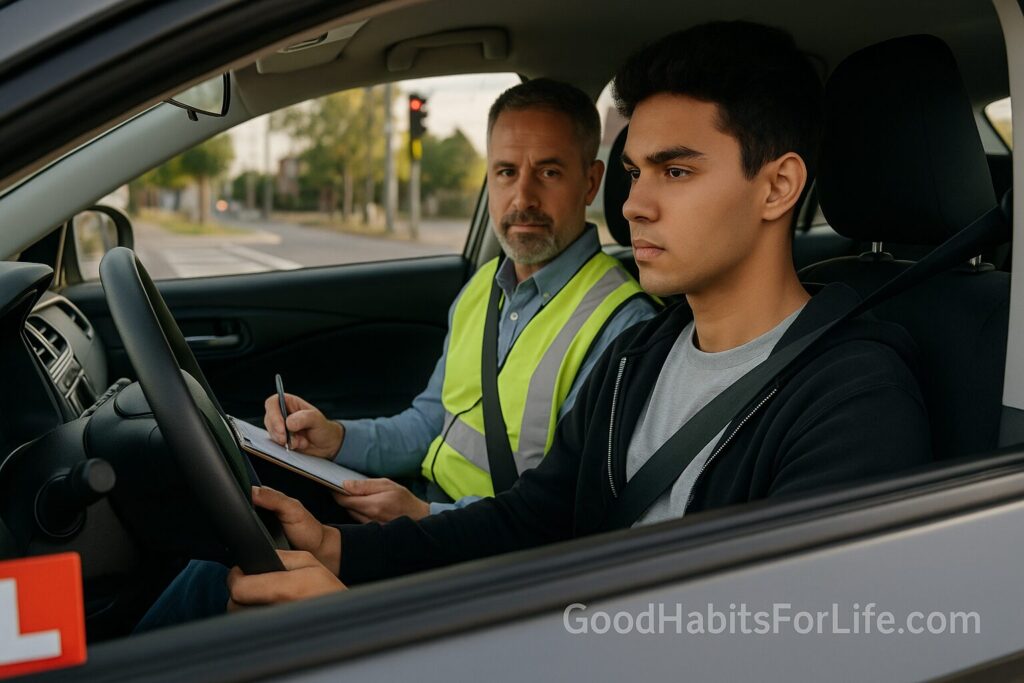
Learners Permit 2025: A PlainEnglish Starter Map
Learner’s Permit 2025: A Plain-English Starter Map
Table of Contents
🧭 What Is a Learner’s Permit?
A learner’s permit (also called a provisional, G1, L-plate, or learner licence) is a restricted licence that allows new drivers to practice on public roads with a supervising driver. It exists to reduce risk while you build skills through a graduated driver licensing (GDL) system—adding privileges as you demonstrate competence.
Why it matters
-
New drivers benefit from structured practice (day/night, different weather, varied routes).
-
Jurisdictions using strong GDL rules see fewer crashes and injuries among teens.
-
Many insurers offer lower premiums once you progress from learner to intermediate stages.
✅ Eligibility, Documents & Costs
Requirements vary by country/state/province. Expect the following common elements:
Typical eligibility
-
Minimum age (often 15–17 years; check local rules).
-
Parental/guardian consent if under the age of majority.
-
Pass vision screening and a knowledge/road-rules test.
-
Pay application and testing fees.
Documents checklist (bring originals)
-
Government photo ID and proof of date of birth (passport, birth certificate).
-
Proof of residency/address (utility bill, lease, bank statement).
-
If underage: consent form and supervising driver details (where required).
-
Medical self-declaration if your jurisdiction requires one.
-
Passport-sized photos (some offices capture a digital photo on site).
Costs
-
Application fee + knowledge test fee + permit card fee (amounts vary).
-
Optional: practice test apps, vision certificate, translation fees (if applicable).
Tip: Many authorities publish a “what to bring” page—print it or save as PDF and tick items off the night before.
🛠️ Quick Start: Do This Today
-
Download the official handbook from your licensing authority (free PDF in most places).
-
Book a knowledge test slot (or check walk-in hours). Choose a morning time when you’re fresh.
-
Create a study plan: 25-minute Pomodoros x 4 per day for one week.
-
Install a practice-test app and do 20 questions daily; mark every wrong item to review.
-
Prepare documents into a clear folder; add two proofs of address just in case.
-
Line up a supervisor + insured car that you’ll practice in, and confirm rules (L-plates, hours, passenger limits).
-
Start a driving logbook (paper or app). Set a reminder to log every session.
🧠 Study Smart for the Knowledge Test
What’s on the test?
Road signs, right-of-way, speed limits, safe following distance, alcohol/drug rules, seat belts/child seats, emergency procedures.
High-yield study tactics
-
Active recall over passive reading: use flashcards; quiz yourself daily.
-
Spaced repetition: review errors after 1 day, 3 days, 1 week.
-
Mix practice: signs + scenarios + calculations (stopping distances).
-
Explain aloud what you’d do at an intersection—teaches decision rules.
Common tricky areas
-
4-way stops and roundabouts
-
Merging vs. yielding
-
School zones and emergency vehicle rules
-
Adverse conditions (rain, fog, night, glare)
Mini-quiz to check readiness (sample)
-
When must you yield at a roundabout? (Answer: to traffic already in the circle; enter when safe.)
-
Minimum following distance at 80 km/h (50 mph)? (At least 3 seconds in good conditions; more in rain/fog.)
-
What does a flashing amber light mean? (Proceed with caution; yield as necessary.)
🚗 Supervised Practice: Rules & Best Practices
Know your restrictions (examples; check local law)
-
Supervisor: fully licensed for X years, seated in the front passenger seat, sober.
-
Zero alcohol/impairment for learner drivers.
-
Display L-plates (or equivalent) where required.
-
Passenger and night-driving limits until you progress to the next stage.
-
No phone use—even hands-free may be restricted for learners.
Build skills by layers
-
Vehicle basics: mirrors, seating, smooth braking/acceleration.
-
Low-traffic areas: parking lot, quiet streets, clutch/creep control (if manual).
-
Core maneuvers: lane changes, turns, roundabouts, parallel parking.
-
Complex environments: arterial roads, night driving, rain, highway entry/exit.
-
Exam simulation: full routes under test conditions with commentary driving.
Safety habits to ingrain
-
S.E.E. (Search, Evaluate, Execute) scanning routine.
-
SMOG (Signal, Mirror, Over-shoulder, Go) for lane changes.
-
2-second rule minimum gap; double in poor conditions.
-
Headlights on in rain/fog; adjust speed to conditions.
-
Stop completely at stop signs; count “one-two” before moving.
📅 30-60-90-Day Roadmap
Day 0–30 (Foundation)
-
Pass the knowledge test and obtain your learner’s permit.
-
10–15 hours: quiet streets + parking lots; master smooth control.
-
Learn 6 core signs per day; finish the handbook once.
-
Log every drive (date, time, weather, distance, skill practiced).
Day 31–60 (Expansion)
-
15–20 hours: mixed traffic, roundabouts, multilane roads.
-
Add night driving (at least 2 hours) and rainy-day practice when safe.
-
Weekly “mock test” on a likely exam route.
-
Review mistakes; re-read relevant handbook sections.
Day 61–90 (Exam Readiness)
-
10–15 hours: highways where allowed; merge, maintain speed, safe following.
-
Perfect parking: parallel, 3-point turn, reverse park.
-
Full simulation: no coaching during the drive, verbalize mirrors and checks.
-
Book the road test; confirm documents, car condition, insurance, and L-plates.
Not all regions require minimum logged hours, but meeting or exceeding common thresholds (often 40–60 hours with night-driving components) improves outcomes and confidence.
📚 Techniques & Frameworks That Work
-
GDL Mindset: Treat each restriction (night, passengers, speed) as a training constraint that builds skill safely.
-
Implementation Intentions (“If-Then”): If I feel rushed at a yellow light, then I will slow and prepare to stop.
-
Pre-Drive Checklist: Seat, mirrors, belt, headrest, doors, parking brake, dashboard warnings.
-
Commentary Driving: Say your observations out loud—forces scanning and anticipation.
-
Deliberate Practice: Isolate weak skills (e.g., roundabouts). Do 5 focused reps, review, repeat.
-
Reflective Log: After each session, write 2 wins + 1 fix. Reinforces learning.
👥 Variations by Region (US/UK/India/Canada/Australia)
Always verify with your local authority; names and steps differ.
United States (DMV/DPS/Secretary of State)
-
Age thresholds and GDL phases vary by state.
-
Often requires a knowledge test, vision test, and parental consent if underage.
-
Many states mandate supervised hours and a waiting period before the road test.
United Kingdom (DVLA/DVSA)
-
Apply for a provisional licence before lessons.
-
Theory test = multiple-choice + hazard perception video clips.
-
“L” plates required; you can drive with a qualified driver or approved instructor.
India (RTO/Parivahan)
-
Apply for Learner’s Licence (LL) online via Parivahan or state portals.
-
Computer-based rules/signs test; LL is typically valid for 6 months.
-
Practice with a valid supervisor; then apply for Driving Licence (DL) test.
Canada (Province-specific: e.g., Ontario G1/G2, BC L/N)
-
Stage names differ (G1/G2, L/N).
-
Written test + vision test; restrictions on passengers, night driving, and highways for early stages.
Australia (State-specific: NSW/VIC/QLD, etc.)
-
Learners display L-plates; strict speed and alcohol rules (0.00 BAC).
-
Logbook hours (e.g., 100+ in some states) often required before the provisional test.
⚠️ Mistakes & Myths to Avoid
-
Myth: “Practice on quiet streets only.”
Reality: Progress to varied conditions (with supervision) to build real-world skill. -
Myth: “Cram the handbook once.”
Reality: Short daily quizzes beat all-nighters. -
Mistake: Rolling stops, not checking blind spots—automatic test fails in many places.
-
Mistake: Over-reliance on reverse camera—use mirrors and head checks first.
-
Mistake: Driving with an uninsured or unsuitable vehicle on test day.
-
Mistake: Ignoring fatigue—schedule sessions when alert; avoid late-night cramming before tests.
💬 Real-Life Scripts & Checklists
Ask a parent/mentor to supervise
“Could we schedule two 45-minute drives this week—one at dusk and one in light rain if it’s safe? I’ll plan routes and log everything.”
Call the licensing office
“Hi, I’m applying for a learner’s permit. Can you confirm the documents I must bring and whether appointments are required for the knowledge test?”
Instructor coordination
“My weak spots are roundabouts and gap selection. Can we spend 20 minutes on each and simulate a test route at the end?”
Test-day checklist
-
Car roadworthy (tires, lights, wipers, plates, fuel)
-
Insurance/registration papers
-
L-plates displayed (if required)
-
Permit + photo ID + appointment confirmation
-
Arrive 15–20 minutes early; silence phone; breathe 😊
🧰 Tools, Apps & Resources
-
Official handbooks & practice tests: Always start here; content matches the exam.
-
Practice-test apps: Fast feedback; watch for outdated or non-official items.
-
Flashcard apps: Great for signs and right-of-way rules (space out reviews).
-
Dashcam or phone mount (supervisor controls it): Useful for reviewing maneuvers afterward.
-
Logbook apps: Automate hours, conditions, routes; some export to PDF for submission.
-
Cones/markers: Practice parking in empty lots without risking other cars.
Pros: structure, feedback, documentation. Cons: some apps are ad-heavy or not aligned with local rules—verify against the official handbook.
🔑 Key Takeaways
-
A learner’s permit is your safe, structured on-road training stage.
-
Know the rules (GDL restrictions) and study smart with active recall.
-
Deliberate, logged practice across conditions builds real confidence.
-
Follow the 30-60-90 plan to reach road-test readiness without rush.
-
Always verify local requirements and bring the exact documents listed by your authority.
❓FAQs
How long is a learner’s permit valid?
Commonly 6–24 months, depending on location. Some regions allow renewals; check your authority’s site.
Do I need insurance as a learner?
Usually you must be covered by the supervising driver’s policy or a separate learner policy. Confirm before driving.
Can I drive alone with a learner’s permit?
No. A qualified supervisor is typically required until you earn the next licence stage.
What car can I use for the road test?
A safe, registered, insured vehicle that meets local requirements (some regions ban heavily tinted windows or require a handbrake accessible to the examiner).
How many hours should I practice?
Aim for 40–60 hours across varied conditions unless your jurisdiction mandates a specific number.
Can learners drive on highways?
Sometimes restricted in early stages (e.g., certain provinces/states). Learn the local rule first; then practice with an instructor.
What score do I need to pass the knowledge test?
Typically 80–90% depending on region. Many tests split into rules + signs sections with separate pass marks.
Do I need L-plates/decals?
Required in several countries (UK, India, Australia, parts of Canada). If required, they must be clearly displayed.
What if I fail the test?
Most places allow retakes after a waiting period (e.g., 1–14 days). Review your weak areas immediately while memory is fresh.
Can I use my own car for learning?
Yes, if the supervisor is qualified and the car is insured and roadworthy. Some prefer instructor cars with dual controls for early sessions.
📖 References
-
World Health Organization — Road traffic injuries: key facts: https://www.who.int
-
U.S. CDC — Teen Drivers: Get the Facts: https://www.cdc.gov/transportationsafety/teen_drivers/
-
U.S. NHTSA — Teen Driving & Graduated Driver Licensing: https://www.nhtsa.gov/road-safety/teen-driving
-
AAMVA — Graduated Driver Licensing (GDL) Best Practices: https://www.aamva.org
-
GOV.UK — Learn to drive a car: step by step: https://www.gov.uk/learn-to-drive-a-car
-
Government of India, Parivahan — Learner’s Licence: https://parivahan.gov.in
-
Government of Ontario — Get a G1 licence: https://www.ontario.ca/page/get-g1-licence-car
-
NSW Government — Getting your learner licence: https://www.nsw.gov.au/driving-boating-and-transport/driver-and-rider-licences/getting-your-learner-driver-licence
-
AAA — Teen Driver Safety: https://exchange.aaa.com/safety/teen-drivers/
Disclaimer
This guide is for general information only; licensing rules change by jurisdiction—always confirm details with your local licensing authority before you apply or drive.