
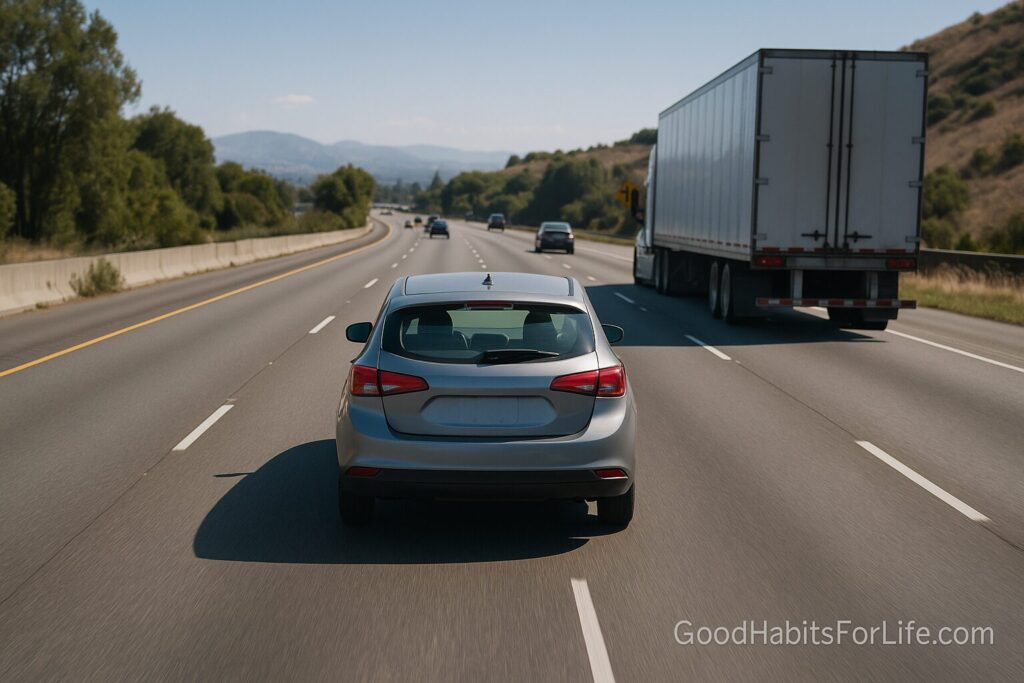
Lane Positioning: Keep Space, Keep Options
Lane Positioning: Keep Space, Keep Options
Table of Contents
🧭 What Lane Positioning Really Means
Lane positioning is the deliberate choice of where you sit within your lane—center, slightly left, or slightly right—to see more, be seen sooner, and keep escape routes. Default to the center for balance, then adjust to widen sightlines (e.g., away from trucks, parked-car doors, or blind bends).
A good lane position supports a space cushion—the time and room around your car to brake, steer, or wait safely. Most state driver handbooks teach a 3-second minimum following gap in ideal conditions and more in poor weather. dmv.ca.govNHTSA
Why it matters
-
More time to react to sudden braking, debris, or erratic drivers.
-
Better line of sight around curves and crests. Federal Highway Administration
-
Fewer surprises from blind spots and door openings.
-
Options to go around a hazard without abrupt, risky moves.
✅ Quick Start: Do This on Your Next Drive
-
Set a time gap. Pick a roadside marker. When the vehicle ahead passes it, count “one-thousand-one…two…three.” If you reach it before 3 seconds, back off. Add more seconds for rain, night, or heavy loads. dmv.ca.govNHTSA
-
Scan far. Keep your eyes aimed 12–15 seconds ahead (about one block in town; 0.4 km/¼ mi on highways) and sweep mirrors every few seconds. pa.gov
-
Center, then adjust. Start centered. Shift slightly left to see past a large vehicle on your right; shift right to avoid a door zone on streets with parked cars.
-
Keep an out. Don’t sit boxed in; offset your position so at least one side stays open. smith-system.com
-
Anticipate merges. If a lane is ending ahead, create a gap early so a merging car can take it smoothly.
-
Near big trucks. Give extra room—they need more to stop and have large blind spots. FMCSA
🛠️ 7-Day Lane Positioning Starter Plan
Goal: build automatic habits for space, sight, and options.
-
Day 1 – Baseline drive (20 min). Measure your current following distance 10 times; write the average.
-
Day 2 – 3-second rule reps. On a regular route, deliberately maintain 3–4 seconds; add +1–2 seconds in traffic waves. dmv.ca.gov
-
Day 3 – 12–15-second scanning. Call out hazards you can see forming (stale green lights, lane drops, pedestrians). pa.gov
-
Day 4 – “Leave an out.” Practice offsetting behind vehicles and avoiding clusters. smith-system.com
-
Day 5 – Weather/night drill. In rain or at night, add 1–2 seconds to your gap and reduce speed; note how visibility changes. NHTSA
-
Day 6 – Intersections & parked cars. Shift right inside your lane to avoid the door zone; shift left to see around obstructions (without crossing lane lines).
-
Day 7 – Review & lock in. Re-measure your average gap; commit to an always-3+ seconds habit (more when conditions worsen).
🧠 Techniques & Frameworks That Work
IPDE / SEE: your decision engine
-
Identify hazards (merging traffic, fading lanes, doors).
-
Predict what could happen (sudden brake, cyclist swerve).
-
Decide your best option (adjust position, slow, signal).
-
Execute smoothly (steer/brake with room to spare). SGI
Smith System (5 keys) applied to lane position
-
Aim High in Steering®: keep a long eye-lead (≈15 s) for earlier, calmer choices.
-
Get the Big Picture®: position for sightlines; don’t tailgate into a tunnel-vision trap.
-
Keep Your Eyes Moving®: frequent mirror checks avoid side surprises.
-
Leave Yourself an Out®: offset in lane; preserve at least one open side.
-
Make Sure They See You®: use signals/positioning that communicates intent early. smith-system.com
The space-cushion, by numbers
-
Minimum: 3 seconds in clear, dry conditions.
-
Increase: add 1–2 seconds for rain, darkness, heavy loads, following motorcycles, or when you’re behind a large truck (longer stopping distances and bigger blind spots). NHTSAexchange.aaa.comFMCSA
🌦️ Adapting to Conditions (Rain, Night, Trucks, Curves, Intersections)
Rain & spray: Slow slightly, add seconds to your gap, and avoid sitting directly behind trucks (reduced visibility from spray). NHTSA
Night: Reduce speed and extend your following gap; your stopping distance must fit inside your headlight range. (Principle: don’t “overdrive” your lights.)
Large trucks & buses: Stay out of their blind spots; when following, add extra time and offset to see the road ahead. FMCSA
Curves & crests: Position to maximize what you can see—do not clip the inside where sight distance shortens. Treat the vanishing/limit point as your speed governor: if it moves away, vision is opening; if it rushes toward you, slow until it stabilizes. Federal Highway Administration
Intersections & parked cars: Shift within your lane to widen sightlines past parked vans or pillars; avoid the door zone by holding slightly left when cars are parked on the right (without leaving your lane).
Motorcycles nearby: Give 3–4 seconds and don’t crowd their lane; they may change position inside their lane to avoid hazards. exchange.aaa.com
On a motorcycle (for readers who ride): Choose the lane path (left/center/right) that gives maximum visibility and space—and change as situations change. dmv.ca.gov
👥 Variations by Driver
Students/new drivers: Make the 3-second rule your non-negotiable; use a passenger to call out “12–15 seconds” scanning targets until it becomes automatic. pa.gov
Daily commuters/professionals: Avoid “platoons.” If you’re boxed in, adjust speed slightly to create offset gaps and reduce stress.
Parents with kids on board: Assume unpredictable stops; run extra following distance and avoid sitting beside trucks.
Seniors: Drive at times/roads with lower complexity; extend following gaps (NHTSA suggests counting to “1004”). NHTSA
⚠️ Mistakes & Myths to Avoid
-
Myth: “The lane center is always best.”
Reality: It’s your starting point—shift within the lane to see and be seen. -
Mistake: Tailgating to “keep traffic moving.”
Fix: Time-based gaps move traffic smoother by reducing brake lights and shockwaves. -
Mistake: Driving blind around curves/crests.
Fix: Let sight distance set your speed and position. Federal Highway Administration -
Myth: “Trucks can stop like cars now.”
Reality: They need more space and have larger blind spots—give them extra margin. FMCSA -
Mistake: Sitting door-zone tight along parked cars.
Fix: Shift slightly left in your lane; slow and cover brake if doors or pedestrians might appear.
🗣️ Real-Life Examples & Scripts
Example 1 — Following a tall SUV that blocks your view
-
Think: “I can’t see around; I’ll increase to 4 seconds and offset left in my lane.”
-
Do: Lift off throttle → count to 3–4 seconds → drift slightly left within lane for a sightline past the SUV.
Example 2 — Approaching a blind right curve
-
Think: “Limit point is closing—vision shrinking.”
-
Do: Ease off → position slightly left of center (within lane) to extend view → re-center as the view opens.
Example 3 — Passing parked cars on the right
-
Script: “Door risk—shift left in my lane, two fingers on brake.”
-
Do: Hold a steady line, eyes scanning mirrors; return to center when clear.
Example 4 — Surrounded by trucks
-
Think: “I’ve lost my out.”
-
Do: Adjust speed ±5–10 km/h to break the cluster, then settle with at least one side open.
🧰 Tools, Apps & Resources
-
Waze / Google Maps / Apple Maps: Early alerts for lane closures and hazards; use for anticipation, not as a crutch.
-
Android Auto / Apple CarPlay: Cleaner prompts reduce head-down time.
-
Dash cams with lane-departure alerts: Useful feedback, but lane positioning is still on you.
-
Driver education refreshers (AAA, state DMV materials): Quick primers on space cushions and scanning techniques. exchange.aaa.comdmv.ca.gov
📌 Key Takeaways
-
Keep a time-based gap (≥3 s) and expand it when visibility, traction, or fatigue worsens. dmv.ca.govNHTSA
-
Center by default; shift within the lane for sightlines, safety, and communication.
-
Look 12–15 seconds ahead; mirrors every few seconds. pa.gov
-
Preserve an escape route—don’t get boxed in, especially near trucks. FMCSA
-
Use IPDE/Smith System to stay proactive, not reactive. SGIsmith-system.com
❓ FAQs
1) What’s better—2 car lengths or 3 seconds?
Time beats distance. Speeds change constantly; 3 seconds adapts automatically (add more in rain/night). dmv.ca.gov
2) How far ahead should I look?
Aim 12–15 seconds ahead (one city block; ~0.4 km/¼ mi on highways) so lane choices are early and smooth. pa.gov
3) When should I shift within my lane?
Anytime it improves visibility or margin—e.g., away from parked-car doors, offset behind tall vehicles, or slightly left on a right-hand bend for a longer view.
4) How much extra space in rain or at night?
Add 1–2 seconds (or more) to your following gap; reduce speed to keep stopping within your visible range. NHTSA
5) What about motorcycles around me?
Give them 3–4 seconds and don’t crowd their lane; they move within their lane to avoid hazards. exchange.aaa.com
6) Do trucks really need special treatment?
Yes—bigger blind spots and longer stopping distances. Stay out of “No-Zones,” and leave more room. FMCSA
7) Is “outside-inside-outside” a good street technique?
Don’t “clip” corners. On public roads, sight distance and legal lane keeping rule your speed and position; stay within your lane and let visibility guide you. Federal Highway Administration
8) I’m teaching a teen—what one habit matters most?
Space first. Make the 3-second rule a reflex, then layer scanning, mirrors, and lane adjustments. dmv.ca.gov
📚 References
-
California DMV. Driver Handbook – Safe Driving (following distance). https://www.dmv.ca.gov/portal/handbook/california-driver-handbook/safe-driving/ dmv.ca.gov
-
Pennsylvania DMV. Managing Space (12–15 seconds ahead). https://www.pa.gov/agencies/dmv/driver-services/pennsylvania-drivers-manual/online-drivers-manual/everyday-driving-skills/managing-space.html pa.gov
-
NHTSA. Driving in Severe Weather. https://www.nhtsa.gov/road-safety/driving-in-severe-weather NHTSA
-
NHTSA. Driving Safely While Aging Gracefully. https://www.nhtsa.gov/older-drivers/driving-safely-while-aging-gracefully NHTSA
-
AAA. Roadway Safety (share the road, 3–4 seconds with motorcycles). https://exchange.aaa.com/safety/roadway-safety/ exchange.aaa.com
-
AAA (Via Magazine). Defensive Driving Techniques (3–4 seconds). https://mwg.aaa.com/via/car/defensive-driving-techniques AAA
-
FMCSA. Following Too Closely: Maintain a Safe Following Distance. https://www.fmcsa.dot.gov/safety/driver-safety/cmv-driving-tips-following-too-closely FMCSA
-
California DMV. Motorcycle Handbook (lane position for visibility & space). https://www.dmv.ca.gov/portal/uploads/2021/03/DL-665-R4-2021.pdf dmv.ca.gov
-
FHWA. Speed Concepts Informational Guide – Sight Distance. https://highways.dot.gov/safety/speed-management/speed-concepts-informational-guide/chapter-4-engineering-and-technical Federal Highway Administration
-
SGI (Saskatchewan Government Insurance). The IPDE Method of Driving. https://sgi.sk.ca/handbook/-/knowledge_base/drivers/the-ipde-method-of-driving SGI