
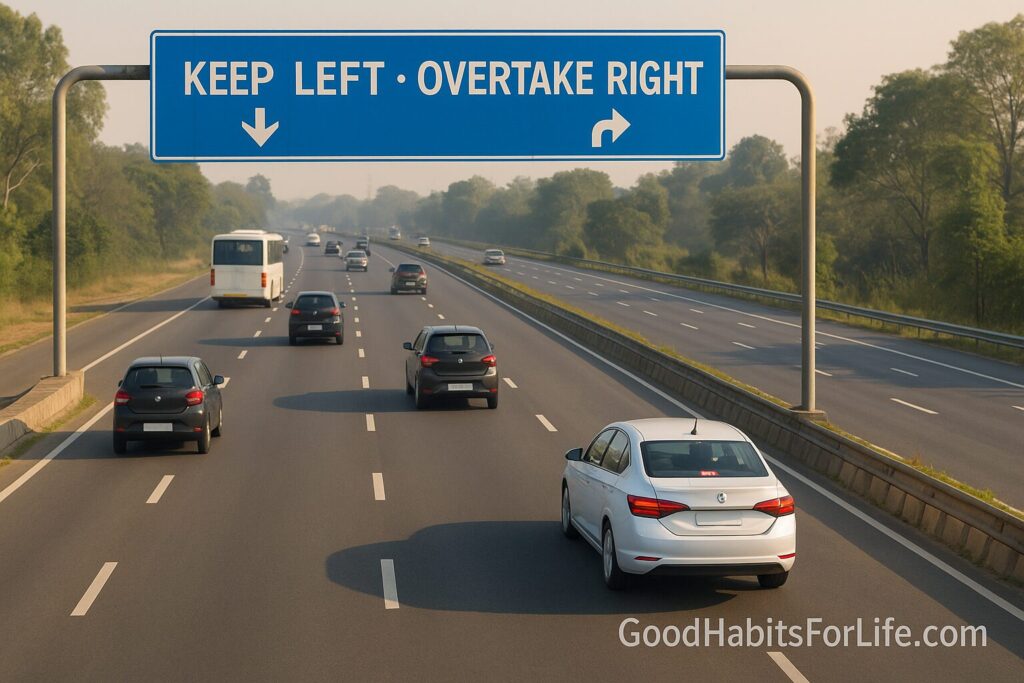
Lane Discipline on MultiLane Highways
Lane Discipline on Multi-Lane Highways (Keep-Left/Pass-Only)
Table of Contents
🧭 What Lane Discipline Means (and Why It Matters)
Definition. Lane discipline is the safe, lawful use of highway lanes so that everyone can travel predictably:
-
In left-hand-traffic countries (e.g., India, UK): keep left, use the right lane to overtake, then move back.
-
In right-hand-traffic countries (e.g., USA, Canada): keep right, use the left lane to pass, then return.
Why it matters. Good lane discipline reduces speed variance, prevents dangerous weaving, and improves traffic throughput. Research from WHO and the OECD/ITF shows that lower speed variance and proper lane use reduce crash risk and crash severity. Large vehicles have bigger blind spots and longer stopping distances; predictable lane behavior helps everyone anticipate and avoid conflicts.
Core principles.
-
Travel in the correct lane for your speed. Use the passing lane only when overtaking.
-
Overtake on the lawful side, complete the pass briskly, and return to the travel lane.
-
Hold a safe following gap (≥3 seconds in dry conditions).
-
Signal early, check mirrors and blind spots, and maintain steady speed during lane changes.
-
Use zipper merge at lane drops: both lanes fill to the merge point, then vehicles take turns.
✅ Quick Start: Do This on Your Very Next Drive
-
Set your “travel lane.” In LHT countries, that’s the left; in RHT, the right.
-
Pick a 3–4-second gap. Choose a roadside marker; when the vehicle ahead passes it, count “one-one-thousand…” to three (or more).
-
Use mirrors every 8–10 seconds. Left, interior, right—build the habit.
-
Plan overtakes. If you must pass, signal, check blind spot, match-then-slightly-exceed the flow to pass, return promptly.
-
Zipper at merges. Stay in your lane until the merge point; take turns calmly.
-
Exit prep. Move to the correct lane at least 1–2 km (0.6–1.2 mi) before your exit; don’t cut across late.
-
Respect trucks. Never hang in their blind spots; pass decisively and give extra space.
🛠️ 7-Day Lane Discipline Starter Plan
Day 1 — Baseline drive. Record (mentally or in a note) how often you: cruise in passing lane, tailgate, or change lanes without signaling.
Day 2 — Spacing. Maintain a 3–4-second gap (add 1–2 seconds in rain/night).
Day 3 — Mirror rhythm. Every 8–10 seconds, do a mirror sweep; shoulder-check before any lane change.
Day 4 — Pass-and-return drill. Make every pass clean: signal → check → pass decisively → signal → return.
Day 5 — Zipper merge practice. At lane drops, hold your lane, match speed, and alternate merges courteously.
Day 6 — Truck awareness. Identify “no-zones” (front, rear, wide right side). Avoid lingering; leave ≥1 truck length when pulling in.
Day 7 — Review. Re-score your baseline items; aim for zero cruising in the passing lane and 100% signaled, shoulder-checked lane changes.
Checkpoint habit: After each highway trip, ask: Did I pass and return? Did I keep 3+ seconds? Did I zipper? Jot a 10-second score (0–5) in your notes.
🧠 Techniques & Frameworks You Can Trust
The IPSGA / MSM routine (adapted from driver-training standards):
-
Information: mirrors, signals, road signs;
-
Position: pick the correct lane early;
-
Speed: match safe flow (within limits);
-
Gear: if applicable;
-
Accelerate: smoothly through the maneuver.
Combine with MSM/SMC: Mirror → Signal → Manoeuvre (or Signal → Mirror → Check blind spot).
12–15-second scan. Keep eyes up; read traffic two or three blocks ahead (urban) or 400–500 m on highways. Spot slowdowns, lane drops, and exits early.
Safe passing checklist (left-hand traffic; invert for right-hand):
-
Need? Overtake only if necessary.
-
Legal? Dashed lines, no signs prohibiting.
-
Clear? Check mirrors/blind spot; on multi-lane divided roads, ensure the passing lane is free.
-
Execute. Signal, move right, pass briskly.
-
Return. When you see both headlights of the passed vehicle in your mirror with ≥2–3 seconds gap, signal and return left.
Zipper merge (late merge) best practice. Use both lanes to the taper; 1-for-1 alternating at the merge point reduces queue length and road-rage incidents.
Speed harmony. Choose a lane that matches your speed within legal limits. High speed variance (too slow in a fast lane, or too fast in a slow lane) multiplies conflict points.
Heavy vehicles & blind spots. Trucks/buses have large “no-zones”:
-
Front: don’t cut in; they need longer stopping distance.
-
Sides: especially the wide right side in LHT (left side in RHT) has a deep blind spot.
-
Rear: if you can’t see their mirrors, they can’t see you.
👥 Variations by Audience
New drivers / students. Start with one goal per drive (e.g., 100% signal use). Ask a coach to quiz you: Which lane are you in and why? Practice calm re-entry from the passing lane.
Professionals / commuters. Pre-plan the two most reliable lanes for your route (often the travel lane plus one buffer). Use predictable indicators and avoid “lane-shopping.”
Seniors. Increase your following gap to 4–5 seconds; pick lanes with lower speed variance; avoid rush hours and night glint if glare affects vision.
Teens. Stick to posted limits; don’t chase gaps. If tailgated, signal and change lanes to let them pass—don’t brake-check.
⚠️ Mistakes & Myths to Avoid
-
Myth: “The rightmost/leftmost lane is the ‘fast lane’ to cruise in.”
Truth: It’s the passing lane; cruising there invites tailgating and aggressive undertakes. -
Mistake: Drifting between lanes or “shopping” for tiny gains.
Fix: Pick the correct lane for your speed; minimize lane changes. -
Mistake: Overtaking on the wrong side.
Fix: Pass only on the lawful side in your country; know the rule before you drive. -
Mistake: Cutting in front of trucks.
Fix: Leave a full vehicle length (or more) before returning to the travel lane. -
Mistake: Early merge at long lane closures causing long queues.
Fix: Zipper at the merge point; it’s safer and more efficient when done courteously.
📋 Real-Life Examples & Copy-Paste Scripts
Script 1 — Clean pass & return (LHT; invert for RHT).
“Mirrors left-center-right, signal right, quick shoulder check… move right, steady throttle +3–5 km/h to pass, see both headlights of the vehicle I passed in my mirror, signal left, shoulder check, return left, cancel signal.”
Script 2 — Being tailgated in the travel lane.
“Signal early, check, change one lane to let them by; re-establish 3–4-second gap.”
Script 3 — Zipper merge at a lane drop.
“Hold my lane to the merge point, match speed, make eye contact if possible, alternate 1-for-1, smooth throttle, no horn.”
Script 4 — Preparing for an exit.
“2 km out: move to the correct lane, set cruise to legal speed, maintain 3–4 seconds, signal 300 m before the diverge.”
📚 Tools, Apps & Resources
-
Google Maps / Apple Maps / Waze. Lane-level guidance near major interchanges can reduce last-second swerves. Pros: familiar, voice prompts. Cons: occasional late prompts.
-
Android Auto / Apple CarPlay. Keeps eyes up with dash display + voice; minimize phone handling.
-
Dash cams. Encourage smoother, more lawful driving and help review habits.
-
Driver-assist (LDW/LKA). Lane departure warning/keeping assist can nudge you back, but you are responsible—treat it as a safety net, not a chauffeur.
-
Checklists. Keep a small card: Scan—Signal—Shoulder—Smooth—Space—Return.
🔑 Key Takeaways
-
Keep-left/pass-only in LHT countries (or keep-right/pass-only in RHT).
-
Choose a lane that matches your speed within limits; don’t cruise in the passing lane.
-
Space saves: 3–4 seconds gap (more in poor conditions).
-
Signal, check, execute, return—every pass, every time.
-
Zipper merge politely; use predictable, steady driving near lane drops and exits.
-
Respect trucks’ no-zones and longer stopping distances.
❓ FAQs
1) Which lane should I cruise in on a three-lane highway?
In LHT countries: cruise in the left/middle depending on speed and conditions; use the right only to overtake. In RHT: cruise in the right/middle and use the left for passing.
2) Is it illegal to stay in the passing lane?
Many regions penalize “lane hogging.” Laws vary, but generally, the passing lane is not for cruising. Move back to the travel lane when safe.
3) How big should my following gap be at 100 km/h (62 mph)?
A minimum of 3 seconds in dry conditions; increase to 4–6 seconds in rain, poor visibility, at night, or when following large vehicles.
4) What’s the safest way to merge when a lane ends?
Use the zipper merge: both lanes proceed to the merge point and alternate in turn. Match speed and signal early.
5) Can I pass on the left/right if traffic is slow?
Follow your country’s rule. Some jurisdictions allow passing on the “non-standard” side only in slow, congested traffic. Know the local law.
6) How do I handle a truck blocking my view?
Increase your gap to see around, or change lanes to pass lawfully. Don’t tailgate; trucks need much longer to stop.
7) What if someone tailgates me while I’m already at the limit?
Keep calm. Signal and move over when safe; maintaining space ahead protects you from chain-reactions.
8) Do lane-keeping systems mean I can relax?
No. Driver-assist is only a backup. Keep hands on the wheel and eyes up.
9) How early should I get into the exit lane?
Aim for 1–2 km ahead on high-speed roads. Avoid late, multi-lane dives to the exit.
10) Is the middle lane a “neutral” lane I can always sit in?
Only if your speed fits its flow. If you’re not passing and a slower lane is available, return there.
📚 References
-
UK Government. The Highway Code – Motorways (Rule 264: Lane discipline). https://www.gov.uk/guidance/the-highway-code/motorways-253-to-273
-
Government of India (MoRTH). Rules of the Road Regulations, 1989 (Keep Left; Overtaking). https://morth.nic.in/sites/default/files/Rules_of_the_Road_Regulations_1989.pdf
-
World Health Organization. Road traffic injuries – Fact sheet. https://www.who.int/news-room/fact-sheets/detail/road-traffic-injuries
-
OECD/International Transport Forum. Speed and Crash Risk. https://www.itf-oecd.org/speed-and-crash-risk
-
Minnesota Department of Transportation. Zipper Merge. https://www.dot.state.mn.us/workzone/zipper.html
-
Federal Motor Carrier Safety Administration. Tips for Sharing the Road with CMVs (No-Zones). https://www.fmcsa.dot.gov/ourroads/tips-drivers-sharing-road-safely-commercial-motor-vehicles
-
Federal Highway Administration (USA). Manual on Uniform Traffic Control Devices – Lane Use Control Signals. https://mutcd.fhwa.dot.gov/htm/2009r1r2/part4/part4e.htm
-
Road Safety Authority (Ireland). Road Positioning & Overtaking Basics. https://www.rsa.ie/road-safety/road-users/drivers/road-positioning
⚖️ Disclaimer
This article offers general driving-safety information, not legal advice; always follow your local highway code and posted signs.