
Kids & Saving: From Jars to Bank Apps: No-Spend Challenge (2025)
Kids & Saving: No-Spend 2025 — Jars to Bank Apps
Table of Contents
🧭 What & Why: No-Spend for Kids, From Jars to Apps
A No-Spend Challenge for kids is a short, game-like period (7–30 days) where a family buys only essentials. It builds delayed gratification, helps kids separate needs from wants, and shifts pocket-money toward saving goals. Educators and consumer organizations recommend structured challenges to boost awareness and savings. The GuardianWhat’s Happening Around Florida
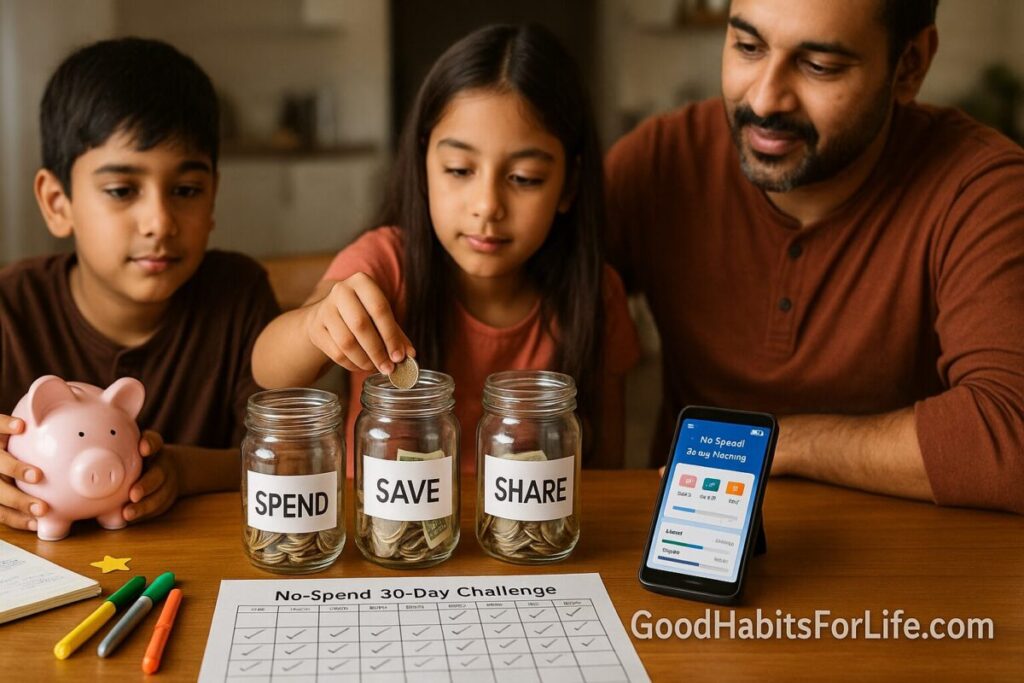
Start with the classic “Spend-Save-Share” jar method, then graduate to youth accounts and (carefully chosen) apps so children practice with real-world digital money under supervision. The U.S. Consumer Financial Protection Bureau (CFPB) offers age-appropriate activities—including saving jars—for young children through teens. Consumer Financial Protection Bureau+3Consumer Financial Protection Bureau+3Consumer Financial Protection Bureau+3
Why now? The OECD’s latest student financial literacy results link higher literacy to more saving and smarter shopping—students who perform well are 72% more likely to save and 50% more likely to compare prices. Building these habits early matters. OECD
Age note: Many money skills begin forming between ages 3–7, so starting early with concrete tools (like jars) helps. (Habits aren’t “fixed,” but early practice pays off.) MaPSaltorwealth.com
✅ Quick Start: Do-This-Today Plan
-
Set a Kid-Visible Goal: “Save ₹500 ($6) for a book by month-end.” Tie it to the Save jar/app goal tracker. Consumer Financial Protection Bureau
-
Declare Your No-Spend Rules: Essentials only (food at home, school needs). No toys, in-app buys, or takeout. The Guardian
-
Create/Label Three Jars: Spend, Save, Share. Add stickers. Start with a 60/30/10 split (adjust by age). Consumer Financial Protection Bureau
-
Open/Link a Youth Account (where allowed) and turn on alerts/limits; schedule a tiny weekly auto-transfer (₹50/$1). FDIC
-
Daily Check-In (2 minutes): “What did we skip? How much moved to Save?”
-
End-of-Week Review: Count the jar/balance, celebrate progress, and pick a free family reward (picnic, game night).
🛠️ The 7-Day No-Spend Challenge (Printable Rules)
Goal: Save ₹350–₹700 ($4–$8) this week.
House Rules
-
Essentials only: groceries, school, transport.
-
Freeze toys, snacks outside the plan, premium in-app purchases, and non-school streaming rentals. OECD
-
Swap with free fun: library books, park time, board games, cooking at home. The Guardian
-
Track daily: sticker chart or app note.
-
Every rupee saved → Save jar / account. Consumer Financial Protection Bureau
Daily Prompts
-
Mon: List needs vs wants together.
-
Tue: Hunt 3 “free fun” swaps.
-
Wed: Pantry challenge dinner.
-
Thu: 24-hour pause on any “want.”
-
Fri: Compare prices (two shops). OECD
-
Sat: Family “trade & share” day (donate 1 item).
-
Sun: Count savings; set next week’s micro-goal.
Jar Split Cheatsheet (suggestion)
| Age | Spend | Save | Share | Notes |
|---|---|---|---|---|
| 5–7 | 70% | 20% | 10% | Keep coins visible; weekly counting. Consumer Financial Protection Bureau |
| 8–12 | 60% | 30% | 10% | Add a simple bank visit 2–3×/yr. Consumer Financial Protection Bureau |
| 13–17 | 50% | 40% | 10% | Youth account + alerts; compare prices. Consumer Financial Protection BureauOECD |
🧠 Techniques & Frameworks That Work
-
Three Jars → Youth Account Ladder: Start tactile (coins in jars), then mirror the same categories as sub-savings goals in an app/account. Consumer Financial Protection Bureau
-
Pay-Yourself-First Rule: Auto-move a small % of allowance/earnings to savings on “pay day.” Consumer Financial Protection Bureau
-
Needs vs Wants Sorting: Practice during shopping and online carts; teens can screenshot and label. OECD
-
Price-Comparison Habit: Make it a game—two shops, lowest total wins. Linked to better financial behavior in OECD data. OECD
-
Spending “Pause” Button: 24-hour rule for non-essentials (kids place the wanted item on a wish list). What’s Happening Around Florida
-
In-App Purchase Controls: Require password/biometric, vendor blocks, and SMS alerts to catch repeat game charges. OECD
👥 Audience Variations (Kids, Tweens, Teens)
Ages 5–7 (early primary):
-
Use clear jars and picture goals; count coins together. Short challenges (3–7 days). Consumer Financial Protection Bureau
Ages 8–12 (tweens):
-
Add a simple bank deposit ritual 2–3×/year; practice goal-breakdowns (₹600 goal → ₹50/week × 12 weeks). Consumer Financial Protection Bureau
Ages 13–17 (teens):
-
Youth account with co-sign/guardian as local rules require; set alerts, category limits, and weekly reviews. Link to part-time income if any. FDIC
Country rule example (India, 2025): RBI’s revised guidelines allow many minors aged 10+ to open and operate accounts independently, within bank-set limits; guardians can still open accounts for younger kids. Check your bank’s policy. PdicaiMondaq
⚠️ Mistakes & Myths to Avoid
-
Myth: “Money habits are fixed by age 7.” Early skills form then, but habits continue to evolve with practice—so it’s never “too late.” MaPSaltorwealth.com
-
Skipping privacy checks on apps. Confirm parental controls and data practices; COPPA in the U.S. protects under-13s. Recent enforcement shows why diligence matters. Federal Trade CommissionThe Verge
-
Only cash, never digital. Kids need both tactile and digital practice to be ready for real-world payments. Pair jars with supervised digital tools. Consumer Financial Protection Bureau
-
All-or-nothing challenges. Start short, adjust rules, and keep it fun to avoid rebound spending. The Guardian
💬 Real-Life Examples & Scripts
Jar Kickoff (Age 6):
“Here are three jars. Every time you get money, we’ll put some in Save for your book, some in Share to help others, and the rest in Spend for small treats.”
Teen Pause Rule (Age 14):
“You can buy this on Saturday if it’s still a want after 24 hours and it fits this month’s budget. Screenshot two prices and pick the better deal.”
Family Review Night (All ages):
“What did we skip this week? How much did that add to Save? What’s our free fun plan tomorrow?”
🧩 Tools, Apps & Resources (Pros/Cons)
-
CFPB “Money as You Grow” (free activities): Age-wise worksheets; strong for jar method and talks. Pro: evidence-based; Con: U.S.-centric. Consumer Financial Protection Bureau
-
FDIC “Money Smart for Young People”: Classroom-grade lessons for K-12; great for homeschool. Pro: comprehensive; Con: educator-oriented. FDIC
-
OECD PISA Financial Literacy (parents/teachers): Data and examples that motivate teens to compare prices/save. Pro: global evidence; Con: not a “how-to.” OECD
-
Youth Banking Resource Center (FDIC): Shows why pairing accounts with education works. Pro: program evidence; Con: U.S. focus. FDIC
-
MoneyHelper (UK) guides: What to cover at each age; simple parent tips. Pro: practical; Con: UK terms. MaPS+1
-
Privacy Readiness: FTC Children’s Privacy page—know your rights and app duties. Pro: authoritative; Con: legal language. Federal Trade Commission
📌 Key Takeaways
-
Start with jars, then graduate to accounts/apps with controls. Consumer Financial Protection Bureau+1
-
Run short, fun No-Spend sprints to practice needs vs wants and boost savings. The Guardian
-
Use auto-saves, alerts, and price-checks to cement habits teens will use for life. OECD
-
Keep it privacy-safe and age-legal when using tech. Federal Trade Commission
❓ FAQs
1) What’s the best age to start?
As early as 3–7 for simple concepts (jars, counting, waiting). Add bank visits or youth accounts later. MaPSConsumer Financial Protection Bureau
2) How long should a No-Spend Challenge be for kids?
Start with 7 days; extend to 14–30 once it’s fun and achievable. The Guardian
3) Should kids get an allowance?
An allowance can teach saving and planning; keep the amount modest and tie it to goals. HealthyChildren.org
4) Are youth debit cards/accounts safe?
Look for guardian controls, alerts, spending caps, and clear fee disclosures; pair account use with education for best outcomes. FDIC
5) Can kids open bank accounts themselves?
Depends on your country/bank. Example: India’s RBI (2025) allows many minors 10+ to operate accounts with bank-set limits. Always check local policy. PdicaiMondaq
6) How do we prevent surprise in-app purchases?
Turn on password/biometric locks, block certain vendors, and enable bank alerts. OECD
7) What if my kid resists the challenge?
Shorten the duration, add free-fun swaps, and give kids ownership (they pick the goal and rules). The Guardian
📚 References
-
OECD. PISA 2022 Results (Vol. IV): Students’ Financial Literacy (2024). OECD
-
CFPB. Money as You Grow (age-wise activities & milestones). Consumer Financial Protection Bureau
-
CFPB. Young Children: Explore Saving (jar activity). Consumer Financial Protection Bureau
-
CFPB. School-Age Children & Preteens: Explore Saving (bank visits 2–3×/yr). Consumer Financial Protection Bureau
-
FDIC. Youth Banking Resource Center (account + education impact). FDIC
-
MoneyHelper (UK). Teaching kids about money: what to cover at each age. MaPS
-
FTC. Children’s Privacy (COPPA). Federal Trade Commission
-
The Guardian. How to succeed at the no-spend challenge (2024). The Guardian
-
RBI (India). Opening and operation in deposit accounts of minors — revised guidance (Apr 21, 2025). Pdicai
-
AZB & Partners. RBI issues revised guidelines on deposit accounts of minors (2025 summary). Mondaq
Disclaimer: This article is for general education only and is not financial advice; check your local laws, bank policies, and privacy rules before opening accounts or using apps.