
Kettlebell Minimalist Strength: 2 Bells, 3 Days: Zone 2 + NEAT (2025)
Kettlebell Minimalist Strength: 2 Bells, 3 Days (2025)
Table of Contents
🧭 What This Plan Is & Why It Works
The idea: a simple, sustainable routine using just two kettlebells to hit the big movement patterns (hinge, squat, push, pull, carry) across three strength days per week, plus Zone 2 aerobic work and NEAT (non-exercise movement) for health and body-composition support.
Why it works
-
Time-efficient, whole-body loading. Kettlebell staples (swings, front squats, presses, rows, carries) train strength, power, and trunk stability efficiently. Controlled studies show kettlebell programs can improve explosive and maximal strength and provide a meaningful cardio-metabolic stimulus. PubMed+1
-
Cardio that you can recover from. Zone 2 (easy, conversational pace) builds aerobic base and metabolic flexibility, pairing well with strength without beating you up. Talk-test and heart-rate ranges are validated ways to gauge this intensity. CDCPubMed
-
NEAT = quiet calorie burn. Daily non-exercise movement (standing, walking, chores) can meaningfully raise total energy expenditure and support weight management. Cambridge University Press & AssessmentAHA Journals
-
Guideline-aligned. You’ll meet global recommendations for strength ≥2 days/week and 150–300 min/week moderate activity. WHO AppsHealth.gov
✅ Quick Start (Do This Today)
-
Pick your two bells
-
Moderate bell you can press for 6–8 reps with solid form.
-
Heavy bell you can swing powerfully for 10–15 reps.
-
Typical starting points: 8–12 kg + 16 kg (many beginners), 12–16 kg + 20–24 kg (stronger/bigger trainees). Adjust by RPE (see below).
-
-
Learn the hinge and clean
Spend 10 minutes on hip-hinge drills (wall taps, dowel hip hinge) and 10 minutes on deadlifts to groove the pattern before swings. -
Schedule your week
-
Mon/Wed/Fri: strength (30–40 min)
-
Tue/Thu or Sat: Zone 2 30–45 min (walk, cycle)
-
Daily: NEAT target 7–10k steps (or +1–2k above baseline)
-
-
Intensity cues
-
Zone 2: you can talk in full sentences; HR ≈ 50–70% of HRmax (rough guide). CDCwww.heart.org
-
Strength: finish sets with 1–3 reps in reserve (RPE ~7–9 on a 10-point CR10 scale). Borg Perception
-
🛠️ Weekly Template (3 Strength Days + Zone 2 + NEAT)
Session format (30–40 min):
5-min warm-up → 20–30 min main sets → 5-min cool-down/breathing.
Day A — Push + Hinge (power emphasis)
-
A1. Single-Arm Clean & Press (moderate bell)
3–4 rounds of 1–3 reps/side ladders (e.g., 1-2-3 x2). -
B1. Two-Hand Swings (heavy bell)
EMOM x 10 min: 10 swings, rest the remainder. -
C1. Offset Front-Rack Carry (mismatched bells OK)
2–3 × 20–40 m, switch sides each lap. -
Optional assistance: Pallof press or dead bug 2–3×8–10.
Day B — Squat + Pull (strength volume)
-
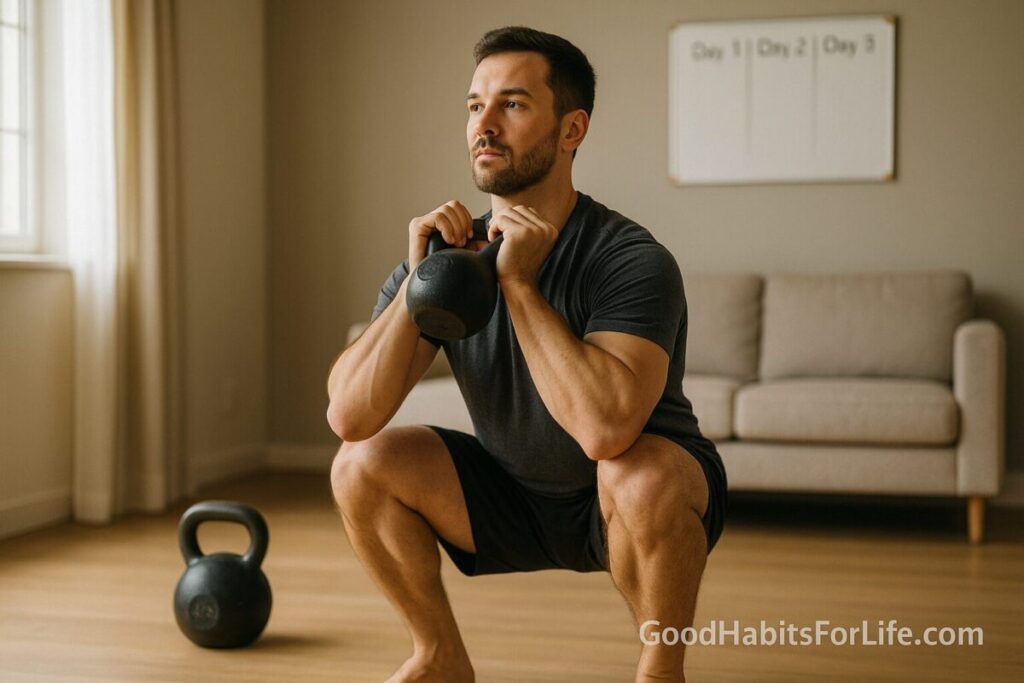
A1. Goblet or Double Front Squat (moderate/heavy)
5×5 @ RPE 7–8. -
B1. One-Arm Row (moderate/heavy)
3×10–12/side; pause at top. -
B2. Romanian Deadlift (single or double bell)
3×8–10; slow 3-sec negatives. -
Finisher: Suitcase Carry (heavy) 3×30–40 m/side.
Day C — Power + Capacity (mixed)
-
A1. Swings (heavy)
30s on / 30s off × 10 (or 10×12–15 reps). -
B1. Push-Ups (or Floor Press with bell)
4×8–12. -
B2. Split Squat (Goblet)
3×8–10/side. -
C1. Turkish Get-Up practice (light)
10 min of crisp singles, alternating sides.
Zone 2 (2–3×/week): 30–45 min brisk walk, easy cycle, or row at talk-test pace (RPE 3–4). CDC
NEAT (daily): walk after meals, stand for calls, take stairs, 2–5 min “movement snacks” each hour. Cambridge University Press & Assessment
🗓️ 30-60-90 Day Habit Plan
Days 1–30 (Foundation)
-
Nail technique (hinge, press, front rack, squat, carry).
-
Progress reps first (e.g., add 1 rep/set weekly up to the cap).
-
Checks: 2–3 Zone 2 sessions/week; daily step trend up.
Days 31–60 (Build)
-
Add one set to key lifts (e.g., squats 5→6 sets across two days).
-
For swings, extend EMOM from 10→12 min or add 1–2 reps.
-
If reps/sets are capped easily, move up a bell.
Days 61–90 (Strong & Simple)
-
Introduce complexes (clean-front squat-press x 3–5 cycles) 1×/week.
-
Keep Zone 2 minutes 150–300 min/week; hold NEAT gains.
-
Checkpoint: photos/measurements, strength log PRs, resting HR trend.
🧠 Techniques & Frameworks That Make It Work
-
RPE / Reps-in-Reserve (RIR): finish sets with 1–3 RIR to progress without grinding. Borg CR10 and RPE scales are validated for regulating intensity. Borg PerceptionPMC
-
Talk Test for Zone 2: able to talk but not sing → you’re in the right zone; closely aligns with ventilatory threshold in studies. PubMedPMC
-
Progression rule: Reps → Sets → Load. When you can hit the top end twice, increase the next variable.
-
Movement minimums per week:
-
Hinge (swings/RDL): 2–3 exposures
-
Squat (goblet/front): 2 exposures
-
Push (press/push-up): 2–3 exposures
-
Pull (rows): 2 exposures
-
Carry (suitcase/rack): 2 exposures
-
-
Density blocks: EMOMs and 20-minute AMRAP-style strength circuits build capacity without form breakdown.
👥 Audience Variations
Beginners
-
Start with deadlifts before swings; keep sets at 2–3; RPE 6–7.
-
Zone 2 20–30 min initially; build +5 min/week.
Busy professionals
-
Make every strength session a trim 30 min:
-
5-min warm-up → A) Main lift 15 min density → B) Swings 10 min EMOM.
-
Older adults (60+)
-
Emphasize controlled goblet squats, carries, and hinge patterning; longer rest.
-
Add balance drills (tandem stands, heel-toe walks). Aligns with guideline emphasis on balance + strength. WHO Apps
Athletic/post-novice
-
Add double-bell front squats and clean & push press if you own a matching pair.
-
Optional power block: swings 15s on/45s off × 15.
⚠️ Mistakes & Myths to Avoid
-
Going too heavy too soon. Own the hinge before high-rep swings.
-
All HIIT, no base. Skipping Zone 2 undercuts recovery and capacity. CDC
-
Death-grip pressing. Use a vertical forearm, crushed-grip only at the finish.
-
Neglecting carries. Carries build anti-lateral-flexion strength for real-life tasks.
-
Inconsistent NEAT. Weekend warrior ≠ daily movement; small bits add up. Cambridge University Press & Assessment
🗣️ Real-Life Examples & Scripts
-
If-Then Plan: “If I finish morning coffee, then I start a 30-min kettlebell session.”
-
Micro-commitment: “Just the warm-up + first block.” Momentum does the rest.
-
Workday NEAT loop: “Every hour: stand, 20 bodyweight squats, 2-min walk.”
-
Zone 2 cue: “Can I chat comfortably? If yes, I’m on pace. If not, slow down.” CDC
🧰 Tools & Resources
-
Two kettlebells (one moderate, one heavy). Add a third later if needed.
-
Timer app (EMOM/intervals) and training log (notes + RPE).
-
Heart-rate monitor (optional): aim for ~50–70% HRmax on Zone 2 days. www.heart.org
-
Stable surface & space for swings/carries; minimalist shoes or barefoot.
📚 Key Takeaways
-
Two bells + three 30–40 min sessions/week deliver serious strength.
-
Layer Zone 2 (talkable pace) and NEAT for health and composition.
-
Progress reps → sets → load while leaving 1–3 reps in reserve.
-
Stick to hinges, squats, presses, rows, and carries; log everything.
-
Keep it easy to repeat—consistency beats complexity.
❓ FAQs
1) How do I choose my two bells?
Pick a moderate bell you can press for 6–8 clean reps and a heavy bell you can swing for 10–15 crisp reps. If uncertain, err lighter and progress by reps first.
2) Can I do this with mismatched bells?
Yes. Use unilateral work and offset carries. Double front squats with mismatched bells are fine if form is solid.
3) How much Zone 2 is enough?
Aim for 150–300 min/week at a talk-test pace you can sustain. Break it into 20–45 min blocks. Health.govCDC
4) I don’t have a heart-rate monitor—how do I find Zone 2?
Use the talk test: full sentences = right zone; struggling to talk = too hard. CDCPubMed
5) Where should I feel swings?
In the hips and hamstrings, not the lower back. If you feel back strain, reset your hinge, shorten sets, and stop before technique breaks.
6) Will kettlebells build muscle?
Yes—especially in glutes, quads, lats, shoulders, forearms—when you progress volume and load and eat enough protein. Studies show strength and power gains with kettlebell programs. PubMed
7) Can I run with this plan?
Yes. Keep easy runs as Zone 2 and place hard sessions away from heavy swing days.
8) What about fat loss?
Combine the plan with a modest calorie deficit and higher NEAT. NEAT meaningfully increases daily burn without extra training stress. Cambridge University Press & Assessment
9) Is this safe for beginners or older adults?
Generally yes with proper instruction, conservative loading, and medical clearance when needed. Prioritize form, balance, and controlled tempo. WHO Apps
10) How do I know I’m progressing?
You’re adding reps, sets, or weight; your Zone 2 pace at the same HR improves; carries feel steadier; and weekly volume trends upward.
References
-
WHO. Guidelines on Physical Activity and Sedentary Behaviour (2020). WHO Apps
-
U.S. HHS. Physical Activity Guidelines for Americans, 2nd ed. (2018). Health.gov
-
Levine JA. Non-exercise activity thermogenesis (NEAT). Proc Nutr Soc. 2003. Cambridge University Press & Assessment
-
Levine JA. Non-exercise activity thermogenesis. Arterioscler Thromb Vasc Biol. 2006. AHA Journals
-
Farrar RE et al. Oxygen cost of kettlebell swings. J Strength Cond Res. 2010. PubMed
-
Lake JP & Lauder MA. Kettlebell swing training improves maximal and explosive strength. J Strength Cond Res. 2012. Lippincott Journals
-
Jay K et al. Kettlebell training for musculoskeletal and cardiovascular health. Scand J Work Environ Health. 2011. PubMed
-
Foster C et al. The talk test as a marker of exercise training intensity. J Cardiopulm Rehabil Prev. 2008. PubMed
-
CDC. Measuring Physical Activity Intensity (talk-test guidance). CDC
-
American Heart Association. Target Heart Rates (moderate ≈ 50–70% HRmax). www.heart.org
-
Borg G. The Borg CR Scales (RPE/CR10 overview). Borg Perception
Disclaimer: This guide is educational and not a substitute for personalized medical advice. Consult a qualified professional before starting or changing your exercise program.