
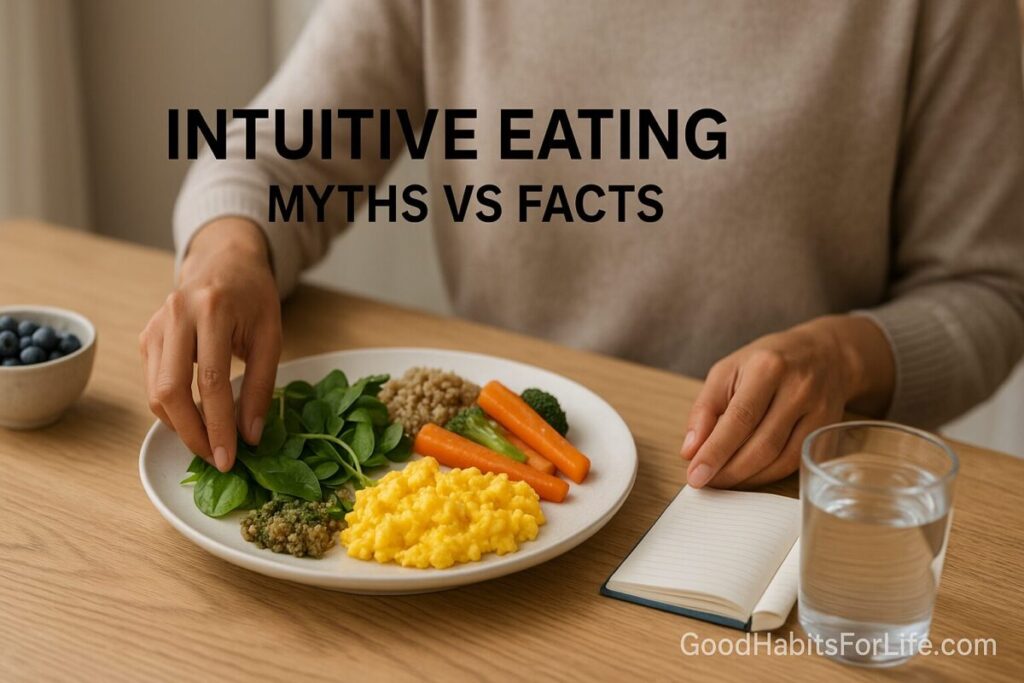
Intuitive Eating Myths vs Facts (2025)
Intuitive Eating Myths vs Facts (2025)
Table of Contents
🧭 What Intuitive Eating Is—and Why It Helps
Intuitive eating (IE) is a weight-neutral, skills-based approach that teaches you to:
-
Honor hunger and fullness (body cues),
-
Allow all foods without moral labels, and
-
Practice “gentle nutrition”—support health with flexible, satisfying choices.
Why it helps (summary of evidence):
-
Linked to better psychological well-being, body appreciation, and lower disordered-eating symptoms.
-
Associated with less dieting and more diverse, satisfying eating.
-
Weight change varies—the aim is metabolic, behavioral, and mental-health improvements rather than a number on the scale (see References).
The 10 core principles (short form): reject diet mentality; honor hunger; make peace with food; challenge food police; feel your fullness; discover satisfaction; cope with emotions with kindness; respect your body; joyful movement; gentle nutrition.
✅ Quick Start: Do-This-Today Checklist
-
Neutralize food language: Replace “good/bad” with “works/doesn’t work for me right now.”
-
Plan regular eating: 3 meals + 1–2 snacks to stabilize appetite cues.
-
Run a 10-second cue scan before eating: hunger (0–10), emotion (word), intention (fuel/comfort/both).
-
Build a balanced plate: protein + fiber-rich carb + colorful veg/fruit + tasty fat (olive oil, nuts, seeds, avocado).
-
Mid-meal pause: put cutlery down for 30–60 seconds—ask “Still hungry? Still enjoying this?”
-
Satisfaction check: after eating, rate taste/comfort (0–10). Note what to change next time.
-
Body respect micro-habit: comfortable clothes, neutral mirror talk, unfollow shame-based feeds.
🗓️ 7-Day Starter Plan
Goal: Re-train attunement, reduce food rules, and practice gentle structure.
-
Day 1 – Awareness: Keep a simple log (time, hunger 0–10, emotion word, what/why). No calorie counting.
-
Day 2 – Regularity: Schedule 3 meals + 1 snack; carry a snack (nuts, yogurt, fruit).
-
Day 3 – Satisfaction Map: List 5 “always satisfying” options per meal. Try one today.
-
Day 4 – Permission Practice: Pick a previously “forbidden” food; eat it mindfully, seated, no distractions for 10 minutes.
-
Day 5 – Gentle Nutrition Swap: Add one nutrient boost (e.g., beans for fiber, Greek yogurt for protein).
-
Day 6 – Joyful Movement: 20–30 min walk, stretch, or dance—choose for how it feels, not calorie burn.
-
Day 7 – Reflect & Adjust: What worked? What rules popped up? Set 2 tiny goals for next week.
🧠 Techniques & Frameworks That Work
-
Hunger–Fullness Scale (0–10):
0 = faint/urgent, 4 = pleasant hunger, 6–7 = comfortable fullness, 10 = stuffed.
Aim to begin eating around 3–4 and stop around 6–7 when possible. -
Satisfaction Trio: Flavor you enjoy, comfortable fullness, supportive nutrition. You need all three for a meal to “stick.”
-
Urge Surfing (emotions): Name → Normalize → Next step (walk, text, breathe 3×5).
-
Plate Formula (flexible): ~¼ protein, ~¼ smart carb (whole grains/legumes/starchy veg), ~½ veg/fruit, + fats for taste.
-
Red/Yellow/Green Rules Audit: List rules, tag them (red = harmful, yellow = maybe, green = helpful habit). Retire one red rule per week.
-
Gentle Nutri-Add-Ins: add rather than subtract—fiber (beans, oats), omega-3s (flax, fish), calcium sources, hydration.
👥 Audience Variations
-
Students: Build a dorm snack kit (nuts, fruit, yogurt, wraps). Use phone alarms for meal regularity during exams.
-
Parents: Model neutral food talk; make a “two-option plate” for picky eaters (1 safe, 1 explore).
-
Busy professionals: Pack “meeting-proof” snacks; block 20-min lunch on calendar as a real appointment.
-
Seniors: Prioritize protein at breakfast (eggs, dairy, tofu); consider softer textures and hydration reminders.
-
Teens: Tie IE to sports/energy; discuss social media myths; keep adult support available.
📚 Myths vs Facts (Top 10)
-
Myth: Intuitive eating means “eat anything, anytime.”
Fact: It pairs unconditional permission with body cues and satisfaction; you still consider timing, energy needs, and gentle nutrition. -
Myth: IE ignores health and nutrients.
Fact: Gentle nutrition is one of the principles—prioritize pattern and variety over perfection. -
Myth: You must stop caring about your weight entirely.
Fact: IE asks you to de-center weight so you can build stable habits. Your weight may go up, down, or stay similar. -
Myth: It’s anti-science.
Fact: IE uses validated measures (e.g., Intuitive Eating Scale-2) and is associated with better psychological outcomes and less disordered-eating symptomatology. -
Myth: It’s the same as mindful eating.
Fact: Mindfulness is a tool; IE is a broader framework (permission, body respect, satisfaction, gentle nutrition, movement). -
Myth: Hunger/fullness are the only rules.
Fact: Emotions, context, and planned meals matter; sometimes you eat before hungry (e.g., travel, training). -
Myth: IE is just for people without health issues.
Fact: It can be adapted (e.g., diabetes, GI conditions, pregnancy) with a registered dietitian. -
Myth: IE causes overeating.
Fact: Over time, permission reduces urgency and “last-supper” eating; satisfaction actually stabilizes intake. -
Myth: There’s no structure.
Fact: Flexible structure (regular meals/snacks) supports reliable hunger cues and steady energy. -
Myth: Results are immediate.
Fact: Like any skill, IE takes weeks to months; you’re unlearning years of diet rules.
⚠️ Mistakes to Avoid
-
Turning IE into another set of rigid rules (“I must stop at 6/10 every time”).
-
Skipping meals “to be intuitive” while cues are still dysregulated.
-
Expecting body image to change overnight—practice body neutrality first.
-
Confusing emotional hunger with physical hunger—use the 10-second cue scan.
-
Cutting entire food groups without medical reason.
🗣️ Real-Life Examples & Copy-Paste Scripts
-
Office cake moment: “I’ll take a slice and eat it at my desk when I’m actually hungry.”
-
Restaurant menu: “What looks satisfying and grounded? I’ll add a side salad/fries based on what I’m craving.”
-
Stress craving: “I’m at a 2/10 hunger but 8/10 stress. I’ll walk 5 minutes, then decide.”
-
Family pressure: “I appreciate the love in your cooking. I’m comfortably full—can I pack some for later?”
🛠️ Tools, Apps & Resources (brief)
-
YouAte (photo-based mindful log): low friction journaling; no calories.
-
Recovery Record (for ED recovery with clinicians): secure sharing; clinical features.
-
Mindful Eating Coach / Headspace (mindfulness audio): easy scripts; may require subscription.
-
Kitchen basics: water bottle, small snack box, microwave mug, travel cutlery—remove logistical barriers.
🔑 Key Takeaways
-
IE is a skills framework, not a diet.
-
Permission + attunement + gentle nutrition drive sustainable change.
-
Start with regular meals, cue scans, and satisfaction mapping.
-
Expect a learning curve; progress is steadier than perfection.
-
Personalize with professional support for medical conditions.
❓ FAQs
Is intuitive eating evidence-based?
Yes. It uses validated scales and is associated with better psychological outcomes and reduced disordered-eating symptoms in observational and intervention studies.
Will I gain or lose weight?
Weight outcomes vary. IE focuses on behaviors and well-being; your body may stabilize at its own set-point range.
Can IE work with diabetes?
Yes—adapt with a dietitian (e.g., pairing carbs with protein/fat, spacing meals, monitoring glycemia while honoring cues).
What if I never feel hungry?
Start with structure (regular meals/snacks); cues usually normalize within weeks.
Can athletes use IE?
Yes—layer IE with performance nutrition (timed carbs/protein, hydration) guided by a sports dietitian.
Is mindful eating the same as IE?
Mindfulness is one tool inside the broader IE framework.
How long until it “clicks”?
Often 6–12 weeks of practice; complex histories may take longer with support.
Can I track anything while doing IE?
Yes—track feelings and satisfaction, not calories. Use notes, not numbers.
What if I binge after giving myself permission?
Normalize the lapse; debrief with the satisfaction and emotions check-ins. If binges persist, seek specialized care.
Does IE work for picky eaters or kids?
Yes—use the Division of Responsibility at meals (parents decide what/when/where; kids decide whether/what among options).
📚 References
-
Tribole, E., & Resch, E. Intuitive Eating (4th ed.). St. Martin’s Essentials, 2020. https://www.intuitiveeating.org
-
Tylka, T. L., & Kroon Van Diest, A. M. (2013). The Intuitive Eating Scale–2 (IES-2): Item refinement and psychometric evaluation. Journal of Counseling Psychology, 60(1), 137–153. https://doi.org/10.1037/a0033137
-
Van Dyke, N., & Drinkwater, E. J. (2014). Relationships between intuitive eating and health indicators: A literature review. Public Health Nutrition, 17(8), 1757–1766. https://doi.org/10.1017/S1368980013002139
-
Bruce, L. J., & Ricciardelli, L. A. (2016). A systematic review of the effects of intuitive eating on psychosocial and physical health. Appetite, 96, 62–77.
-
National Eating Disorders Association (NEDA). Intuitive Eating overview and resources. https://www.nationaleatingdisorders.org
-
Harvard T.H. Chan School of Public Health – The Nutrition Source: Mindful Eating. https://www.hsph.harvard.edu/nutritionsource/mindful-eating/
-
Academy of Nutrition and Dietetics (EatRight). Mindful & Intuitive Eating resources. https://www.eatright.org/health/wellness
Disclaimer: This article is for general education only and does not replace personalized advice from a registered dietitian or healthcare professional—especially if you have a medical condition or a history of disordered eating.