
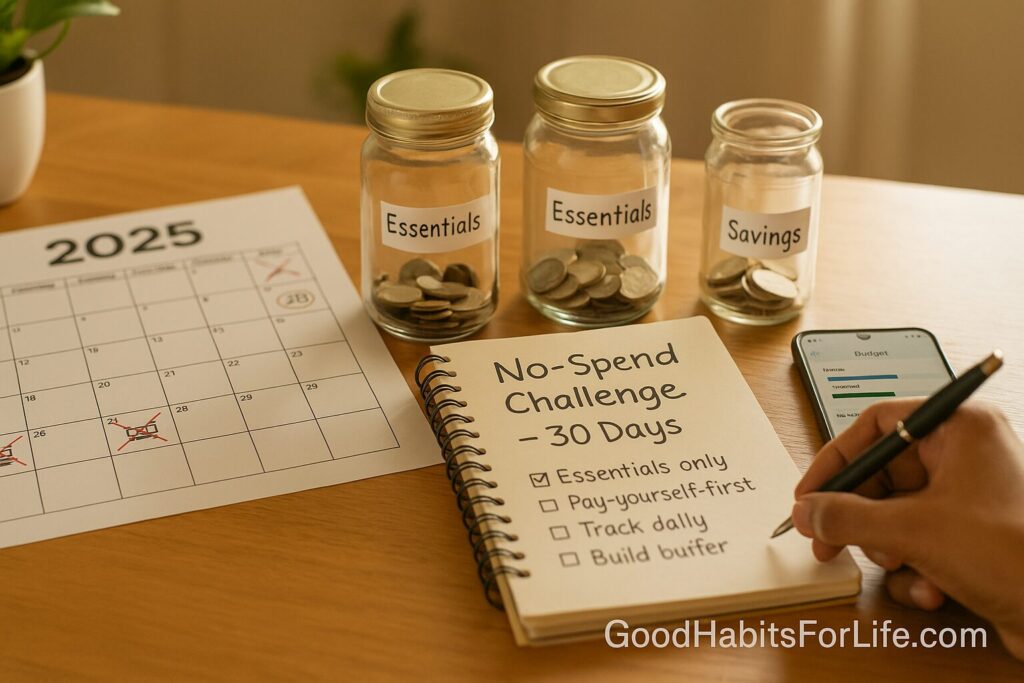
InflationProofing Your Monthly Plan: No-Spend Challenge (2025)
No-Spend Challenge (2025): Inflation-Proof Your Monthly Plan
Table of Contents
🧭 What Is a No-Spend Challenge (and Why It Works)
A no-spend challenge is a time-boxed commitment (often 7–30 days) to buy only essentials you’ve pre-defined (e.g., rent, utilities, medicines, basic groceries) while freezing discretionary categories (e.g., apparel, takeout, gadgets). It’s not deprivation forever; it’s a reset to reclaim cash flow during high or sticky inflation.
Why it works
-
Automated savings first. Moving money to savings before spending (pay-yourself-first) uses default effects to your advantage.
-
Fewer cues, fewer buys. Cutting exposure to shopping triggers reduces impulse purchases (implementation intentions and friction help).
-
Rapid feedback. Daily tracking builds awareness and habit strength; repeated context–action pairing forms routines over time.
-
Buffer building. Lower variable outflows grow your emergency fund—crucial when prices rise or incomes wobble.
Evidence you can use:
-
Inflation erodes purchasing power; tracking and budgeting mitigate overspending (BLS, OECD).
-
Habit research shows implementation intentions and consistent repetition speed up habit formation (Gollwitzer; Lally et al.).
✅ Quick Start: Do This Today
-
Name your freeze window. Pick 30 days (or start with 7 days if new).
-
Define essentials vs. wants. Essentials: housing, utilities, transport to work/school, baseline groceries, medication, minimum debt payments.
-
Write your rules & exceptions. E.g., “No dining out; exception: pre-planned anniversary dinner (₹2,000 cap).”
-
Automate the good stuff. Schedule bill pay and automatic transfers to savings or an offset account on payday.
-
Create friction. Uninstall shopping apps, remove saved cards, mute promo emails, leave non-essentials out of the house.
-
Track every transaction. Use an app or a single Google Sheet; one daily 3-minute check-in.
-
Park temptations. Keep a “Later List” of wants with a date; review after the challenge.
-
Announce your goal. Tell a friend or family member; social commitment improves follow-through.
-
Reallocate savings. Decide now: 80% to emergency fund, 20% to debt (or your ratio).
🛠️ 30-60-90 Day Inflation-Proof Plan
Days 1–30 (No-Spend Reset)
-
Freeze 3–5 categories (e.g., takeout, apparel, gadgets, rideshares beyond commute).
-
Pre-meal plan + batch-cook once a week.
-
Weekly “bill audit” to cancel/ downgrade subscriptions.
-
Track daily; celebrate no-spend streaks with a non-monetary reward (walk, playlist, home spa).
-
Target outcome: 10–30% cut in discretionary spend vs. last month; 1–2 weeks of expenses saved.
Days 31–60 (Low-Spend Groove)
-
Unfreeze one category with a weekly cap (e.g., dining out ₹1,000/week).
-
Introduce “1-in, 1-out” for items (clothes, gadgets).
-
Shift to zero-based budgeting so every rupee has a job.
-
Target outcome: At least one full month of expenses in emergency fund; all subscriptions intentional.
Days 61–90 (Lock-In & Grow)
-
Add a sinking fund for near-term goals (school fees, insurance premium, festivals).
-
Automate bill-due alerts; move credit card payments to autopay in full when possible.
-
Consider “no-buy” year for one category (e.g., apparel) with strict exceptions.
-
Target outcome: 2–3 months of expenses saved (keep building toward 3–6), debt payoff plan running.
🧠 Techniques & Frameworks That Make It Stick
-
Implementation Intentions (“If–Then”). If I feel like ordering takeout, then I’ll heat the freezer batch and add a side salad.
-
Temptation Bundling. Pair a necessary habit with a treat: only listen to your favorite podcast while cooking at home.
-
Envelope / Category Caps. Digital or cash envelopes reduce mindless overshoot.
-
The 30-Day Rule. Non-essential? Wait 30 days; if it still matters and fits the plan, buy.
-
Default & Friction. Keep money in a higher-yield savings or offset account; require two steps to transfer out.
-
Visual Debt/Savings Tracker. A simple bar you color daily increases salience and motivation.
-
Receipts to Reality. Once a week, total “tiny purchases” (snacks, micro-rides). Shine light on leakages.
🧺 Smart Exceptions & Replacement Ideas
Allowed exceptions (pre-written): medical needs, essential repairs, pre-paid commitments, gifts for major family events (cap it), one pre-planned meal out.
Replacement ideas
-
Coffee shop ➜ home brew + a “walk & chat.”
-
Ride-hail ➜ bus/metro for <5 km, or shared rides to split costs.
-
Streaming add-ons ➜ rotate one service per month.
-
New clothes ➜ wardrobe remix/repair/borrow.
-
Entertainment ➜ parks, library events, potluck, board-game night.
-
Takeout ➜ freezer meal kits, sheet-pan dinners, pressure cooker recipes.
👥 Audience Variations
Students: Use campus resources (library software, gym). Cap social spend with a weekly envelope. Build a ₹10–₹50/day meal plan with staple rotations.
Parents: Pre-plan kid snacks; budget for school surprises. Pick free weekend activities. Involve kids with a sticker savings chart.
Professionals: Default to meal-prep + bulk office snacks. Batch errands near work to cut fuel/time.
Seniors: Review insurance and prescriptions for lower-cost alternatives; explore senior concessions for transit and utilities.
Teens (with guardians): Create a beginner envelope system with two goals: Emergency ₹1,000 and Big Wish; match contributions for motivation.
⚠️ Mistakes & Myths to Avoid
-
Myth: No-spend means no joy.
Reality: You’re swapping paid treats for free/low-cost alternatives—on purpose. -
Mistake: Vague rules.
Fix: Write specific category freezes and ₹ caps for exceptions. -
Mistake: Not tracking.
Fix: One 3-minute nightly check-in. -
Myth: You must cut everything forever.
Reality: It’s a sprint that resets habits; switch to low-spend afterward. -
Mistake: Saving with no destination.
Fix: Route savings to emergency fund, debt, or a sinking fund immediately.
🗣️ Real-Life Scripts You Can Copy
-
Opt-out of a spendy plan:
“I’m on a 30-day no-spend reset to build a buffer. Can we do a home dinner / park walk instead this week?” -
Cancel a subscription:
“Please cancel effective today. I’m simplifying my bills for the next 90 days.” -
Negotiate a bill:
“I’ve been a customer for X years. I’m reviewing expenses—can you match your current new-customer rate or offer a loyalty discount?” -
At checkout (self-talk):
“Pause. Is this essential, budgeted, and worth delaying my goal? If not, I’ll add it to my Later List.”
🧰 Tools, Apps & Resources
-
Budgeting: YNAB (envelopes, paid), EveryDollar (zero-based), Google Sheets/Notion templates (free, flexible).
-
Tracking: Your bank app categories; export CSV weekly for clarity.
-
Worksheets: CFPB Spending Tracker and Budget worksheet (simple, printable).
-
Savings: Automate to a high-yield savings or offset account; nickname goals (e.g., “3-Month Buffer”).
-
Receipts: Keep a single envelope or photo album called “Month-Name Receipts.”
Pros/Cons quick take
-
Apps ease tracking but may have subscriptions.
-
Sheets are free and customizable but need manual discipline.
-
Bank categories are automatic but sometimes mislabel—spot-check weekly.
📌 Key Takeaways
-
A time-boxed no-spend is a powerful inflation shield.
-
Pre-write rules, exceptions, and targets; automate savings on payday.
-
Track daily; use if-then plans and friction to beat impulses.
-
After 30 days, shift to low-spend with category caps and sinking funds.
-
Redirect saved cash toward emergency funds and debt payoff—that’s your real win.
❓ FAQs
1) How long should a first no-spend be?
Start with 7–14 days if you’re new; aim for 30 days for maximum reset.
2) What counts as “essential”?
Housing, utilities, baseline groceries, transport to work/school, medicines, minimum debt payments. Everything else is frozen unless pre-approved.
3) Is cash better than cards during the challenge?
Cash or digital “envelopes” both work. The key is category caps and daily tracking.
4) How do I handle social plans?
Offer free or low-cost alternatives in advance. Use the scripts above.
5) What if an emergency happens?
Handle genuine needs. Document the expense, adjust, and keep going—don’t abandon the challenge.
6) Can I do this with a family?
Yes. Co-create rules, give kids age-appropriate roles, and add one fun, free family ritual each week.
7) Will this hurt my credit score?
No. Paying bills on time helps. Just avoid carrying credit card balances or missing payments.
8) What’s after the challenge?
Switch to a low-spend rhythm: unfreeze one category with a cap, keep tracking, and maintain automatic transfers.
9) How much can I realistically save?
Many households cut 10–30% of discretionary spend in Month 1. Redirect it to buffers and debt.
10) Is “no-buy year” safe?
Choose a single category (e.g., apparel) with clear exceptions (repairs, replacements). Keep essentials funded.
📚 References
-
U.S. Bureau of Labor Statistics. Consumer Price Index (CPI) Overview. https://www.bls.gov/cpi/
-
OECD. Inflation (CPI) – Annual and Monthly Indicators. https://data.oecd.org/price/inflation-cpi.htm
-
Consumer Financial Protection Bureau (CFPB). Spending Tracker & Budgeting Worksheets. https://www.consumerfinance.gov/
-
FINRA. Emergency Fund: Why You Need One and How to Build It. https://www.finra.org/investors
-
Lally, P., et al. (2009). How are habits formed in everyday life? European Journal of Social Psychology. https://onlinelibrary.wiley.com/
-
Gollwitzer, P. M. (1999). Implementation intentions: Strong effects of simple plans. American Psychologist. https://psycnet.apa.org/
-
Milkman, K. L., et al. (2014). Holding the Hunger Games Hostage: Temptation Bundling and Habit Formation. Management Science. https://pubsonline.informs.org/
-
Consumer.gov. Make a Budget. https://consumer.gov/
⚖️ Disclaimer
This article provides general personal-finance education, not individualized financial advice. Consider speaking with a licensed advisor for your situation.