
HungerFullness Scale: Learn Your 3s and 7s: Protein-Forward Plan (2025)
Hunger–Fullness Scale: Learn Your 3s & 7s (Protein-Forward)
Table of Contents
🧭 What the Hunger–Fullness Scale Is & Why It Works
The hunger–fullness scale is a simple 1–10 check-in that trains you to notice body cues—think gentle belly emptiness, pleasant satisfaction, or uncomfortable stretch—so you eat enough (not too little, not too much) and choose foods that truly help you feel your best. It pairs naturally with mindful and intuitive eating, which emphasize awareness, responding to hunger/satiety, and a non-judgmental approach to food. The Nutrition Source+1
Protein plays a starring role because it increases satiety and supports stable energy. Distributing protein more evenly across meals (rather than skewing to dinner) improves 24-hour muscle protein synthesis and can help curb later snacking. PMC+1PubMed
Public-health guidance encourages patterns rich in varied protein foods (fish, pulses, soy, dairy/fortified alternatives, nuts/seeds, poultry; limit processed meats). Dietary GuidelinesThe Nutrition Source
✅ The “3s & 7s” Rule (and the 1–10 Scale)
Use this everyday shorthand:
-
Start eating near a “3” (comfortably hungry; stomach feels empty; you’re thinking about food but not irritable).
-
Finish near a “7” (comfortably satisfied; you could move or work after; not stuffed).
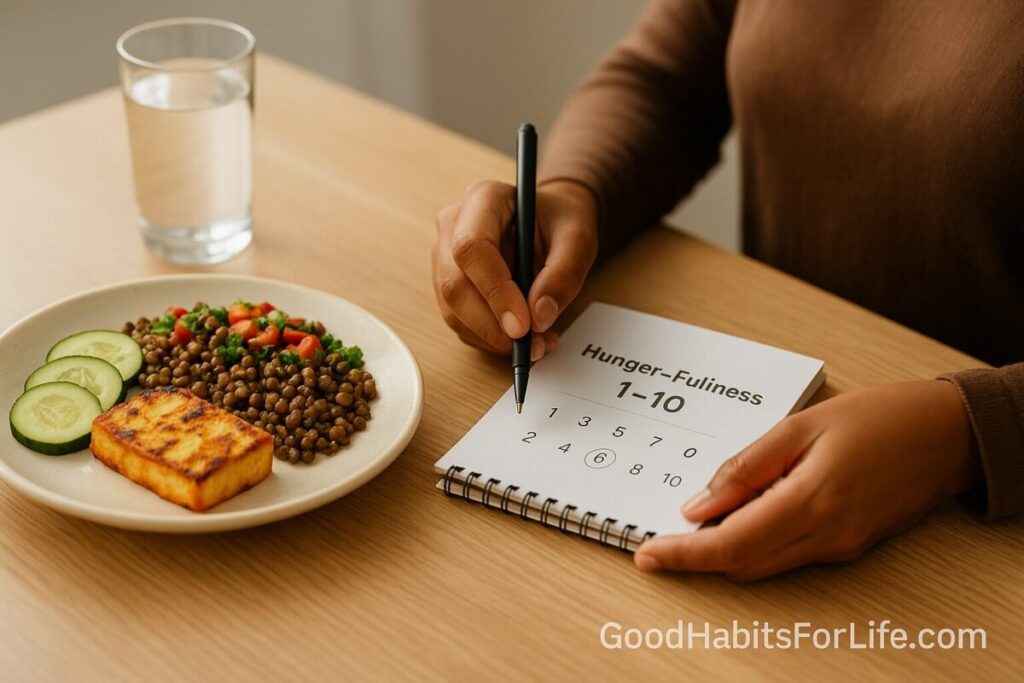
The 1–10 scale (print or save):
1 = dizzy/weak; 2 = very hungry; 3 = nicely ready to eat; 4 = could eat soon; 5 = neutral; 6 = lightly satisfied; 7 = pleasant fullness; 8 = full/heavy; 9 = overfull; 10 = uncomfortably stuffed.
Why it helps: arriving at meals at 3 reduces impulsive choices; stopping at 7 prevents energy dips and refluxy discomfort. This approach is aligned with mindful/intuitive eating—attend to internal signals and respond kindly. The Nutrition Source+1
🛠️ Quick Start Today (5 minutes)
-
Make the card: On your phone notes, type the 1–10 scale (bold 3 and 7).
-
Set a cue: Before each meal/snack, ask: “What number am I?”
-
Build the plate (protein-forward): Add 25–35 g protein + produce + smart carbs + fats. Examples below. PMC
-
Two-bite check: Mid-meal, pause: “Still hungry or near 7?”
-
Log 3 numbers/day: Pre-meal, mid-meal, and 20-minute post-meal.
Protein-forward plate ideas (≈25–35 g protein):
-
200 g Greek yogurt + 30 g mixed nuts + berries.
-
2 eggs + 100 g tofu bhurji + whole-grain roti.
-
120 g grilled paneer/chicken + dal + salad + rice.
-
1 cup cooked lentils + 100 g edamame + veggies + quinoa.
-
120–150 g fish + potatoes + greens.
(Choose culturally familiar swaps; see protein foods guidance.) Dietary Guidelinesmyplate.gov
🧠 30-60-90 Protein-Forward Roadmap
Days 1–30: Awareness & Even Protein
-
Goal: Hit 3 check-ins/day and 25–35 g protein at breakfast, lunch, dinner. PMC
-
Actions:
-
Pre-plan a protein anchor for each meal (e.g., eggs/tofu at breakfast, dal/yogurt at lunch, fish/pulses at dinner).
-
Keep the 3s & 7s card visible.
-
Track satiety score 20 min post-meal (1–10).
-
Days 31–60: Fine-Tune Cues
-
Goal: Reduce “<3” (over-hungry) and “>7” (over-full) episodes by 50%.
-
Actions:
Days 61–90: Sustain & Personalize
-
Goal: Maintain 3–7 routine 80% of meals; tailor protein to your body:
-
Actions:
-
Spread protein across meals; keep dinner from hoarding most of it. PubMed
-
Keep a weekly “wins & tweaks” review (what moved you toward 3–7?).
-
🛠️ Techniques & Frameworks (Mindful + Intuitive Eating)
-
Mindful bite: Look, smell, chew thoroughly; notice textures/flavors; put the utensil down every few bites. The Nutrition Source
-
Intuitive check-ins: Am I hungry? What number? What food would be satisfying and supportive right now? The Nutrition Source
-
Protein distribution: Target ≈25–35 g per meal (often ~0.25–0.4 g/kg at a time) to support satiety and muscle protein synthesis. PMC
-
Environment reset: Eat seated, fewer screens, smaller default plates, water handy. (Mindfulness around context supports noticing cues.) The Nutrition Source
-
Lifestyle levers: Prioritize sleep and regular activity; both modulate appetite hormones (ghrelin/leptin) and hunger. PMC
👥 Audience Variations
Students & Busy Professionals
-
Pack protein-forward portable options (Greek yogurt cups, chana/chickpea bowls, paneer/tofu wraps, boiled eggs, edamame).
-
Calendar alerts for meals so you arrive around 3 not 2 (over-hungry).
-
If late nights are common, favor earlier protein (breakfast/lunch) to reduce evening snack drive. PubMed
Parents & Caregivers
-
Serve family-style with small plates; everyone uses the 3–7 language (“Are you closer to a 3 or 7?”).
-
Build dinners around protein + veg + carb; keep beans/lentils ready-to-eat for fast add-ins. Dietary Guidelines
Seniors (Older Adults)
-
Appetite may be blunted—set gentle reminders to avoid slipping below 3.
-
Aim for ≥1.0–1.2 g/kg/day protein, spread across 3–4 meals; add dairy/fortified alternatives, eggs, fish, pulses, tofu, nuts/seeds. ESPN+1
Teens
-
Rapid growth and sport increase needs; focus on regular meals and protein with each eating occasion (milk or soy drink, peanut butter, eggs, lentils). Dietary Guidelines
⚠️ Mistakes & Myths to Avoid
-
Myth: “Hunger is bad—ignore it.”
Reality: Hunger is a helpful body cue; the skill is recognizing and responding to it—earlier is easier. The Nutrition Source -
Mistake: Saving all protein for dinner.
Fix: Distribute evenly (25–35 g/meal) for better satiety and muscle support. PMC -
Myth: Mindful/intuitive eating = no structure.
Reality: It’s structured flexibility—use the 3s & 7s rule, meal anchors, and reflection. The Nutrition Source+1 -
Mistake: Ignoring sleep/stress and then blaming “willpower.”
Fix: Protect sleep; stress-management supports appetite regulation. PMC -
Myth: Only animal foods provide “real” protein.
Reality: Pulses, soy, nuts/seeds, and dairy/fortified alternatives are excellent sources; vary them. Dietary GuidelinesThe Nutrition Source
📋 Real-Life Examples & Scripts
Before eating (choose one line):
-
“What number am I—closer to 3 or 4?”
-
“If I eat now, will I likely stop at 7?”
-
“What protein would make this satisfying?”
Mid-meal pause (two-bite check):
-
“Am I passing 7 or still around 5–6? One more bite or wrap it?”
Post-meal reflection (20 min later):
-
“What’s my number now? If I overshot, what led there—speed, low protein, distractions?”
Sample day (≈90 g protein total):
-
Breakfast (≈30 g): 200 g Greek yogurt + 30 g nuts + fruit.
-
Lunch (≈30 g): 1 cup dal + 100 g paneer + salad + roti.
-
Dinner (≈30 g): 120–150 g fish/tofu + veg + rice/quinoa.
(Adjust to culture, budget, and preferences; use MyPlate’s protein-foods guidance for swaps.) myplate.gov
🧰 Tools, Apps & Resources
-
MyPlate Protein Foods Group: handy ounce-equivalents and ideas. myplate.gov
-
Dietary Guidelines for Americans 2020–2025: flexible pattern guidance by life stage. Dietary Guidelines+1
-
Harvard Nutrition Source (Protein / Mindful & Intuitive Eating): evidence summaries and food lists. The Nutrition Source+2The Nutrition Source+2
🔑 Key Takeaways
-
The 3s & 7s rule makes the hunger–fullness scale practical.
-
Protein-forward plates (≈25–35 g/meal) improve satiety and steady energy. PMC
-
Spread protein across the day; don’t hoard it at dinner. PubMed
-
Mindful + intuitive methods strengthen body-awareness and decision-making. The Nutrition Source+1
-
Support your cues with sleep and stress care. PMC
❓ FAQs
1) What should I eat when I’m at a “3”?
Choose a protein-forward meal (25–35 g protein) plus produce and smart carbs. This combo boosts satiety without heaviness. PMC
2) Is it okay to eat at a “4–5”?
Yes—context matters (e.g., a long meeting ahead). The skill is intentionality: notice, choose, stop near 7. The Nutrition Source
3) How much protein do I actually need?
Most healthy adults meet needs around 0.8–0.83 g/kg/day, but older adults often benefit from ≥1.0–1.2 g/kg/day, spread across meals. IRISESPN
4) Why is a high-protein breakfast recommended in this plan?
It can improve appetite control and reduce evening snacking in many people. PubMedPMC
5) Can plant-based eaters do this?
Absolutely—use pulses, soy (tofu/tempeh), nuts/seeds, and dairy alternatives; vary sources and portions to hit your per-meal target. Dietary GuidelinesThe Nutrition Source
6) Does mindful eating mean I can never track anything?
No. Mindful/intuitive eating can include light structure like check-ins, meal anchors, and short reflections—without rigid calorie counting. The Nutrition Source+1
7) I often overshoot to an “8–9” at dinner. Fixes?
Eat earlier (hit 3 instead of 2), add protein at breakfast/lunch, pause mid-meal, and plate smaller first portions. PubMed+1
8) Do sleep and stress really change hunger?
Yes—short sleep raises ghrelin and lowers leptin, often increasing appetite/cravings. Manage sleep and stress alongside eating skills. PMC
9) What’s a quick protein snack if I’ll miss mealtime?
Greek yogurt, roasted chana/chickpeas, milk or soy drink, cottage cheese/paneer cubes, eggs, edamame, or a tofu wrap. See MyPlate for ounce-equivalents. myplate.gov
10) Do I need supplements?
Most people can meet needs with food variety. If appetite is low (e.g., during illness/aging), talk to a clinician/dietitian. ESPN
📚 References
-
World Health Organization/FAO/UNU. Protein and Amino Acid Requirements in Human Nutrition (TRS 935). 2007. IRIS
-
Harvard T.H. Chan School of Public Health — The Nutrition Source. “Protein.” The Nutrition Source
-
Mamerow MM, et al. Dietary protein distribution positively influences 24-h muscle protein synthesis in healthy adults. (Open-access review + full text). 2014. PMCPubMed
-
Leidy HJ, et al. The addition of a protein-rich breakfast and its effects on appetite/food intake. 2010/2013. PMCPubMed
-
U.S. Departments of Agriculture & Health and Human Services. Dietary Guidelines for Americans 2020–2025. Dietary Guidelines
-
MyPlate.gov — Protein Foods Group (ounce-equivalents). myplate.gov
-
Harvard T.H. Chan — The Nutrition Source. “Mindful Eating.” and “Intuitive Eating.” The Nutrition Source+1
-
ESPEN Practical Guideline: Clinical nutrition and hydration in geriatrics (protein ≥1.0–1.2 g/kg/day). 2022 (also 2019 guideline). ESPN+1
-
Papatriantafyllou E, et al. Sleep restriction and appetite hormones (ghrelin/leptin) review. 2022. PMC
Disclaimer: This article is for general education; it is not medical or nutrition advice. If you have a medical condition, pregnancy, or special dietary needs, consult a qualified clinician or registered dietitian.