
Homework Hour: A StartFinish Ritual for Teens: AI workflows (2025)
Homework Hour for Teens: Start–Finish Ritual (2025)
Table of Contents
🧭 What the “Homework Hour” Is & Why It Works
Definition. A “Homework Hour” is a daily, pre-scheduled 45–90-minute block where teens handle assignments, study, and prep—using a repeatable Start→Finish Ritual so the session always opens the same way and ends with a clean hand-off to “Future You.”
Why it works (evidence-based).
-
Distributed practice beats cramming. Spacing and regular review significantly boost long-term retention.
-
Retrieval practice outperforms rereading/highlighting. Testing yourself (flashcards, practice questions) leads to deeper learning than re-exposure.
-
Short, deliberate breaks prevent attention drop-off. Brief mental breaks sustain focus on long tasks.
-
Single-tasking > multitasking. Heavy media multitasking correlates with poorer attention control.
-
Sleep matters. Teens need 8–10 hours; consistent routines improve learning and mood.
-
Homework has meaningful impact when well-structured in secondary school.
Bottom line: a same-time daily block that prioritizes retrieval, spacing, and attention hygiene helps teens learn more in less time.
✅ Quick Start: Do This Today
Pick a time you can hold most days (e.g., 7:30–8:30 pm).
Prepare a 60-minute template (adapt to 45 or 90 minutes):
-
2 min — Set up. Phone on Do Not Disturb; materials out; open task list.
-
5 min — Plan. Write today’s Outcome 1–2 (e.g., “Finish bio worksheet Q1–8; review ch.3 key terms”).
-
20–25 min — Deep Focus Block #1. One subject only; timer on.
-
5 min — Break. Stand, stretch, sip water; no social feeds.
-
20–25 min — Deep Focus Block #2. Retrieval practice or problem sets.
-
3 min — Review. Summarize key points in 3 lines (Cornell summary).
-
5 min — Finish Ritual. Log what’s done, schedule next step, pack bag.
If workload is high: extend to 90 minutes (add a third focus block).
If it’s light: run 30–45 minutes and bank the win.
🛠️ The Start→Finish Ritual (SFR)
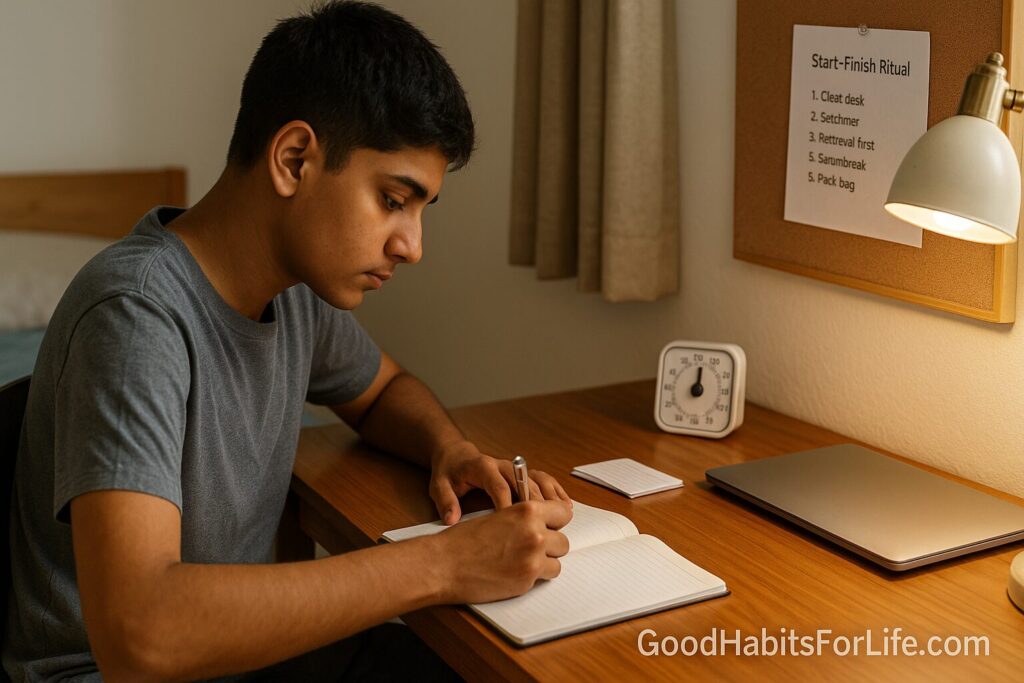
Start (the same every day)
-
Clear desk → water bottle → timer ready.
-
Open Task Triage: Must Do / Should Do / Nice to Do.
-
State Two Outcomes and a why (“So I can quiz tomorrow without notes”).
-
Choose a technique for Block #1 (e.g., practice test).
Finish (the same every day)
-
3-line daily summary (What I learned / What confused me / What I’ll do next).
-
Next step scheduled in planner (date + exact task).
-
Pack & prep (charged calculator, printouts, kit).
-
Tiny reward (tea, song, 5-min chat). This closes the loop and makes the habit sticky.
🧠 Techniques & Frameworks That Actually Improve Learning
High-impact (use daily):
-
Retrieval practice. Close notes and produce answers. Use past papers, question banks, or self-quizzes.
-
Spaced repetition. Revisit content after increasing intervals (1-2-7-14 days).
-
Interleaving. Mix problem types (A-B-C) rather than blocking (AAA-BBB). (Discussed in Dunlosky review.)
-
Cornell notes. Cues on left, notes on right, summary at bottom; ideal for end-of-block recaps.
-
Pomodoro-style timing. 20–25 min focus + 5 min break = reduced mental fatigue. (General framework origin: Cirillo.)
What to avoid or downgrade:
-
Rereading/highlighting as the main method (okay for skimming, poor for retention).
Quality check after each block:
-
Can I teach the idea in 60 seconds (Feynman check)?
-
Can I answer 3 questions from memory?
-
What error pattern did I notice?
🤖 AI Workflows for Teens (2025 — Safe & Ethical)
Guardrails first
-
AI is a coach, not a copy machine. Always write your own answers.
-
Keep personal data out; follow school policies; cite sources you actually used.
The Prompt Sandwich (copy-paste template)
Context: course, chapter, goal, grade level.
Constraints: syllabus terms, word counts, examples needed, show steps, ask me checkpoint questions.
Output: outline/quiz/step list; end with a 3-item action plan I can do in 20 min.
Workflow examples
-
Reading guide: “You are a study coach. Summarize Ch. 3 of photosynthesis for Grade 9, then generate 10 retrieval questions (MCQ + short answer), then give a 5-minute spaced review plan for the week.”
-
Math practice: “Create 8 interleaved problems on linear equations (mixed difficulties). After each, show the worked solution only after I attempt an answer.”
-
Languages: “Give a 15-minute drill mixing vocab from Unit 4 with spaced repetition intervals and a final oral-practice script.”
-
Science write-up: “Turn these bullet notes into a lab report outline (Aim, Hypothesis, Method, Results, Discussion). Add 3 questions I must answer with data.”
-
Essay planning: “Based on this prompt and sources, propose 3 thesis options, counterarguments, and a paragraph-by-paragraph plan. Do not draft the full essay.”
Self-check after AI help
-
Can I explain it without the AI’s text?
-
Did I solve a new problem of the same type solo?
-
Are all sources credible and cited?
👪 Variations: Busy Schedules, Exams, ADHD-friendly Tweaks, Parents & Teachers
Busy days (sports, rehearsals): run a Micro-Hour (30–40 min): one 20-min retrieval block + 5-min break + 10-min quiz/summary.
Exam season: extend to 90–120 min with 3–4 blocks, heavier on practice tests.
ADHD-friendly supports (general tips, not medical advice):
-
externalize steps (visual checklist), shorter blocks (15–20 min), body-double (quiet co-study), tactile timers, and immediate “done” logging.
Parents: protect a household quiet hour, model phone-free focus, ask “What’s your next step?” (not “How much homework?”).
Teachers: post weekly “Must/Should/Nice” task lists and five retrieval questions per lesson so students can plug them straight into Homework Hour.
⚠️ Mistakes & Myths to Avoid
-
Myth: “I learn better while multitasking/music with lyrics.” → Splits attention. Try lyric-free or no audio for heavy reading.
-
Cramming the night before. Short-term gains, long-term losses; prioritize spacing + sleep.
-
Copying AI text. Teachers (and you) lose visibility into your understanding. Use AI to quiz, structure, and check thinking.
-
Skipping the finish ritual. No scheduled next step = tomorrow’s friction.
-
Unbounded sessions. No timer means drift; keep blocks tight.
🗣️ Real-Life Examples & Copy-Paste Scripts
Daily plan (notebook or Notes app)
-
Outcomes: 1) Finish physics worksheet Q1–8; 2) Quiz vocab set B (15 cards).
-
Blocks: 25 + 25 min; Breaks: 5 min walk + water.
-
Summary: “Got Q1–6 solid; Q7–8 need teacher check. Vocab 80% recall.”
-
Next step: “Ask Ms. A about Q7–8; review set B on Thu.”
Text to parent/guardian
“From 7:30–8:30 I’m doing a phone-off Homework Hour. If I’m on my phone, please ask, ‘What’s your next step?’ Thanks!”
Self-talk before starting
“Two outcomes only. Start timer. I’ll earn my break.”
Teacher cue on board
“Exit Ticket = 3 retrieval questions to use tonight in your Homework Hour.”
🧰 Tools, Apps & Resources (Pros/Cons)
-
Timer: any phone timer or a simple cube timer. Pro: zero friction. Con: phones tempt distraction.
-
Website blockers (PC/Mac/Chromebook): Focus, Freedom, BlockSite. Pro: reduces drift. Con: setup time.
-
Flashcards: Anki / Quizlet. Pro: spaced repetition built-in. Con: initial card-writing effort.
-
Notes: OneNote, Notion, Google Docs. Pro: cross-device. Con: can become cluttered—use Cornell layout.
-
Past papers & question banks: school portals or official exam boards. Pro: retrieval + exam-style questions.
-
AI assistants: use for outlines, practice, checks; never final answers.
📅 7-Day Starter Plan + 30-60-90 Roadmap
7-Day Starter (60 minutes/day; adjust as needed)
-
Day 1 (Mon): Set up workspace + checklist; 1 block retrieval + 1 block practice; write 3-line summary.
-
Day 2: Add spaced review (yesterday’s material first 10 min).
-
Day 3: Interleave two subjects (A then B).
-
Day 4: Add AI coach to generate 10 practice Qs; answer without notes.
-
Day 5: Try a mini mock quiz (15 min) + error log.
-
Day 6: Organize notes Cornell-style; create 8 flashcards.
-
Day 7 (Sun): Weekly reflection (10 min): What stuck? What needs help? Plan next week.
30-60-90 Roadmap
-
Days 1–30: Build the ritual; prioritize retrieval; make 100+ active flashcards.
-
Days 31–60: Raise difficulty; more interleaving; weekly past-paper set.
-
Days 61–90: Optimize—longer blocks for tough subjects; teach-back sessions; refine AI prompts; aim for consistency ≥85% of school nights.
🗝️ Key Takeaways
-
A consistent Homework Hour simplifies decisions and boosts learning.
-
Start→Finish Ritual turns scattered effort into a repeatable routine.
-
Focus on retrieval, spacing, and interleaving, not rereading.
-
Use AI as a practice partner, not a shortcut.
-
Protect attention and sleep; tiny daily wins compound.
❓FAQs
How long should Homework Hour be?
Most teens do well with 60 minutes on school nights; scale to 45–90 minutes depending on workload.
Best time to schedule it?
When home is quiet and energy is decent—often early evening. Keep it consistent.
Can I listen to music?
For heavy reading/problem-solving, try no lyrics or instrumental; multitasking with media can impair attention.
What if I have sports or part-time work?
Run a Micro-Hour (30–40 min): one focused block + quick summary. Consistency beats occasional marathons.
How do I use AI without cheating?
Ask AI for outlines, practice questions, explanations, and checks—then produce your own answers and cite sources.
What if I’m stuck or confused?
Write a 3-line summary including the sticking point, then make a plan: re-read one specific section, watch a class video, or email a single precise question to your teacher.
Does this help with exams?
Yes—Homework Hour builds retrieval and spacing, the exact skills that support exam prep.
Is 7 days a week necessary?
No. Aim for 5 school-night sessions plus an optional light weekend review.
📚 References
-
Cepeda, N. J., et al. (2006). Distributed practice in verbal recall tasks. Psychological Bulletin. (Spacing effect overview). https://pubmed.ncbi.nlm.nih.gov/16822161/
-
Karpicke, J. D., & Blunt, J. R. (2011). Retrieval practice produces more learning than elaborative studying. Science. https://www.science.org/doi/10.1126/science.1199327
-
Ariga, A., & Lleras, A. (2011). Brief and rare mental breaks keep you focused. Cognition. https://www.sciencedirect.com/science/article/pii/S0010027711000618
-
Ophir, E., Nass, C., & Wagner, A. D. (2009). Cognitive control in media multitaskers. PNAS. https://www.pnas.org/content/106/37/15583
-
CDC. (Updated). How Much Sleep Do I Need? Teens 8–10 hours. https://www.cdc.gov/sleep/about_sleep/how_much_sleep.html
-
Education Endowment Foundation. Homework (Secondary)—impact summary. https://educationendowmentfoundation.org.uk/education-evidence/teaching-learning-toolkit/homework-secondary
-
Dunlosky, J., et al. (2013). Improving Students’ Learning With Effective Learning Techniques. Psychological Science in the Public Interest. https://journals.sagepub.com/doi/10.1177/1529100612453266
-
Cornell University Learning Strategies Center. The Cornell Note-Taking System. https://lsc.cornell.edu/how-to-study/taking-notes/cornell-note-taking-system/
-
Cirillo, F. The Pomodoro Technique (method overview). https://francescocirillo.com/pages/pomodoro-technique