
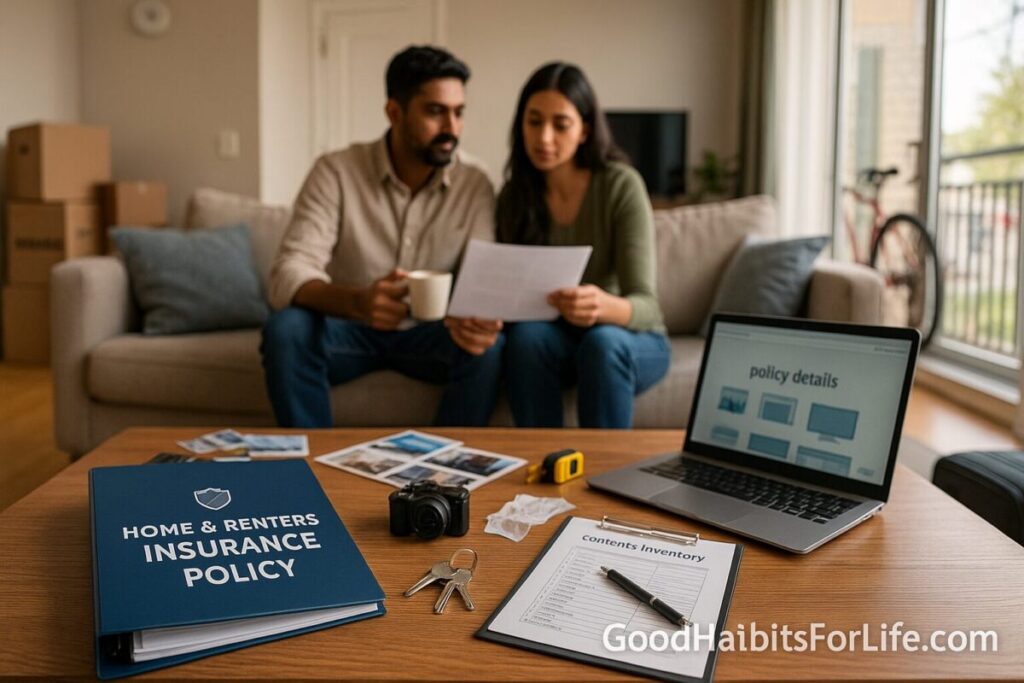
Home & Renters Insurance: Whats Typically Covered: No-Spend Challenge (2025)
Home & Renters Insurance: What’s Typically Covered (2025)
Table of Contents
🧭 What Home & Renters Policies Are—and Why They Matter
Homeowners (HO-3) policies protect your dwelling (the building) plus belongings, liability, and additional living expenses (ALE) if a covered peril makes your home uninhabitable. It’s the most popular form in many markets. III
Renters (HO-4) policies protect your belongings, personal liability, and ALE; the landlord’s policy covers the building itself. III
If you have a mortgage, homeowners insurance is typically required; it also protects your finances if someone is injured and sues you. mid.ms.gov
✅ What’s Typically Covered (At a Glance)
Core Protections (“the big four”)
| Coverage | Homeowners | Renters | Typical Notes |
|---|---|---|---|
| Dwelling (A) | ✅ | — | Pays to repair/rebuild your home from covered causes. III |
| Personal Property (C) | ✅ | ✅ | Belongings at home and (often) off-premises; some insurers limit off-premises to ~10% of contents limit. III |
| Personal Liability (E) | ✅ | ✅ | Lawsuits for injury/property damage; many policies start at US$100k, with recommendations to consider US$300–500k. III |
| Loss of Use / ALE (D) | ✅ | ✅ | Extra costs (hotel, meals, temporary rent) when a covered loss makes your home unlivable. III+1 |
🧠 What’s Not Covered (and How to Fill the Gaps)
Common Exclusions
-
Flood (rising water): Not covered by standard home or renters policies; consider NFIP or private flood insurance. floodsmart.gov
-
Earthquake: Usually excluded; purchase a separate earthquake policy (e.g., via state authorities like CEA in CA). earthquakeauthority.comCalifornia Department of Insurance
-
Maintenance/Wear & Tear: Damage from neglect, rot, or routine wear is generally excluded (insurance covers sudden/accidental losses). III
-
Business & Home-Sharing (e.g., frequent Airbnb): Standard policies aren’t designed for business pursuits; specialized endorsements or policies may be required. III+1
Useful Add-Ons (Endorsements/Riders)
-
Water/Sewer Backup: Covers damage from backed-up drains/sump pumps (often excluded otherwise). dfr.oregon.gov
-
Ordinance or Law: Pays extra to bring repairs up to current building codes after a covered loss. dfr.oregon.gov
-
Scheduled Personal Property: Raises sublimits for jewelry, watches, art, etc. (jewelry theft sublimit often ~US$1,500). III
-
Umbrella Liability: Adds extra liability limits above home/auto. III
🛠️ Quick Start: Set Up the Right Coverage Today
-
Estimate rebuild cost accurately (not market price). Ask your insurer for a replacement-cost estimate and review annually. mid.ms.gov
-
Know your loss settlement: RCV vs ACV. Replacement cost (RCV) generally pays more than actual cash value (ACV, depreciation deducted). Check which applies to dwelling and contents. Consumer Financial Protection Bureau
-
Set liability limits aligned to your net worth and risk (pools, pets, trampolines). Many experts suggest ≥ US$300k–US$500k. III
-
Fix sublimits for valuables: Schedule jewelry, cameras, collectibles. III
-
Add key endorsements (as relevant): water/backup, ordinance-or-law, equipment breakdown, cyber (if offered). dfr.oregon.gov
-
Create a photo/video home inventory (room by room) and store it off-site/cloud; NAIC offers a free inventory app. California Department of InsuranceApple
-
Understand ALE rules: Save receipts; know your time/amount caps. California Department of Insurance
📅 30–60–90 Day Coverage Tune-Up Plan
Days 1–30 (Foundation)
-
Pull your declarations page; list limits for A/B/C/D/E and deductibles.
-
Photograph each room, closets, and high-value items; upload to cloud/NAIC app. Apple
-
Email your agent: request RCV on contents (if available), confirm off-premises coverage %, and ask about jewelry scheduling. III+1
Days 31–60 (Gaps & Endorsements)
-
If you have a basement/sump pump, add water-backup endorsement.
-
In older homes, add ordinance-or-law coverage. dfr.oregon.gov
-
Live in quake-prone areas? Price separate earthquake coverage. earthquakeauthority.com
Days 61–90 (Resilience & Liability)
-
Raise liability to 300–500k; price an umbrella if assets exceed that. III
-
If hosting short-term rentals, obtain appropriate home-sharing/landlord coverage. III
-
Set an annual review reminder (policy anniversaries + after renovations).
🧩 Techniques & Frameworks to Right-Size Coverage
The A-B-C-D-E Snapshot (Homeowners)
-
A — Dwelling: Limit ≈ rebuild cost (use insurer’s estimator).
-
B — Other Structures: Usually a %. Adjust if you have large sheds/ADUs.
-
C — Contents: 50–70% of A is common; verify and inventory. Off-premises may be limited (often ~10%). III
-
D — Loss of Use (ALE): Understand time/cap rules and what’s reimbursable. III
-
E — Liability: Start at US$300k if possible; consider umbrella. III
RCV vs ACV Quick Check (Both Homeowners & Renters)
-
RCV = Replace with new at today’s price.
-
ACV = RCV – depreciation (pays less).
Confirm which applies to your dwelling and contents; some policies mix methods. Consumer Financial Protection Bureau
👥 Audience Variations
-
Students/Roommates (Renters): Each non-related adult typically needs their own policy; confirm whether a roommate is covered or excluded. Check ALE caps for dorm/apartment stays. NJ.gov
-
Parents/Families: Consider higher liability (playsets/pools), schedule valuables (rings/collectibles), and ensure off-premises coverage suits kids at school. III+1
-
Professionals (Home Office): Standard policies restrict business property—ask about endorsements or a separate in-home business policy. dfr.oregon.gov
-
Seniors: Review ordinance-or-law and ALE duration; rebuilding to current codes can raise costs and timelines. dfr.oregon.gov
-
Teens/Young Adults (First Apartment): Renters insurance is inexpensive and crucial; many landlords require it. oci.wi.gov
⚠️ Mistakes & Myths to Avoid
-
“My landlord’s insurance covers my stuff.” False—landlord policies cover the building, not your belongings. Get renters insurance. NJ.gov
-
“Flood is included.” It isn’t; buy NFIP or private flood coverage separately. floodsmart.gov
-
“Earthquakes are covered if the fire is caused by a quake.” Homeowners policies cover fire damage even if an earthquake caused it—but quake damage itself needs separate coverage. California Department of Insurance
-
“I don’t need receipts/inventory.” Proof matters; keep photos and receipts off-site/cloud. oci.wi.gov
-
“Home-sharing is fine under my policy.” Frequent short-term rentals are often excluded; get the right endorsement or separate policy. III
💬 Real-Life Examples & Scripts
1) Scheduling a Ring (Jewelry) — Email Script
Subject: Scheduling Jewelry on Policy #[number]
Hi [Agent Name], I want to schedule my [item] worth [value]. Please advise documentation needed (appraisal/receipt) and quote for a [zero/low] deductible rider. Thanks!
(Reason: theft sublimits for jewelry are typically ~US$1,500 without a rider.) III
2) Water Backup Add-On — Call Script
“Can you add a sewer/sump water-backup endorsement to my policy and quote US$10k–US$25k limits? Also confirm whether it extends ALE.” dfr.oregon.gov
3) Home-Sharing Check — Call Script
“I occasionally list a room on Airbnb. Does my current policy exclude ‘home-sharing host activities’? What endorsement or policy do I need for property and liability while hosting?” moagent.org
4) Filing a Claim (RCV vs ACV) — Checklist
-
Document damage (photos/video) before cleanup.
-
Ask the adjuster: “Is my settlement ACV or RCV? What are steps to recover depreciation?” Consumer Financial Protection Bureau
🧰 Tools, Apps & Resources
-
NAIC Home Inventory App (iOS/Android): Fast photo cataloging; exports for claims. Pro: free, off-site backup. Con: learn the tagging flow. Apple
-
FloodSmart.gov (NFIP): Official flood risk and policy info. Pro: authoritative; Con: pricing varies by Risk Rating 2.0. floodsmart.gov
-
State Insurance Dept Guides (e.g., ME, OR, WI, NJ): Consumer PDFs with limits, claims tips. Pro: local rules; Con: state-specific. maine.govdfr.oregon.govoci.wi.govNJ.gov
-
Insurance Information Institute (III): Clear explainers on HO-3/HO-4 coverage, sublimits, and ALE. Pro: industry standard. III+2III+2
🔑 Key Takeaways
-
Homeowners covers the building + belongings + liability + ALE; renters covers belongings + liability + ALE. III+1
-
Big gaps: floods, quakes, routine wear, and many home-sharing scenarios—close them with separate policies/endorsements. floodsmart.govearthquakeauthority.comIII
-
RCV beats ACV for replacing belongings; understand how your policy settles claims. Consumer Financial Protection Bureau
-
Raise liability to 300–500k if you can; consider an umbrella for extra protection. III
-
Inventory + receipts speed claims and reduce disputes. oci.wi.gov
❓ FAQs
1) Does renters insurance cover roommates automatically?
Usually no—non-related roommates typically need their own policies unless the insurer explicitly allows adding them. Check your policy. NJ.gov
2) Are my belongings covered outside my home (e.g., in a car or hotel)?
Often yes, but off-premises coverage may be capped (commonly ~10% of your contents limit). III
3) Is water damage from a burst pipe covered?
Sudden/accidental pipe bursts are typically covered; flooding from outside rising water is not (needs separate flood insurance). IIIfloodsmart.gov
4) What is ALE and how do I claim it?
Additional Living Expenses reimburse necessary extra costs (hotel, meals, temporary rent) while your home is repaired after a covered loss—keep receipts and watch time/amount caps. IIICalifornia Department of Insurance
5) How much liability coverage should I carry?
Many policies start at US$100k, but consider US$300k–US$500k; add an umbrella if your assets exceed that. III
6) Are earthquakes covered if they cause a fire?
Fire damage is typically covered under homeowners even if an earthquake caused it; quake damage itself requires separate coverage. California Department of Insurance
7) I host on Airbnb—am I covered?
Standard policies often exclude home-sharing business risks; you may need a specific endorsement or separate policy. III
8) Do I need to schedule my jewelry?
If its value exceeds the standard theft sublimit (often ~US$1,500), scheduling adds broader protection and higher limits. III
9) What’s the difference between ACV and RCV?
ACV pays depreciated value; RCV pays today’s replacement cost (usually higher). Know which your policy uses for dwelling and contents. Consumer Financial Protection Bureau
10) Are sewer backups covered?
Usually not without a water/backup endorsement—ask your insurer to add it and set a suitable limit. dfr.oregon.gov
📚 References
-
Insurance Information Institute — What’s Covered by a Standard Homeowners Policy; Homeowners Insurance Basics; Personal Belongings & Off-Premises Coverage; Renters Insurance; Special Coverage for Valuables. III+4III+4III+4
-
National Flood Insurance Program (FloodSmart.gov) — Buying Flood Insurance (flood not covered by standard policies). floodsmart.gov
-
California Earthquake Authority / CA Dept. of Insurance — Earthquake Coverage and Exclusions. earthquakeauthority.comCalifornia Department of Insurance
-
NAIC — A Consumer’s Guide to Home Insurance (endorsements incl. sewer/backup; ordinance-or-law). dfr.oregon.gov
-
CFPB — How do home insurance companies pay out claims? (ACV vs RCV). Consumer Financial Protection Bureau
-
Wisconsin Office of the Commissioner of Insurance — Consumer’s Guide/Home Inventory (proof, receipts). oci.wi.gov
-
Insurance Information Institute — Coverage for Renting Out Your Home (home-sharing). III
-
NAIC Home Inventory App — official listing. Apple
-
New Jersey Dept. of Banking & Insurance — A Consumer Guide to Renters Insurance. NJ.gov
Disclaimer
This guide offers general educational information about insurance and is not financial, legal, or policy advice. Always confirm details with your insurer and read your policy.