
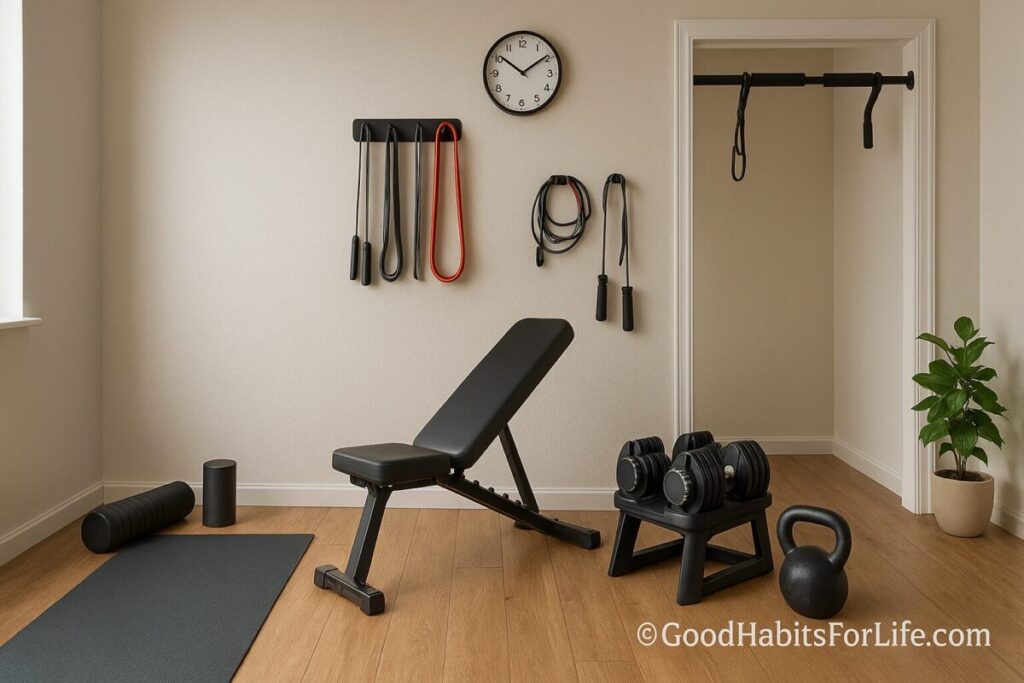
Home Gym on a Budget (2025 Build Guide)
Home Gym on a Budget: 2025 Build Guide
Table of Contents
🧭 What This Guide Covers & Why a Budget Home Gym Works
A budget home gym is a compact training setup—usually one corner of a room—with a few high-impact tools that let you hit all major movement patterns: push, pull, hinge, squat, carry, and core. Done right, it’s cheaper long-term than gym memberships, saves commute time, and removes friction so you train more consistently.
Evidence-backed benefits
-
Regular physical activity improves cardiometabolic health, strength, mobility, and mental wellbeing.
-
Adults should aim for 150–300 minutes/week of moderate aerobic activity and 2+ days/week of muscle-strengthening work.
-
Elastic resistance (bands) and free weights both build strength effectively when you progress load/volume and train near fatigue.
Budget mindset for 2025
-
Prices on steel and shipping are still variable; prioritize versatile gear you’ll keep for years (bands, adjustable dumbbells, a sturdy mat).
-
Buy in phases; use a shortlist and track deals rather than impulse purchases.
✅ Quick Start: Your Minimal Setup Today
Goal: Train full body safely with one order and < 2×2 m space.
Buy/collect (Day 1)
-
Mat (non-slip, ~6–8 mm).
-
Resistance bands (light, medium, heavy) + door anchor.
-
1 pair dumbbells you can press for 8–12 reps (or adjustable set).
-
Timer app (EMOM/Tabata capable) + notebook or app to log sets/reps/RPE.
-
Optional: Loop mini-bands, foam roller, yoga block.
20-minute “first workout” (full body, repeat x2 if fresh)
-
Warm-up (3–4 min): march, arm circles, hip hinges, bodyweight squats.
-
Circuit (15 min):
-
A1) Band Row – 10–15 reps (RPE 7)
-
A2) Goblet Squat (DB) – 8–12 reps
-
A3) Push-up (hands on bench/sofa if needed) – 6–10 reps
-
A4) Hip Hinge (DB/RDL) – 8–12 reps
-
A5) Plank – 20–40 s
Rotate continuously; rest 30–60 s between moves as needed.
-
-
Cool-down (2–3 min): breathing + light stretching.
Progression next sessions
-
Add 1–2 reps per set or slow the tempo (3-0-3).
-
When top reps feel easy at RPE ≤6, increase band resistance or dumbbell load.
🛠️ The 3-Tier Budget Build (Starter/Core/Upgrade)
Primary keyword: home gym on a budget
| Tier | Ideal Budget | What to Buy | Why It Works |
|---|---|---|---|
| Starter | <$75 / ₹6,000 | Mat, mixed tube bands with door anchor, loop mini-bands, jump rope | Full-body strength + simple cardio; portable for travel. |
| Core | <$250 / ₹20,000 | Adjustable dumbbells (or 2–4 fixed pairs), basic bench (or sturdy step), foam roller, kettlebell (8–16 kg) | Adds load range for progressive overload; bench unlocks presses/rows. |
| Upgrade | <$600 / ₹50,000 | Adjustable DBs to higher range, 2–3 kettlebells, folding rack or wall-mount pull-up bar, set of micro-plates (0.5–1 kg), thick mat tiles | Heavier lifts (squats/press/pull-ups) and long-term progression without a full room. |
Tip: Prioritize load range (adjustable DBs/kettlebells) and anchoring options (door/pull-up bar). A folding rack is optional but nice if you’ll barbell later.
🧠 Training Frameworks That Work at Home
Frequency: 3 full-body sessions/week (e.g., Mon-Wed-Fri).
Structure: 5 movement slots + core/conditioning.
Sample 35-minute session
-
Warm-up (5 min): mobility + activation.
-
Strength (20–22 min):
-
-
Squat pattern: Goblet Squat 3×8–12
-
-
-
Push pattern: DB Floor/Bench Press 3×8–12
-
-
-
Hinge pattern: DB RDL 3×8–12
-
-
-
Pull pattern: Band Row or One-arm DB Row 3×10–15
-
-
-
Carry/core: Farmer Carry 3×30–45 s or Side Plank 3×20–40 s
-
-
-
Finisher (5–8 min): EMOM 8: 6 KB swings + 6 push-ups on the minute (scale reps).
Progressive overload (without a barbell)
-
Reps → Tempo → Load: First add reps; then slow eccentric (3–4 s); then increase weight/band.
-
RPE scale (1–10): Keep most working sets at RPE 7–9 (1–3 reps in reserve).
-
Density: Keep total work the same but shorten rests over weeks.
-
Micro-plates/ankle weights help bridge small jumps when DBs escalate by 2.5–5 kg.
Conditioning at home
-
Low-impact: brisk walking, incline treadmill, step-ups, shadow boxing, rope.
-
Intervals: 30:30 × 10–12 with bands/KB swings/jump rope for 10–12 min.
📐 Small-Space & Rental-Friendly Layout Tips
-
Footprint: A 2×2 m square (≈ 6.5×6.5 ft) fits a bench, mat, dumbbells, and a KB.
-
Flooring: Interlocking rubber or EVA tiles protect floors and dampen noise.
-
Vertical storage: Wall hooks for bands/jump rope; under-sofa bins for DBs.
-
Anchors: Door anchor for pulls/presses; removable pull-up bar for apartments.
-
Noise/heat: Train earlier hours; use fans and open windows for ventilation.
-
Safety zone: Keep 50–60 cm (20–24 in) clear space around your working area.
👥 Audience Variations: Students, Professionals, Parents, Seniors
Students
-
Budget: bands + one DB pair; study-break 10-minute AMRAPs (3–4 moves).
-
Habit cue: pair workouts with post-class schedule or Pomodoro breaks.
Busy professionals
-
Calendar blocks at lunch or end-of-day; EMOM sessions limit decision fatigue.
-
Keep the kit in view; friction↓ = adherence↑.
Parents
-
Train with kids: timed circuits, carries, step-ups. Use quiet options during naps.
-
Safety: fence off storage; avoid trip hazards.
Seniors (or returning from inactivity)
-
Emphasize balance (heel-to-toe walks, single-leg holds), sit-to-stand, light bands.
-
Use RPE 5–7; prioritize range of motion and daily walks. Consult a clinician if needed.
⚠️ Mistakes & Myths to Avoid
-
Over-buying gear: Start with a minimal kit; upgrade only when you’ve outgrown it.
-
No plan/log: If you don’t track sets/reps/RPE, progression stalls.
-
Only “feeling the burn”: Chase measured progress, not soreness.
-
Skipping pulling work: Rows/pull-ups balance all the pushing in daily life.
-
Myth: “Bands can’t build muscle.” When trained near fatigue with progression, they do.
💬 Real-Life Examples & Scripts
“I have 15 minutes.”
→ EMOM 15: odd minutes DB Goblet Squat 8–12, even minutes Band Row 12–15.
“I feel stuck on push-ups.”
→ Use incline push-ups on a bench/counter. Lower the height by ~5–10 cm each week.
“No heavier dumbbells yet.”
→ Slow tempo (4-0-4), 1½ reps, pause at the bottom, or add back-off sets high-reps.
“I miss the treadmill.”
→ Rope intervals 30:30 × 10, or shadow boxing 3×3-min rounds between strength sets.
Habit scripts
-
If-Then: “If I make coffee, then I set a 25-min timer and train while it brews/cools.”
-
Implementation intention: “At 7:30 p.m., in the living-room corner, I’ll start Workout B.”
🧰 Tools, Apps & Resources (Pros/Cons)
-
FitNotes / Strong (logging) – Pros: fast logging, graphs; Cons: manual setup at start.
-
Interval Timer / Seconds (timers) – Pros: EMOM/Tabata presets; Cons: ads on free tiers.
-
Google Fit / Apple Health – Pros: integrates steps/HR; Cons: limited strength features.
-
NHS Strength & Flex plan – Pros: free, progressive; Cons: UK-centric examples.
-
YouTube instructional channels (evidence-based) – Pros: form cues; Cons: variable quality—vet sources.
Gear brands: Buy for warranty + knurling/handles quality over looks. Bands should have clearly labeled resistance and secure stitching at anchors.
📆 30-60-90 Habit Roadmap
Day 0 Baseline tests
-
Max push-ups (strict or incline), bodyweight squat reps in 60 s, plank hold, 10-min step count.
Days 1–30 — Foundation
-
3×/week full-body (35 min).
-
Keep RPE 7–8; master technique.
-
Progression: add reps each session until top of range; then tempo 3-0-3.
-
Checkpoint (Day 30): +20–30% reps on baseline tests; consistent log.
Days 31–60 — Build
-
Add a second DB pair or heavier KB if ready.
-
Introduce pull-up practice (band-assisted or negatives) or door-anchor lat-pull.
-
Add a fourth short session (20 min, EMOM or mobility).
-
Checkpoint (Day 60): increase working loads; plank +20–40 s vs baseline.
Days 61–90 — Performance
-
Periodize: Week A (higher reps/volume), Week B (heavier/tempo).
-
Add loaded carries and single-leg work (split squats, single-leg RDL).
-
Consider folding rack/pull-up bar if you’re consistently at RPE 6 on rows/push-ups.
-
Checkpoint (Day 90): 2–3 clear PRs (reps, load, or density); adherence ≥80%.
🗝️ Key Takeaways
-
You can build a complete home gym on a budget with bands + dumbbells + space.
-
Consistency beats complexity—log sessions and progress by reps, tempo, then load.
-
Optimize your corner (2×2 m), protect the floor, and store vertically.
-
Upgrade in tiers only when you’ve earned the next tool.
❓ FAQs
1) Are resistance bands actually effective for strength?
Yes—trained near fatigue with progressive overload, bands stimulate strength and muscle gains comparable to free weights for many movements.
2) How many dumbbells do I need to start?
One adjustable set or 1–2 fixed pairs matched to your pressing/squatting strength covers most exercises.
3) What about cardio if I don’t have a machine?
Use rope intervals, shadow boxing, step-ups, fast outdoor walks, or KB swings. Track time in moderate/vigorous minutes each week.
4) Can I train daily at home?
Aim for 3–4 focused strength sessions/week. On other days, do low-intensity cardio or mobility. Ensure at least 48 h between hard sessions for the same muscle group.
5) I have knee or back niggles—what should I adjust?
Shorten range of motion, reduce load, use tempo/pauses, and prioritize hip hinge mechanics. If pain persists, speak with a clinician.
6) Do I need a bench?
Nice to have, but not required. Floor presses, elevated hip thrusts, and step-ups on a sturdy chair/step cover most bases.
7) How do I progress if my dumbbells feel light?
Increase tempo, range, one-arm/one-leg variations, pause reps, or add mini-bands. Then upgrade load.
8) Will a folding rack or pull-up bar damage my rental?
Use door-frame pull-up bars or stud-mounted folding racks with proper anchors; protect contact points and confirm load ratings.
9) What’s a safe target for workout length?
30–40 minutes is plenty for full body. Time-box sessions with EMOM/AMRAP to keep intensity up.
10) How much space do I really need?
A 2×2 m area works for most. If kettlebell swings or carries, add 1 m clearance in front.
📚 References
-
World Health Organization. Physical Activity (guidelines & benefits). https://www.who.int/news-room/fact-sheets/detail/physical-activity
-
U.S. Dept. of Health and Human Services. Physical Activity Guidelines for Americans, 2nd ed. https://health.gov/sites/default/files/2019-09/Physical_Activity_Guidelines_2nd_edition.pdf
-
Centers for Disease Control and Prevention. How Much Physical Activity Do Adults Need? https://www.cdc.gov/physicalactivity/basics/adults/index.htm
-
American College of Sports Medicine. Progression Models in Resistance Training for Healthy Adults (Position Stand). https://journals.lww.com/acsm-msse/Fulltext/2009/03000/Progression_Models_in_Resistance_Training_for.26.aspx
-
National Health Service (UK). Benefits of Exercise. https://www.nhs.uk/live-well/exercise/exercise-health-benefits/
-
American Heart Association. Recommendations for Physical Activity in Adults. https://www.heart.org/en/healthy-living/fitness/fitness-basics/aha-recs-for-physical-activity-in-adults
-
National Institute on Aging (NIH). Exercise and Physical Activity: Getting Started. https://www.nia.nih.gov/health/exercise-physical-activity
-
Lopes J et al. Elastic Resistance Training to Increase Muscle Strength: A Systematic Review and Meta-Analysis. (Open-access summary) https://pubmed.ncbi.nlm.nih.gov/ (search “elastic resistance training meta-analysis”)
⚖️ Disclaimer
This guide is educational and not a substitute for personalized medical advice; consult a qualified professional before starting or modifying an exercise program, especially if you have health conditions.