
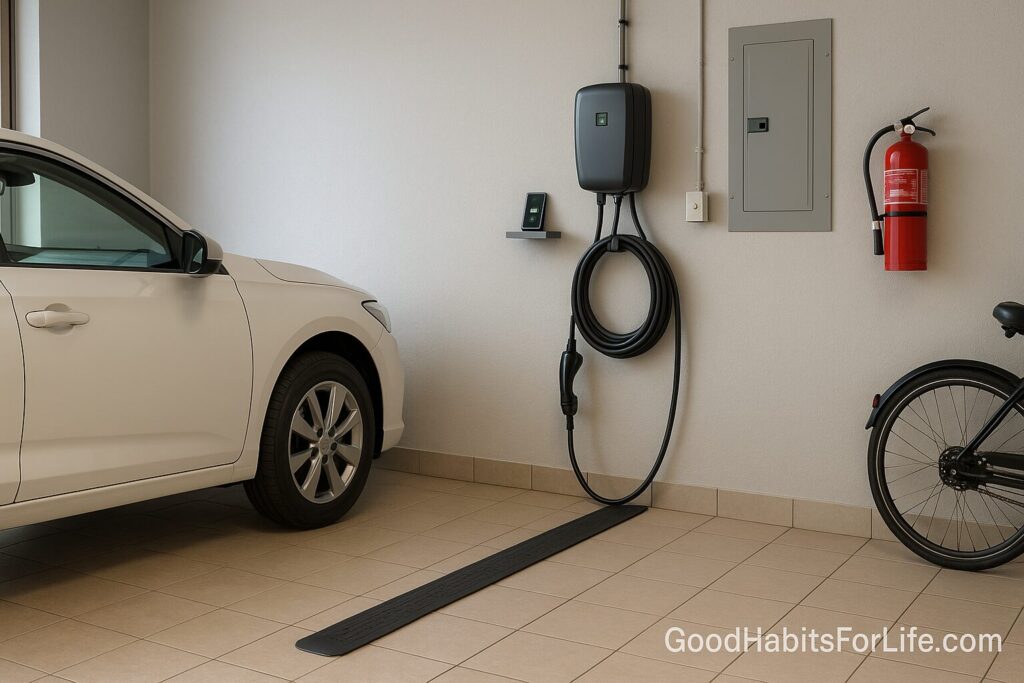
Home Charging Setup: Safety First, Cables Second: Dopamine Detox (2025)
Home EV Charging Setup: Safety First, Cables Second (2025)
Table of Contents
🧭 What & Why
A safe home EV charging setup is two things: (1) an electrical installation that meets code and (2) daily habits that keep heat, clutter, and distraction risks low. Use a listed/approved EVSE on a dedicated circuit with the right breaker and residual-current/ground-fault protection. In most regions, installations must comply with local codes and may require permits—start here before buying hardware. afdc.energy.gov
Why it matters: Poor connections and overloaded cords create heat; messy cables trip people and collect grime; checking apps repeatedly during charging feeds unhelpful “novelty loops.” The fix is both technical (correct wiring, protection, placement) and behavioral (tidy cable habits, one-tap routines, scheduled charging).
Levels at a glance:
-
Level 1 (120 V): slow, simple, for plug-in hybrids or overnight top-ups.
-
Level 2 (208–240 V): faster home standard; typically 7–11 kW depending on EVSE and circuit.
-
DC fast: not for home.
For definitions and typical times, see official guidance. Department of Transportation
✅ Quick Start: Safe Setup in One Afternoon
Before you begin (15–30 min)
-
Check panel capacity (amperage headroom for a dedicated circuit).
-
Choose the spot (clear, ventilated area; away from flammables; reachable without stretching cable across walkways). NFPA
-
Pick your EVSE (wall-mounted, outdoor-rated if needed; Type-tested/listed).
Install (licensed electrician recommended)
-
Dedicated circuit sized to EVSE draw (e.g., 40 A breaker for a 32 A EVSE; 20% continuous load margin).
-
Protection: breaker + RCD/GFCI; for outdoor installs, weatherproof enclosure; follow local wiring rules.
-
Avoid extension cords and multi-socket leads—they overheat and can cause fires. Electrical Safety Firstcityofprosser.com
Configure
-
Limit daily charge (e.g., 70–90% depending on commute).
-
Schedule off-peak charging in the EV or charger app to cut costs and grid strain; many regions now default chargers to off-peak by regulation. GOV.UK
-
Label & QR: Stick a label with breaker size and a QR to the EVSE manual.
Final check (5 min)
-
Warm-up test: after 20–30 minutes of Level-2 charging, touch the plug face and cable jacket—warm is normal; hot or soft is not. Stop and investigate.
🛠️ 30-60-90 Day Habit Plan
Days 1–7 (Install & Baseline)
-
Nightly routine: Arrive → Plug → Holster slack (two-hand coil) → Close app.
-
Put a microfiber + cable brush on a hook; quick wipe keeps grit out of connectors.
-
Set charge limit (e.g., 80%).
-
Add a weekly 2-min inspection: look for nicks, discoloration, tripping hazards.
Days 8–30 (Automation & Tidy)
-
Enable off-peak schedule and a departure-time profile.
-
Place a floor line or small cable caddy to keep pathways clear.
-
Create a “no phone linger” rule: once plugged, leave the garage/driveway—no doom-scrolling.
Days 31–60 (Optimization)
-
Track energy use and cost; tweak charge window/limit.
-
If multiple drivers, color-code key tags with each person’s preferred limit/schedule.
-
Add a small fire extinguisher (ABC or per local guidance) nearby but not on the EVSE.
Days 61–90 (Scale & Review)
-
Add load management if you have other large appliances (smart panel or charger-to-charger balancing).
-
Review wear items: holster, cable strain relief, connector latch. Replace proactively.
🧠 Techniques & Frameworks (Safety + “Dopamine Detox”)
S.A.F.E. Setup Framework
-
Source: dedicated circuit, correctly sized breaker, RCD/GFCI.
-
Ambient: clean, dry, ventilated, away from combustibles and vehicle exhaust paths. NFPA
-
Fixture: listed EVSE, weather rating for outdoors (e.g., IP54+), strain relief, holster.
-
Etiquette: no extension leads; clear walkways; child-safe cable routing. Electrical Safety First
“Cables Second” Micro-Routine
-
Plug first (seat connector fully).
-
Immediately manage the slack: two-loop coil → holster/retractor.
-
Glance at EVSE lights; do not open the app unless troubleshooting.
-
Close the door/gate—habit complete.
Dopamine Detox Angle (for real)
-
Reduce novelty triggers: turn off non-critical charger notifications; keep only failure/complete alerts.
-
Make it boring on purpose: same socket, same path, same holster—no searching, no fiddling.
-
Bundle with a competing mini-reward: “Plug → coil → 5 mindful breaths” or “Plug → 1 glass of water.”
Battery-Friendly Defaults
-
Daily limit 70–90% (commute-dependent).
-
Avoid repeated 100% storage; schedule finish-near-departure for fulls.
-
Heat is enemy #1: keep cables/plugs clean; fix resistance (loose/dirty contacts) early.
🧳 Audience Variations
Renters / Apartments
-
Prefer plug-in Level-2 (NEMA 14-50) if allowed, or Level-1 in a dedicated, GFCI-protected outlet; obtain written permission.
-
Use lockable holsters and compact retractors; mount with landlord-approved hardware.
-
If shared power, schedule off-peak and set shorter charge windows to reduce load conflicts.
Homeowners
-
Wall-mount Level-2 with hard-wired connection for weather resistance and theft deterrence.
-
Consider smart panels or load-shedding relays if your main service is tight.
-
Outdoor driveway? Choose UV-stable cables and NEMA/IEC weather-rated enclosures.
Apartments with Community Chargers
-
Keep a glove + wipe kit in the trunk.
-
Set courtesy timers (e.g., 2–3 hours) and move when done.
-
Use cable guards if the cable crosses walkways.
Seniors
-
Prioritize low-bend holsters at hip height.
-
Add high-contrast floor tape to show safe cable paths.
Multi-Driver Families
-
Create profiles in the charger/EV app: “Workday,” “Weekend,” “Road Trip.”
-
Post a fridge card with each driver’s charge limit and the emergency stop procedure.
⚠️ Mistakes & Myths to Avoid
-
Myth: “Any outlet is fine.” → Reality: Fast charging draws continuous current; use a dedicated, code-compliant circuit. afdc.energy.gov
-
Mistake: Using extension cords or daisy-chained power strips. → Heat, voltage drop, and fire risk. Electrical Safety First
-
Myth: “More amps = always better.” → Oversizing beyond panel capacity trips breakers and may shorten equipment life. Match EVSE to wiring.
-
Mistake: Mounting near flammables or in cramped corners with poor airflow. → Keep clearance and ventilation. NFPA
-
Myth: “Off-peak is just a money thing.” → It also reduces grid stress; many countries now require default off-peak scheduling. GOV.UK
💬 Real-Life Examples & Scripts
Script: Electrician Brief (copy-paste)
“I need a dedicated circuit for a wall-mounted Level-2 EVSE at [amps] A continuous load. Please include appropriate breaker, RCD/GFCI, outdoor rating if applicable, and labeling. The run is approximately [meters] with [conduit type]. Mount at [height] with cable strain relief and a holster.”
Family Rule Card
-
Plug immediately; cables second: coil → holster.
-
No extension cords.
-
Off-peak schedule: 22:30–06:30.
-
Daily limit: 80%; road-trip to 100% finishing at departure.
-
Inspect weekly; report heat/discoloration.
Garage Layout Tips
-
Place EVSE near the charge port side of the car to avoid crossing paths.
-
Mount holster at hip height; add a retractable reel or hook for slack.
-
Use rubber cable ramps if crossing walkways is unavoidable.
📚 Tools, Apps & Resources
Hardware
-
Wall-mounted Level-2 EVSE (listed/certified; outdoor-rated if exposed).
-
Cable holster + retractor (keeps slack off the floor).
-
Smart panel / load-shed relay (balances with HVAC/water heater).
-
Label set (breaker size, QR to manual).
-
Safety kit: gloves, microfiber, small flashlight, contact cleaner, ABC extinguisher (per local guidance).
Apps & Settings
-
EV native app: set charge limit and off-peak schedule; enable only critical notifications.
-
Utility app/portal: check time-of-use tariffs; enroll in managed charging if offered.
-
Home automation (advanced): link departure-time routines; never bypass EVSE protections with generic smart plugs.
Pros/Cons Snapshot
-
Hard-wired EVSE: +robust, weather-tight; −less portable.
-
Plug-in EVSE: +flexible; −receptacle wear, theft risk outdoors.
-
Smart chargers: +scheduling, data, load-sharing; −firmware learning curve.
🧾 Key Takeaways
-
Start with code-compliant electrical work and a listed EVSE—that’s your base layer. afdc.energy.gov
-
Never use extension leads or multi-socket adapters. Keep cables short, intact, and holstered. Electrical Safety First
-
Default to off-peak schedules; many regions now require smart chargers to ship that way. GOV.UK
-
Make charging mindless and tidy: “Plug → coil → holster → walk away.”
-
Inspect weekly for heat, nicks, and trip risks; fix early.
❓ FAQs
1) Do I need a permit for a home charger?
Often yes. Many jurisdictions require permits/inspection for new circuits; check local rules or ask your electrician. afdc.energy.gov
2) Can I charge from a regular outlet?
Level-1 on a dedicated, GFCI-protected outlet is acceptable for slow charging; avoid extension leads and don’t share the circuit with other heavy loads. Electrical Safety First
3) What’s the safest place to mount the EVSE?
Close to the charge port, off the floor, with cable managed and away from flammables or high-traffic areas. NFPA
4) Why off-peak scheduling?
Lower cost, less grid strain; in the UK it’s built into smart-charger regulations as default hours you can override. GOV.UK
5) I live in India—anything special?
MoP guidance enables home charging via existing connections (subject to rules). Use BIS-compliant EVSE, proper earthing, and a licensed electrician. eVYatra
6) How hot is too hot for the cable/plug?
Warm is normal; hot to the touch or discoloration means stop and inspect (loose fit, damaged contacts). Get an electrician to check.
7) Do I need a surge protector?
Panels often include whole-home surge protection; adding one is a good idea in lightning-prone areas—ask your electrician.
8) Should I charge to 100% daily?
Not usually. Aim for a routine limit (e.g., 70–90%); reserve 100% for trips and time the finish near departure.
9) Is a portable EVSE safe?
Yes if listed, used per the manual, and plugged into a dedicated, correct-rating outlet. Store dry; inspect before use.
10) Can I run the cable under a rug or mat?
No—traps heat and invites wear. Use purpose-built cable ramps if you must cross a path.
📑 References
-
U.S. DOE Alternative Fuels Data Center — Charging Electric Vehicles at Home. https://afdc.energy.gov/fuels/electricity-charging-home afdc.energy.gov
-
NFPA — Electric Vehicle Safety Information & Home Charging Tip Sheet. https://www.nfpa.org/education-and-research/electrical/electric-vehicles NFPA
-
Electrical Safety First (UK) — Electric car charging safety. https://www.electricalsafetyfirst.org.uk/guidance/product-safety/electric-vehicles/ Electrical Safety First
-
City of Prosser Fire Dept — EVs: Safe Charging at Home (PDF). https://www.cityofprosser.com/DocumentCenter/View/1037/Electric-Vehicles-Safe-Charging-at-Home-PDF cityofprosser.com
-
UK Government — Regulations: Electric Vehicle Smart Charge Points. https://www.gov.uk/guidance/regulations-electric-vehicle-smart-charge-points GOV.UK
-
UK Legislation — The Electric Vehicles (Smart Charge Points) Regulations 2021 (PDF). https://www.legislation.gov.uk/ukdsi/2021/9780348228434/pdfs/ukdsi_9780348228434_en.pdf Legislation.gov.uk
-
U.S. DOT — Charger Types and Speeds (EV Toolkit). https://www.transportation.gov/rural/ev/toolkit/ev-basics/charging-speeds Department of Transportation
-
India MoP / BEE — Guidelines & Standards for EV Charging Infrastructure (overview). https://evyatra.beeindia.gov.in/central-govt-initiative-details/mop-2022/ eVYatra
-
U.S. DOE Energy Saver — How to Charge Electric Vehicles. https://www.energy.gov/energysaver/how-charge-electric-vehicles The Department of Energy’s Energy.gov
-
DOE Building Energy Codes Program — EV Charging Tech Brief (2024, PDF). https://www.energycodes.gov/sites/default/files/2025-01/TechBrief_EV_Charging.pdf energycodes.gov