
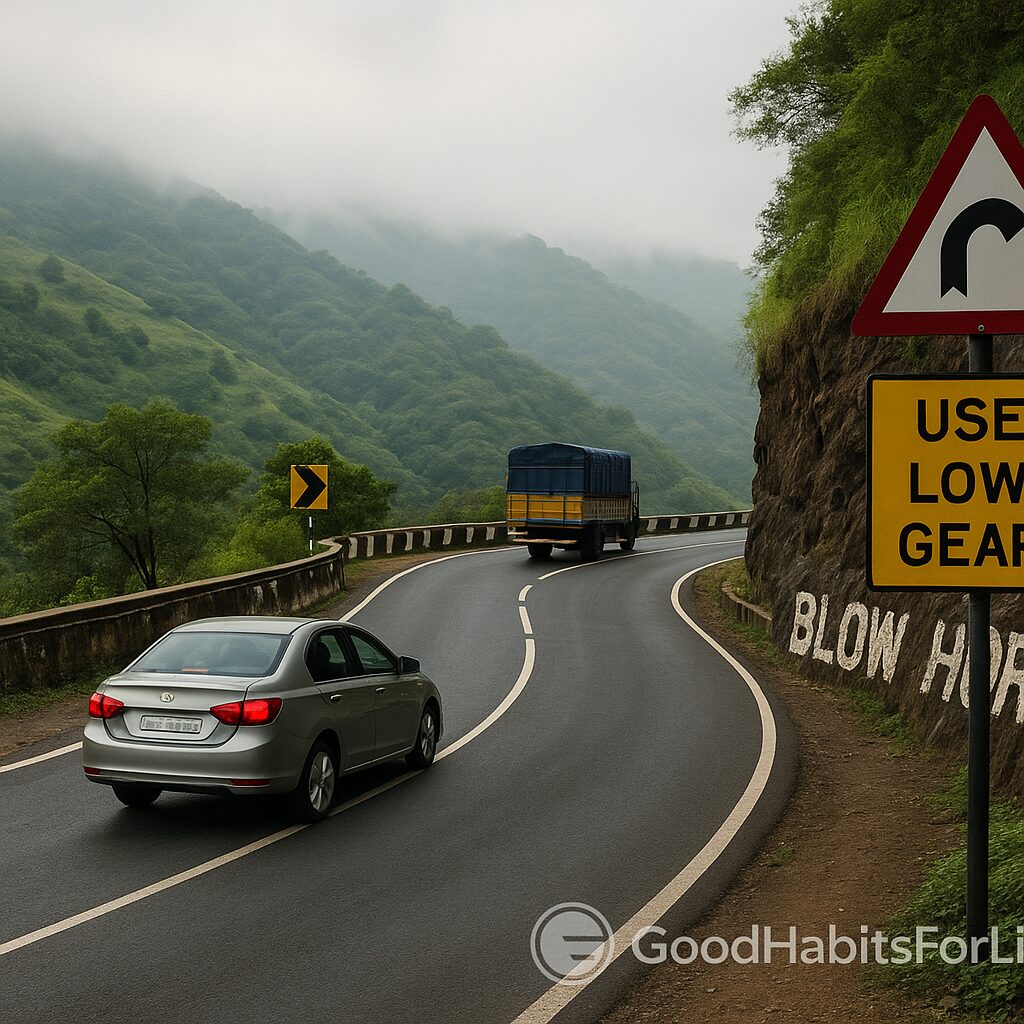
Hills & Ghats: Engine Braking, Hairpins, Honk Rules
Hills & Ghats: Engine Braking, Hairpins, Honk Rules
Table of Contents
🧭 What Counts as “Hill/Ghat Driving” & Why It’s Different
Hill/ghat roads combine steep grades, tight radius curves, rapidly changing weather, and limited sight distance. That combo increases risk of brake fade, lane departures, and head-on conflicts—especially on single-lane or narrow two-lane sections. Using lower gears for speed control and clear communication (signals/horn where appropriate) significantly reduces risk. Guidance from highway and park authorities consistently recommends low-gear descents and cooling overheated brakes before continuing. National Park Service+1
✅ Engine Braking 101 (and How to Avoid Brake Fade)
Engine braking means selecting a lower gear so the engine’s resistance controls speed. It saves brakes and stabilizes the vehicle.
Downhill protocol (proven for steep grades):
-
Select a proper low gear before the descent.
-
Use “snub braking”: firm brake for ~3 seconds to drop ~8 km/h (5 mph), then release and let engine hold; repeat.
-
If you smell brakes or feel fade, pull over, let them cool, and do a test stop before proceeding. FHWA OperationsNational Park Service+1
Why it matters: Continuous light braking overheats pads/rotors and fluid → longer stopping distances or loss of brakes (“fade”). Agencies studying steep downgrades advise gearing down and using brakes only to supplement the engine. FHWA OperationsROSA P
Quick gear guidance
-
Automatics: choose “L/1/2/B” modes or paddle-downshift to keep revs in a safe band.
-
Manuals: choose a gear that would require similar throttle to climb the same hill.
-
EVs: use maximum regen (B mode/Level 3-5); still watch temperatures and speed.
🌀 Hairpin Technique: Approach, Apex, Exit
Hairpins (very tight U-bends) demand a slow, deliberate rhythm.
The 3-part rhythm:
-
Approach: Brake in a straight line; select 1st/2nd (or strong regen in EVs). Enter slow.
-
Apex: Look deep into the turn; hold your lane—don’t “straight-line” across the centre.
-
Exit: Unwind steering; add gentle throttle only when you can see clear road.
Non-negotiables:
-
Never overtake on or near hairpins; watch advisory speed/chevrons.
-
Expect oncoming wide vehicles to swing; set up far left (in India) without clipping the edge.
-
Use mirrors and windows de-fogged for maximum visibility. standards.transport.nsw.gov.auUK Government Publishing
📢 Honk Etiquette on Ghats (and the Law)
Purpose: A short horn tap can warn unseen road users at blind curves. But Indian law is clear: unnecessary use of horn is prohibited, and horn-free/silence zones must be respected. Use only to avert danger or when directed by signs. Ministry of Road Transport and Highwayshspcb.org.in
Practical etiquette:
-
Blind hairpins/limited sight: one short, polite tap to declare presence (if not in a horn-prohibited zone).
-
Silence zones/“Horn Prohibited” signs: lights and speed reduction only—no horn.
-
Avoid multi-tone/pressure horns; these are restricted. chandigarhtrafficpolice.gov.inDigital Sansad
🛣️ Right of Way & Lane Discipline in the Hills
-
On narrow/one-lane hill roads, give way to uphill traffic. Stopping an uphill vehicle can cause rollback or loss of momentum. jhpolice.gov.inpolice.py.gov.in
-
Keep to your lane; never cross centre lines on bends.
-
Use designated turnouts to let faster vehicles pass; don’t stop on the apex.
🛠️ Quick Start: Do This on Your Next Drive
-
Before the climb: Tyres at spec, coolant topped, wipers/lights clean.
-
Before the descent: Select low gear (or max regen).
-
At hairpins: Slow in straight line → look → roll through in 1st/2nd.
-
At blind curves: Tap horn only if needed; otherwise lights + lane position.
-
Smell brakes? Pull over, cool, test, then continue.
🗓️ 7-Day Hill-Skills Starter Plan
-
Day 1: Parking-lot practice—tight turns, smooth throttle/brake.
-
Day 2: Short hill nearby—practice selecting low gear/regen and steady 30–40 km/h descent.
-
Day 3: Sequence of curves—“slow-in, look, roll-out” at posted advisory speeds.
-
Day 4: Communication—mirror checks, indicators 3 sec early, brief horn only at blind bends.
-
Day 5: Mixed traffic—use turnouts; rehearse uphill right-of-way.
-
Day 6: Long descent—apply snub-braking pattern; log temps/smell awareness. FHWA Operations
-
Day 7: Full route with rain/fog simulation if safe; debrief and set personal speed caps.
🧠 Techniques & Frameworks That Work
-
Snub-Braking Framework: Repeatable 3-second firm brake → 8 km/h drop → release, let engine hold. FHWA Operations
-
“See–Set–Signal–Steer” Hairpin Flow: See the exit → Set speed/gear early → Signal intentions → Steer smoothly.
-
Temperature Triggers: Any brake smell, softness, or pulling → stop and cool. National Park Service+1
🧍♀️ Variations: Cars, Two-Wheelers, EVs, Heavy Vehicles
-
Two-wheelers: Use rear brake to settle the chassis at low speed; look through the turn; avoid front-brake grabs mid-apex.
-
EVs: Use highest regen; be mindful that regen can reduce at full battery or in heat—keep a low gear available if your EV supports blended braking.
-
Heavy vehicles: Start very slow on downgrades; engine braking is primary, foundation brakes supplement. Watch posted truck descent advisories. FHWA OperationsROSA P
⚠️ Mistakes & Myths to Avoid
-
Myth: “Riding brakes lightly is safer.” → False. It overheats pads/fluid—use engine braking + snub method. FHWA Operations
-
Mistake: Cutting across hairpins. Lane departures cause head-ons—hold your line. UK Government Publishing
-
Mistake: Honking everywhere in the hills. Law allows horn only when necessary; silence zones prohibit it. Ministry of Road Transport and Highwayshspcb.org.in
-
Mistake: Forcing uphill vehicles to stop on narrow sections—give way. jhpolice.gov.in
🗣️ Real-Life Scripts & Signals
-
Blind hairpin (not a silence zone): Tap horn once, low-beam on, keep left, 1st/2nd gear.
-
Meeting a bus on a single-lane climb: You (downhill) stop at a turnout and signal with hazard/hand wave to let it pass. jhpolice.gov.in
-
Hot brake smell: “I’m pulling over to cool the brakes—resume only after a test stop.” National Park Service
📚 Tools, Apps & Resources
-
Offline maps with elevation/grade hints: Google Maps offline, OpenStreetMap apps.
-
OBD scanner/temps (cars): Spot early overheating behavior.
-
Tyre pressure monitors: Keep pressures stable for grip and braking.
-
Dash indicators refresher: Know your low-gear/“B”/regen settings from the owner’s manual.
-
Physical aids: Microfiber for misted glass; headtorch; reflective triangle.
🧾 Key Takeaways
-
Pick the right gear early; brakes only supplement the engine on descents. FHWA Operations
-
Hairpins: slow in, look long, hold your lane, no overtaking. UK Government Publishing
-
Honk only to warn at blind curves where permitted; silence zones override. Ministry of Road Transport and Highwayshspcb.org.in
-
Give way to uphill traffic on narrow ghats; use turnouts. jhpolice.gov.inpolice.py.gov.in
-
If brakes smell/feel weak, stop and cool, then test before continuing. National Park Service
❓ FAQs
1) What gear should I use on a long 10–12% descent?
Choose a gear that holds ~30–40 km/h without constant braking (e.g., 1st/2nd or “L/B”). Use snub-braking if speed creeps up. FHWA Operations
2) Is it legal to honk at every curve in the hills?
No. Indian rules prohibit unnecessary horn use; honk only to warn of danger or when directed by signs. Silence/horn-prohibited zones must be respected. Ministry of Road Transport and Highwayshspcb.org.in
3) Who has right of way on a narrow hill road?
The downhill vehicle should stop and let uphill traffic pass. This avoids rollback and loss of momentum. jhpolice.gov.inpolice.py.gov.in
4) My brakes smell on a descent—what do I do?
Pull over safely, let them cool, and perform a test stop before proceeding. Resume only when pedal feel returns and smell fades. National Park Service
5) Can EV regen replace engine braking completely?
Regen is excellent but can reduce at high battery SOC or high temps; keep speed low and be ready to use friction brakes and low-gear equivalents. (General safety guidance; see vehicle manual.)
6) What speed is safe for hairpins?
Follow posted advisory speeds and chevrons; typically 10–25 km/h depending on radius/grade—enter slow, stay in lane, and accelerate only on exit. standards.transport.nsw.gov.au
7) Are multi-tone or pressure horns allowed in India?
They are restricted/banned except for emergency vehicles; stick to standard horns. Digital Sansad
8) Should I use hazard lights while descending?
No. Use low beam and proper gear; hazards are for stopped/temporary obstruction situations.
References
-
Motor Vehicles (Driving) Regulations, 2017 — Use of Horns & Silence Zones. Ministry of Road Transport & Highways (India). Ministry of Road Transport and Highways
-
Noise Pollution (Regulation and Control) Rules, 2000 — Restrictions on horn use & silence zones. Govt. of India (CPCB/State Boards). hspcb.org.in
-
FHWA Driver Safety Issues (Module 7): Engine braking & snub-braking method on long downgrades. FHWA Operations
-
FHWA Research on grade severity & safe descent speeds for steep downgrades. ROSA P
-
US National Park Service — Mountain Driving Tips (Rocky Mountain NP): Downshift, cool brakes, test before proceeding. National Park Service
-
US National Park Service — Driving Mountain Roads (Sequoia & Kings Canyon): Downshift to prevent brake failure/burning. National Park Service
-
Jharkhand Police — Hill Driving: “Always give priority to uphill traffic.” jhpolice.gov.in
-
Puducherry Police — Guidelines for Car Drivers: Give priority to uphill traffic; avoid overtakes on curves. police.py.gov.in
-
Transport NSW / Standards — Curve & advisory speed signs and chevrons: advance warning of abrupt alignment changes. standards.transport.nsw.gov.au
-
Overseas Road Note 20 (UK Aid) — Measures for tight bends (signing, delineation, superelevation). UK Government Publishing