
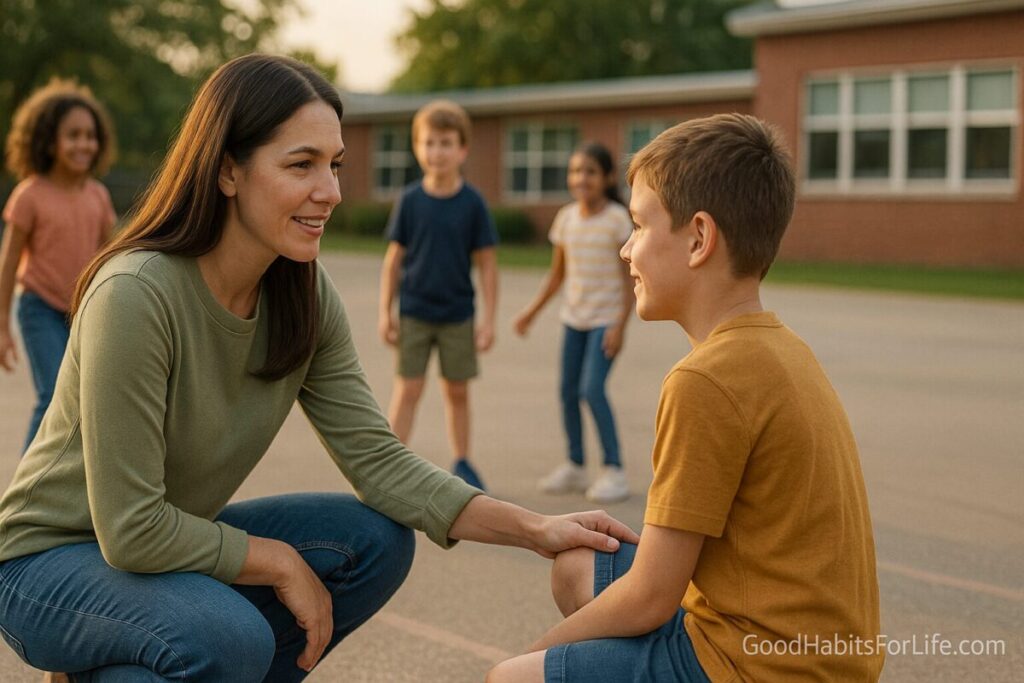
Helping Kids Make Friends: Coach, Dont Fix
Helping Kids Make Friends: Coach, Dont Fix
Table of Contents
🧭 What & Why
Helping kids make friends is less about swooping in to fix problems and more about coaching the everyday skills that make friendships work: noticing social cues, starting conversations, joining groups, taking turns, and repairing small ruptures. Strong friendships are consistently linked with better well-being and even long-term health outcomes, so these skills matter now and later in life. APA
Early serve-and-return interactions—those responsive back-and-forth exchanges with caring adults—lay the brain foundations for later social skills. When you coach instead of fix, you’re extending that pattern: guiding kids to respond, reflect, and try again. developingchild.harvard.edu
Pediatric guidance emphasizes open communication, involvement, and monitoring as friendships evolve, with parents modeling empathy, problem-solving, and safe boundaries from early years through adolescence. HealthyChildren.org+1
If a child repeatedly struggles to form or keep friends, especially alongside attention, language, or behavior challenges, it’s worth checking in with your pediatrician or school team for additional support. Harvard HealthCDC
✅ Quick Start: Do This Today
-
Name the goal together.
“This week, we’ll practice saying ‘Hi’ and joining one game at recess.” -
Rehearse one micro-skill (10 minutes).
Practice: smile, eye contact, “Hi, can I play too?” + taking a turn. -
Plan one low-stakes opportunity.
Neighborhood park time, library activity hour, or club meeting. -
Coach before—not during—the moment.
Agree on a simple plan (“greet + join + share”), then observe without stepping in. -
Debrief after with two questions.
“What went well?” and “What’s one thing to try differently tomorrow?” -
Track tries, not just outcomes.
A sticker or checkmark for each attempt builds confidence. -
Keep safety in view.
If there’s bullying (targeted, repeated harm or power imbalance), document and escalate with school per policy. UNICEF
🗓️ 7-Day Friendship Starter Plan
Goal: 5+ friendly “tries” by Week’s end.
Day 1 (Home):
-
Watch a 2-minute demo (you act as peer).
-
Role-play greeting, joining, and taking turns (3 reps).
-
Choose a Friendly Act for tomorrow (e.g., offer a game, share a pencil).
Day 2 (School/Club):
-
Try one greeting + join once.
-
Evening debrief: 2 wins, 1 tweak.
Day 3 (Home):
-
Practice noticing cues: look for open body language and eye contact; rehearse what to do if a group says “not now.”
Day 4 (School/Club):
-
Try a give-and-take game (cards, drawing, catch).
-
Debrief: What made it flow?
Day 5 (Home):
-
Repair scripts: “Sorry I grabbed that; your turn.” Practice tone + timing.
Day 6 (Community):
-
Attend a public activity (library LEGO hour, sports clinic).
-
Parent observes from a distance; praise effort.
Day 7 (Reflect & Reset):
-
Count total tries and celebrate.
-
Set one next-week target (e.g., invite one classmate to play for 20 minutes).
🧠 Techniques & Frameworks for Parents as Coaches
The C.O.A.C.H. Model
-
C—Connect first: Validate feelings; stay curious (“Tell me what happened at recess”).
-
O—Observe patterns: When is it easier/harder? Who’s around? What cues were missed or used?
-
A—Ask, don’t advise (yet): “What could you try first next time?”
-
C—Choose one micro-skill: Greeting, joining, sharing, complimenting, or repairing.
-
H—Help them rehearse: Role-play twice; quick body-language check; agree on a plan.
Core Friendship Micro-Skills (teach 1 at a time)
-
Starting: greeting + name + open-ended question.
-
Joining: stand near, watch 10 seconds, comment on the game, ask to join.
-
Sharing/turn-taking: verbalize the turn (“Your turn now”), set 2-minute timer if needed.
-
Complimenting: specific, behavior-based praise (“I like how you kept the ball in play”).
-
Repairing: short apology + action (“Sorry I cut in; you go first”).
Role-Play & Rehearsal
Brief, targeted practice (5–10 minutes) at home increases readiness for real settings. Organizations supporting children’s mental health encourage home-based coaching and role-play to build social confidence. Child Mind Institute
Partnering with School & SEL
Ask teachers about explicit SEL instruction and practice opportunities (class jobs, buddy benches, cooperative games). Evidence reviews show school-based SEL improves social behaviors and belonging and reduces conduct issues. Casel SchoolguideLearning Policy Institute
Safety: Conflict vs Bullying
-
Conflict: peers of equal power disagree; teach problem-solving.
-
Bullying: repeated, intentional harm with power imbalance (including cyber); document and escalate per school policy and local law. UNICEF
Parent Involvement That Helps (Not Hovers)
Know your child’s friends, set expectations, and create chances to connect—without micromanaging every interaction. Pediatric guidance highlights proactive involvement and monitoring as children’s friendships deepen. HealthyChildren.org+1
🧑🎓 Audience Variations (By Age & Needs)
Early Primary (5–7):
-
Keep scripts short (5–7 word starters).
-
Practice turn-taking with timers and cooperative board games.
-
Coach noticing faces and voices (happy/neutral/frustrated).
Upper Primary (8–10):
-
Teach joining groups and repair language.
-
Encourage “one friendly act a day” at school.
-
Begin self-reflection (“What kind of friend do I want to be?”).
Preteens/Young Teens (11–14):
-
Add values and boundaries (choosing good-fit friends).
-
Discuss online group chats; practice bystander-to-upstander moves.
-
Rotate responsibilities in clubs/teams for shared leadership.
Older Teens (15–17):
-
Emphasize healthy relationships, consent, and digital citizenship.
-
Coach conflict resolution and “cool-down + return” strategies.
-
Encourage mixed-context friendships (school + community + volunteering).
Shy/Anxious Kids:
-
Start in small, structured settings (clubs with defined roles).
-
Pre-plan exits (“I’m heading to the art table—see you later”).
-
Measure tries, not outcomes; celebrate micro-bravery.
Neurodiverse Learners (e.g., ADHD, autism):
-
Teach explicit steps with visuals; practice in predictable settings.
-
Offer clear rules of games; pair with empathetic peers.
-
Coordinate with school for coaching in real contexts. If friendship struggles persist, consult your pediatrician for tailored supports. Harvard Health
⚠️ Mistakes & Myths to Avoid
-
Myth: “If I arrange more playdates, the problem disappears.”
Reality: Quantity without coaching rarely works; focus on skills first. -
Mistake: Solving every conflict for your child.
Fix: Prep and debrief; let them try first unless safety issues arise. -
Myth: “SEL is just feelings talk.”
Reality: High-quality SEL builds measurable skills linked to behavior and belonging. Learning Policy Institute -
Mistake: Ignoring power dynamics online.
Fix: Teach screenshot/save/report; model respectful digital behavior. UNICEF -
Myth: “Only extroverts make friends easily.”
Reality: Friendship is a teachable set of micro-skills for all temperaments.
🛠️ Real-Life Examples & Scripts (Copy-Paste Friendly)
Greeting & Join
-
“Hey [Name]! That tower looks awesome—can I build the roof?”
-
“Hi, I’m [Name]. What level are you playing? Mind if I try after you?”
Compliment & Continue
-
“Nice pass—want to try a triangle play?”
-
“Your drawing has great shadows. Can you show me how you did that?”
Repair After a Slip
-
“I talked over you—sorry. Tell me your idea.”
-
“I grabbed the ball. My mistake. Your turn.”
Upstander Lines (Safe, Short, Clear)
-
“That’s not okay. Let’s go.” (exit with target)
-
“We don’t talk to people like that.” (name behavior, not person)
-
Online: “I’m leaving this chat—too mean.” (then block/report) UNICEF
Parent Coaching Phrases
-
Before: “What will be your first step?”
-
After: “What worked? What’s your one tweak?”
-
Praise: “You tried twice today—that’s brave. Effort builds skill.”
📚 Tools, Apps & Resources (Pros/Cons)
-
School Clubs/Activities (sports, music, coding, scouts)
-
Pros: Built-in roles, repeated contact.
-
Cons: Fit matters; try a few before committing.
-
-
Library & Community Programs
-
Pros: Free/low-cost, mixed ages, structured.
-
Cons: Limited schedules.
-
-
Mindfulness for Kids (e.g., Smiling Mind, Headspace for Kids)
-
Pros: Calm body/voice before social tries; short sessions.
-
Cons: Works best paired with real-world practice.
-
-
Family SEL Practices (gratitude, emotion-labeling, weekly “high/low” chats)
-
Pros: Reinforces at home; no tech needed.
-
Cons: Requires consistency.
-
-
Buddy Benches & Peer-Mentor Programs at School
-
Pros: Visible supports; normalize asking to join.
-
Cons: Needs staff follow-through and culture building. Casel SchoolguideLearning Policy Institute
-
🔑 Key Takeaways
-
Coach micro-skills (greet, join, share, repair) with short, repeated practice.
-
Plan real chances to try at school and in the community.
-
Partner with teachers/clubs so skills transfer and stick.
-
Measure attempts to build confidence; celebrate small wins.
-
Protect safety and escalate bullying concerns promptly. UNICEF
❓ FAQs
1) My child says “no one likes me.” What should I do first?
Validate feelings, ask for specifics (“Who? When?”), then coach one micro-skill and arrange a low-stakes opportunity to try it this week.
2) How many friends does a child need?
Quality beats quantity; one or two steady friendships can be protective for well-being. APA
3) Should I correct rude behavior in the moment?
If safety isn’t at risk, wait. Debrief privately afterward; rehearse a better script and try again tomorrow. HealthyChildren.org
4) How do I tell if it’s bullying or a one-time conflict?
Bullying is repeated, intentional harm with a power imbalance (or cyber). Document, save evidence, and contact school per policy. UNICEF
5) What if my child’s challenges seem bigger than skills practice?
Speak with your pediatrician and school team; attention, language, or social-communication differences can impact friendships, and targeted supports help. Harvard HealthCDC
6) How can schools help?
Ask about explicit SEL instruction, cooperative learning, and structured recess/clubs; these approaches are linked with better social outcomes. Casel SchoolguideLearning Policy Institute
7) What’s one daily habit that helps most?
A 5-minute evening debrief (“wins + tweak”) keeps effort focused and momentum high.
References
-
American Psychological Association. The science of why friendships keep us healthy (2023). APA
-
Harvard Center on the Developing Child. Serve and Return: Back-and-forth exchanges. developingchild.harvard.edu
-
American Academy of Pediatrics / HealthyChildren.org. What Parents Can Do to Support Friendships (2022). HealthyChildren.org
-
American Academy of Pediatrics / HealthyChildren.org. Getting to Know Your Child’s Friends (2024). HealthyChildren.org
-
Child Mind Institute. Kids Who Need a Little Help to Make Friends (2025). Child Mind Institute
-
Learning Policy Institute. Evidence for Social and Emotional Learning in Schools (2023). Learning Policy Institute
-
CASEL SchoolGuide. Explicit SEL Instruction. Casel Schoolguide
-
UNICEF Parenting. Bullying: What is it and how to stop it. UNICEF
-
CDC. Social/Emotional Development & Milestones (Act Early). CDC
-
Harvard Health Publishing. Helping children make friends: what parents can do (2023). Harvard Health
Disclaimer: This guide is educational and not a substitute for personalized medical, mental health, or legal advice.