
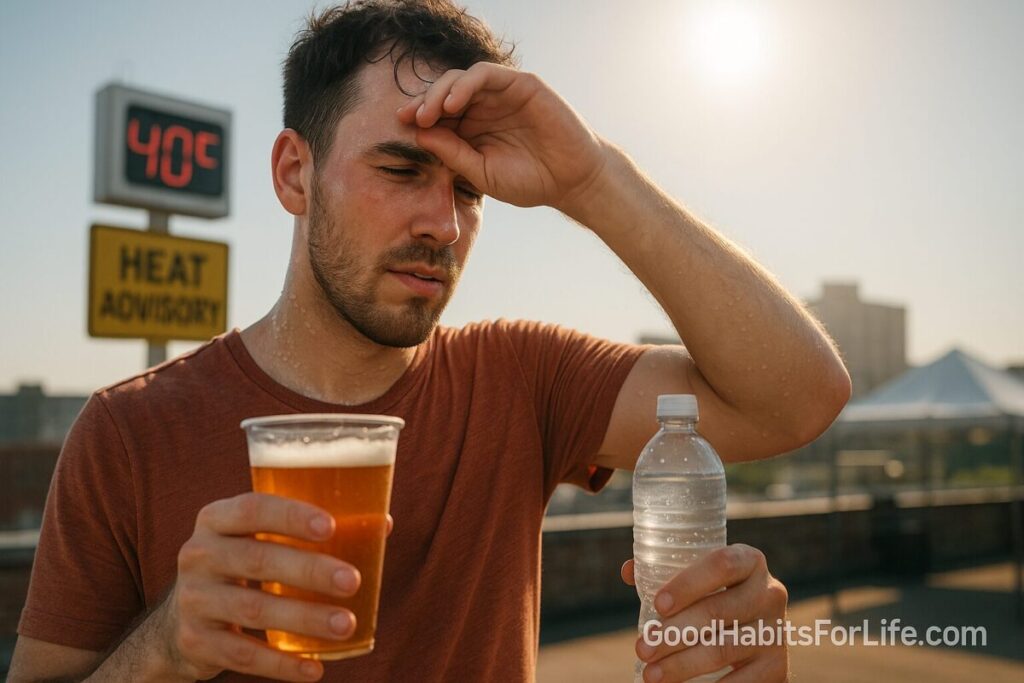
Heat + Alcohol: Dehydration Risks & Safer Defaults
Heat + Alcohol: Dehydration Risks & Safer Defaults
Table of Contents
🧭 What’s the risk?
Extreme heat strains your body’s cooling system. When sweat can’t evaporate fast enough, core temperature rises and dehydration accelerates—risks that are largely predictable and preventable with smart choices and planning. World Health Organization
Public-health advisories consistently list alcohol as a behavior that increases heat-illness risk—especially for outdoor workers, athletes, and people with chronic conditions. CDC+1
🧠 Why heat + alcohol is a risky combo
-
Alcohol is a diuretic. It suppresses vasopressin (ADH), so the kidneys make more urine → net fluid loss → reduced sweat and blood volume for cooling. NIAAAPMC
-
Less circulating volume = less cooling. Dehydration impairs cardiovascular and thermoregulation; even ~2% body-mass loss can reduce endurance and capacity. Heat amplifies these effects. PubMed
-
Compounded by sweat loss. Hot environments increase perspiration; guidance from meteorological and health agencies explicitly says to avoid alcohol during heat events. National Weather ServiceWorld Health Organization
⚠️ Warning signs that need action
Recognize heat illness early—particularly if alcohol is involved.
Heat exhaustion (urgent)
-
Heavy sweating, weakness, dizziness, nausea/vomiting, headache, rapid pulse, cool/clammy skin.
What to do: Move to shade/AC, loosen clothing, apply cool wet cloths, sip water/electrolytes. Seek medical care if not improving within an hour. OSHA
Heat stroke (emergency)
-
Confusion, slurred speech, fainting, seizures, hot skin (may be dry), core temp ≳40 °C (104 °F).
Action NOW: Call emergency services. Cool rapidly (cold water/ice bath if possible; cold packs to neck/armpits/groin) until help arrives. OSHA
✅ Quick Start: Do this today
-
Check today’s heat index (how hot it “feels”). If high, shift activity to morning/evening; plan shade and AC breaks. WPC
-
Pre-hydrate: 500 ml water 2 hours before outdoor activity; carry a 1 L bottle. (Add electrolytes if sweating heavily.) PubMed
-
If you’ll drink alcohol:
-
Switch to low-ABV (≤5%) or zero-proof options.
-
1:1 rule—alternate every alcoholic drink with equal water (250–300 ml).
-
Cap daytime alcohol (e.g., ≤2 standard drinks) when temps are high.
-
-
Pack cooling: light clothing, hat, misting bottle, cool packs, ORS sachet, and a snack.
-
Know red flags above—and who you’ll call if someone deteriorates.
🛠️ Safer Defaults for hot days & nights out
Before you go
-
Hydration baseline: Pale-straw urine = good; dark = drink more before heading out. nhs.uk
-
Med check: Some meds (diuretics, certain psychotropics) raise heat risk—ask your clinician about hot-weather plans. CDC
-
Route & refuge: Identify shade, AC stops, and water refill points.
While out
-
Default to non-alcoholic first round. If choosing alcohol, low-ABV beer/spritzers; avoid shots.
-
Pacing: 1 drink/hour max; 1:1 water rule; sip ORS if you’re sweating a lot (skip salt tablets). CDC
-
Cool-down breaks every 30–60 minutes in shade/AC; use mist + fan for evaporative cooling.
-
Food matters: Eat salty-carb snacks to replace sweat electrolytes; avoid heavy, very hot meals at peak heat.
-
Buddy check: Monitor each other for confusion, unsteady gait, or a sudden stop in sweating.
After
-
Rehydrate to baseline: Continue fluids until urine returns to pale straw.
-
Avoid alcohol for 24 h before/after heavy heat exposure days; NIOSH notes alcohol within 24 h of hot work increases risk. CDC
📅 7-Day “Beat-the-Heat” Habit Plan
Day 1 (Set-up): Install a heat index app, place a 1 L bottle by the door, freeze two gel packs, stock ORS/sports drink, and low-ABV/zero-alcohol options. CDC
Day 2 (Pre-hydrate): 500 ml water 2 h pre-outdoor time + steady sipping; review red flags with family. PubMed
Day 3 (Defaults): Practice the 1:1 water rule with any drink.
Day 4 (Cooling): Schedule cool-down every 45 minutes (shade/AC + wet cloths).
Day 5 (Fuel): Pack salty-carb snacks and a backup ORS; skip salt tablets. CDC
Day 6 (Audit): Use the urine-color check morning and evening; adjust fluids. nhs.uk
Day 7 (Emergency-ready): Save local emergency numbers; rehearse the cool-rapidly + call steps. OSHA
📚 Techniques & Frameworks
-
SIP-PACE-COOL loop:
SIP 150–250 ml every 15–20 min when active → PACE effort (slow down at high heat index) → COOL (shade/AC + wet cloths/gel pack). WPC -
1:1 Hydration Ratio: Match each alcoholic drink with equal water (or ORS during heavy sweating).
-
Heat-Index Gate:
-
Caution: extra breaks; avoid first drinks until sunset.
-
Extreme caution/danger: keep it alcohol-free; reschedule outdoor plans. National Weather Service
-
-
Performance reality: Even small dehydration (~2% body mass) can cut endurance and raise heat strain. Your best “PR” on a hot day is staying safe. PubMed
👥 Audience Variations
Students/Teens: Pre-hydrate before festivals or sports days; stick to mocktails and water. Pair up for buddy checks. CDC
Professionals/Outdoor workers: Use the OSHA-NIOSH heat app for job-site planning; avoid alcohol the night before; bring 2–4 L water + ORS. CDC
Parents/Caregivers: Kids heat up faster; choose shaded play, frequent water/milk breaks; strictly no alcohol while supervising water play. CDC
Seniors: Blunted thirst—set timed sips and urine-color checks; review meds with clinician for heat risk. CDC
❌ Mistakes & Myths to Avoid
-
“A cold beer hydrates.” No—alcohol increases urine output and net fluid loss. Start with water; choose low-ABV if you drink. NIAAA
-
“Caffeine always dehydrates.” Typical amounts have minimal impact on overall hydration, but avoid high-caffeine energy drinks—especially when mixed with alcohol. CDC
-
“Salt tablets prevent cramps.” Not recommended; regular meals/snacks plus fluids cover salt losses for most people. CDC
-
“If they stop sweating, they’re fine.” Sudden hot, dry skin with confusion suggests heat stroke—call emergency services and cool rapidly. OSHA
💬 Real-Life Examples & Scripts
Designated-driver script: “It’s 38 °C today—I’m on water/zero-proof until we’re home. I’ll swap in a spritzer later.”
Buddy-check script: “You’re woozy and not making sense—let’s get you to AC, cool you down, and I’m calling for help.”
Host script: “First round is iced water + fruit. Alcohol later, low-ABV only, and we’re doing a water-with-every-drink rule.”
Festival plan: Pack 2 L water, ORS sachets, hat, mist bottle, gel pack. Set 45-min shade alarms; no shots before sunset.
🧰 Tools, Apps & Resources
-
OSHA-NIOSH Heat Safety Tool (iOS/Android) — real-time heat index, risk levels, and precautions. CDC
-
NOAA/NWS Heat Index Calculator — check “feels like” with your temp + humidity. WPC
-
CDC Heat & Your Health — symptoms, who’s at risk, prevention tips. CDC
-
WHO: Heat & Health — global guidance and prevention principles. World Health Organization
🔑 Key Takeaways
-
Heat + alcohol amplify dehydration and heat-illness risk—plan to avoid or strictly limit alcohol in hot conditions. National Weather Service
-
Know the warning signs and first-aid steps; when in doubt, cool rapidly and call emergency services. OSHA
-
Adopt safer defaults: pre-hydrate, low-ABV or zero-proof, 1:1 water rule, scheduled cool-down breaks, ORS for heavy sweat, and buddy checks.
-
Use apps and the urine-color check to guide hydration in real time. nhs.uk
❓FAQs
1) Does any alcohol dehydrate, or just spirits?
All alcoholic beverages have a diuretic effect; higher-ABV and faster drinking raise risk. Low-ABV or zero-proof are safer choices in heat. NIAAA
2) Are sports drinks better than water?
For light activity, water is fine. With heavy sweating over hours, add electrolytes; skip salt tablets. CDC
3) How much should I drink in heat?
Aim for regular sipping and pale-straw urine. Before activity, ~500 ml 2 h prior is a solid pre-hydrate target. PubMednhs.uk
4) Is coffee off-limits on hot days?
Not necessarily—typical caffeine amounts have little impact on total hydration, but avoid high-caffeine energy drinks, especially with alcohol. CDC
5) What’s the fastest safe cooling method?
For suspected heat stroke: call emergency services and cool rapidly (cold/ice water immersion or cold packs to neck/armpits/groin) while waiting. OSHA
6) What heat index is “too hot to drink”?
As heat index rises to extreme caution/danger, alcohol should be avoided; prioritize water/electrolytes, shade, and AC. National Weather Service
References
-
World Health Organization — Heat and health (2024). World Health Organization
-
CDC — About Heat and Your Health (2025). CDC
-
NIAAA/NIH — Hangovers (mechanism: vasopressin suppression; dehydration). NIAAA
-
NOAA/NWS — Heat Safety (public guidance incl. avoid alcohol; heat-index safety). National Weather Service+1
-
Cheuvront SN et al. — Fluid balance & endurance performance (2% body-mass threshold). PubMed
-
NIOSH/CDC — Heat Stress: Hydration (alcohol within 24 h raises risk; caffeine note). CDC
-
OSHA — Heat-related Illnesses and First Aid (emergency steps). OSHA
-
WHO Europe — How summer heat impacts health & how to #KeepCool (avoid alcoholic drinks). World Health Organization
-
NHS — Water, drinks and hydration (pale-straw urine cue). nhs.uk
-
ACSM Position Stand — Exercise & Fluid Replacement (pre-hydrate ~500 ml 2 h prior). PubMed
-
NOAA/WPC — Heat Index Calculation (method and tool). WPC
Disclaimer
This article offers general education on heat, alcohol, and hydration; it is not medical advice. If you have symptoms or medical conditions, consult a qualified clinician.