
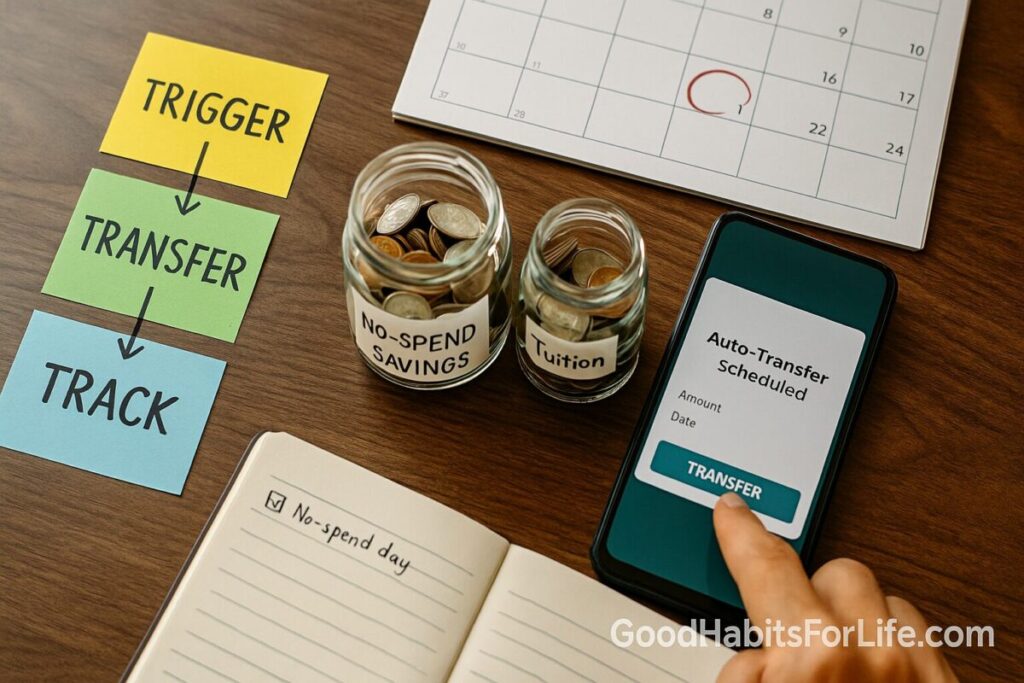
Habit Stack Saving: Trigger Transfer Track: No-Spend Challenge (2025)
Habit Stack Saving: Trigger Transfer Track — No-Spend Challenge
Table of Contents
🧭 What Is “Habit Stack Saving”? Why It Works
Habit Stack Saving links your saving routine to an existing cue (Trigger), moves money automatically (Transfer), and monitors drift (Track). It’s a No-Spend Challenge that relies on systems over willpower. Two evidence pillars make it effective:
-
If-then plans (“implementation intentions”) hard-wire a response to a cue and significantly increase follow-through across hundreds of tests. PMCBpb Us E1 Wpmucdn
-
Defaults and automation (e.g., automatic enrollment/ contributions) produce large, durable increases in savings vs. asking people to act every time. Oxford AcademicEconometrics Laboratory
Add commitment devices (e.g., goal-locked accounts) and fresh-start timing (new week/month) and you’ve got compounding advantages. Professor Nava AshrafINFORMS Publications
✅ Quick Start: Do This Today
-
Pick your Trigger (cue). Example: after morning tea or right after paycheck posts.
-
Set up Transfer. Create/raise an automatic transfer (or split direct deposit) into “No-Spend Pot.” Start small (₹500–₹2,000 / $10–$25). Consumer Financial Protection Bureau
-
Turn on Tracking. Choose a tracker (app or spreadsheet) and schedule a 10-minute Friday review. Use it to spot subscriptions or impulse categories to cut. Consumer Financial Protection BureauInvestopedia
-
Define your No-Spend rules. Essentials allowed; define 2–3 “friction rules” (e.g., 24-hour wait, cart to wish-list).
-
Bundle your reward. Only listen to your favorite podcast during the weekly review (temptation bundling). INFORMS Publications
🛠️ The Trigger-Transfer-Track Method (Step-by-Step)
1) Trigger (Stack your saving on a cue)
-
Choose a specific, reliable context: after breakfast, post-work commute, or “payday at 9:00.”
-
Write a simple if-then plan: If it’s 18:30 after dinner, then I’ll open my spending log and reconcile today’s purchases. Implementation intentions increase the odds you’ll do the behavior when the cue appears. PMC
-
For new habits, start tiny (≤2 minutes). Small wins build automaticity as repetition binds cue→action. Wiley Online LibraryAnnual Reviews
2) Transfer (Automate the saving)
-
Split deposit/auto-transfer on payday to a separate, named account (e.g., “No-Spend 30”). Defaults drive behavior even when nothing else changes. Oxford Academic
-
Prefer goal-locked/commitment options (can’t withdraw till target date/amount) when available; these products increase savings. Professor Nava Ashraf
3) Track (Spot leaks weekly)
-
Use a weekly 10-minute audit to label outliers, cancel unused subscriptions, and adjust next week’s plan. Subscription creep is common and costly. Consumer Financial Protection BureauInvestopedia
-
Government toolkits provide simple, printable trackers if you prefer paper/spreadsheets. Consumer Financial Protection BureauConsumer Financial Protection Bureau
🗓️ 7-Day Starter + 30-60-90 Roadmap
7-Day Starter
-
Day 1: Write your if-then plan and No-Spend rules.
-
Day 2: Set up automatic payday transfer (even ₹500/$10). Consumer Financial Protection Bureau
-
Day 3: Create categories for tracking (Food at home, Eating out, Transport, Fun, Subscriptions, Misc.).
-
Day 4: Add a 24-hour cooling-off rule for cart checkouts.
-
Day 5: Schedule a Friday 10-minute review recurring.
-
Day 6: Audit subscriptions; cancel at least one. Investopedia
-
Day 7: Celebrate with a free reward (park walk, home movie night).
30-60-90 Roadmap
-
Day 30 (Checkpoint): Raise auto-transfer by 10–20%; lock a commitment if permitted. Professor Nava Ashraf
-
Day 60: Introduce category caps (e.g., Eating out ≤ ₹2,000 / $25 per week).
-
Day 90: Convert “No-Spend Pot” into Emergency Fund Tier 1; set new quarterly target and keep the same Trigger-Transfer-Track cadence. Evidence shows simple behavioral nudges plus automation support emergency savings. Consumer Financial Protection Bureau
🧠 Techniques & Frameworks (Backed by Research)
-
Implementation intentions (if-then planning): Pre-decide the cue and response to reduce friction and forgetfulness. Meta-analytic and review evidence shows robust effects. PMCBpb Us E1 Wpmucdn
-
Habit automaticity through repetition: Repeating a behavior in the same context increases automaticity; many habits stabilize over weeks. Wiley Online Library
-
Defaults & automation: Automatic enrollment/contributions dramatically increase participation and balances—use this logic for your own accounts. Oxford AcademicEconometrics Laboratory
-
Commitment devices: Goal-locked accounts meaningfully boost savings when self-control is a barrier. Professor Nava Ashraf
-
Fresh-start effect: Launch or reset on temporal landmarks (new week/month, birthday) for a motivational bump. INFORMS Publications
-
Temptation bundling: Pair tracking or decluttering with a pleasure (playlist, show) to counter present bias. INFORMS Publications
-
Mental accounting: Use separate “pots” (envelopes/buckets) to limit spillover from fun money to essentials. INFORMS Publications
👥 Audience Variations
-
Students/Teens: Micro-transfers (₹100–₹300 / $2–$5). Use campus calendars for fresh starts (new term). Prioritize canceling free-trial traps. Investopedia
-
Parents: Family No-Spend rules (e.g., free weekend activities). Track kids’ subscriptions/micro-purchases in the weekly review.
-
Professionals: Split direct deposit to “No-Spend Pot” + “Annuals” (insurance, travel). Quarterly raise to match increments/bonuses. Consumer Financial Protection Bureau
-
Seniors: Keep tools simple (paper log or bank-provided tracker). Weekly 10-minute review with a buddy for accountability. Consumer Financial Protection Bureau
⚠️ Mistakes & Myths to Avoid
-
Myth: “I need perfect discipline.” Systems beat willpower; automation and if-then cues do the heavy lifting. PMCOxford Academic
-
Mistake: All-or-nothing no-spend. Use category-specific rules and planned exceptions to prevent rebound spending.
-
Mistake: Tracking daily forever. Weekly is enough for most people—consistency > intensity. Consumer Financial Protection Bureau
-
Myth: “Canceling a few subscriptions won’t matter.” Small recurring fees accumulate; many underestimate by over $100/month. Investopedia
💬 Real-Life Examples & Copy-Paste Scripts
-
If-Then for Tracking: If it’s Friday 18:30, then I open my tracker and reconcile this week (10 minutes). PMC
-
If-Then for Cravings: If I feel the urge to buy online, then I add to wish-list and start a 24-hour timer.
-
Bank Instruction (Payday Split): “Transfer ₹2,000 to ‘No-Spend 30’ every 1st and 15th at 09:00.” Consumer Financial Protection Bureau
-
Temptation Bundling: Track expenses only while listening to my favorite podcast. INFORMS Publications
-
Commitment Device: Open a goal-locked account that releases funds only when balance hits ₹25,000 ($300). Professor Nava Ashraf
🧰 Tools, Apps & Resources (Pros & Cons)
Pick one tracker you’ll actually use. Do a quick 10-minute weekly review.
-
YNAB (You Need A Budget) — Proactive, envelope-style budgeting; strong education; paid subscription. YNAB+1
-
Monarch Money — Clean dashboards, great for couples; paid; good subscription tracking. NerdWalletApple
-
Rocket Money — Finds & cancels subscriptions; be mindful of premium upsells. rocketmoney.com+1
-
Tiller (Sheets/Excel) — Spreadsheet lovers; robust templates. (Also a Mint alternative after Mint’s 2024 shutdown.) Tiller
-
Government Trackers — Printable CFPB spending trackers (great for low-tech setups). Consumer Financial Protection Bureau+1
-
Self-hosted (privacy-focused): Firefly III for full control; setup required. firefly-iii.orgdocs.firefly-iii.org
-
India-friendly SMS parsers: axio/Walnut, ET Money for expense tracking + investments (evaluate permissions). Google PlayThe Indian ExpressET Money
🔑 Key Takeaways
-
Stack saving on a reliable Trigger, automate the Transfer, and Track weekly.
-
Use if-then plans, defaults, commitment devices, and fresh starts to tilt the environment in your favor. PMCOxford AcademicProfessor Nava AshrafINFORMS Publications
-
Keep your No-Spend rules flexible, and review subscriptions monthly. Investopedia
❓ FAQs
1) How much should I auto-transfer for a No-Spend Challenge?
Start with a small, painless amount (₹500–₹2,000 / $10–$25) and ratchet up 10–20% every 30 days. Small, automatic steps are more sustainable. Consumer Financial Protection Bureau
2) Does tracking actually reduce spending?
Tracking creates awareness and exposes “leaks” (e.g., subscriptions). Simple government-issued trackers work; weekly cadence is sufficient for most. Consumer Financial Protection Bureau+1
3) What if I break my No-Spend rule?
Use the fresh-start effect: reset on Monday or the 1st of the month; don’t wait for New Year’s. INFORMS Publications
4) Are commitment accounts safe?
They’re designed to lock goals and curb impulse withdrawals. Evidence shows they raise savings—but confirm terms/fees and access rules with your bank. Professor Nava Ashraf
5) Why not just rely on willpower?
Defaults, if-then planning, and automation consistently outperform willpower-only approaches. Oxford AcademicPMC
6) Is “habit stacking” legit or just a buzzword?
Under the hood, it’s cue-based planning—a well-studied method that boosts follow-through by linking actions to contexts. PMC
7) How long until saving feels automatic?
It varies by behavior and person; repetition in a stable context builds automaticity over weeks. Wiley Online Library
📚 References
-
Lally P., et al. How are habits formed? European Journal of Social Psychology (2010). Wiley Online Library
-
Wood W., Rünger D. Psychology of Habit. Annual Review of Psychology (2016). Annual Reviews
-
Gollwitzer P., Wieber F., et al. Promoting the translation of intentions into action by implementation intentions (review). (2015). PMC
-
Madrian B., Shea D. Inertia in 401(k) Participation and Savings Behavior. QJE (2001). Oxford Academic
-
Chetty R., et al. Active vs. Passive Decisions and Crowd-Out in Retirement Savings. QJE (2014). Econometrics Laboratory
-
Ashraf N., Karlan D., Yin W. Tying Odysseus to the Mast: Evidence from a Commitment Savings Product in the Philippines. QJE (2006). Professor Nava Ashraf
-
Dai H., Milkman K., Riis J. The Fresh-Start Effect. Management Science (2014). INFORMS Publications
-
Milkman K., Minson J., Volpp K. Temptation Bundling. Management Science (2014). INFORMS Publications
-
CFPB. Evidence-Based Strategies to Build Emergency Savings (2020). Plus: Spending tracker tools. Consumer Financial Protection Bureau+2Consumer Financial Protection Bureau+2
-
OECD/INFE. International Survey of Adult Financial Literacy: Budgeting & Monitoring Expenditure (latest compendium). OECD
Disclaimer: This article is for education only and is not financial advice; consider your circumstances or consult a qualified professional before making financial decisions.