
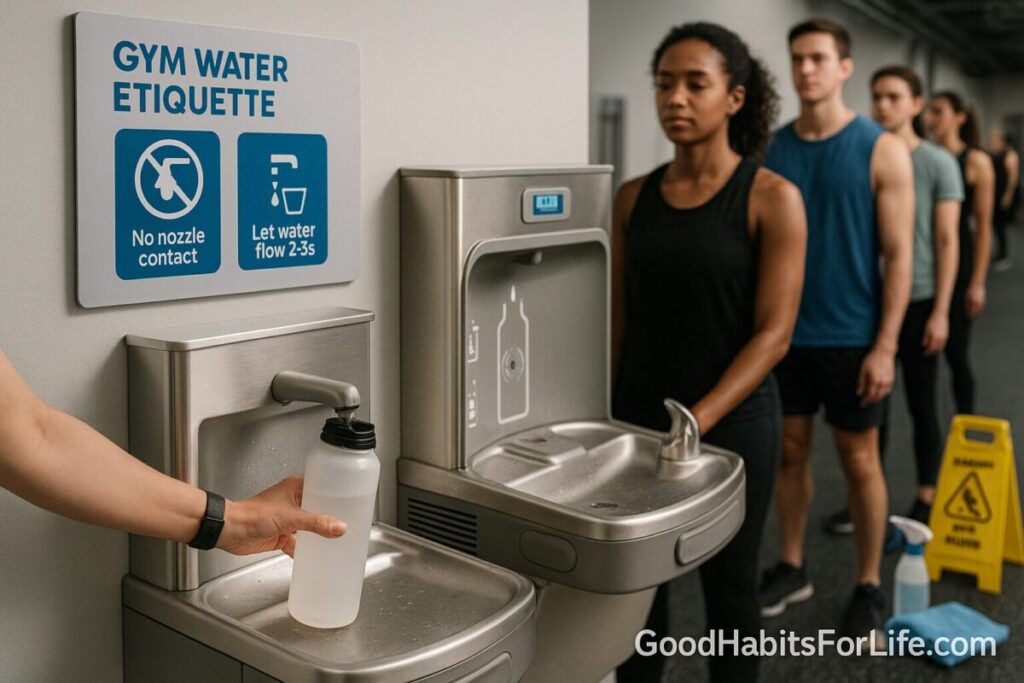
Gym Water Etiquette: Fountains, Floors & Refill Rules
Gym Water Etiquette: Fountains, Floors & Refill Rules
Table of Contents
🧭 What Is “Gym Water Etiquette” & Why It Matters
“Gym water etiquette” is the set of shared rules that keep hydration safe, hygienic, and convenient for everyone in a training space. It covers how you use drinking fountains and bottle-fillers, how you handle your bottle around equipment and floors, and how you treat other people waiting to drink.
Why it matters
-
Hygiene & safety: Avoiding mouth/nozzle contact and basic hand hygiene reduce germ transfer on shared fixtures. Public-health agencies explicitly advise not touching the spout and letting water run briefly when using public fountains.
-
Slip prevention: Water on smooth floors is a top cause of slips and injuries; quick cleanup and barriers matter.
-
Performance & health: Sound hydration supports cognition, thermoregulation and endurance. Sports-medicine statements advise avoiding >2% body mass loss during exercise and caution against over-drinking (exercise-associated hyponatremia).
-
Access & courtesy: ADA guidance requires accessible fountains; don’t block them, and keep the queue moving.
✅ Quick Start: Do-This-Today Rules
-
At the fountain/bottle filler
-
Don’t put your mouth on the spout.
-
Don’t let your bottle touch the nozzle; hold it a few centimetres below.
-
Let water run ~5–10 seconds before drinking/refilling if posted guidance suggests.
-
Keep the line moving: fill, cap, step aside; no refilling multiple bottles in peak hours.
-
-
Floors & equipment
-
Keep lids closed when you walk.
-
If you drip or spill, stop and wipe (ask front desk for towels or a mop).
-
Never place open bottles on treadmills or near electricals; use holders only.
-
-
Respect & access
-
Don’t block the low/accessible fountain; park bags elsewhere.
-
Offer your place in line to someone clearly mid-set or breathless.
-
-
Hydration smarts
-
Come in hydrated; drink as needed to avoid noticeable thirst or >2% body-mass loss.
-
For long/hot sessions, consider electrolytes; avoid over-drinking.
-
-
Follow advisories
-
If the facility or city issues a boil / do-not-drink notice, use bottled/boiled water only.
-
🛠️ 7-Day Starter Plan (Hydration + Habits)
Goal: Lock in clean fountain use, no-spill habits, and smart hydration without overthinking.
Day 1 – Bottle setup
-
Choose a 600–750 mL (20–25 oz) leak-proof bottle. Write your initials. Test cap seal.
Day 2 – Pre-gym pre-hydrate
-
Drink ~500 mL (17 oz) water 1–2 hours before training. Pack a small towel just for spills.
Day 3 – Fountain flow routine
-
At the filler: 1) queue behind the line, 2) avoid nozzle contact, 3) cap, 4) step aside.
Day 4 – Floor discipline
-
Keep the lid closed whenever you walk. If anything drips, stop and wipe immediately.
Day 5 – Mid-session checks
-
After your heaviest block, pause: light thirst? dry mouth? dark urine? Take 3–6 sips.
Day 6 – Weigh-in learning (optional)
-
Weigh before/after a typical session (dry clothes). >2% loss? Add small sips next time.
-
Example: 70 kg → 1.4 kg loss = ~2%: add ~500–700 mL across the session next time.
Day 7 – Courtesy & access audit
-
Notice lines and accessible units. Rehearse a one-liner to prevent/resolve bottlenecks (see scripts).
Weekly repeat: Keep what worked; reduce what felt fussy.
🧠 Techniques & Frameworks (Bottle, Refill, Flow, Floor)
The B.R.E.W. Framework
Bottle: leak-proof, labelled, cleaned daily.
Refill: no nozzle contact; brief flush if advised; step aside after filling.
Etiquette: keep queues short; no shaker-washing at fountains; don’t block accessible units.
Wet-floor control: lids closed when moving; wipe drips; report leaks immediately.
“2% Guardrail” for performance
-
Aim to avoid >2% body mass loss in long/hot training. Weigh-in learning once helps personalize.
-
Customize to sweat rate, environment, and session length; don’t force fluid if you feel sloshy.
Over-drinking safety
-
Endurance over-drinking can cause exercise-associated hyponatremia (EAH). Sip to thirst; add electrolytes for very sweaty or multi-hour sessions.
Accessibility awareness
-
High-low units exist for wheelchair users and standing users. Keep bags clear and don’t lean on the low basin.
When the water is under advisory
-
During boil / do-not-drink advisories, use bottled/boiled water only—even for refilling bottles. Gyms should post notices; ask staff if unsure.
👥 Audience Variations
Students & new lifters
-
Bring a mid-size bottle (600–700 mL). Learn the queue rhythm. Don’t wash meal-prep boxes or shakers at the fountain—use a sink.
Busy professionals
-
Pre-hydrate at your desk (300–500 mL) 60–90 min pre-gym. Save time with a bottle filler and keep conversations short while others wait.
Parents with kids
-
Teach kids not to touch the spout. Hold bottles under the nozzle for them. Leave strollers/bags away from accessible units.
Seniors
-
Prioritize steady footing: cap bottle before walking; avoid wet areas; ask staff for assistance if a spill occurs.
Endurance/heat-exposed athletes
-
Track session weight change once. Use electrolytes during long/hot sessions; avoid both big deficits and over-drinking.
⚠️ Mistakes & Myths to Avoid
-
Touching the nozzle: Increases contamination risk; always leave a small gap.
-
“I’ll rinse my mouth on the spout.” Never. Use a sink; fountains are for drinking.
-
Shaker-washing at the fountain: Blocks lines and splashes floors—use designated sinks.
-
Leaving lids open: Common cause of drips on cardio decks and platforms.
-
“More water is always better.” Not in endurance blocks—over-drinking can be dangerous.
-
Ignoring advisories: During a boil/do-not-drink notice, fountains are not safe to use for drinking unless water is disinfected first.
-
Relying on signs alone for spill safety: Signs help but don’t prevent slips—clean or cordon off slick areas.
💬 Real-Life Examples & Scripts
Someone is touching the nozzle with their bottle
-
“Hey—quick heads-up: they ask us not to touch the nozzle. I can hold the bottle for you if that helps.”
A long queue forms at peak time
-
“I’ll just fill halfway so others can go—then I’ll circle back.”
Spill near the treadmills
-
“There’s a wet spot by #6. I’ll grab towels—could we pop a cone there too?”
Blocking the accessible unit (bags or stretching)
-
“Mind if we clear a little space? Folks using the low fountain need room to roll up.”
Boil advisory posted
-
“Are we switching to bottled at the desk today? I’ll skip the fountain until we’re cleared.”
🧰 Tools, Apps & Resources
-
WaterMinder / Hydro Coach / Waterllama — Simple hydration reminders and logs. Pros: easy; Cons: notifications can be noisy.
-
MyFitnessPal / Cronometer — Track fluids alongside nutrition. Pros: integrated logs; Cons: more setup.
-
Tap / WeTap / Refill — Find public refill stations when you’re out. Pros: crowd-sourced maps; Cons: coverage varies.
-
Leak-proof bottles (locking cap, marked volume) — Reduce spills and help dose sips. Pros: safer on cardio decks; Cons: hand-wash recommended.
-
Microfibre towel — Quick-dry cleanup; carry a small one just for drips.
📌 Key Takeaways
-
Keep no spout contact, quick fills, and step-aside flow.
-
Cap before walking; wipe any drips immediately—slips are preventable.
-
Respect accessible fountains and queues.
-
Hydrate to avoid >2% body-mass loss on long/hot days; don’t over-drink.
-
Follow posted water advisories; use bottled/boiled water when required.
❓ FAQs
1) How much should I drink before a workout?
About 500 mL (17 oz) 1–2 hours before is a common sports-medicine guideline. Then sip to thirst during the session, adjusting for heat and sweat rate.
2) Is it OK to touch the fountain spout with my bottle or mouth?
No. Avoid contact to reduce contamination risk; hold the bottle just below the flow.
3) Can I wash my protein shaker at the fountain?
No. It blocks the line and splashes floors. Use a sink or take it home.
4) What if there’s a boil or do-not-drink advisory?
Use bottled/boiled water for drinking and refilling until officials clear the advisory.
5) How do I keep floors safe when I’m sweaty and moving fast?
Cap the bottle before walking, place it in holders only, and wipe any drips/spills right away.
6) I cramp in hot classes—do I need electrolytes?
If your sessions are long/hot or you’re a salty sweater, try electrolytes. Still avoid over-drinking.
7) What’s the deal with the low fountain?
It’s for accessibility. Don’t block it with stretching or bags; leave space for wheelchair users.
8) Do I need to flush the fountain before drinking?
If posted or advised locally, let it run briefly (5–10 s) and avoid spout contact.
9) How do I know if I’m under- or over-doing hydration?
Under: dark urine, dry mouth, >2% session weight loss. Over: stomach slosh, nausea, swelling—slow down intake and add electrolytes if needed.
10) Are spills really that risky?
Yes—smooth wet floors are a major slip hazard. Clean up, and ask staff to cone or cordon the area.
📚 References
-
American College of Sports Medicine. Position Stand: Exercise and Fluid Replacement (2007). https://pubmed.ncbi.nlm.nih.gov/17277604/
-
National Athletic Trainers’ Association. Position Statement: Fluid Replacement for the Physically Active (2017). https://pmc.ncbi.nlm.nih.gov/articles/PMC5634236/
-
CDC. Fast Facts: Data on Water Consumption (2024). https://www.cdc.gov/nutrition/php/data-research/fast-facts-water-consumption.html
-
NHS (UK). Water, drinks and hydration (current guidance). https://www.nhs.uk/live-well/eat-well/food-guidelines-and-food-labels/water-drinks-nutrition/
-
Washington State Dept. of Health. Safely Cleaning and Disinfecting Public Spaces (public fountains guidance). https://doh.wa.gov/sites/default/files/2022-08/333-299.pdf
-
HSE (UK). Slips and trips – Cleaning & Wet Floors (hazard controls). https://www.hse.gov.uk/cleaning/topics/slips.htm
-
U.S. Access Board. ADA Guide: Drinking Fountains (Chapter 6) — accessibility requirements. https://www.access-board.gov/ada/guides/chapter-6-drinking-fountains/
-
CDC. Drinking Water Advisories: An Overview (what to do during advisories). https://www.cdc.gov/water-emergency/about/drinking-water-advisories-an-overview.html
-
Hew-Butler T. et al. Statement of the Third International Exercise-Associated Hyponatremia Consensus (2015). https://pubmed.ncbi.nlm.nih.gov/26102445/
⚖️ Disclaimer
This article offers general fitness and hydration guidance; it is not medical advice. If you have health conditions or fluid restrictions, consult a healthcare professional.