
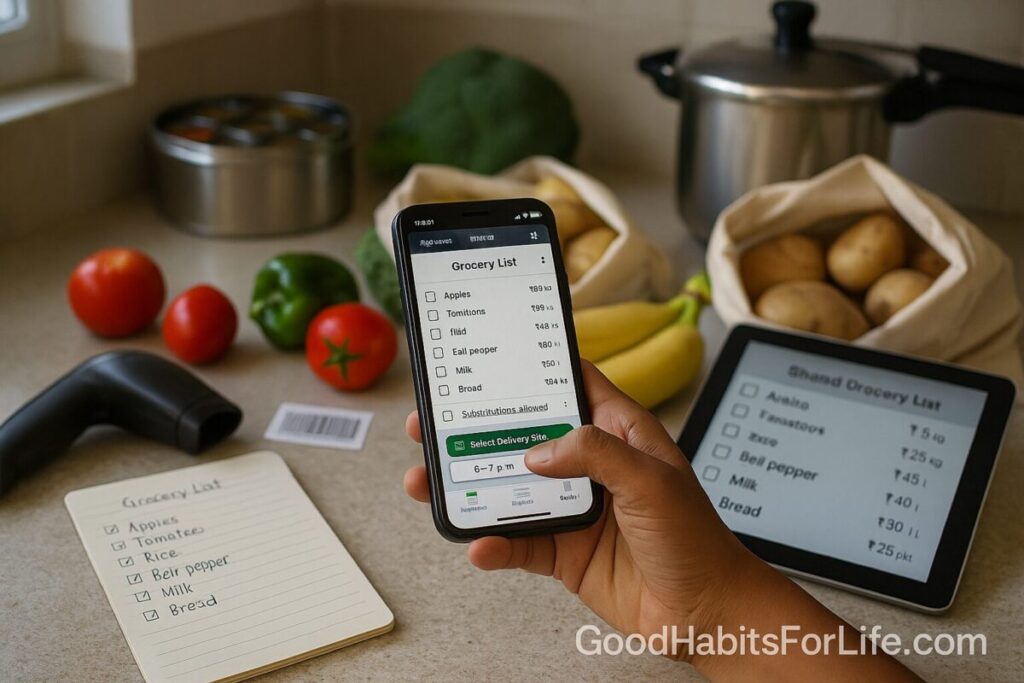
Grocery Apps 2025: Lists, Substitutions & Slots
Grocery Apps 2025: Lists, Substitutions & Slots
Table of Contents
🧭 What Are “Grocery Apps” in 2025—and Why Use Them
Definition. Grocery apps include:
-
Retailer apps (e.g., your local supermarket) with real-time inventory, substitutions, and pickup/delivery slots.
-
Aggregators (multi-store ordering).
-
List & meal-planning apps that sync with families, scan barcodes, and export to stores.
Why they help.
-
Fewer impulse buys. Studies show online grocery baskets often include less spending on impulse-sensitive items than in-store, supporting healthier choices and budgets. PubMedPMC
-
Time saved, better planning. Re-order history, favorites, and list templates reduce friction every week.
-
Unit price visibility. Comparing prices per kg or liter (per lb/oz) quickly reveals best value; consumer research and standards bodies highlight its usefulness. GOV.UKNIST
-
Wider access. Around 1 in 5 U.S. shoppers reported buying groceries online in the last 30 days (2022–23), and the channel keeps growing. Economic Research Service
-
Health information (with gaps). Nutrition facts and allergens are not always prominently shown online; regulations are evolving. PMCU.S. Food and Drug Administration
✅ Quick Start: Your First Efficient Order (Today)
-
Create a “Master List.” In a list app, add staples by aisle/category (produce, dairy, pantry, proteins, frozen, household).
-
Spin a “This Week” list. Duplicate the master list; remove what you already have; add menu items for 3–5 dinners.
-
Enable Unit Pricing view (per kg/L) to compare sizes.
-
Set Substitution Rules in the retailer app:
-
Allow: “Store brand OK,” “Same size or smaller,” “Plain yogurt only.”
-
Block: “No nuts,” “No pork,” “No spicy variants.”
-
-
Pick a Slot: Choose early-morning pickup (often freshest and less crowded) or off-peak delivery; enable slot alerts and widen the time window if possible.
-
Before Checkout:
-
Sort the cart by price and remove low-priority extras.
-
Verify nutrition/allergens for packaged foods; if missing online, check the manufacturer site or the pack on arrival. PMC
-
-
After Delivery/Pickup:
-
Review substitutions; reject ones that break your rules.
-
Save the final basket as Favorites for faster repeats.
-
🧠 30-60-90 Habit Plan for Smarter Online Grocery Runs
Days 1–30 (Foundation).
-
Build your Master List + 3 meal templates (e.g., Stir-fry Night, Pasta Night, Grain Bowl Night).
-
Always order with unit price visible; track 5 commonly bought items and note their value ranges. GOV.UK
-
Add substitution notes to 10 sensitive items (milk fat %, bread type, spice level, brand boundaries).
-
Book slots 48–72h ahead; set app notifications.
Days 31–60 (Optimization).
-
Split your list into “Must-Have / Nice-to-Have.”
-
Use re-order history and favorites; time your order while you’re not hungry and not rushed.
-
Start a Price Tracker (simple sheet) for your top 15 items (rice, oil, eggs, yogurt, tomatoes, onions, bananas, coffee, etc.).
-
Trial pickup vs delivery to see which yields better accuracy and timing in your area.
Days 61–90 (Automation).
-
Schedule a recurring order for shelf-stable staples (rice, lentils, oats, canned tomatoes).
-
Keep a two-week pantry buffer to blunt stockouts/substitution risk.
-
Add a food-storage routine using the USDA FoodKeeper guidelines to reduce waste. FoodSafety.gov
-
Review monthly: spending vs. budget, substitution success rate, and app features used.
🛠️ Techniques & Frameworks (Lists, Unit Pricing, Substitutions, Slots)
📋 Lists that work
-
Master → Weekly clone: Treat your list as a checklist you copy and trim.
-
Aisle order: Group by produce → dairy → meat/fish → pantry → frozen → household.
-
Behavioral edge: Lists act like implementation intentions, cutting “just-in-case” buys. Wiley Online Library
🧮 Unit pricing (your money-saver)
-
Always compare per kg/L (per lb/oz).
-
Beware “shrinkflation”: check the unit price when package sizes change. Regulators emphasize clear unit pricing online to help shoppers compare. GOV.UK
🔁 Substitutions you control
-
Post-purchase stockouts (PP-OOS) happen when items go out of stock during picking. Research shows matching past purchases or dominant attributes increases acceptance. Use notes like “replace with same brand/low-sodium.” eprints.leedsbeckett.ac.uk
-
Mark “no substitutions” for critical items (allergy-sensitive, specialty ingredients).
📦 Slots & timing
-
Early pickup or off-peak delivery improves on-time rates and fresh options (practical ops guidance).
-
Enable slot notifications; accept wider windows to unlock availability.
-
Keep backup stores in your app (a second location can rescue last-minute orders).
🧾 Labels & allergens online
-
Many online product pages still lack full nutrition/allergen info; the FDA has an active information-gathering process to improve digital labeling. Verify when in doubt. PMCU.S. Food and Drug Administration
🎯 Healthy nudges
-
Studies show default ordering and design changes in online stores can nudge healthier choices without extra effort (e.g., surfacing whole-grain first). ScienceDirect
-
Personalized incentives inside retail apps can measurably improve basket quality. PMC
👥 Audience Variations
Students: Keep a “5-meal loop” (omelet, dal-rice, pasta, stir-fry, bean tacos). Share lists with roommates; batch-buy spices, freeze bread in halves.
Parents: Create profiles (kid lunch, vegetarian partner). Use substitution guardrails (no added sugar yogurts; seed-/nut-free snacks).
Busy professionals: Schedule auto-repeats for breakfast and work-lunch staples; book early pickup near the commute.
Seniors: Favor pickup to avoid heavy carrying; add “no substitutions for meds/medical foods”; use larger text and reorder history.
Teens (learning budgeting): Give a fixed budget and a shared list; require unit-price screenshots for big choices (cereal, drinks).
⚠️ Mistakes & Myths to Avoid
-
Myth: “Online always costs more.”
Reality: Fees exist, but unit-price comparisons and list discipline often neutralize extras. GOV.UK -
Mistake: Allowing open-ended substitutions on allergy or diet-specific items.
-
Mistake: Ignoring label gaps online—verify allergens/ingredients for new brands. PMC
-
Myth: “Lists are rigid.”
Reality: Lists reduce unplanned buys without stopping variety; keep a “wildcard” line for one treat. Wiley Online Library
💬 Real-Life Examples & Scripts (Copy-Paste)
Substitution notes to paste in your app:
-
“Milk: 1L low-fat (1–2%), store brand OK. If OOS, same size, no flavored.”
-
“Bread: 100% whole-wheat, no seeds; if OOS, select closest fiber ≥6g/100g.”
-
“Yogurt: plain, unsweetened, 500 g tub; no fruit/sugar.”
-
“Tomato puree: no added salt; if OOS, canned tomatoes crushed (no basil).”
-
“Allergies: no peanuts/tree nuts in any snacks.”
Delivery driver notes:
-
“Please leave at security gate; call on arrival.”
-
“Separate raw meat and produce; keep frozen together.”
List templates:
-
Stir-Fry Night: veg mix (capsicum, broccoli, carrot), tofu/chicken, soy sauce, garlic, ginger, rice.
-
Grain Bowl: quinoa, chickpeas, cherry tomatoes, cucumber, feta/curd, lemon, olive oil.
-
Pasta Night: whole-wheat pasta, tomato passata, onions, mushrooms, olive oil, parmesan.
📱 Tools, Apps & Resources (Pros/Cons)
(Choose locally available equivalents in your country.)
-
Retailer apps (your supermarket):
Pros: Live stock, substitutions, pickup/delivery slots, loyalty pricing.
Cons: Single-store only; nutrition info may be incomplete. PMC -
Aggregators (multi-store):
Pros: Wider slot options, multi-store access.
Cons: Fees can add up; substitutions vary by store and picker. -
List apps (AnyList/Bring!/Out of Milk/Google Keep):
Pros: Shared lists, barcode scanning, Siri/Assistant input, categories by aisle.
Cons: Separate from store inventory; export/sync varies. -
Meal-planning apps (Paprika/Whisk):
Pros: Recipe clipper → auto-list; nutrition estimates; marketplace integrations.
Cons: Learn-once setup; ingredient mapping not perfect. -
USDA FoodKeeper (web/app):
Pros: Evidence-based storage times to cut waste.
Cons: U.S.-centric terms; check local equivalents. FoodSafety.gov
📌 Key Takeaways
-
Plan with lists, buy by unit price, and set tight substitution rules.
-
Book smarter slots (early pickup/off-peak delivery) with alerts and wider windows.
-
Verify nutrition/allergens online; labeling is improving but still inconsistent. PMCU.S. Food and Drug Administration
-
Automate repeats for staples; review spending and success monthly.
-
Combine a list app (collaboration) + retailer app (inventory/slots) for the best of both.
❓FAQs
1) Do online orders actually save money?
Yes—if you shop from a list and compare by unit price, you typically avoid many impulse add-ons. Evidence suggests online baskets can include fewer impulse-sensitive items. PubMed
2) Are substitutions worth it—or should I turn them off?
Use guardrails (brand/size/diet rules). Research shows matching the dominant attribute or your past purchases boosts acceptance. Turn off substitutions on critical items. eprints.leedsbeckett.ac.uk
3) How do I get better slots?
Set slot alerts, widen delivery windows, try early pickup, and keep a backup store enabled.
4) Can I trust nutrition labels online?
Sometimes—but not always. A 2024 study found many listings omit nutrition and allergen info; FDA has an open process to improve digital labeling. Verify when items are new to you. PMCU.S. Food and Drug Administration
5) Is it healthier to shop online?
Not automatically, but design nudges and incentives in apps can improve basket quality; you still need a plan. ScienceDirectPMC
6) What’s the fastest way to compare prices?
Unit pricing (per kg/L). UK and U.S. authorities highlight it as the best consumer tool for value comparisons. GOV.UKNIST
7) Should I use delivery or pickup?
Pickup often has more accurate fills and flexible times; delivery saves travel time. Test both for your area.
8) How do I reduce waste with online shopping?
Order in realistic quantities, use FoodKeeper storage guidance, and batch-prep perishables on delivery day. FoodSafety.gov
📚 References
-
USDA ERS. New survey data show online grocery shopping prevalence and frequency in the United States. 2024. https://www.ers.usda.gov/amber-waves/2024/february/new-survey-data-show-online-grocery-shopping-prevalence-and-frequency-in-the-united-states Economic Research Service
-
Sharib JR, et al. Disclosure of mandatory and voluntary nutrition labelling on online grocery platforms. Public Health Nutr. 2024. https://pmc.ncbi.nlm.nih.gov/articles/PMC11604316/ PMC
-
U.S. FDA. Request for Information on Food Labeling in Online Grocery Shopping. 2023. https://www.federalregister.gov/documents/2023/04/24/2023-08543/food-labeling-in-online-grocery-shopping-request-for-information Federal Register
-
Zatz LY, et al. Comparing Online and In-Store Grocery Purchases. J Nutr Educ Behav. 2021. https://pubmed.ncbi.nlm.nih.gov/34116742/ PubMed
-
Pitts SBJ, et al. Online grocery shopping: promise and pitfalls for healthier food purchasing. Curr Nutr Rep. 2018. https://pmc.ncbi.nlm.nih.gov/articles/PMC10260851/ PMC
-
UK Government (DBT/CMA). Summary of consumer research and unit pricing analysis. 2024. https://www.gov.uk/government/publications/unit-pricing-analysis-and-consumer-research/summary-of-consumer-research-and-unit-pricing-analysis GOV.UK
-
NIST. Uniform Unit Pricing: Tools for Consumers to Fight Shrinkflation. 2024. https://www.nist.gov/programs-projects/uniform-unit-pricing-tools-consumers-fight-shrinkflation NIST
-
Hoang D, Breugelmans E. Sorry, the product you ordered is out of stock: Effects of substitution policy in online grocery retailing. 2022. https://eprints.leedsbeckett.ac.uk/id/eprint/8738/8/SorryTheProductYouOrderedIsOutOfStockEffectsOfSubstitutionPolicyInOnlineGroceryRetailingPV-HOANG.pdf eprints.leedsbeckett.ac.uk
-
Valenčič E, et al. Changing the default order of food items in an online supermarket increases healthy choices. Appetite. 2024. https://www.sciencedirect.com/science/article/pii/S0195666323025345 ScienceDirect
-
Vadiveloo M, et al. Effect of Personalized Incentives on Dietary Quality. JAMA Netw Open. 2021. https://pmc.ncbi.nlm.nih.gov/articles/PMC7876589/ PMC
-
USDA, Cornell University & FMI. FoodKeeper App. https://www.foodsafety.gov/keep-food-safe/foodkeeper-app FoodSafety.gov