
Gratitude in 3 Lines: A 2025 MicroJournal
Gratitude in 3 Lines: 2025 MicroJournal You’ll Keep
Table of Contents
🧭 What is the 3-Line Gratitude MicroJournal?
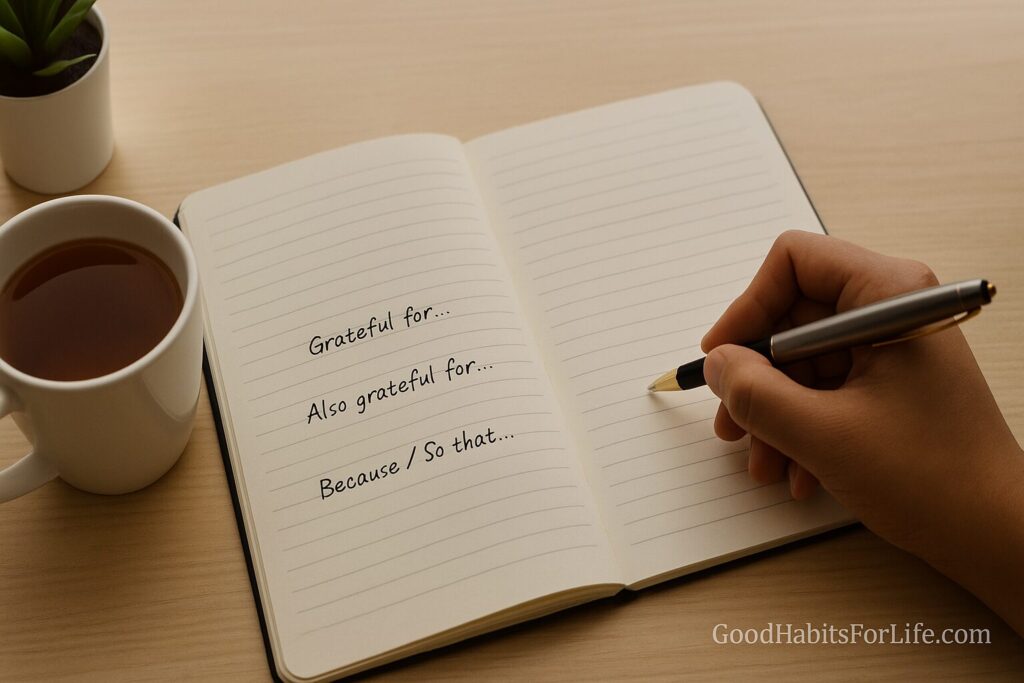
A microjournal is the smallest repeatable version of journaling that still delivers results. The 3-Line Gratitude MicroJournal asks you to write just three short lines each day:
-
Grateful for… (person, moment, resource)
-
Also grateful for… (another, different angle)
-
Because / So that… (why it matters, or how you’ll pay it forward)
This format drives reflection beyond a basic list. The third line (“because/so that…”) creates context and meaning, which research links to stronger emotion and memory consolidation.
Why 3 lines? It’s fast enough to do daily, yet deep enough to shift attention toward positive events, social support, and progress—without the pressure of a long diary session.
📚 Research-Backed Benefits
Gratitude is not just “good vibes.” Controlled studies and reviews associate regular gratitude practices with:
-
Higher subjective well-being and life satisfaction and lower depressive symptoms in multiple randomized trials and meta-analyses.
-
Better sleep quality and fewer physical complaints when practices are done consistently (e.g., nightly journaling).
-
Stronger relationships, increased prosocial behavior, and support-seeking.
-
Motivation and goal progress, likely via broaden-and-build effects and attention re-training.
The key is consistency over intensity: brief, regular entries outperform sporadic long ones.
(See References below.)
🛠️ Quick Start: Set It Up in 10 Minutes
Timebox: 10 minutes now; 2 minutes per day after.
-
Pick your container (1 min).
-
Paper: small notebook on your pillow.
-
Digital: a pinned note or app with a ready template.
-
-
Create a 1-tap template (3 min).
Copy this: -
Choose your cue (2 min).
Attach writing to a reliable event: after brushing teeth, after lunch, or before lights out. -
Set a micro-commitment (1 min).
“I will write three short lines—even if they’re ordinary.” -
Add a visual trigger (1 min).
Place the notebook on your pillow / pin the note to phone home screen. -
Plan a weekly 2-minute review (1 min).
Every Sunday, star your favorite line; this builds salience and keeps it fun.
🗓️ Habit Plan: 30-60-90 Roadmap
Goal: Turn 3-line gratitude into a never-miss nightly ritual.
Days 1–30: Install
-
Cue: After brushing teeth.
-
Action: Write 3 lines; stop at 2 minutes.
-
Reward: Tick a tiny calendar box ✅ and say “Done.” (Small verbal rewards strengthen habit loops.)
-
Checkpoint: If you miss a day, write the next morning—never miss twice.
Days 31–60: Deepen
-
Keep 3 lines, but add one “specificity boost” word: a sensory detail (sound, smell, color).
-
Weekly experiment: One day per week, text a thank-you to someone from your entry.
Days 61–90: Expand Impact
-
Add a Monday “pay-it-forward” line: “One small way I’ll pass this on is…”
-
Monthly reflection (10 min): Scan entries; note top 3 themes (people, health, learning, etc.). Set a micro-goal aligned to a theme for the next month.
Measuring Progress:
Track consistency (%), mood (0–10) before bed, and sleep quality (0–10) for 7 days at start and at day 90. Look for +10–20% shifts.
🧠 Techniques & Frameworks that Make It Stick
-
Habit stacking: “After I set my toothbrush down, I write my 3 lines.”
-
Implementation intentions: “If I feel too tired, I’ll write one word per line.”
-
Time boxing: 2 minutes max reduces perfectionism.
-
Temptation bundling: Pair with tea or a favorite calm playlist.
-
CUE–ROUTINE–REWARD loop: Keep the notebook visible (cue), write (routine), then small celebration (reward).
-
Specificity > breadth: Concrete details (“the cinnamon smell of morning coffee”) beat generic (“coffee”).
-
Gratitude variety: Rotate themes—people, body, nature, learning, setbacks, privileges, tools—to avoid “gratitude fatigue.”
👥 Variations for Different Audiences
Students:
-
Do it after last class; include “one thing I learned” in line 2.
-
Weekly: thank a peer or teacher.
Professionals:
-
Lunchtime entry to reduce evening drop-off.
-
Add a “work win” detail and a next best action for tomorrow.
Parents:
-
Do it with kids at bedtime; each shares a gratitude.
-
Keep entries on the fridge; invite drawings as the third line.
Seniors:
-
Pair with a short walk; include a nature observation.
-
Print larger-font template; keep pen with the notebook.
Teens:
-
Use phone widget; allow emojis.
-
Share one “micro-thank-you” via DM each week (with consent and privacy).
⚠️ Mistakes & Myths to Avoid
-
Myth: “If I repeat items, I’m failing.”
Reality: Repetition is fine—focus on a new detail (the because/so that line). -
Mistake: Over-engineering with fancy layouts.
Fix: Keep format identical every day. -
Myth: “Gratitude means ignoring problems.”
Reality: It widens attention, which can increase problem-solving and resilience. -
Mistake: Writing only on “good” days.
Fix: On hard days, be microscopic: “Hot water,” “A reply from a friend,” “Because it reminded me I’m not alone.”
💬 Real-Life Examples & Copy-Paste Prompts
Examples
-
1) Grateful for Asha’s check-in message.
2) Also grateful for the shade under the gulmohar tree.
3) Because I felt seen and cooled down after a tough commute. -
1) Grateful for sticking to my 10-minute walk.
2) Also grateful for the cinnamon smell of morning coffee.
3) So that I start the day calmer and kinder to others.
Prompts (rotate weekly)
-
People who helped me (and how)
-
Something I learned today
-
A body part that worked hard
-
Nature I noticed
-
A small mistake I won’t repeat
-
A tool or privilege I often overlook
-
A past self I’m grateful to
🧰 Tools, Apps & Resources
Paper vs Digital (quick guide)
| Option | Pros | Cons | Best for |
|---|---|---|---|
| Pocket notebook | No screens, tactile, easy bedtime cue | Harder to search; can misplace | Bedtime rituals |
| Phone note (e.g., Google Keep/Apple Notes) | 1-tap, searchable, free | Notifications can distract | On-the-go |
| Journaling apps (Day One, Journey) | Templates, reminders, photos, export | Paid features | Power users |
| Notion/Obsidian | Custom templates, backlinks | Setup time | Knowledge nerds |
Template to paste anywhere
Nice-to-have automations
-
Phone reminder at your chosen cue time.
-
“If bedtime mode turns on → open gratitude note.”
-
Weekly calendar event “Star a favorite line.”
📌 Key Takeaways
-
Three lines are enough to shift attention and mood if done daily.
-
The third line (“because/so that…”) adds meaning and stickiness.
-
Stack to an existing cue, keep it 2 minutes, and never miss twice.
-
Use the 30-60-90 roadmap and track simple metrics to see results.
-
Choose a tool you’ll use; consistency beats features.
❓FAQs
1) What’s the best time to write?
Whenever you can be consistent. Evenings work well because you’re reflecting on the day and priming sleep.
2) What if I miss a day?
Resume the next day and, if possible, jot a quick “catch-up” line. The rule is don’t miss twice.
3) Should I write three new items every time?
Variety helps, but repetition with new details is perfectly fine.
4) Paper or digital—what’s better?
The best is the one you’ll do daily. Paper reduces screens at night; digital is searchable and always with you.
5) Can gratitude journaling help with stress or low mood?
Research links gratitude practices with improved mood and coping. It’s not a replacement for professional care if you’re struggling significantly.
6) How long before I notice benefits?
Some people feel lighter within 2–3 weeks; measure mood/sleep weekly to notice trends.
7) Is it okay to include “negatives”?
Yes—write a gratitude related to a challenge (e.g., what it taught you or who helped).
8) How do I keep it fresh?
Rotate prompts, add a sensory word, or highlight a weekly favorite.
9) Should I share entries?
Sharing a genuine thank-you can strengthen relationships; keep private notes private if that feels safer.
10) Can kids do this?
Absolutely. Use drawings or stickers as the third line for younger children.
📖 References
-
Emmons, R. A., & McCullough, M. E. (2003). Counting blessings versus burdens: An experimental investigation of gratitude and subjective well-being in daily life. Journal of Personality and Social Psychology, 84(2), 377–389. Link
-
Wood, A. M., Froh, J. J., & Geraghty, A. W. (2010). Gratitude and well-being: A review and theoretical integration. Clinical Psychology Review, 30(7), 890–905. Link
-
Davis, D. E., et al. (2016). Thankfulness and well-being: A review of the theoretical and empirical work. Journal of Counseling Psychology, 63(1), 20–31. Link
-
Harvard Health Publishing. Giving thanks can make you happier (updated). Summary of research and practical tips. Link
-
American Psychological Association. Gratitude—evidence overview and tips. Link
-
Greater Good Science Center (UC Berkeley). Brown, B., & Wong, J. (2017). How gratitude changes you and your brain. Link
-
Dickens, L. R. (2017). Using gratitude to build resilience in response to negative life events. The Journal of Positive Psychology, 12(6), 579–588. Link
-
Jackowska, M., et al. (2016). A brief gratitude intervention for subjective well-being and sleep. Journal of Health Psychology, 21(10), 2207–2217. Link
Disclaimer
This article is for educational purposes and is not a substitute for professional medical or mental-health advice.