
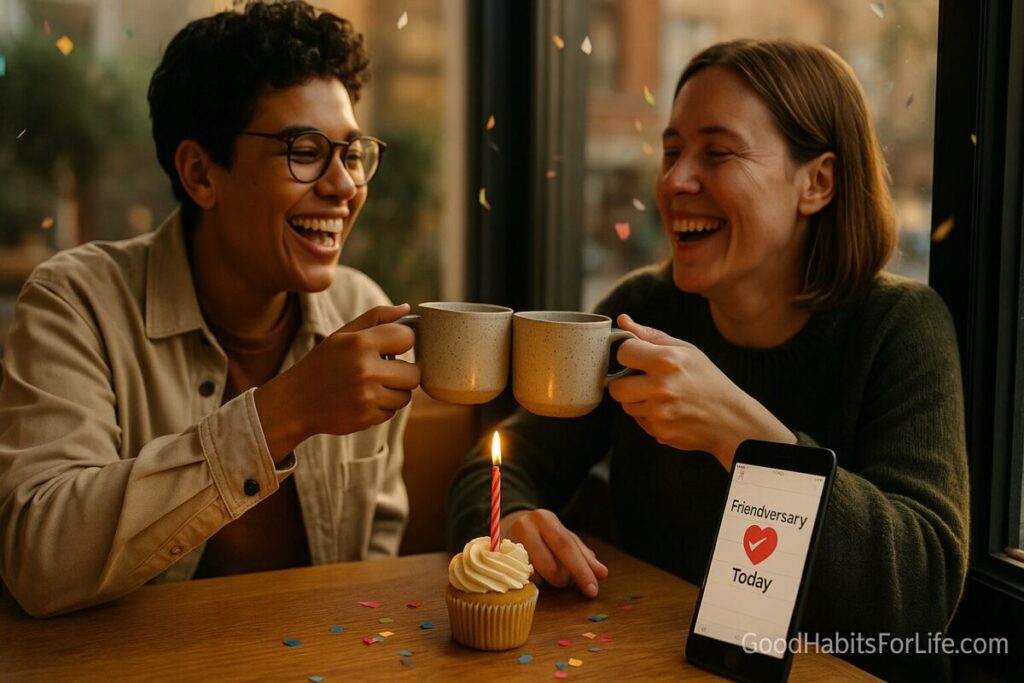
Friendversaries: Celebrate the Day You Met
Friendversaries: Celebrate the Day You Met
Table of Contents
🧭 What & Why
A friendversary is a personal anniversary that marks the day you met or a defining moment in your friendship. Treating it as a ritual—something done intentionally, the same time each year—turns a nice idea into a bond-strengthening habit.
-
Rituals build connection and meaning. Psychological research shows rituals regulate emotions, prime performance, and tighten social bonds. faculty.haas.berkeley.edu
-
Celebrations lift perceived social support. Marking positive events with food/drink and others increases the feeling that your network “will be there for you,” a driver of well-being. news.iu.edu
-
Relationships = health. Strong social ties are associated with a ~50% higher likelihood of survival across 148 studies. Prioritize the bonds that keep you well. PMC
-
Savoring and nostalgia add fuel. Looking back together and labeling what you appreciate heightens positive emotion and connectedness—exactly what a yearly friendversary does. PMC+1
✅ Quick Start (Today)
If your friendversary date is known:
-
Send a “save-the-minute.” “Hey! Our friendversary is next Tuesday at 7pm—5-minute FaceTime toast?”
-
Prepare a 2-part toast: (a) one vivid micro-story from the day you met; (b) one thing you appreciate now.
-
Add a small shared consumption ritual: tea, coffee, a cookie—anything you both have on hand. (Ritual+consumption boosts savoring.) Harvard Business School
-
Snap one photo/screenshot and title it “Friendversary Year 1 – [Both Names].”
-
Log a micro-plan for the year: one activity you’ll do together before next friendversary.
If the date is fuzzy:
-
Pick a symbolic day (first DM, first game, first trip) and commit. Rituals work because they’re repeated and meaningful, not because they’re perfect. faculty.haas.berkeley.edu
🗓️ 30-60-90 Friendversary Plan
Day 0–30 (Start & Anchor)
-
Create a shared calendar event (annual repeat).
-
Write a 100-word origin note in a shared doc/album—what happened, where, who introduced whom.
-
Decide a signature ritual (e.g., same mug, same playlist, same walk route). Consistency matters. faculty.haas.berkeley.edu
Day 31–60 (Savor & Capture)
-
Launch a shared album called “Friendversaries.” Add 3 supporting pics (then/now/inside joke).
-
Post a private “photo-a-day” week together before the date to build anticipation and well-being. PMC
-
Draft two prompts you’ll answer annually (e.g., “What did we overcome?” “Favorite tiny moment?”). Savoring prompts increase positive emotion. PMC
Day 61–90 (Expand the Ritual)
-
Add a “do one kind thing” micro-challenge for each other (voice note pep talk, playlist, book rec).
-
Schedule a mini-plan for the next 90 days (one hangout, one shared goal check-in).
-
Choose a token (keychain charm, sticker) that returns each year in the photo.
Simple Milestones Table
| Year | Micro-Ritual | Memory Add-On | Shared Goal Nudge |
|---|---|---|---|
| 1 | 5-min toast + cookie | 1 photo | Plan 1 activity |
| 2 | “Same song” start | 1-paragraph origin update | 30-day mini-project |
| 3 | Walk & talk (20 min) | 3-photo collage | Book/film club pick |
| 4 | Handwritten postcard | Memory jar note | Plan a day-trip |
| 5 | Small gift under ₹500 ($10) | 5-year highlight reel | Set “next 5” list |
🛠️ Techniques & Frameworks
1) The 3-Part Celebration Formula
-
Social + Consumption + Positive Event → higher perceived social support. (Even virtual works if you both bring a drink/snack.) news.iu.edu
2) Savoring Prompts (Fred Bryant’s model)
-
Past: “What made us laugh this year?”
-
Present: “What’s delightful about today’s moment?”
-
Future: “What are we excited to build?”
Savoring—attending to and amplifying positives—boosts meaning and mood. PMC
3) Synchrony for Bonding
-
Start the call together with a 10-second countdown, clink mugs in sync, or press play on the same 30-second track—synchrony and shared exertion raise bonding (endorphin pathway). PubMedPMC
4) Tiny Ritual, Big Meaning
-
Repeatable cues (same mugs, same greeting, same first photo) create identity and emotional regulation—the essence of ritual. faculty.haas.berkeley.edu
👥 Audience Variations
-
Students/Teens: Low-cost snack, campus walk, shared playlist; rotate “host” to practice planning.
-
Busy Professionals: 10-minute calendar-protected slot; swap 3 bullet wins and 1 ask.
-
Parents: Include kids for one pic; do a separate 10-minute adult call later.
-
Long-Distance Friends: Virtual coffee + time-zone-friendly “parallel activity” (e.g., both take a sunset photo).
-
Seniors: Include a brief reminiscence segment—recalling positive stories supports well-being and communication. CochraneBioMed Central
⚠️ Mistakes & Myths
-
Myth: “If the date isn’t exact, it doesn’t count.” Meaning beats precision; choose a symbolic date and honor it. faculty.haas.berkeley.edu
-
Mistake: Over-engineering. Keep the ritual small and repeatable; scale later.
-
Myth: “Virtual can’t bond us.” Virtual celebrations with the right ingredients still lift perceived support. news.iu.edu
-
Mistake: Skipping the toast. Naming the moment is what signals care and responsiveness. SAGE Journals
🗣️ Real-Life Examples & Scripts
The 60-Second Origin Toast
“Five years ago at [place/event], we swapped [funny detail]. I’m grateful for your [specific quality] and this year’s highlight was [tiny win]. Here’s to our next adventure: [one plan].”
When You’re Late
“I missed the exact date but not the meaning. Rain-check toast this Friday? I brought our signature tea.”
When It’s Long-Distance
“Same song, same sip—press play in 3…2…1. Favorite memory this year—and one thing I can do for you next month?”
If It Feels Awkward
“I’m trying a new ritual: celebrating the day we met. Can we do a 5-minute toast tonight? I’ll start with a short story.”
🧰 Tools, Apps & Resources
-
Calendar: Google Calendar/Apple Calendar (annual repeat; add notes + location).
-
Shared Albums: Google Photos/Apple Photos—create a dedicated “Friendversaries” album.
-
Pros: Easy, timeline view, live collaboration. Cons: Storage caps; mind privacy settings.
-
-
Memory Jar App/Doc: Notion, Obsidian, or a simple Google Doc—insert your yearly speech and photo.
-
Video/Voice: FaceTime, WhatsApp, Zoom—record a short greeting to play each year.
-
Prompt Cards: Keep a running list of 5 savoring prompts to rotate annually.
-
Optional “Photo-a-Day” Week: Use your phone camera + shared album; daily micro-sharing supports well-being. PMC
📌 Key Takeaways
-
A friendversary is a repeatable, meaningful ritual—not a big party.
-
Use the 3-part formula (social + consumption + positive event) to raise perceived support. news.iu.edu
-
Add savoring prompts and a signature cue (song/mug/greeting) to boost emotion and memory. PMC
-
Lock it in with a calendar repeat and a 30-60-90 plan so it becomes effortless.
-
Keep a photo log and one tiny plan for the year ahead—connection compounds. PMC
❓ FAQs
1) Do friendversaries really matter, or is this just cute branding?
They matter. Small, repeatable rituals increase meaning and social connection—key ingredients for well-being and long-term relationship health. faculty.haas.berkeley.edu
2) What if we can’t meet in person?
Do it virtually—bring a drink/snack, explicitly mark the positive event, and name one appreciation; the perceived support boost still shows up. news.iu.edu
3) How long should it be?
5–20 minutes is enough. What counts is intentionality and repetition, not duration. faculty.haas.berkeley.edu
4) Is there science behind doing something “in sync” (like a countdown or song)?
Yes. Synchrony and even light shared exertion are linked to higher bonding via endorphin pathways. PubMedPMC
5) We don’t remember the exact date—help?
Pick a meaningful proxy (first game, first DM) and standardize it. Rituals work because they’re consistent and symbolic. faculty.haas.berkeley.edu
6) Any tips for older adults or memory support?
Include gentle reminiscence (short stories, labeled photos); group reminiscence shows small but meaningful gains in quality of life and communication. CochraneBioMed Central
7) How is a friendversary different from a birthday?
Birthdays celebrate a person; friendversaries celebrate the relationship—the shared story and commitments that keep it strong. faculty.haas.berkeley.edu
8) Do photos actually help, or do they pull us out of the moment?
Mindful, intentional photo-taking and brief sharing can increase enjoyment and memory; pair one photo with a sentence of savoring. PMC
📚 References
-
Brick, D. J., Wight, K. G., Bettman, J. R., Chartrand, T. L., & Fitzsimons, G. J. (2023). Celebrate Good Times: How Celebrations Increase Perceived Social Support, Journal of Public Policy & Marketing. (Publisher page + DOI). SAGE Journals
-
Holt-Lunstad, J., Smith, T. B., & Layton, J. B. (2010). Social Relationships and Mortality Risk: A Meta-analytic Review, PLOS Medicine. PMC
-
Hobson, N. M., Schroeder, J., Risen, J. L., Xygalatas, D., & Inzlicht, M. (2017). The Psychology of Rituals: An Integrative Review, Personality and Social Psychology Review. (PDF). faculty.haas.berkeley.edu
-
Newman, D. B., Sachs, M. E., Stone, A. A., & Schwarz, N. (2019). Nostalgia and Well-Being in Daily Life, Emotion (PMCID article summarizing mechanisms). PMC
-
Brewster, L. (2018). The Daily Digital Practice as a Form of Self-Care: Using Photography for Everyday Well-Being, Health (PMCID). PMC
-
Vohs, K. D., Wang, Y., Gino, F., & Norton, M. I. (2013). Rituals Enhance Consumption, Psychological Science (open copy). Harvard Business School
-
Charles, S. J., et al. (2021). United on Sunday: The Effects of Secular Rituals on Social Bonding and Affect, PLOS ONE. (Citation page). PLOS
⚖️ Disclaimer
This article is for general information only and is not a substitute for professional mental-health advice.