
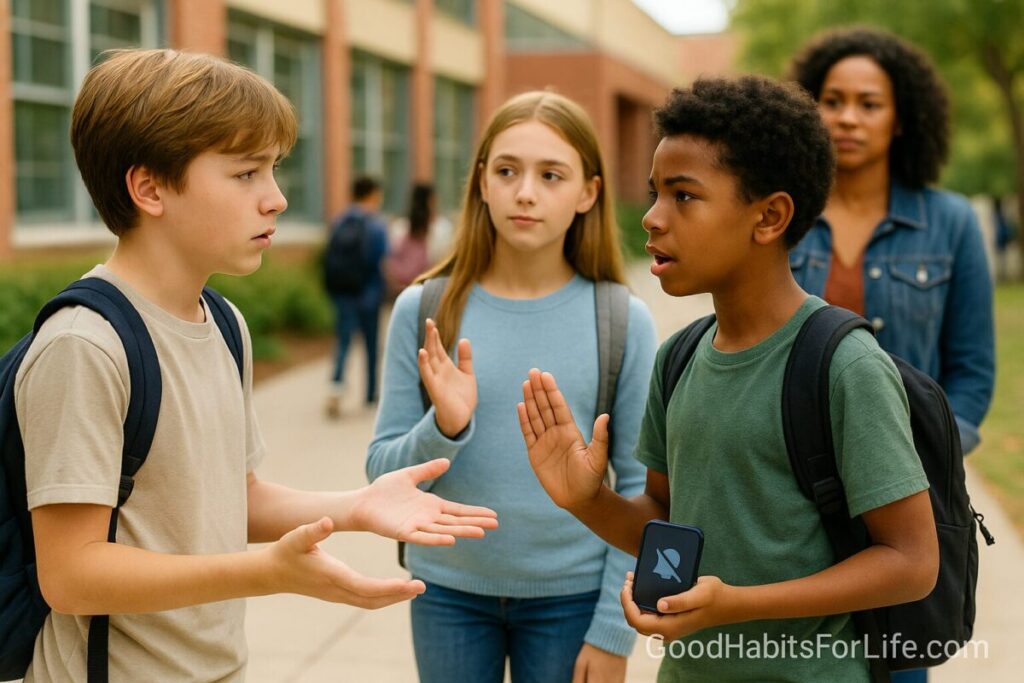
Friend Drama 101 for Tweens: Name, Normalize, Navigate
Tween Friend Drama 101: Name, Normalize, Navigate
Table of Contents
🧭 What This Is & Why It Matters
“Friend drama” is the everyday conflict, misunderstandings, and social jostling that come with growing up. It’s uncomfortable—but it’s also how kids practice empathy, boundaries, and repair. Distinguish drama from bullying, which includes (1) unwanted aggression, (2) a power imbalance, and (3) repetition or high likelihood of repetition. Bullying needs adult intervention; typical drama can often be coached at home/school. StopBullying.gov
Online, drama can spill into group chats and DMs. Cyberbullying is bullying that uses digital tech (social/messaging/games/phones) and is repeated to scare, anger, or shame. Early steps: seek help from a trusted adult, document, block/report. UNICEF
Social-emotional skills—self-awareness, self-management, social awareness, relationship skills, and responsible decision-making—help tweens move from reactivity to repair. These are the core competencies in widely used SEL frameworks. CASEL
✅ Quick Start: Do-This-Today Plan
-
Pause the spiral (1–2 minutes). Breathe in 4, out 6; shake out hands; drink water.
-
Name it. “Sounds like exclusion at recess and you feel left out + angry.”
-
Sort it. Use the chart below to decide: drama, mean moment, or bullying? (If bullying/civil-rights harassment, escalate.) StopBullying.gov+1
-
Pick a path. Choose one: clarify → boundary → take space → repair → adult help.
-
Send one message or try one line in person (see Scripts).
-
Screenshot & safe steps for digital issues; block/report if needed. UNICEF
-
Debrief at night. What helped? What to try tomorrow?
🧠 The “Name–Normalize–Navigate” Framework
-
Name: Label the problem and feelings (specific beats vague): “You felt left out when the group started a new chat.”
-
Normalize: “Conflict happens to everyone. You’re not broken; you’re learning skills.”
-
Navigate: Choose a next action (ask, set a boundary, repair, or escalate for safety).
This reduces intensity and raises problem-solving—exactly what SEL aims to build across home and school. CASEL
🧩 Spot the Difference: Drama vs. Bullying vs. Mean Moment
| Situation | What it looks like | Power imbalance? | Repeated? | Response |
|---|---|---|---|---|
| Friend drama | Misunderstandings, shifting groups, tone issues | Usually no | Maybe once | Coach skills; kid-led repair |
| Mean moment | One-off rude comment/eye-roll | No | No | Respond/repair; move on |
| Bullying | Targeted aggression (in person/online) | Yes | Yes/likely | Document, involve school; follow policy/law |
Definition anchors: aggression + power imbalance + repetition/high likelihood. Civil-rights-based harassment (race, sex, disability, etc.) may trigger additional legal protections—schools must act. StopBullying.gov+1
🗓️ 7-Day “Drama-Smart” Habit Plan
Day 1 (Mon): Make a Drama Map (who/where/when/trigger/feeling).
Day 2 (Tue): Learn 2 scripts (one clarity, one boundary). Practice aloud.
Day 3 (Wed): Role-play the hardest moment (parent = friend).
Day 4 (Thu): Digital hygiene: tighten privacy, mute/leave one drama chat, set Do-Not-Disturb blocks. Screenshot any harmful posts. UNICEF
Day 5 (Fri): Try one real-world action (ask or boundary).
Day 6 (Sat): Repair or reset: a short message or a clean break (see Scripts).
Day 7 (Sun): Family check-in + update your Family Media Plan (quiet hours, bedrooms screen-free, reporting rules). HealthyChildren.org
🛠️ Techniques & Tools That Work
1) OFNR “I-Message” (kid-friendly).
-
Observe: “When the new chat started without me…”
-
Feel: “…I felt left out.”
-
Need: “I want to know if I did something.”
-
Request: “Can we add me back or talk?”
Builds relationship skills + responsible decision-making (SEL). CASEL
2) The COPE Loop.
Calm → Options → Plan → Execute (then evaluate). Repeat after each attempt.
3) Green/Yellow/Red Drama.
-
Green: misread tone; try clarify.
-
Yellow: pattern of exclusion; set boundary.
-
Red: threats, slurs, pile-ons; document & escalate (school/platform/parents). UNICEFStopBullying.gov
4) Digital safety first.
Screenshot, save dates, block/report within the app; don’t retaliate. Many pediatric experts warn that abruptly removing all devices can silence disclosure; pair supervision with open dialogue and reporting processes instead. Children’s Hospital Colorado
5) Partner with school.
Ask for the school’s bullying policy and reporting form; share concise evidence (timeline + screenshots). Schools have obligations, especially when harassment targets protected characteristics. StopBullying.gov
👥 Audience Variations
-
Tweens (9–12): Practice one script at a time; keep messages short; avoid group-chat pile-ons; use “leave/mute” tools. UNICEF
-
Parents/Caregivers: Be a coach, not a fixer. Schedule weekly 15-minute “friendship labs.” Create/refresh a Family Media Plan with kid input. HealthyChildren.org
-
Teachers/School Staff: Reinforce classroom SEL routines (circles, restorative questions), provide neutral spaces for repair, and apply policy consistently. CASEL
-
Neurodivergent Tweens: Pre-write scripts, use visuals (emoji traffic lights), and role-play tone/volume. Loop in counselors for scaffolds.
⚠️ Mistakes & Myths to Avoid
-
“Just ignore it.” Ignoring can help with attention-seeking behavior, but bullying requires documentation and adult action. StopBullying.gov
-
“Taking the phone solves it.” Sudden device removal often shuts down reporting; use collaborative plans + app reporting instead. Children’s Hospital Colorado
-
“Drama is always toxic.” Managed conflict teaches repair and boundaries (SEL). CASEL
-
“Boys don’t have drama.” All kids need language for feelings and boundaries.
🗣️ Real-Life Scripts (Copy/Paste)
Clarity (Green):
-
“Hey, quick check—did I miss the invite to the new chat? If it was a mix-up, can you add me?”
-
“When you said ‘kidding,’ I wasn’t sure. Can you clarify?”
Boundary (Yellow):
-
“I don’t want jokes about my braces. If it happens again, I’ll leave the convo.”
-
“Group roasts aren’t for me. I’m muting this chat.”
Take Space (Yellow):
-
“I’m stepping back for a day. We can talk tomorrow.”
Repair (Any):
-
“I rolled my eyes today—that wasn’t okay. I’m sorry. Next time I’ll say I need space.”
Bystander Boost:
-
“Let’s change the subject.”
-
“That’s not cool—let’s not post stuff about people.”
Adult Ask (Red):
-
“There are threats in the chat. I saved screenshots. Can we report this to school and the app?” UNICEF
🧰 Apps, Sites & Resources
-
AAP Family Media Plan — customize rules (bedroom screens, quiet hours, reporting steps). Pros: evidence-aligned, printable; Con: needs regular review. HealthyChildren.org
-
StopBullying.gov — definitions, laws, how to report. Pros: concise & official; Con: U.S.-specific. StopBullying.gov+1
-
UNICEF Guides on Cyberbullying — global, youth-friendly steps to block/report/seek help. Pros: accessible; Con: broad. UNICEF
-
CASEL SEL Framework — explains core skills schools teach for emotions/relationships. Pros: shared language with schools; Con: implementation varies. CASEL
📌 Key Takeaways
-
Teach Name–Normalize–Navigate so kids move from feelings to choices.
-
Use scripts for clarity, boundaries, and repair.
-
Document, block, and escalate when behavior meets bullying criteria or involves protected characteristics. StopBullying.gov+1
-
Build the habit with a weekly check-in + a living Family Media Plan. HealthyChildren.org
❓ FAQs
1) How do I tell drama from bullying?
Look for a power imbalance and repetition/high likelihood. If present, it’s bullying and needs adult action. StopBullying.gov
2) When should I contact the school?
If safety is at risk, the pattern continues, or harassment targets a protected class (race/ethnicity/sex/disability). Share a neutral timeline and screenshots. StopBullying.gov
3) What are first steps for cyberbullying?
Don’t engage; screenshot; block/report in-app; tell a trusted adult; consider school involvement. UNICEF
4) Should I take away my kid’s phone?
Use collaborative media rules instead; sudden device loss can shut down disclosure. Adjust privacy, mute/leave drama chats, and supervise reporting. Children’s Hospital Colorado
5) My child was unkind—now what?
Coach an own-it + repair message (“I’m sorry—next time I’ll ___”). Focus on making amends and practicing better boundaries.
6) What if my child won’t talk?
Try low-pressure talks (car rides/walks), ask concrete questions (“What was most annoying today?”), and offer one actionable choice (“clarify, boundary, or take space?”).
7) How can school and home align?
Use shared SEL language (feelings, needs, requests) and mention your Family Media Plan so expectations match. CASELHealthyChildren.org
📚 References
-
StopBullying.gov — Definition of Bullying (US HHS/CDC/ED) https://www.stopbullying.gov/resources/facts StopBullying.gov
-
StopBullying.gov — Federal Civil Rights & Harassment https://www.stopbullying.gov/resources/laws/federal StopBullying.gov
-
UNICEF — Cyberbullying: What it is & how to stop it https://www.unicef.org/lac/en/parenting-lac/security-protection/cyberbullying-what-is-how-stop-guide-parents UNICEF
-
CASEL — SEL Core Competencies & Framework https://casel.org/casel-sel-framework-11-2020/ CASEL
-
AAP/HealthyChildren — How to Make a Family Media Plan https://www.healthychildren.org/English/family-life/Media/Pages/How-to-Make-a-Family-Media-Use-Plan.aspx HealthyChildren.org
-
Children’s Hospital Colorado — Pediatric Guidance on Bullying & Devices https://www.childrenscolorado.org/doctors-and-departments/departments/psych/mental-health-professional-resources/primary-care-articles/pediatrician-role-bullying-prevention/ Children’s Hospital Colorado
Disclaimer: This guide is educational and not a substitute for personalized mental-health, legal, or school policy advice. If safety is at risk, contact your school and local authorities.