
Freezer Inventory System: Label, Rotate, Enjoy: AI workflows (2025)
Freezer Inventory System: Label, Rotate, Enjoy (2025)
Table of Contents
🧭 What Is a Freezer Inventory System & Why It Works
A freezer inventory system is a simple method to track what you freeze, where it sits, and when to use it. The core parts are:
-
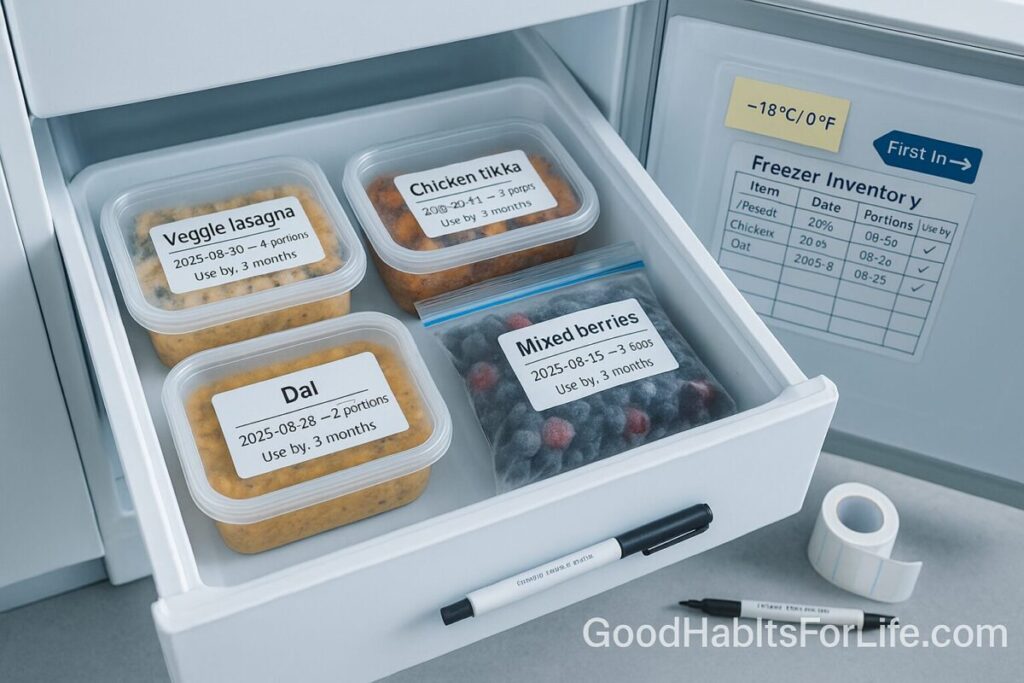
Labels that include item, date, quantity/portions, and optional “use by for quality.”
-
A living index (paper on the freezer door or a shared digital sheet).
-
A rotation rule (FIFO: first in, first out).
Benefits (evidence-aligned):
-
Less waste: Knowing what’s inside reduces forgotten food. Households typically discard a noticeable share of their food budget; freezing with tracking cuts this dramatically.
-
Food safety confidence: Following government guidance on temperature (–18 °C / 0 °F) and safe thawing reduces risk.
-
Time savings: Batch cook once; reheat in minutes.
-
Budget control: Buy in bulk during sales, then portion and freeze.
✅ Quick Start: Set It Up This Weekend
You’ll need: freezer-safe bags/containers, a thick marker or freezer labels, tape, a one-page inventory template (paper or Google Sheet), and 30–60 minutes.
Step-by-step
-
Clear & group: Pull out contents. Group by Protein / Veg / Fruits / Baked / Meals / Stocks. Toss anything clearly damaged or long past quality guidelines.
-
Create zones: Assign shelves or bins to categories (e.g., top = cooked meals, middle = meats, drawer = veg/fruit).
-
Label like this:
Chicken tikka | 2025-09-06 | 2 servings | 2/4(item | freeze date | portions | remaining/total). -
Log to index: Add each item to your sheet/list: Row = Item, Qty, Location (shelf/bin), Freeze date, “Best quality by,” Notes.
-
FIFO load-in: New items go behind older ones. Use front-facing “soonest to use.”
-
Put a pen + labels on a magnet on the freezer. No excuse not to label.
-
Weekly habit: Each weekend, open the list for 3 minutes, mark used items, and plan 1–2 meals from the “due soon” column.
One-page paper template (copy):
-
Item | Portions | Freeze date | Best by | Shelf/Bin | Notes/Allergens | ✅ Used (dates)
🗓️ 7-Day Starter Plan
Day 1 (30–60 min): Declutter, categorize zones, print/setup index.
Day 2 (15 min): Label everything already inside; estimate dates if unknown and star them for faster use.
Day 3 (10 min): Portion & freeze one bulk buy (e.g., chicken in 300 g packs).
Day 4 (5 min): Add two “use soon” meals to your weekly plan.
Day 5 (10 min): Batch-cook a soup/stew; cool, portion (1–2 cups), label, freeze.
Day 6 (5 min): Review the index; reorder items on the shelf for FIFO.
Day 7 (10 min): Tick off what you used; schedule a weekly 3-minute review repeating next week.
🧠 Techniques & Frameworks
FIFO Rotation (the golden rule)
-
Front = oldest, back = newest.
-
Add a colored dot (e.g., red = “use this week”) to anything nearing its quality window.
Labeling System (fast + readable)
-
Format:
Item | YYYY-MM-DD | Portions | #/Total. -
Color code: Proteins (blue), cooked meals (green), veg (yellow), desserts/breads (purple).
-
Containers: Use freezer-safe bags for flat stacking; rigid containers for soups; leave headspace for expansion.
Batch Once, Eat Thrice
-
Cook one base (e.g., beans, pulled chicken, roasted veg), portion into three flavor paths (e.g., Mexican, Mediterranean, Indian). Label each with spice profile.
“Two-for-Freezer” Rule
-
When cooking dinner, double it. Eat half; freeze half in single-meal portions.
Door-Check Habit (cue)
-
Stick the inventory list on the door. Every time you put something in or take something out, mark it before you close the door.
🤖 AI Workflows: From Scan to Supper
1) QR/Code + Sheet Auto-Update
-
Print simple QR codes (one per recipe/meal type). Scanning opens a pre-filled Google Form to add/subtract quantities from your Google Sheet inventory.
2) Photo-to-Text Intake
-
Snap a shelf photo; use OCR (built into many phones/apps) to read labels into text; paste into your sheet. Clean up once—faster than typing.
3) “Cook From What I Have” Prompts
-
Copy your inventory list into an AI and ask:
“Make a 5-day dinner plan using only these freezer items + common pantry staples. 30-minute max, budget-friendly, high-protein.”
Request shopping gaps for any missing small items.
4) Smart Rotation Nudges
-
Use a calendar reminder titled “Freezer FIFO—use red dots first”.
-
Optional: build a simple IFTTT/Zapier that pings you when items pass a chosen “best quality by” date in your sheet.
5) Label Text Generator
-
Paste a batch-cook recipe and ask for label strings in the exact format you use (item name, grams, servings, freeze date placeholder).
🛠️ Storage Times & Safety Basics
-
Freezer temperature: –18 °C (0 °F). Food is safe indefinitely at this temp, but quality declines over time.
-
Thaw safely: Best is refrigerator thawing (≤4 °C / 40 °F). You can cook from frozen for many items; add time.
-
Refreezing: Food thawed in the refrigerator can be safely refrozen (quality may suffer).
Quality-focused freezer guide (typical maxima):
| Food | Best Quality Window |
|---|---|
| Raw ground meat | 3–4 months |
| Steaks/roasts/chops | 4–12 months |
| Whole chicken/turkey | Up to 12 months |
| Chicken pieces | Up to 9 months |
| Cooked leftovers & casseroles | 2–3 months |
| Soups & stews | 2–3 months |
| Bacon/sausage | 1–2 months |
| Bread & baked goods | ~3 months |
| Fish, fatty (salmon, mackerel) | 2–3 months |
| Fish, lean (cod, tilapia) | 6–8 months |
| Fruit | 8–12 months |
| Vegetables (blanched) | 8–12 months |
| Stock/broth | 2–3 months |
Always check official guidance for specifics by item and packaging.
👥 Audience Variations
Families:
-
Use bin labels kids can read: “Taco Night,” “Pasta Helpers,” “Breakfast.”
-
Portion in single-meal pouches so teens can heat safely.
Students/Young professionals:
-
Freeze in single servings (350–450 g). Flat-freeze bags to save space; stand them upright like a file drawer.
Busy professionals:
-
Build a “Weeknight 10”: ten proven freezer dinners you love. Keep two of each in rotation.
Seniors:
-
Date and large-print labels. Favor smaller portions to avoid leftovers sitting too long. Keep a paper index on the door.
⚠️ Mistakes & Myths to Avoid
-
Myth: “Freezing kills all bacteria.”
Truth: Freezing pauses microbial growth; it doesn’t sterilize food. Handle safely before freezing. -
Mistake: Skipping headspace in liquids → cracked containers.
-
Mistake: Labeling only the lid (lids wander); label the side too.
-
Mistake: Piling new items on top—breaks FIFO.
-
Mistake: Freezing huge blocks that take forever to thaw—portion first.
-
Myth: “You can’t refreeze thawed food.”
Truth: If thawed in the fridge, refreezing is safe though quality may drop.
🧾 Real-Life Examples & Scripts
Label scripts (copy-paste):
-
Beef bolognese | 2025-09-06 | 2 cups | 1/3 | Pasta night -
Chana masala | 2025-09-06 | 1.5 cups | 2/4 | Vegan -
Vegetable stock | 2025-09-06 | 500 ml | 3/6 | Salt-free
Weekly review script (3 minutes):
-
Open sheet → sort by “Best by.”
-
Circle two items due soon → slot into next week’s dinners.
-
Mark anything used today (–1 on quantity).
-
Add a red dot to any item within 1 week of “Best by.”
Family role script:
-
“If you take the last pouch, you add the item to the ‘Cook Next’ list.”
📦 Tools, Apps & Resources
Containers & supplies
-
Freezer-safe bags (flat-freeze), rigid containers for soups, masking/freezer tape, bold marker, bin dividers.
Inventory methods
-
Paper: Door-sheet with pencil—fast and resilient.
-
Spreadsheet: Google Sheets + Form (works with QR codes; shareable).
-
Apps (examples): NoWaste, Pantry Check, Listonic, Sortly.
-
Pros: Barcode scan, cloud sync, reminders.
-
Cons: Learning curve; some features paywalled.
-
Time savers
-
Quarter-sheet trays to freeze single portions flat.
-
Silicone muffin trays for 120 ml “pucks” of pesto, stock, sauces.
AI helpers
-
OCR to pull label text → sheet.
-
“Recipe from inventory” prompts for rapid meal plans matching your macros or diet.
📌 Key Takeaways
-
Label + index + FIFO is the foundation.
-
Keep the freezer at –18 °C (0 °F) and follow safe thawing.
-
Portion before freezing; use clear, consistent labels.
-
A 3-minute weekly review sustains the system.
-
AI and simple automations cut admin time and spark meal ideas.
-
Expect lower waste, faster meals, and lower costs within one month.
❓ FAQs
1) What should I include on every label?
Item name, freeze date (YYYY-MM-DD), portions, and optional “best quality by” date or color dot.
2) Do I need to cool food before freezing?
Yes—cool hot foods quickly (shallow containers, brief chill) before freezing to protect texture and safety.
3) What’s the safest way to thaw meat?
In the refrigerator. Microwave or cold-water methods are acceptable with care, but cook immediately after. Avoid room-temperature thawing.
4) Can I refreeze thawed food?
If it was thawed in the fridge, yes—though quality may decline.
5) How do I avoid freezer burn?
Use air-tight packaging, remove excess air (press bags or vacuum seal), keep a consistent freezer temp, and follow quality windows.
6) Do vegetables need blanching before freezing?
Most do; blanching deactivates enzymes that affect texture/flavor. Many pre-frozen store veg are already blanched.
7) What’s a good portion size for batch meals?
Single meals: ~350–450 g; soups/sauces: 300–500 ml; proteins: 120–170 g per serving.
8) My freezer is tiny. Can I still inventory?
Yes—flat-freeze in bags, file upright in a bin, and keep a lean list (max ~20 items).
9) Are vacuum sealers worth it?
For frequent freezers, yes; they extend quality window by reducing air exposure.
10) What temp should the freezer be?
–18 °C (0 °F) or colder.
📚 References
-
USDA Food Safety & Inspection Service. Freezing and Food Safety. https://www.fsis.usda.gov/food-safety/safe-food-handling-and-preparation/food-safety-basics/freezing-and-food-safety
-
FoodSafety.gov. Cold Food Storage Chart (Refrigerator & Freezer). https://www.foodsafety.gov/food-safety-charts/cold-food-storage-charts
-
USDA. Leftovers and Food Safety. https://www.fsis.usda.gov/food-safety/safe-food-handling-and-preparation/food-safety-basics/leftovers-and-food-safety
-
Centers for Disease Control and Prevention (CDC). Four Steps to Food Safety. https://www.cdc.gov/foodsafety/keep-food-safe.html
-
NHS (UK). How to freeze food and leftovers. https://www.nhs.uk/live-well/eat-well/food-guidelines-and-food-labels/how-to-freeze-food/
-
University of Minnesota Extension. Freezing foods: Safety and quality. https://extension.umn.edu/preserving-and-preparing/freezing
-
U.S. Department of Agriculture. Refrigeration and Food Safety. https://www.fsis.usda.gov/food-safety/safe-food-handling-and-preparation/food-safety-basics/refrigeration-and-food-safety
-
FAO/WHO Codex Alimentarius. General Principles of Food Hygiene. https://www.fao.org/fao-who-codexalimentarius
Disclaimer
This article provides general food-safety information; always follow official guidance and your local regulations.