
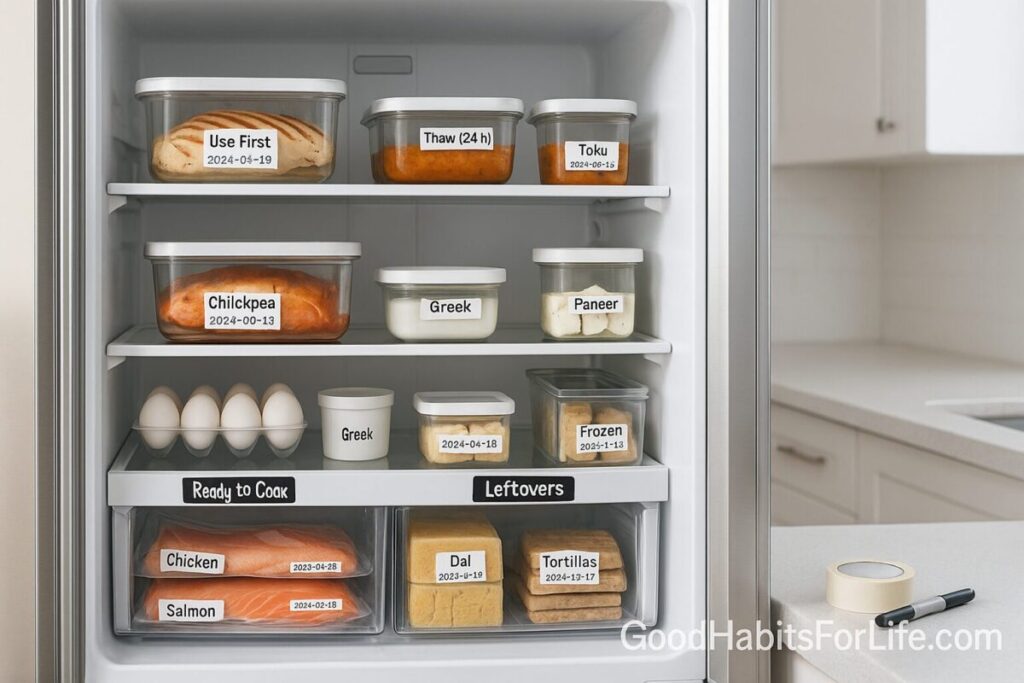
Food Waste to Zero: Storage & Labeling That Works: Protein-Forward Plan (2025)
Food Waste to Zero: Storage & Labels, Protein-First (2025)
Table of Contents
🧭 What this guide covers & why waste-to-zero matters
Food waste is money, time, and climate impact literally thrown away. Households waste a significant share of purchased food, and proteins (meat, fish, eggs, dairy, tofu/tempeh, legumes) are among the most expensive and highest-impact items to waste. This guide gives you a protein-forward, practical system—storage zones, a labeling language, safe time windows, and a weekly rhythm—so you keep nutrition high, costs low, and waste near zero.
Benefits you’ll notice
-
Lower grocery bills (fewer impulse re-buys of items you already had).
-
Faster weekday cooking (pre-portioned proteins you can see and trust).
-
Safer meals (correct temps, thawing, and reheat targets).
-
A cleaner, calmer fridge and freezer.
✅ Quick Start: Do-it-today checklist
-
Set temperatures: Fridge 1–4 °C (34–40 °F); Freezer −18 °C (0 °F). Put a digital thermometer inside each.
-
Clear the decks (20 min): Toss spoiled items; consolidate duplicates; wipe shelves.
-
Make three zones: Cook Soon, Ready to Eat, Freeze Queue (use bins or labeled shelves).
-
Label kit: Dissolvable labels + marker (or masking tape), a date stamp, and 3 colored dots: red = cook soon, yellow = ready, blue = frozen.
-
Protein triage (today’s groceries):
-
Cook today/tomorrow: portion → label “Cook by [date]”.
-
Freeze today: portion flat in bags or containers → label “Freeze by [date]” + grams/servings.
-
Ready-to-eat: cooked items → label “Cooked on [date]; Eat by [date]”.
-
-
Plan one “Eat-the-Fridge” meal this week using oldest items (front row of each zone).
🛠️ Core Setup: Zones, containers, labeling system
Zones that prevent waste
-
Top shelf (Ready to Eat): cooked proteins, leftovers, yogurt/curd, dips.
-
Middle (Cook Soon): raw proteins to cook within 1–3 days.
-
Crisper drawers: veg/fruit, lined and separated; protein never here.
-
Door: condiments only (it’s the warmest area).
-
Freezer drawers:
-
Drawer 1: ready-to-heat proteins (cooked).
-
Drawer 2: raw, portioned proteins.
-
Drawer 3: soup/stew bases, bones, stock cubes, frozen legumes.
-
Containers that save you money
-
Clear, stackable, airtight (borosilicate glass or high-quality BPA-free).
-
1–2 cm headspace for liquids.
-
Shallow, flat bags for fast freeze/thaw.
-
Vacuum sealer (optional): extends freezer life and reduces freezer burn.
Label like a pro (copy-paste template)
Add grams/servings and a colored dot. Place label on the front face, not the lid.
🧊 Protein Storage Cheatsheet (fridge & freezer times)
General guidance; when in doubt, use your senses and follow safety rules below.
| Protein (state) | Fridge (1–4 °C) | Freezer (−18 °C) |
|---|---|---|
| Poultry, raw | 1–2 days | 9–12 months (whole), 9 months (parts) |
| Poultry, cooked | 3–4 days | 2–6 months |
| Beef/pork/lamb, raw | 3–5 days (steaks/roasts); 1–2 days (minced) | 6–12 months (steaks/roasts); 3–4 months (minced) |
| Beef/pork/lamb, cooked | 3–4 days | 2–3 months |
| Fish, raw | 1–2 days (fatty often 1 day) | 2–3 months (fatty), 6–8 months (lean) |
| Fish, cooked | 3–4 days | 2–3 months |
| Shellfish, raw | 1–2 days | 2–3 months (shucked), 12 months (in shell) |
| Eggs (in shell) | 3–5 weeks | Not recommended (texture) |
| Hard-boiled eggs | 1 week | Not recommended |
| Tofu/tempeh, raw (unopened) | As dated (usually 5–7 days once opened) | 3–5 months (texture may change) |
| Cooked legumes | 3–4 days | 2–3 months |
| Paneer/cottage cheese | 3–5 days | 2–3 months |
| Yogurt/curd | 1–2 weeks (opened: ~5–7 days) | 1–2 months (texture may change) |
| Milk | As dated (opened: ~5–7 days) | 3 months |
Tip: Freeze in single-meal portions (e.g., 120–180 g per adult/meal) so you only thaw what you need.
🌡️ Safety Basics: Temperatures, thawing, reheating
-
Cold chain: Keep fridge 1–4 °C; freezer −18 °C.
-
Thaw safely:
-
Fridge (slow, safest),
-
Cold water (sealed bag, change water every 30 min),
-
Microwave (cook immediately after).
Never thaw at room temperature.
-
-
Reheat targets:
-
Leftovers and poultry: ≥74 °C (165 °F).
-
Whole cuts of beef/pork/lamb: 63 °C (145 °F) with rest time; minced meats: 71 °C (160 °F); fish: 63 °C (145 °F) until flaking.
-
-
Refreezing: If raw meat was thawed in the fridge and kept cold, it can be refrozen (quality may drop). If thawed by water/microwave/room temp, do not refreeze raw—cook first, then you can freeze the cooked result.
🗂️ Labeling that works: Dates, FIFO, portioning
-
Use-by vs Best-before:
-
Use-by: safety; do not use after the date.
-
Best-before: quality window; often fine after if stored correctly—use senses and safety rules.
-
-
FIFO: Put new items behind old; once a week, scan for any red-dot “cook soon” items and plan a meal around them.
-
Portion math: Label portions + grams. Aim for 120–180 g cooked meat/fish per adult serving (or ¾–1 cup cooked legumes/tofu equivalents).
🧠 Techniques & frameworks for a protein-forward week
1) Two-Base Method (Sun/Thu)
-
Sunday: Cook 2 versatile bases (e.g., roasted chicken thighs + pot of beans). Portion half to freezer.
-
Thursday: Cook 1 quick base (e.g., baked salmon or tofu trays).
-
Weeknights: Remix with sauces/spices (tacos, stir-fries, salads, wraps).
2) Freezer-Marinade Pipeline
-
Portion raw proteins → bag with marinade → label “Freeze by [date], cook from thaw”. Citrus/soy/yogurt marinades work well. Stack flat for rapid thaw.
3) Protein Ladder
-
Start with least stable first: fish → poultry → ground meat → whole cuts → cooked legumes → eggs/yogurt. Schedule meals accordingly.
4) “Cook Once, Eat Twice”
-
Purposefully cook 150% of tonight’s protein. Half for tonight, half boxed for a different dish in 48 h.
👥 Audience variations
Students (tiny fridge): buy small packs; cook 1 base on Sunday; freeze single portions; label with servings to avoid overeating and waste.
Parents: tray-bake double; freeze child-size portions; add a “snack box” zone so kids don’t raid meal components.
Busy professionals: pre-label containers; a shared household note in your phone listing freezer inventory with portions/grams.
Seniors: favor cooked, easy-to-chew proteins (fish, stews, legumes); label in larger fonts; reheat to safe temps.
⚠️ Mistakes & myths to avoid
-
Myth: “If it smells fine, it’s safe.” Some pathogens don’t change odor—use time + temperature rules.
-
Mistake: Overstuffing the fridge; air can’t circulate—temps rise.
-
Mistake: Freezing huge blocks; they thaw unevenly—flat packs win.
-
Myth: “You can’t refreeze anything.” You can refreeze cooked food and raw items thawed in the fridge (quality aside).
-
Mistake: Label on lids only—when stacked, you can’t see the top. Label the front.
💬 Real-life examples & scripts
Sunday 60-minute prep (family of 4)
-
Roast 1.2 kg chicken thighs (lemon-garlic). Cool, label: Cooked on 6 Apr; Eat by 10 Apr; 6 portions (150 g). Freeze 3 portions.
-
Pressure-cook 900 g chickpeas. Cool, portion 300 g packs. Freeze two, refrigerate one.
-
Prep 4 marinade packs: salmon 600 g (miso), tofu 400 g (ginger-soy), pork 700 g (smoky), paneer 400 g (tikka). Freeze flat.
“Eat-the-Fridge” script
“What has a red dot or an ‘eat by’ date within 48 h? That’s dinner. Search the freezer for a matching veg or carb. Done.”
Label shorthand
-
“Ck-th 150g ×2 6/4 → Eat by 10/4” (chicken thighs).
-
“Beans 300g ×3 6/4 → 1 fridge, 2 freeze.”
🧰 Tools & apps
-
USDA FoodKeeper App (iOS/Android): authoritative time windows; search by food.
-
Too Good To Go / OLIO: save money, share surplus locally.
-
NoWaste / Fridge Pal / AnyList: inventory + reminders.
-
Dissolvable labels & date stamp: quick, legible, no sticky residue.
-
Digital fridge/freezer thermometers: cheap, accurate.
-
Vacuum sealer (optional): extends freezer quality; useful for bulk buys.
Pros/cons snapshot
-
FoodKeeper: free, evidence-based; not tailored to your labels.
-
Inventory apps: reduce “I forgot” waste; need habit of logging.
-
Vacuum sealing: best quality; upfront cost + bags.
🔁 30-60-90 habit plan
Days 1–30 (Foundation)
-
Set temps; establish zones; buy labels/markers.
-
Start Sunday prep: 2 bases + 2 marinade packs.
-
Track waste: items or grams thrown each week.
Days 31–60 (Optimization)
-
Add Thursday mini-cook; refine portions; standardize label template.
-
Introduce Eat-the-Fridge night.
-
Goal: 50% less waste vs. baseline; fewer emergency takeouts.
Days 61–90 (Automation)
-
Maintain inventory list on phone; schedule a recurring 10-min Friday audit.
-
Add vacuum sealer or upgrade containers if needed.
-
Goal: Near-zero protein waste; freezer always has 6–10 ready meals.
Checkpoints
-
Week 2: Fridge still at 1–4 °C?
-
Week 4: Are labels legible with portions/grams?
-
Week 8: Waste reduced ≥50%?
-
Week 12: Two-Base rhythm feels routine?
📌 Key takeaways
-
Keep temps tight and labels consistent—that alone slashes waste.
-
Protein-first planning saves the most money and risk.
-
Portion small, freeze flat, and FIFO like a pro.
-
Make waste visible (log it) and schedule Eat-the-Fridge weekly.
❓ FAQs
1) What temp should my fridge/freezer be?
Fridge 1–4 °C (34–40 °F); Freezer −18 °C (0 °F) for safety and quality.
2) Is it safe to meal-prep meat for 4 days?
Cooked meat is typically fine 3–4 days in the fridge. If prepping for longer, freeze portions for later.
3) Can I refreeze raw meat?
If it thawed in the fridge and stayed cold, yes—quality may drop. If thawed by water/microwave/room temperature, cook first, then you can refreeze.
4) What’s the difference between “use-by” and “best-before”?
Use-by is about safety; don’t use after. Best-before is about quality; food may still be OK if stored correctly—use senses and time/temperature rules.
5) How do I cool cooked food fast for the fridge?
Divide into shallow containers; leave lids slightly ajar until steam dissipates; refrigerate within 2 hours of cooking.
6) How long do cooked beans last?
Usually 3–4 days in the fridge; 2–3 months in the freezer.
7) What about eggs?
In-shell eggs keep 3–5 weeks refrigerated. Hard-boiled: about 1 week.
8) My freezer burns food—what helps?
Use airtight containers or vacuum sealing, remove excess air, and freeze in flat packs so they freeze fast.
9) Any quick wins to start today?
Set temps, buy labels, portion this week’s proteins, and schedule one Eat-the-Fridge meal.
📚 References
-
USDA FoodKeeper Database/App. https://www.foodsafety.gov/keep-food-safe/foodkeeper-app
-
USDA Food Safety & Inspection Service (FSIS) — Refrigeration & Food Safety; Leftovers & Food Safety. https://www.fsis.usda.gov
-
U.S. FDA — Safe Minimum Internal Temperatures & Food Safety Basics. https://www.fda.gov/food
-
UK NHS — Food safety & chilling leftovers guidance. https://www.nhs.uk/live-well/eat-well/
-
UK Food Standards Agency — Use-by vs Best-before; chilling and freezing. https://www.food.gov.uk
-
WRAP (UK) — Love Food Hate Waste: Household waste data and guidance. https://wrap.org.uk
-
UNEP — Food Waste Index Report. https://www.unep.org/resources
-
FAO — Food Loss and Waste facts & guidance. https://www.fao.org
-
Harvard T.H. Chan School of Public Health — Food waste overview & impacts. https://www.hsph.harvard.edu/nutritionsource/
-
CDC — Food safety, refrigeration, and thawing guidance. https://www.cdc.gov/foodsafety/