
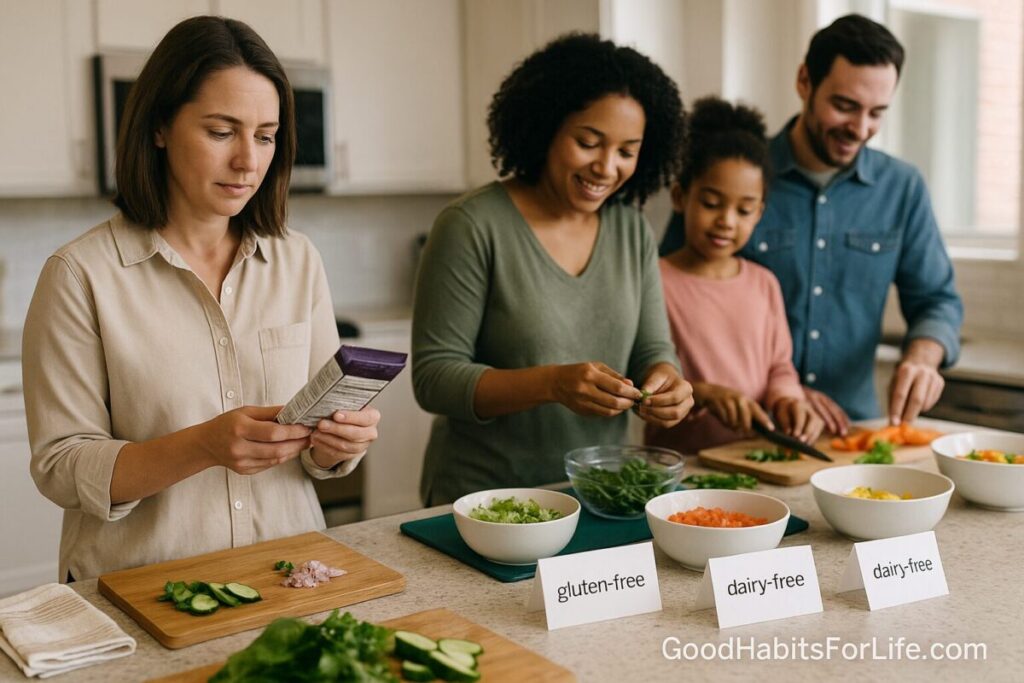
Food Allergies & Preferences: Kind Planning
Food Allergies & Preferences: Kind Planning Guide
Table of Contents
🧭 What & Why
Food allergies are immune reactions to specific food proteins that can trigger symptoms ranging from hives to life-threatening anaphylaxis. Around 5.8–6% of U.S. children have a diagnosed food allergy—enough that every class, team, or friend group is likely to include someone affected. CDC
Label laws to know. In the U.S., manufacturers must clearly identify the “Big 9” major allergens on packaged foods: milk, egg, fish, crustacean shellfish, tree nuts, peanuts, wheat, soybeans, and sesame (added in 2023 under the FASTER Act). U.S. Food and Drug Administration+1
In the EU/UK, labels must flag 14 allergens (includes the above plus celery, mustard, sesame, lupin, molluscs, and sulphur dioxide/sulphites). European Food Safety Authority
Cross-contact (sometimes called cross-contamination) happens when allergen proteins transfer from one food or surface to another—even tiny, invisible amounts can cause reactions. FoodAllergy.org
“May contain” & “made in a facility…” These advisory (PAL) statements are voluntary in the U.S., intended to warn about unavoidable cross-contact; they are not a substitute for good manufacturing practices. For high-risk guests, interpret these as not safe unless confirmed otherwise. U.S. Food and Drug Administration+1
Preferences vs. allergies. Vegetarian, vegan, halal, kosher, Jain, low-FODMAP, or simply “no mushrooms” are preferences or values. They matter for inclusion and comfort. Allergies are medical—your plan must prioritize safety first (and still honor preferences kindly).
✅ Quick Start: Do This Today
-
Ask upfront, in writing. “Any food allergies or preferences? Need separate prep?” Save responses in a shared note.
-
Create a simple tracker. Columns: Name • Allergy • Reaction severity • EpiPen? • Preferences • Notes.
-
Plan the menu around the riskiest item. Default to allergen-aware mains and keep risky foods sealed and separate.
-
Read every label, every time. Re-check even “safe” brands—recipes change; watch for “Contains” statements and PAL advisories. U.S. Food and Drug Administration+1
-
Prevent cross-contact. Separate boards/knives, wash with hot, soapy water, use new utensils, and plate allergy-safe dishes first. FoodAllergy.org
-
Label at serving. Clear cards: “Gluten-free • Contains egg • Vegan • Nut-free kitchen line.”
-
Have an emergency plan. Know where epinephrine is and who can use it; if a reaction is suspected, use epinephrine immediately and call emergency services. AAAAI+1
📅 30-60-90 Habit Plan (for households, teams, and hosts)
Days 0–30 (Set the foundation)
-
Build a master list of regulars and their needs (allergies & preferences).
-
Stock a safe pantry: staples free of the relevant allergens; choose brands with transparent labeling.
-
Buy duplicate tools (e.g., allergen-free cutting board, knives, toaster liners).
-
Print label cards and a 1-page emergency poster (symptoms + epinephrine steps). AAAAI
Days 31–60 (Standardize & stress-test)
-
Run a mock prep: cook two versions (e.g., with/without dairy) using strict separation; time each step.
-
Draft a potluck protocol: ingredient forms, no-nuts rule if relevant, separate serving spoons, and first-serve line for allergy-safe table.
-
Align with your venue or caterer: confirm Big 9 / EU-14 labeling on menus and prep practices. U.S. Food and Drug AdministrationEuropean Food Safety Authority
Days 61–90 (Scale & automate)
-
Create menu templates (breakfast, lunch, party) with “swap lists” (e.g., almond → oat drink).
-
Add shopping checklists in your notes app; star trusted products.
-
For teams or schools: run a 20-min training on cross-contact and label reading; record attendance. FoodAllergy.org
🛠️ Techniques & Frameworks
The A.L.L.E.R.G.Y. Framework (use this before any shared meal):
-
Ask early & kindly (allergies, preferences, severity).
-
List & label (central tracker + label cards).
-
Learn the laws (U.S. Big 9; EU 14). U.S. Food and Drug AdministrationEuropean Food Safety Authority
-
Eliminate cross-contact (separate tools, wash, plate safe foods first). FoodAllergy.org
-
Read every label, every time (watch Contains & may contain). U.S. Food and Drug Administration
-
Gear for emergencies (know epinephrine location/steps). AAAAI
-
Yes-and inclusion (offer preference-friendly options without judgment).
Diagnosis clarity (for planning conversations). Only a clinician can diagnose a true food allergy; the oral food challenge is the gold standard, with skin-prick/specific IgE as supportive tests. Don’t pressure someone to “test” a food at your event. NIAID
👥 Audience Variations
Students & campus groups
-
Use sign-up forms with a required allergy/preference field.
-
In shared kitchens: color-code utensils; assign “allergen-free shelf” rules.
Parents & kids’ parties
-
Opt-in “safe snack list” shared before the party.
-
Keep nut-containing items out if any attendee has severe nut allergies; use sealed goody bags labeled per child.
Work teams / offsites
-
Send the caterer a written brief listing allergens, and ask for separate prep + labeled trays.
-
Provide vegan, vegetarian, halal, kosher options as standard (not “special”).
Seniors
-
Consider dentures, texture, sodium, and medication interactions alongside allergies; keep simple, soft, labeled options.
Multicultural gatherings
-
Honor dietary laws (halal/kosher), fasting windows, and typical spice/oil preferences; when unsure, ask respectfully and privately.
⚠️ Mistakes & Myths to Avoid
-
“A little bit is okay.” False. Trace proteins can trigger reactions. FoodAllergy.org
-
“Baking or frying destroys allergens.” Not reliably; heat doesn’t make foods universally safe.
-
“May contain is legalese; it’s fine.” In the U.S., PAL is voluntary—don’t assume safety. U.S. Food and Drug Administration
-
“Antihistamines first.” For suspected anaphylaxis, epinephrine first, then emergency care. AAAAI+1
-
“Same knife, quick rinse.” Wash with hot, soapy water; use dedicated boards/utensils for safe prep. FoodAllergy.org
-
“One clean read is enough.” Ingredients change—read every label, every time. U.S. Food and Drug Administration
💬 Real-Life Examples & Scripts (copy-paste friendly)
RSVP / Invite
“I’m planning the menu and want to make everyone comfortable. Do you or your family have any food allergies or dietary preferences (e.g., vegan, halal, kosher)? Any cross-contact concerns or an EpiPen we should know about?”
Follow-up confirmation (day-of)
“Quick check for tonight: still nut-free + egg-free for you? We’ve set up a separate serving area and labels.”
Restaurant / caterer brief
“We need: (1) clearly labeled items; (2) separate prep and utensils for [allergen-free] dishes; (3) confirm ingredients and PAL (‘may contain’) risks on packaged items.”
Potluck form note
“Please list every ingredient and mark: contains, may contain, made in a facility with. Use separate spoons for each dish.”
Emergency cue
“Are you having an allergic reaction? We’re using your epinephrine now and calling emergency services.” AAAAI
🧰 Tools, Apps & Resources
-
FDA — Food Allergies & Labels (U.S.): rules for the Big 9, “Contains,” and advisory (PAL) statements. U.S. Food and Drug Administration+1
-
FASTER Act (U.S.): sesame added as the 9th major allergen (effective 2023). U.S. Food and Drug Administration
-
EFSA/EU: overview of 14 allergens that must be indicated in the EU. European Food Safety Authority
-
FARE — Cross-contact basics (training-friendly handouts). FoodAllergy.org
-
AAAAI — Anaphylaxis (when in doubt, epinephrine first). AAAAI+1
-
Spokin (global community reviews; allergy-friendly restaurants/brands). SpokinApple
-
AllergyEats (U.S.) (peer ratings of allergy-friendly restaurants). Apple
📌 Key Takeaways
-
Ask early, track details, and confirm on the day.
-
Know the U.S. Big 9 and EU 14 allergen rules. U.S. Food and Drug AdministrationEuropean Food Safety Authority
-
Treat PAL “may contain” as a real risk unless a product is verified safe. U.S. Food and Drug Administration
-
Prevent cross-contact with separate tools, washing, and smart serving order. FoodAllergy.org
-
In a suspected reaction, epinephrine first; call emergency services. AAAAI+1
❓ FAQs
1) What’s the difference between an allergy and an intolerance?
Allergies involve the immune system and can cause anaphylaxis; intolerances (e.g., lactose) are not immune-mediated and are rarely life-threatening. Planning should honor both, but safety drives allergy handling.
2) Are “may contain” labels reliable?
They are voluntary in the U.S. and indicate potential cross-contact; do not assume the food is safe for someone with a severe allergy. U.S. Food and Drug Administration
3) What if a guest forgets their EpiPen?
If you suspect anaphylaxis, use epinephrine immediately if available and call emergency services. Do not wait for antihistamines to work. AAAAI+1
4) How can I minimize cross-contact in a small kitchen?
Prep the allergy-safe dish first, use dedicated board/knife, wash with hot, soapy water, and store sealed and labeled. FoodAllergy.org
5) What about potlucks?
Require ingredient lists, provide label cards, set a separate safe table, and assign a “one spoon per dish” rule.
6) Do I need different menus for preferences (vegan/halal/kosher)?
Not always; plan modular menus (e.g., base salad + protein add-ons) and label clearly so everyone can build a safe plate.
7) How do I talk to a caterer or restaurant?
Share allergies in writing, ask about separate prep, confirm labels and PAL, and request clearly marked trays.
8) What if ingredients change?
They do—read every label, every time, even for familiar brands. U.S. Food and Drug Administration
9) Is there a universal list of major allergens worldwide?
No. Lists differ by region (U.S. Big 9 vs. EU 14). If hosting international guests, plan to the strictest relevant standard. U.S. Food and Drug AdministrationEuropean Food Safety Authority
10) Who decides if someone truly has a food allergy?
Only a clinician. The oral food challenge is the gold standard, supported by history and tests (SPT/specific IgE). NIAID
📚 References
-
U.S. FDA. Food Allergies (labeling, “Contains,” and advisory PAL). https://www.fda.gov/food/nutrition-food-labeling-and-critical-foods/food-allergies U.S. Food and Drug Administration
-
U.S. FDA. FASTER Act: Sesame Is the Ninth Major Food Allergen. https://www.fda.gov/food/food-allergies/faster-act-sesame-ninth-major-food-allergen U.S. Food and Drug Administration
-
EFSA (EU). Food allergens: the 14 that must be indicated. https://www.efsa.europa.eu/en/safe2eat/food-allergens European Food Safety Authority
-
CDC NCHS Data Brief No. 459 (2023). Diagnosed Allergic Conditions in Children 0–17. https://www.cdc.gov/nchs/products/databriefs/db459.htm CDC
-
FARE. Avoiding Cross-Contact. https://www.foodallergy.org/resources/avoiding-cross-contact FoodAllergy.org
-
AAAAI. Anaphylaxis: 2023 Practice Parameter Update. https://www.aaaai.org/…/Anaphylaxis-Practice-Paramaters-2023.pdf AAAAI
-
AAAAI. Anaphylaxis — symptoms & treatment (public page). https://www.aaaai.org/conditions-treatments/allergies/anaphylaxis AAAAI
-
NIAID. Diagnosing Food Allergy. https://www.niaid.nih.gov/diseases-conditions/diagnosing-food-allergy NIAID
-
FDA Consumer Update. Have Food Allergies? Read the Label. https://www.fda.gov/consumers/consumer-updates/have-food-allergies-read-label U.S. Food and Drug Administration
-
Spokin (app). Food-allergy resources and dining guides. https://www.spokin.com/ Spokin
-
AllergyEats (app). Allergy-friendly restaurant ratings (U.S.). https://apps.apple.com/us/app/allergyeats/id458377975 Apple
Disclaimer: This guide is informational and not a substitute for professional medical advice; for diagnosis or treatment decisions, consult a qualified clinician.