
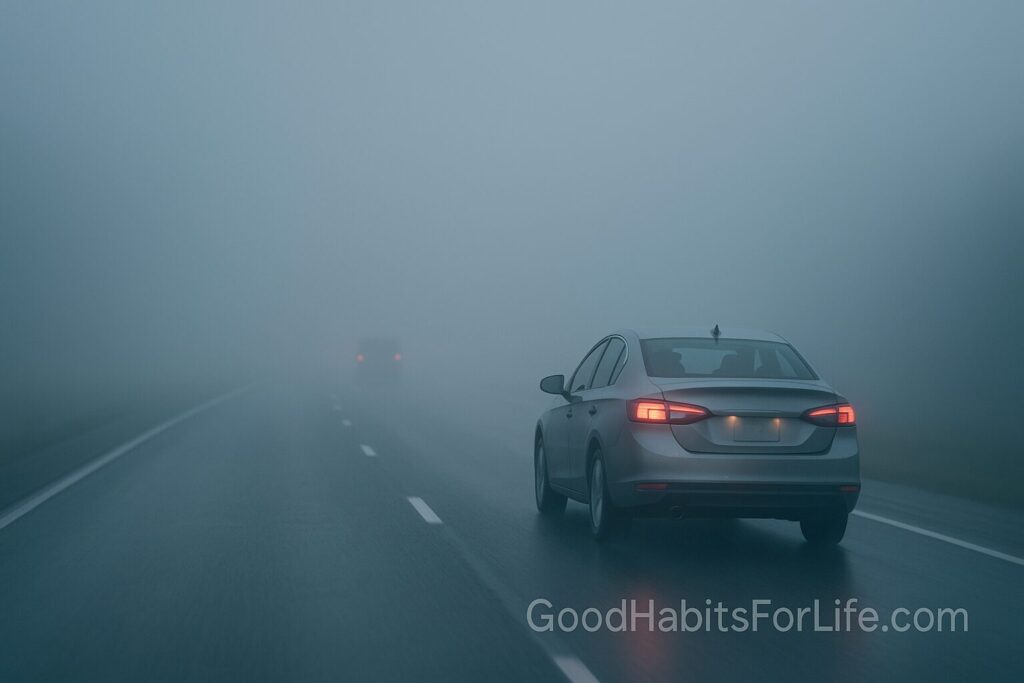
Fog & LowVisibility: Slow, Show, Space
Fog & Low-Visibility: Slow, Show, Space
Table of Contents
🧭 What “Slow, Show, Space” Means in Fog
Fog + low visibility dramatically shorten sight distance and increase speed variance between drivers, which raises crash risk. In the U.S. alone, fog is involved in ~38,700 crashes and 600+ deaths each year. That’s why a simple operating rule helps: Slow, Show, Space. Slow your speed, show your vehicle with the right lights, and create space for mistakes. FHWA Operations
Show: In fog, use low-beam headlights so your taillights are on; add front/rear fog lights if your car has them. Never use high beams—they reflect off droplets and make visibility worse. National Weather Service+1ontario.ca
Space: Leave a much larger time gap and be able to stop within the distance you can see. Steering to the road’s right-hand edge line (“fog line”) reduces lane drift when the centerline and scenery disappear. AAA NewsroomW Livingstone LtdNational Weather Service
Why slow? Small increases in average speed sharply raise fatal-crash risk; fog compounds that. World Health Organization
✅ Quick Start: Do This the Moment You Hit Fog
-
Ease off to a safe speed—turn off cruise control. Expect hidden hazards. AAA Newsroom
-
Lights: Low beams on; use fog lights if equipped; avoid high beams. National Weather Service
-
Glass & airflow: Wipers and defogger on to clear exterior moisture and interior condensation. National Weather Service
-
Follow the edge line (right-hand line/reflectors), not the vehicle ahead. National Weather Service
-
Build space: Open a 6–8 second following gap (longer if visibility keeps dropping). AAA Newsroom
-
If visibility collapses: Turn on hazards and carefully pull off to a safe location (parking area), then stop. Do not drive with hazards on unless local law allows. National Weather Service
🛠️ 7-Day Habit Plan to Master Fog Driving
Goal: Make “Slow, Show, Space” automatic.
Day 1 – Car Check (15 min): Clean windshield inside/out; confirm low-beam, fog lights, and rear fog (if fitted) work; set defogger workflow. Transport Canada
Day 2 – Controls Rehearsal (10 min, parked): Practice toggling low/high beam, fog lights, and defogger without looking down for long.
Day 3 – Edge-Line Practice (light traffic): On a clear evening, practice using the right edge line as your primary visual reference. National Weather Service
Day 4 – Spacing Drill: Drive with a 6–8-second gap. Count “one-one-thousand…” from the vehicle ahead reaching a fixed point. AAA Newsroom
Day 5 – Speed Discipline: Choose a speed that allows you to stop inside what you can see; rehearse smooth braking. W Livingstone Ltd
Day 6 – Visibility Tools: Practice quick toggles: wipers, rear defogger; crack a window slightly to listen for traffic when visibility is poor. National Weather Service
Day 7 – Full Simulation (safe, low-risk route): Combine all steps; identify safe pull-off areas on routine routes.
🧠 Techniques & Frameworks that Work
“Stop-Within-Sight” Rule
Drive so you can stop within the visible clear distance. In fog, that usually means much lower speed than posted. W Livingstone Ltd
Lighting Logic: Low vs. Fog vs. High vs. Rear Fog
-
Low beams: Default in fog; they illuminate the road without blinding you with back-scatter; they also activate taillights. National Weather Service
-
Front fog lights (if fitted): Use with low beams for a wider, lower beam pattern. Turn off when visibility improves to avoid glare. Local laws vary. GOV.UK
-
High beams: Avoid—they reflect off droplets and create a “white wall.” National Weather Service
-
Rear fog light (if fitted): Use only when visibility is “seriously reduced” (≈ ≤100 m / 328 ft) and switch off as soon as it clears, to avoid dazzling others. GOV.UK
Glass, Moisture & Micro-Climate
Fog often fogs both sides of the glass. Use wipers for the outside and defogger/AC for the inside; keep glass squeaky-clean. National Weather Service
Lane Positioning & Rumble Strips
Use the edge line/reflectors and, if present, rumble strips as tactile/auditory cues when visibility dips. Federal Highway Administration
Speed Discipline Framework
Remember: Every 1% increase in mean speed → +4% fatal crash risk. In fog, resist pressure to “keep up.” World Health Organization
When to Abandon the Drive
If you cannot maintain sight of the edge line or judge lane position safely, pull into a safe place and stop (hazards on while pulling off). National Weather Service
🧑🤝🧑 Variations by Driver & Situation
-
Students/new drivers: Pre-assign pull-off spots on familiar routes; rehearse the lighting sequence (low beam → fog lights → hazards only when pulling off). National Weather Service+1
-
Professionals/commuters: Keep a microfiber cloth in the car; schedule glass cleaning weekly; disable auto high-beams in fog so they don’t kick on. National Weather Service
-
Seniors: Night + fog increases glare sensitivity; drive earlier in daylight where possible.
-
Parents: Model calm speed discipline; narrate “edge line, low beam, big gap.”
-
Rural/high-speed roads: Expect sudden density changes; cut speed before the fog bank; don’t overtake. National Weather Service
⚠️ Mistakes & Myths to Avoid
-
Myth: “High beams help me see through fog.” Reality: they reflect off droplets and reduce visibility. National Weather Service
-
Tail-light chasing. Don’t fixate on the car ahead; use the edge line. National Weather Service
-
Driving with hazards on. Use hazards to warn while pulling over and once fully off the roadway (local laws vary), not as a substitute for headlights while moving. National Weather Service
-
Forgetting rear fog etiquette. Rear fogs only when visibility is seriously reduced (~≤100 m)—then switch off. GOV.UK
-
Cruise control in fog. Don’t use it; you need instant throttle control. McCraren Compliance
🗣️ Real-Life Scripts & Checklists
“Fog Bank Ahead” Script (say it out loud)
-
“Slowing now—cancel cruise.”
-
“Low beam on; fog lights on (if fitted).”
-
“Edge line in view; 6–8 seconds gap.”
-
“Wipers + defogger set.” National Weather Service+1AAA Newsroom
Pull-Off Procedure (near-zero visibility)
-
Signal right, hazards on, steer gently to a safe area (car park/lay-by).
-
Stop well clear of traffic; keep hazards on; reassess after conditions improve. National Weather Service
Glare-Free Glass Checklist (weekly)
-
Inside windshield cleaned; outside washed; blades inspected; washer fluid topped. Transport Canada
🧰 Tools, Apps & Car Features
-
Weather apps: National Weather Service / Met Office radar + visibility alerts. Use them to plan departure and identify fog-prone valleys/lowlands. National Weather Service
-
Vehicle features:
-
Front/rear fog lights—learn the switch and the 100 m rule. GOV.UK
-
Rumble strips—edge/center strips help you hold lane in low visibility. Federal Highway Administration
-
Adaptive lighting (ADB)—now permitted in the U.S.; still use low beams in fog to minimize back-scatter. Federal RegisterNational Weather Service
-
Pros/cons snapshot
-
Fog lights: ✅ better short-range spread; ❌ glare if misused/left on. GOV.UK
-
Rear fog: ✅ helps others see you in heavy fog; ❌ dazzling in clear conditions. GOV.UK
-
Auto high-beams: ✅ great on dark, clear roads; ❌ disable during fog. National Weather Service
📌 Key Takeaways
-
Slow enough to stop within what you can see. W Livingstone Ltd
-
Show your car: low beams on; fog lights if fitted; never high beams. National Weather Service
-
Space: open a big time gap; avoid tail-light chasing. AAA NewsroomNational Weather Service
-
Manage moisture: wipers + defogger; keep glass clean. National Weather Service
-
If it turns to white-out: hazards on while pulling off, then stop in a safe place. National Weather Service
❓ FAQs
1) Should I ever use high beams in fog?
No. High beams reflect off fog droplets and create glare; stick to low beams (and fog lights if available). National Weather Service
2) What following distance is safe in dense fog?
Aim for 6–8 seconds or more and a speed that allows stopping within your sight distance. AAA NewsroomW Livingstone Ltd
3) Are rear fog lights legal everywhere?
Rules vary. In places like the UK, use only when visibility is seriously reduced (≈ ≤100 m/328 ft) and switch off as soon as it improves. GOV.UK
4) Should I use my hazard lights while driving slowly in fog?
Best practice is to use hazards to pull off and when stopped in a safe place. Driving with hazards is restricted in many regions—check local law. National Weather Service
5) Why do my windows fog inside during foggy weather?
Warm, moist cabin air condenses on cooler glass. Use the defogger/AC and a clean windshield to stay clear. National Weather Service
6) What’s the safest visual reference when visibility is poor?
Follow the right edge line/reflectors, not the vehicle ahead’s tail lights. National Weather Service
7) Does fog really cause many crashes?
Yes. In the U.S., fog is associated with tens of thousands of crashes annually. FHWA Operations
8) Should I disable auto high-beam in fog?
Yes—auto systems can raise glare in fog. Keep low beams on. National Weather Service
9) Is cruise control okay in fog?
No; you need immediate control of speed and following distance. McCraren Compliance
10) What if I can’t see the edge line anymore?
That’s your cue to pull off safely and stop until conditions improve. National Weather Service
📚 References
-
U.S. Federal Highway Administration — Low Visibility (stats & risk). FHWA Operations
-
National Weather Service — Driving in Fog (low-beam, no high-beam; extreme fog procedure). National Weather Service+1
-
National Weather Service (Melbourne, FL) — Dense Fog & Smoke Safety Rules (edge line; wipers/defogger). National Weather Service
-
Ontario MTO Driver’s Handbook — Driving at night and in bad weather (use low beams; fog lights). ontario.ca
-
UK Highway Code — Adverse weather (fog light legality; 100 m rule; switch off when clear). GOV.UK
-
AAA Foundation/Newsroom — Wet-weather & spacing guidance (increase following distance). AAA Newsroom
-
RoSPA — Winter Driving Tips (“stop within the distance you can see to be clear”). W Livingstone Ltd
-
FHWA — Rumble Strips Safety (lane-limit alerts in rain/fog/snow/dust). Federal Highway Administration
-
WHO — Road traffic injuries (speed vs. fatality risk). World Health Organization
-
Transport Canada — Using vehicle lights (don’t use high beams in fog/rain/snow). Transport Canada